

The 1935 crown coin was the first British coin issued specifically for a royal jubilee, and its standard circulation issue consisted of 714,769 pieces, with a separately reported 2,500 specimen or proof-style strikes. That distinction matters because the ordinary crown and the scarcer specimen are not interchangeable in authentication, rarity or value.
A collector once brought a 1935 crown to a dealer expecting a straightforward valuation. The obverse date and Rocking Horse reverse looked right, but the central question was on the edge and in the strike quality. A careful examination separated a normal commemorative issue from the type that serious buyers treat as a premium specimen.
The Historic Significance of the 1935 Crown
The Silver Jubilee of King George V created a different role for the British crown. Earlier crowns were denominations associated with commerce, even when they circulated only intermittently. The 1935 issue was made specifically to mark the King's jubilee, celebrating 25 years on the throne since 1910, rather than serving as an ordinary circulating coin.
That decision changed the meaning of the denomination. The Royal Mint Museum describes the coin as the beginning of the Mint's modern commemorative-coin tradition. For collectors, this is more important than a simple anniversary label. The 1935 crown represents the moment when a familiar British denomination became a purpose-built national souvenir and collecting object.
The issue also broke visually with earlier crown imagery. Instead of relying on a conventional Britannia-style composition, the reverse introduced Percy Metcalfe's St George and dragon design, rendered in an Art Deco manner. The Royal Mint Museum identifies this change as a significant departure from earlier crown designs, giving the coin a modern visual identity at a time when commemorative coinage was still developing.
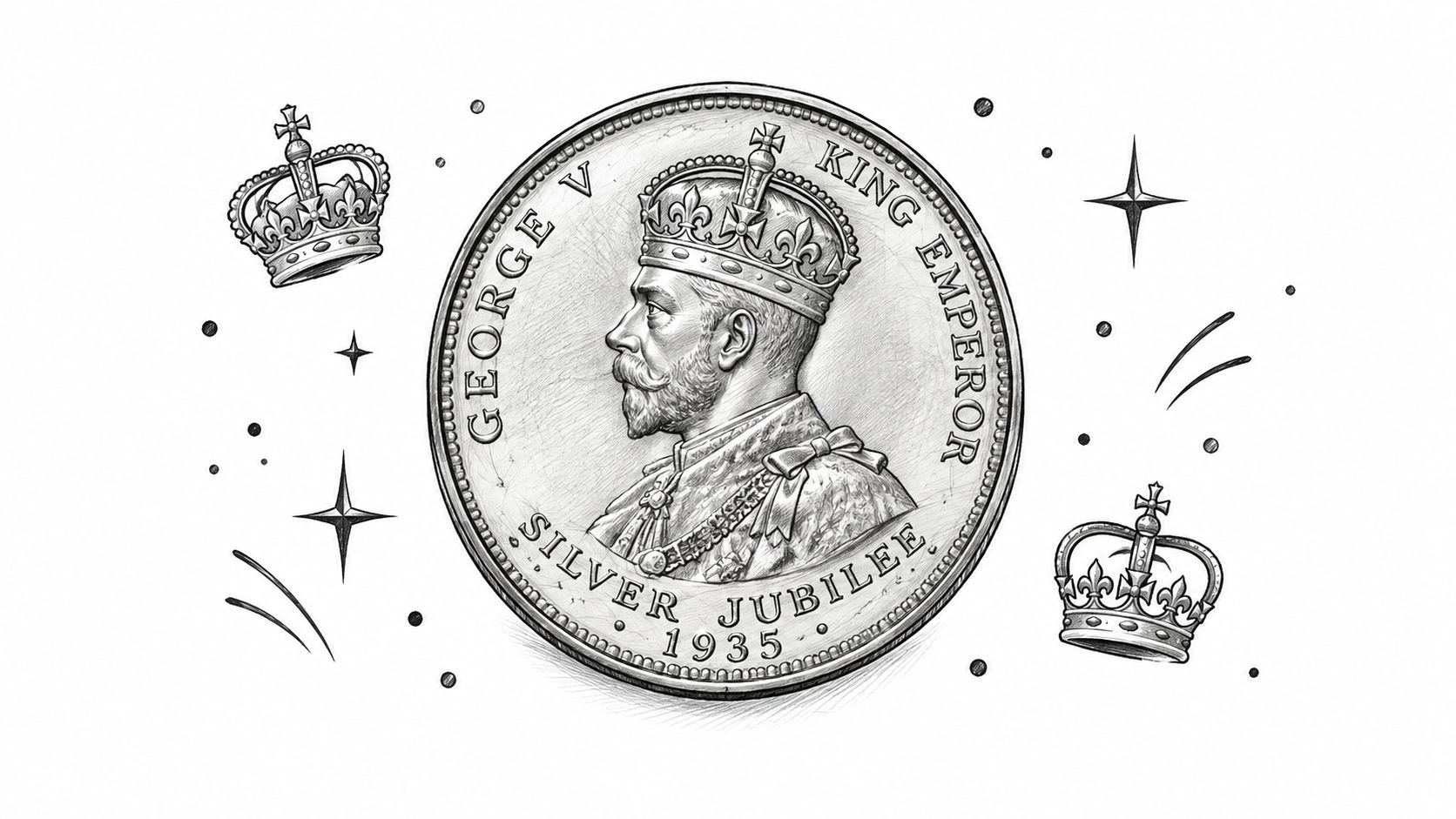
A crown made for commemoration
The 1935 crown wasn't struck for general circulation. That fact gives it a clear place in British numismatic history, because the Mint shifted the crown from a denomination used in commerce into a commemorative format intended for collectors and the public.
The Royal Mint Museum also records that the issue was primarily silver, while a very small number were produced in gold. Those gold pieces belong to a different rarity category and shouldn't be confused with the standard silver crown just because both carry the same commemorative date.
A useful way to place the coin within the wider tradition is to read this brief history of British coins. The 1935 issue stands out because it connects monarchic celebration, modern design and the formal growth of British commemorative coinage in one object.
Collector's perspective: The 1935 crown isn't important only because it commemorates George V. It matters because it helped establish how Britain would use coins to record royal occasions for collectors.
Design Details and Percy Metcalfe's Masterpiece
The 1935 crown is often called the Rocking Horse Crown, a nickname taken from the distinctive reverse. Percy Metcalfe's St George and dragon composition doesn't present the saint in the heavily traditional manner seen on many earlier British designs. The scene is compact, energetic and deliberately stylised, with strong lines and an angular treatment that reflects Art Deco taste.
The reverse is the first feature most collectors study. St George appears in combat with the dragon, but the design avoids excessive ornament. The forms are simplified, the movement is easy to read and the composition feels balanced within the broad crown flan. This gives the piece a modern character while preserving the recognisable legend of St George.
The obverse carries the portrait of King George V, linking the contemporary monarch to the anniversary being marked. Its relationship with the reverse is important. The obverse supplies the formal royal authority, while Metcalfe's reverse gives the coin its distinctive commemorative personality.
What the design tells you
Collectors should learn to describe the piece by its visual structure rather than relying only on the nickname. Look for:
- The Art Deco treatment: The reverse uses simplified, geometric forms instead of a naturalistic medieval scene.
- The St George and dragon subject: This is the defining departure from more conventional crown imagery.
- The broad crown format: The large canvas allows the composition to remain legible without becoming crowded.
- The contrast between sides: The royal portrait feels official, while the reverse is more dynamic and experimental.
The design also affects authentication. A convincing date alone isn't enough if the portrait, lettering or reverse devices lack the expected sharpness and proportions. Die analysis begins with the overall design, then moves to small details such as lettering shapes, the relationship between devices and fields, and the quality of the edge.
For readers interested in the production process behind such details, how coins are made provides useful background. Striking, die preparation and finishing all influence the appearance collectors eventually inspect under magnification.
How to Authenticate Your 1935 Crown
Authentication should start with basic physical checks, not with a seller's description or an attractive photograph. The standard 1935 crown was struck in 0.500 silver, weighs 28.28 g and measures 38.61 mm in diameter, according to The Royal Mint's specification for the 1935 George V crown.
Use a calibrated digital scale and a reliable calliper. A small difference can result from wear, dirt or measurement equipment, so one reading shouldn't decide the case by itself. A major discrepancy, however, warrants caution and professional examination.
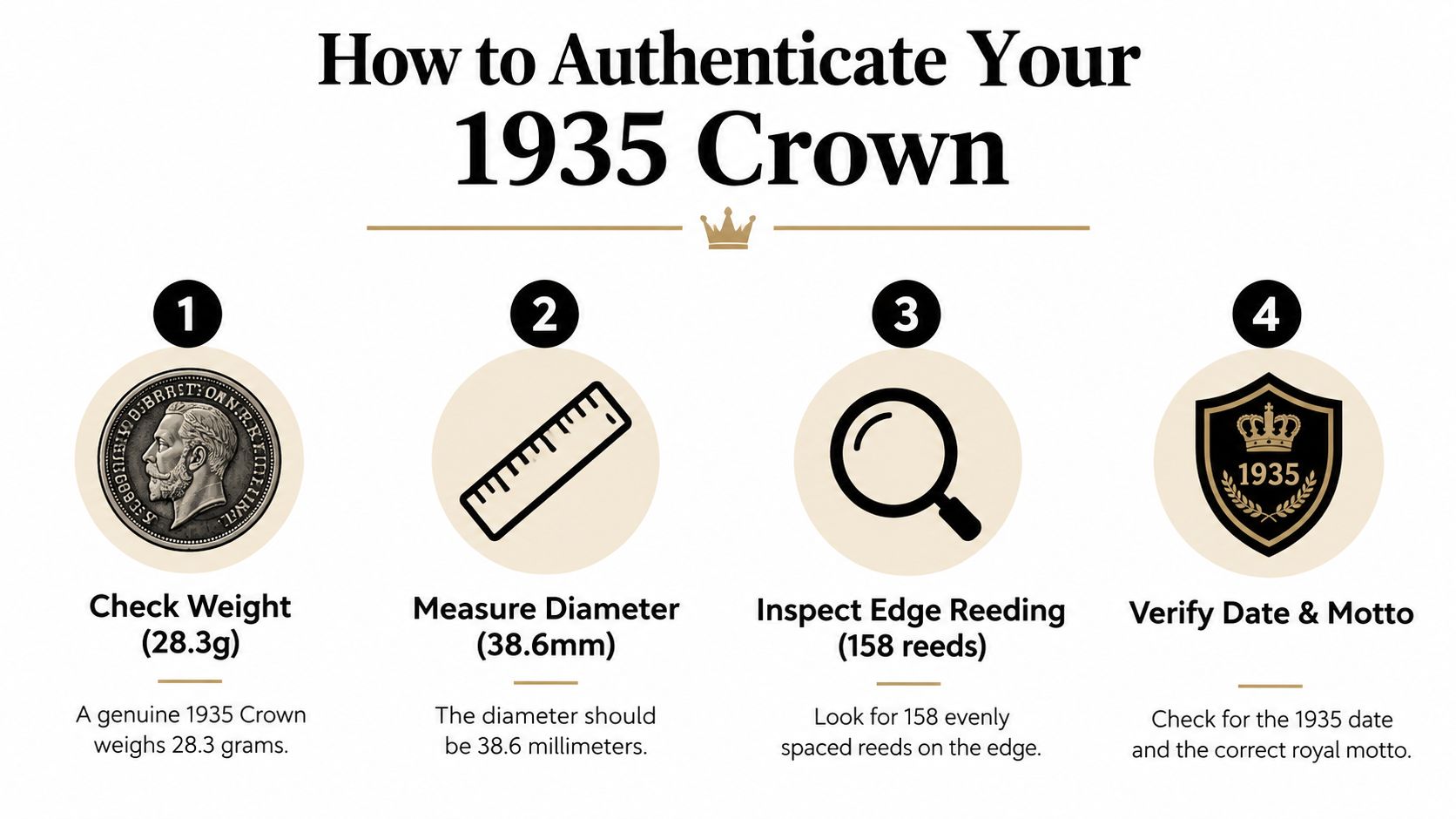
Examine the edge before judging the grade
The edge inscription is one of the most useful diagnostics:
DECUS ET TUTAMEN ANNO REGNI XXV
The Royal Mint identifies this inscription as a practical feature for authentication and die-match verification in the UK market. Rotate the coin slowly under strong, diffuse light. Check whether the lettering is complete, correctly formed and properly positioned, rather than merely looking for the presence of words.
A genuine-looking obverse and reverse can still conceal an incorrect edge. This is why photographs that show only the two faces are inadequate for a serious purchase. Ask for a clear edge image, or inspect the coin in person.
A preliminary checklist
- Confirm the date and monarch: Make sure the obverse corresponds to George V and the jubilee issue.
- Check the dimensions: Compare the coin with 28.28 g and 38.61 mm, allowing for sensible tolerance from wear and equipment.
- Assess the metal: The standard issue is 0.500 silver, not a modern base-metal reproduction with a silver-coloured surface.
- Read the edge inscription: Verify the complete motto and its lettering before considering rarity.
- Compare the strike: Look for consistent detail across the portrait, lettering and Metcalfe reverse.
A preliminary inspection isn't a substitute for professional grading. If the coin is represented as a specimen, the seller should provide evidence supporting that attribution. Specialist coin authentication services can assess the physical coin, rather than relying on an incomplete listing photograph.
Circulation Strikes vs Proof Specimens
The most consequential distinction in the 1935 crown market is between the standard circulation issue and the scarcer specimen or proof-style strike. The reported figures are sharply different. Numismatic references place the circulation mintage at 714,769 pieces, while 2,500 specimen or proof-style collector strikes are reported separately in the Numista catalogue entry for the issue.
That split explains why a common market description, “1935 Rocking Horse Crown”, isn't precise enough. It identifies the design and date, but not necessarily the strike type. A buyer who pays a specimen premium without confirming the coin's characteristics risks buying an ordinary example with optimistic wording.
What to look for in a specimen
A specimen or proof-style piece may show stronger presentation than a normal circulation strike. Collectors commonly examine the fields for a more reflective appearance and the devices for sharper, sometimes contrasting detail. These features must be judged together, because cleaning, polishing or later surface treatment can create artificial reflectivity.
The edge is especially important. Specialist references identify the raised-edge lettering issue as the tougher premium subtype. Don't infer this solely from a seller's use of “proof” or “specimen”. Confirm the edge treatment, inspect the lettering and compare the coin with recognised examples or a qualified assessment.
| Feature | Standard circulation crown | Specimen or proof-style strike |
|---|---|---|
| Reported quantity | 714,769 | 2,500 |
| Primary role | Broad commemorative issue | Collector-focused strike |
| Market position | More readily encountered | Scarcer premium subtype |
| Main diagnostic concern | Correct design, specification and edge | Strike quality, edge treatment and attribution |
Why the difference changes the buying decision
The ordinary issue can be historically important without being a specimen. That distinction is central to fair pricing, catalogue accuracy and collection planning. A normal crown with honest wear and clear provenance may be a better purchase than a questionable “proof” offered without edge photographs or credible verification.
Practical rule: Treat the word “specimen” as a claim to investigate, not as proof of rarity.
Understanding Grading and Condition
Condition affects how collectors interpret a 1935 crown, but grade should follow authenticity and strike attribution. A worn standard crown remains a genuine piece of commemorative history, while an artificially bright or cleaned coin may look impressive in a photograph and perform poorly under close inspection.
Traditional grading descriptions move from circulated grades such as Fine towards About Uncirculated and Uncirculated levels. The exact label matters less than the visible evidence supporting it. On this design, inspect the raised portrait details, the lettering and the high points of the St George and dragon reverse.
Read wear in context
A Fine example should show clear wear across the higher relief, but the main design remains readable. As condition improves, the original surfaces become more complete, with less flattening on the portrait and reverse devices. An Uncirculated coin should retain its mint-state appearance, though surface marks and strike quality still influence the final assessment.
Collectors often make the mistake of equating brightness with quality. Silver can be polished, dipped or otherwise disturbed, and a harshly cleaned coin may lose the natural surface that buyers value. Look for hairlines, circular scratches, dull patches and unnatural contrast around the devices.
Preserve what you've bought
Handle the coin by its edge and keep fingers away from the fields. Store it in an inert, purpose-made holder, away from moisture and abrasive materials. Don't rub the surfaces, apply household polish or attempt to improve the appearance before a valuation.
For a valuable specimen claim, third-party grading can provide an independent record of authenticity, type and condition. It won't make a normal circulation strike into a proof, and it can't replace careful buying, but it may reduce uncertainty when the price difference between types is substantial.
Current Market Values and Collector Demand
There isn't one meaningful value for every 1935 crown coin. The market separates pieces by strike type, authenticity, condition, surface quality and provenance, with the standard circulation issue occupying a different category from the scarcer specimen strikes.
A circulated crown may appeal to buyers seeking an accessible example of the Silver Jubilee design. Its value is usually shaped by preservation and presentation rather than rarity alone. A clean, accurately described coin with the correct edge inscription can be easier to sell than a brighter example whose surfaces have been damaged by polishing.
The specimen market is more demanding. The separate report of 2,500 specimen or proof-style strikes gives that category a materially different scarcity profile from the 714,769-piece circulation issue. Buyers will expect the seller to explain why the coin qualifies as a specimen, show the edge clearly and distinguish original reflective fields from post-mint treatment.
Questions to ask before buying or selling
- Which type is it? Establish whether the coin is a standard circulation strike or a specimen-style example.
- What supports the attribution? Look for edge photographs, a recognised reference, dealer documentation or third-party grading.
- Has the surface been altered? Ask directly about cleaning, polishing and other treatments.
- Does the description match the coin? A listing should state the condition rather than relying on a broad “rare crown” label.
- Is the price based on the correct comparison? Compare ordinary examples with ordinary examples, and specimen pieces with verified specimens.
Cavalier Coins Ltd offers coins and banknotes through its online shop and may list dated UK material such as the 1935 crown, while its auction activity can provide another route for collectors assessing availability. Visit Cavalier Coins Ltd to inspect current listings, discuss a potential purchase or explore options for building and monetising a collection.