
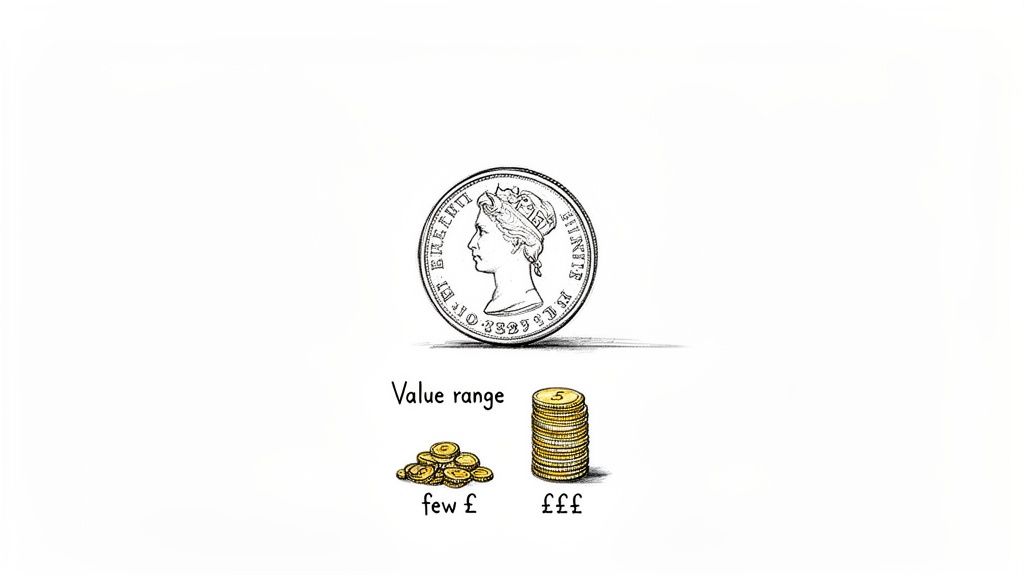
The value of a 5 shilling coin can swing dramatically, from just a few pounds to well over £5,000. It's a vast range, and the difference often comes down to the smallest details.
Common commemorative pieces, like the 1965 Winston Churchill crown, were made in their millions and are typically worth very little. On the other end of the scale, rare, high-grade historical coins, such as an 1847 Gothic Crown, are fiercely sought after by collectors. The coin's date, the monarch it features, and most importantly, its physical condition, are what truly determine its final worth.
Unpacking the Value of Your 5 Shilling Coins
Many people find a 5 shilling coin, also known as a Crown, tucked away in an old drawer and wonder if they’ve stumbled upon a hidden treasure. The answer isn't a simple yes or no; it depends entirely on the specific coin in your hand.
Think of it like owning a classic book. A mass-produced paperback from the 1960s is common, but a first edition signed by the author could be incredibly valuable. Coins work on a very similar principle of rarity and desirability.
A huge number of 5 shilling coins were minted for commemorative events and were never meant for general circulation. These were often produced in large quantities, making them easy to find today. On the other hand, older Crowns struck from silver were true workhorses of the British economy, circulating widely and often showing heavy signs of use.
Key Factors Influencing Value
To get a real sense of your coin's potential worth, you need to look at three core elements. These are the first pieces of information any collector or appraiser will ask for.
- Date and Monarch: The year the coin was minted and the monarch on the obverse (the 'heads' side) are your starting points. A Victorian Crown from the 1800s will almost always have a higher base value than an Elizabeth II Crown from the 1950s.
- Rarity and Mintage: Simply put, how many were made? Some years had surprisingly low production runs, making those coins instantly scarcer. The 1934 'Wreath' Crown, for instance, had a tiny mintage of only 997, making it a key date for serious collectors.
- Condition (Grade): This is arguably the most critical factor. A coin that looks brand new, with no scratches or wear, is graded as 'Uncirculated' and will command the highest price. The exact same coin showing significant wear might only be worth a fraction of that amount.
The journey from a simple piece of currency to a valuable collectible is defined by its history and preservation. A common date in pristine condition can often be more valuable than a rare date in poor condition.
Ultimately, the story your coin tells through its design, date, and state of preservation determines its place in the market. A 1965 Churchill Crown tells a story of modern commemoration, while an 1847 Gothic Crown speaks to the height of Victorian artistry. This guide will walk you through each of these aspects, helping you identify what you have and uncover its true value.
5 Shilling (Crown) Value at a Glance
This table gives a quick overview of what you can generally expect. It highlights the massive difference in value between the common commemorative coins most people find and the rarer, older silver pieces that collectors are hunting for.
| Coin Type or Era | Common Circulated Value | High-Grade Uncirculated Value |
|---|---|---|
| Pre-1947 Silver Crowns | £20 - £100+ | £250 - £5,000+ |
| Post-1947 Cupro-Nickel | £1 - £5 | £10 - £50 |
| Common Commemoratives | £1 - £3 | £5 - £15 |
As you can see, a silver Crown from before 1947 has a much higher starting value, and this can skyrocket if the coin is in top condition. Let's dig deeper into what makes these coins so different.
The Story of the British Crown Coin
To really get a feel for the 5 shilling coin's value, you have to understand its incredible journey through British history. The Crown, as it’s properly known, was never just pocket money; it was a statement. It was a big, heavy silver coin that represented serious buying power and carried the monarch's portrait in stunning detail.
It actually started life as a gold coin back in the Tudor era, but the silver Crown quickly became a cornerstone of British currency. By the Victorian period, it was a circulating giant, used for paying wages or settling larger bills. Its sheer size and weight meant it wasn't the most practical thing for everyday use, but its presence was always felt. Every new design marked another chapter in the nation's story.
This tangible link to the past is what really drives its value today. Each Crown is like a little time capsule, perfectly reflecting the era it was minted in. For a bit more background on this amazing numismatic heritage, you can explore a brief history of British coins.
The Great Silver Melt and Metal Content
A huge turning point in the Crown's story came just after the Second World War. The country was financially drained from the war, and the global price of silver was on the rise. The government had to make a tough call.
In 1947, they changed the recipe for all of Britain's "silver" coinage. Coins like the 5 shilling Crown were no longer made from actual silver. Instead, they were switched to a cupro-nickel alloy—a simple mix of copper and nickel.
This single decision permanently changed the coin's intrinsic value.
- Pre-1920 Crowns: These were struck from .925 sterling silver. They have the highest precious metal content.
- 1920-1946 Crowns: The silver content was reduced to .500 fine silver (50% silver). Still valuable, but less so.
- Post-1946 Crowns: These contain no silver at all. Their value is purely down to collectability, not metal.
This is the most important distinction to grasp. An old silver Crown will always have a baseline value tied to the price of silver, whereas a later cupro-nickel one doesn't have that safety net.
Iconic Designs and Legendary Issues
The artistry of the Crown is a massive part of its appeal and, by extension, its price. Some designs have become true legends among collectors, loved for their beauty and historical weight. The Victorian era, in particular, gave us some of the most sought-after pieces.
The most famous designs, like the Gothic Crown, are considered masterpieces of numismatic art. Their intricate details and historical significance elevate them from mere currency to treasured artefacts, commanding prices to match.
The famous "Gothic" Crown, first minted in 1847, is a perfect example. It features a breathtakingly ornate portrait of a young Queen Victoria, complete with medieval-style lettering. It’s a collector’s dream. Another classic is the 1951 "Festival of Britain" Crown, which brought back Benedetto Pistrucci’s iconic St George and the Dragon design. These special issues, often produced in smaller numbers, are always fiercely competed for.
The value of these rare Victorian coins can be astonishing. An 1847 'Gothic' Crown, for instance, can be worth thousands of pounds if it’s in top condition. This combination of history, artistry, and changing metal content is exactly why one 5 shilling coin might be worth a few quid, while another could be a serious financial asset.
How to Identify Your 5 Shilling Coins
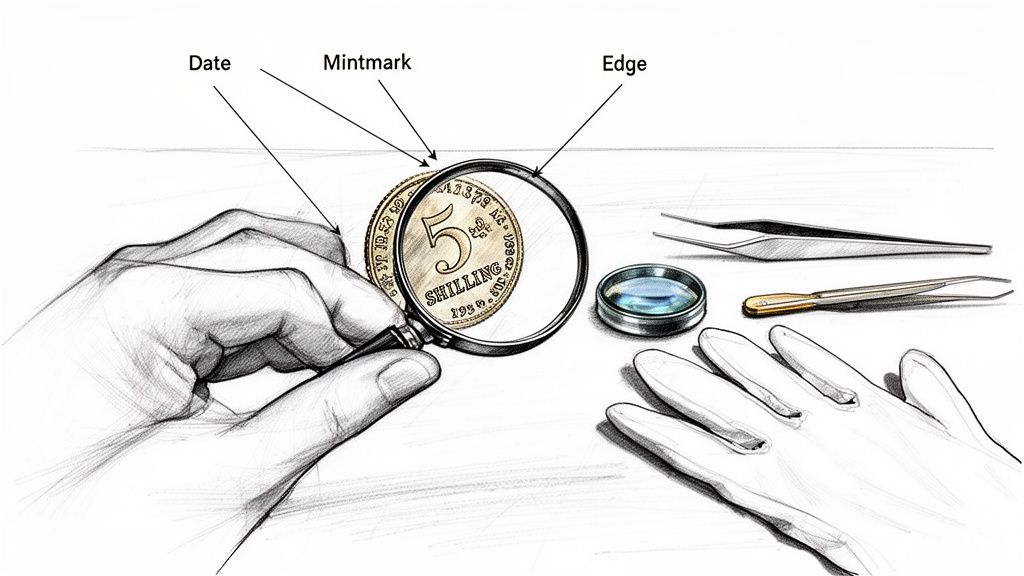
Holding a 5 shilling coin is like holding a piece of history, but its real story—and its value—is hidden in the tiny details. Properly identifying your coin is the first crucial step to figuring out what it's truly worth. Think of it as detective work; you're on the hunt for specific clues that separate a common piece from a rare treasure.
The good news is you don't need a high-tech lab to get started. All it takes is a good light source and a magnifying glass. With these simple tools, you can begin to uncover the key features that determine a 5 shilling coin's value. Let's walk through a straightforward examination to help you spot what really matters.
Start with the Obvious Clues: The Date and Monarch
The first and most obvious piece of information is the date. You'll usually find this on the reverse (the 'tails' side), though its placement can shift depending on the coin's design. The date immediately anchors your coin in a specific historical period and serves as your primary reference point.
Next, flip the coin over and identify the monarch on the obverse (the 'heads' side). Is it Queen Victoria, George V, or Queen Elizabeth II? The portrait not only confirms the era but can also point towards different varieties. For example, Queen Victoria’s long reign saw several portraits on her coinage, like the 'Young Head' or 'Jubilee Head', and each one defines a distinct series of Crowns.
Hunt for Mintmarks and Subtle Variations
Now it's time to zoom in and look for the details that get collectors really excited. Mintmarks are tiny letters that tell you where the coin was struck. While most British coins were produced at the Royal Mint in London (which often didn't use a mintmark), some were made at branch mints. These marks are often minuscule and tucked away within the design, frequently below the main image on the reverse.
Beyond mintmarks, keep an eye out for design variations. Some coin issues have subtle differences that create rare and valuable sub-types. A classic example is the famous 1847 'Gothic' Crown, which has several varieties based on the lettering on its edge. A plain edge is standard, but finding one with inscribed lettering like "DECUS ET TUTAMEN. ANNO REGNI UNDECIMO." means you're holding a distinct and far more desirable variety.
These small differences can have a massive impact on value. Two coins from the same year might look identical at a glance, but a tiny variation in the design or edge inscription could mean one is worth hundreds—or even thousands—of pounds more than the other.
The most significant discoveries in numismatics often come from spotting the smallest details. A seemingly insignificant letter or a slight change in the engraving can be the defining characteristic of a rare and valuable coin.
Examine the Edge Lettering
Don't forget to check the edge of your coin. Many of the older silver Crowns have inscribed or raised lettering around the rim. This was originally an anti-counterfeiting trick to stop people from "clipping" small amounts of precious metal from the coin's edge.
This edge lettering can be a key identifier in its own right. For instance, the 1934 'Wreath' Crown, one of the rarest 5 shilling coins, has a unique edge inscription. Verifying this detail is absolutely essential for authenticating such a valuable piece.
Let's put this into practice with a quick checklist to guide you:
- Locate the Date: Pinpoint the year the coin was issued.
- Identify the Monarch: Determine whose portrait is on the obverse.
- Search for Mintmarks: Use your magnifying glass to scan for small letters.
- Check the Edge: See if there is any lettering or a unique design on the rim.
- Look for Design Varieties: Compare your coin to images of known varieties for that year.
By following these simple steps, you'll gather the essential information needed to start an accurate valuation. This process turns you from a casual owner into an informed investigator, ready to uncover the hidden story and potential of your 5 shilling coin.
How Coin Condition Determines Its Value
Why is one 5 shilling coin worth a mere £5 while an identical one from the same year fetches £5,000? The answer, in a word, is condition. In the world of coin collecting, the physical state of a coin—what we call its grade—is the single biggest factor driving its market price.
Let's use an analogy. Imagine an antique car that’s been driven daily for fifty years. It’s got dents, rust, and a worn interior. It's still a classic, but its value is limited. Now, picture the exact same model, but one that’s been kept in a climate-controlled garage, never driven, and preserved in showroom condition. That second car is worth exponentially more.
Coins are no different. Every scratch, spot of wear, or clumsy cleaning attempt tells the story of a coin's journey, but each imperfection also chips away at its potential value. The difference in 5 shilling coins value between a heavily circulated piece and a pristine, uncirculated specimen can be truly staggering.
Understanding the Language of Coin Grading
Coin grading is simply a standardised system collectors and dealers use to describe a coin's condition. It might seem complex at first, but the basic principles are quite straightforward. Think of each grade as a point on a spectrum, from heavily worn to absolutely perfect.
For our purposes, we'll focus on the most common grades you're likely to encounter when looking at your own coins. These terms create a universal language for describing a coin's state of preservation.
- Fine (F): A coin in Fine condition has seen plenty of circulation. The main design elements are all there, but the finer details have worn smooth. It’s like that reliable daily driver—it has clearly been used for its intended purpose.
- Very Fine (VF): This grade shows moderate wear, but much more of the intricate detail remains. You’ll see sharpness in the monarch’s hair or the feathers on a crest that would be completely flat on a Fine coin.
- Extremely Fine (EF): An EF coin has only seen light circulation. Any wear is minimal and just on the highest points of the design. You might even see a good amount of the original mint lustre—that 'sheen' of a brand new coin.
- Uncirculated (Unc): This is that pristine classic car from the garage. An Uncirculated coin has no signs of wear at all. It might have picked up minor bag marks from storage, but its details are as sharp as the day it was struck.
The leap in value between grades isn't a straight line—it's exponential. Moving from a Fine to a Very Fine grade might double a coin's value, but jumping from Extremely Fine to Uncirculated could increase it tenfold or even more.
For a deeper dive into the subtleties involved, you can learn more about the professional grading of coins and exactly what the experts look for.
The Financial Impact of a Single Grade
The monetary difference between grades is where the importance of condition really hits home. With pre-decimal UK 5 Shilling coins, rarity and grade combine to create some serious investment potential. A low-mintage 1934 Crown, for example, might be valued at around £800 in Fine condition. That very same coin in Uncirculated grade can soar to £5,500—that’s a nearly 700% premium for condition alone.
This principle isn't unique to coins. Understanding how condition impacts the market for other antiques, like in valuing antique jewelry, can offer a broader perspective on assessing your collection's worth.

Tips for Preserving Your Coin's Condition
Preserving the condition you have is just as important as identifying it in the first place. A moment of carelessness can instantly diminish the value of a high-grade coin. The golden rule is simple: less is more.
- Handle with Care: Always hold a coin by its edges, between your thumb and forefinger. The natural oils and acids on your skin can cause permanent damage to a coin's surface over time.
- Never Clean Your Coins: It is so tempting to polish a tarnished silver Crown, but please, don't do it. Cleaning a coin, no matter how gently, creates microscopic scratches and removes the original patina that collectors value. This act alone can slash a coin's worth by 50-90%.
- Use Proper Storage: Keep your coins in inert, acid-free flips or holders made for long-term preservation. You'll want to avoid PVC-based plastics, which can degrade and leave a damaging green residue on your coins.
Detailed 5 Shilling Coin Price Guide
Right, let's get down to the brass tacks—working out what your 5 shilling coins might actually be worth. This is where the real fun begins. The price guide below is built on recent auction results and dealer price lists, giving you a solid starting point whether you're collecting or selling.
Just remember, the coin market is a living thing. Prices can and do change. Think of these figures as a reliable snapshot of today's market, not a guaranteed sale price.
To make things simple, I've organised the guide by monarch. As you scan the numbers, you'll spot a clear trend: the 5 shilling coins value doesn't just climb with better condition, it leaps. This really drives home how critical proper grading is.
How to Read the Value Table
Before you jump into the numbers, it's worth keeping a few things in mind. The prices you see are for problem-free coins.
Any coin that’s been harshly cleaned, damaged, or turned into jewellery will unfortunately be worth far less—often just its scrap silver value. On the flip side, a coin with stunning eye appeal or a documented history (what we call provenance) can sometimes fetch a price well above the average.
This chart really shows how a coin’s value can explode as it moves from a circulated 'Fine' grade up to a pristine 'Uncirculated' state.
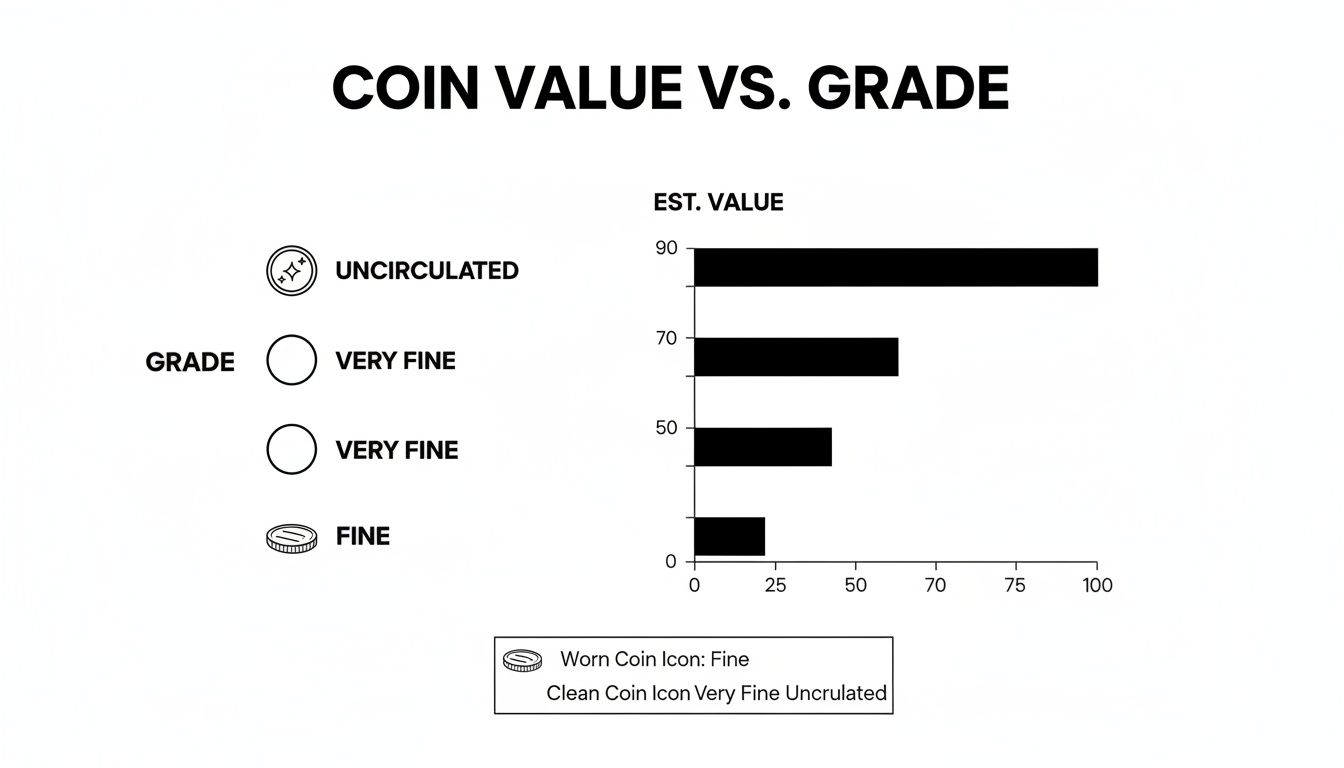
The takeaway here is simple: the jump from a decent coin to a top-tier one isn't a small step, it’s a giant leap in value.
UK 5 Shilling (Crown) Estimated Values by Date and Grade
This table provides estimated market values for key UK 5 Shilling coins, showing how prices vary significantly based on the coin's year, monarch, and condition. Find your coin's date and match it to the closest grade to get a solid first estimate.
| Year and Type | Fine (F) | Very Fine (VF) | Extremely Fine (EF) | Uncirculated (Unc) |
|---|---|---|---|---|
| Queen Victoria | ||||
| 1847 'Gothic' | £450 | £1,100 | £2,500 | £5,000+ |
| 1887 'Jubilee' | £25 | £40 | £75 | £180 |
| 1893 'Old Head' | £30 | £50 | £110 | £300 |
| George V | ||||
| 1927-1936 'Wreath' | £35 | £60 | £120 | £350 |
| 1934 'Wreath' (Rare) | £800 | £1,500 | £3,000 | £5,500+ |
| George VI | ||||
| 1937 Coronation | £15 | £25 | £45 | £90 |
| 1951 Festival | £5 | £8 | £15 | £40 |
| Queen Elizabeth II | ||||
| 1953 Coronation | £5 | £10 | £25 | £60 |
| 1960 British Exhibition | £10 | £15 | £30 | £75 |
| 1965 Winston Churchill | £1 | £2 | £5 | £15 |
As you can see, key dates like the 1847 'Gothic' or the rare 1934 'Wreath' Crown command serious prices, especially in top condition. Even for more common dates, the difference between a worn 'Fine' example and a sharp 'Uncirculated' one is huge.
Valuing Modern Commemorative Crowns
Around the middle of the 20th century, the Crown began its transition from a coin you'd find in your pocket to a piece made for collectors. The 1953 Coronation crown for Queen Elizabeth II really kicked off this new era.
While you can pick up a standard circulated example for £5-£15, the higher grades are where the value is. An Extremely Fine one can reach £50-£100, and a perfect Uncirculated coin could fetch £200 or more.
The 1965 Winston Churchill Crown is far more common, but don't dismiss it entirely. A truly pristine, untouched Uncirculated specimen can still be worth over £100 to the right collector. If you're interested in these later issues, you can discover more insights about commemorative coins.
How to Sell Your 5 Shilling Coins
So, you've identified your coins and have a good sense of their condition. Fantastic. Now you might be thinking about the next step: selling them. Turning a collection into cash can be a really satisfying part of the journey, but how you go about it makes all the difference to the final price you’ll get.
There are a few well-trodden paths you can take: online marketplaces, auction houses, or selling directly to a specialist dealer. Each route has its own ups and downs. Big platforms like eBay have a massive audience, but you’re on your own for everything from taking good photos to packing and shipping. Auctions can be great for a really rare piece, but the fees can be hefty, and you'll often have a bit of a wait before you see any money.
Presenting Your Coins for Sale
No matter which path you choose, how you present your coins is everything. Good, clear photos aren't just a good idea; they're essential. You need to show both sides of the coin (the obverse and reverse) in nice, even light. If there's any lettering on the edge, get a close-up of that too. Whatever you do, avoid using a flash – it creates a glare that will hide the very details a buyer wants to see.
When you write the description, just be honest and thorough. Mention the date, the monarch, and what you believe the grade is. Most importantly, point out any problems, like scratches, signs of cleaning, or dings on the rim. Being upfront builds trust and stops any headaches down the line. Many of the same tips apply across collectibles, so it can be useful to learn how to sell antiques online to get a broader perspective.
A well-photographed coin with an honest, detailed description will always attract more serious buyers and achieve a better price than a poorly presented one. Your goal is to give a potential buyer complete confidence in what they are purchasing.
Selling Directly to a Trusted Dealer
For a lot of people, the easiest and most secure way to sell is directly to a reputable dealer. It cuts out all the fuss of a public sale and you get paid straight away. A good dealer can look at your whole collection in one go, offering a fair market price for common coins and stand-out rarities alike.
Here at Cavalier Coins, we specialise in giving fair, expert appraisals. We buy collections from individuals all the time and we’re proud to work with charities, helping them turn donated coins into vital funds. Selling to a specialist gives you peace of mind that your coins are valued correctly and handled by people who know what they're doing. To get a better feel for it, you can read our complete guide on how to sell your coin collection. It's the best way to make sure your journey with these coins ends on a high note.
Your Questions Answered
Let's tackle some of the most common questions people have about 5 shilling coins. Think of this as a quick-reference guide to clear up any lingering queries and give you a bit more confidence when looking at your own coins.
How Much Is a 1965 Winston Churchill 5 Shilling Coin Worth?
This is probably the single most asked question about modern crowns. The 1965 Winston Churchill crown is incredibly common, with a huge mintage of over 19 million coins. Because so many were made and kept as souvenirs, a typical circulated one is only worth about £1 to £2 today.
That said, condition is everything in coin collecting. If you have a perfect, uncirculated example that looks like it just left the Royal Mint – especially if it's still in its original plastic wallet – the 5 shilling coin's value can climb into the £10-£20 range.
Are All 5 Shilling Coins Made of Silver?
No, and this is one of the most important things to get right when valuing them. The metallic content of British 5 shilling coins, or Crowns, changed significantly over the years.
- Pre-1920 Crowns: These are the real prizes, struck from .925 sterling silver.
- 1920-1946 Crowns: The silver content was reduced to .500 fine (50% silver).
- From 1947 onwards: All Crowns were minted in a copper-nickel alloy (cupro-nickel), containing no silver at all.
This shift means any Crown dated before 1947 has an intrinsic value based on its silver content. Post-1946 coins, on the other hand, are valued purely on their appeal to collectors.
Realising the importance of the 1947 changeover is key. It's the clear dividing line between coins that have a base metal value and those whose worth depends entirely on numismatic demand.
What Is the Difference Between a 5 Shilling Coin and a Crown?
There's no difference at all – they are just two names for the very same coin. 'Crown' was the official and historic name for the five-shilling piece, a name that goes back centuries in British coinage.
The term stuck around long after the coin's size, metal, and daily use changed. So, if you're holding a Crown, you're holding a 5 shilling coin. Simple as that.
How Can I Get a Coin Collection Valued?
For a trustworthy and accurate valuation, your best bet is always to speak with a specialist coin dealer. An expert has the hands-on experience to spot rare varieties, grade a coin's condition accurately, and give you a realistic market value.
This is a fantastic way for individuals to find out what their inherited or collected coins are truly worth. It's also an essential service for charities who often receive donated coins and need to turn them into vital funds for their cause.
At Cavalier Coins Ltd, we specialise in providing fair, expert appraisals for collections of all sizes. Whether you are a collector, inheritor, or charity, we can help you understand and realise the full value of your coins. Explore our services and discover your coin’s potential at https://www.cavaliercoins.com.