
Absolutely. It’s a common question, and the short answer is yes, some 50p coins are worth a lot more than their face value. In fact, the rarest ones can sell for hundreds of pounds.
It all boils down to a few key things: low production numbers, special commemorative designs, and the occasional minting error. These are the ingredients that create scarcity, and where there's scarcity, collector demand isn't far behind.
Uncovering Hidden Treasure in Your Pocket Change
Ever found yourself glancing at the change in your hand and wondering if you're holding onto a secret? For many of us in the UK, a seemingly ordinary 50p coin could be just that—a hidden gem. This guide is your map to spotting the 50p coins worth money, helping you turn that loose change into a potential collector's prize.
We’re going to walk through the crucial details that elevate a coin from everyday currency to something truly valuable. It's not just about how old a coin is; the real story is often in the finer points of its design and creation.
Why Are Some 50p Coins So Valuable?
The value of a 50p coin is a fascinating mix of rarity, demand, and its place in history. Getting to grips with these principles is the first step to becoming a savvy coin hunter. Think of it less like a lottery and more like a treasure hunt where you actually know what you're looking for.
Here are the main drivers of a coin's value:
- Low Mintage Figures: This is the big one. The fewer coins The Royal Mint produced with a specific design, the rarer they become. Scarcity is the number one reason a coin becomes sought-after.
- Commemorative Designs: Coins that celebrate major events, anniversaries, or beloved characters often catch the eye of collectors. This intense interest can drive their market price well above 50p.
- Minting Errors: Mistakes happen, even at the Mint. Things like a misaligned strike or an incorrect metal composition can create exceptionally rare and valuable varieties that were never meant to exist.
A coin's journey from the Royal Mint to your pocket is usually a straightforward one. But when that process involves a tiny production run or an accidental mistake, its story changes completely—and its value can shoot up dramatically.
To help you get started, here’s a quick overview of some of the most famous valuable 50p coins and why they're so sought after.
Quick Guide to Valuable 50p Coins
| Coin Name | Year | Key Reason for Value | Estimated Value Range |
|---|---|---|---|
| Kew Gardens | 2009 | Very low mintage (210,000) | £150 - £250 |
| Judo (Olympics) | 2011 | Low mintage for the series | £10 - £18 |
| Wrestling (Olympics) | 2011 | Low mintage for the series | £8 - £15 |
| Football (Olympics) | 2011 | Explains the 'offside rule' | £10 - £20 |
| Triathalon (Olympics) | 2011 | Original version had wrong design | £8 - £12 |
| Peter Rabbit | 2016 | First in a highly popular series | £4 - £8 |
| Mrs. Tiggy-Winkle | 2016 | Part of the popular Beatrix Potter set | £4 - £8 |
This table is just a snapshot, but it shows how factors like low mintage and popular themes can dramatically affect a coin's worth.
With this foundation, you can start looking at your coins with a more trained eye. By learning what makes certain 50p coins special, you'll be ready to spot the valuable gems hiding in plain sight. For a deeper look at specific prices, our guide on how much a 50p is worth offers even more insight.
The Journey of The Iconic British 50p Coin
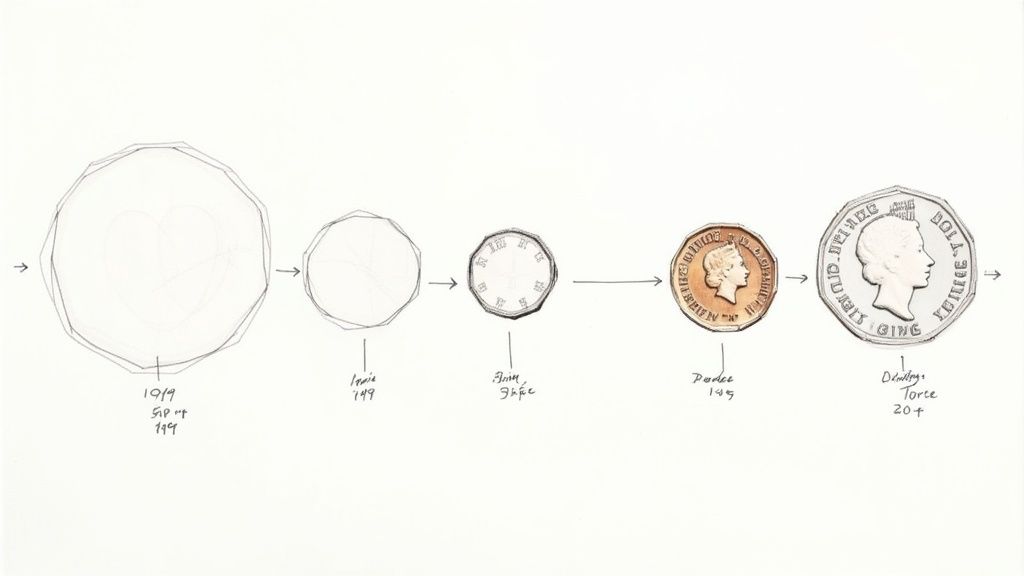
To really get why some 50p coins are worth a pretty penny, we need to wind the clock back to its birth. The story of the 50p isn't just about money; it’s about Britain standing on the edge of a massive change.
In the late 1960s, the UK was getting ready to ditch the old, wonderfully complicated system of pounds, shillings, and pence. This move to a decimal currency needed a whole new family of coins, and the 50p was set to be a star player in this modern lineup.
A Shape Like No Other
The first thing anyone notices about the 50p is its shape. It wasn't round, and it wasn't a clunky polygon with sharp corners either. Instead, the designers came up with the world's first equilateral curve heptagon—a seven-sided coin with beautifully curved edges.
This design was nothing short of brilliant. The coin felt completely unique in your hand, making it easy to pick out by touch alone. But here’s the clever part: its special geometry meant it could roll smoothly and always measure the same width, no matter which way it went into a vending machine, just like a round coin.
The British 50p officially landed in our pockets in 1969, a trailblazer for the UK's decimalisation. Since then, The Royal Mint has struck over 900 million 50p coins that are still in circulation, making it a true staple of British life. You can dive deeper into its specs and history with this detailed overview of the fifty pence piece).
An Evolving Design
Just like the nation it represents, the 50p has changed a lot over the years. Its story reflects both practical updates and major cultural moments, which is exactly why it's so collectible today.
One of the biggest shake-ups happened in 1997. The original, larger 50p was retired and replaced with the smaller, lighter version we all use now. The old, heavier coins were pulled from circulation the next year, instantly turning them into pocket-sized pieces of history.
The decision to shrink the 50p wasn't just for our convenience. It was a practical move that made the coin easier to handle, but for collectors, it drew a firm line in the sand between the "old" and "new" eras of its life.
But the evolution didn't stop there. The portrait of Queen Elizabeth II on the obverse (the "heads" side) was also updated several times, each one marking a different chapter of her long reign.
- 1969-1984: The second definitive portrait of The Queen by Arnold Machin.
- 1985-1997: The third portrait by Raphael Maklouf.
- 1998-2015: The fourth portrait by Ian Rank-Broadley.
- 2015-2022: The fifth and final portrait by Jody Clark.
Each new portrait creates a distinct series of coins, and for many collectors, the challenge of completing a set from each period is part of the fun.
This rich history—from its game-changing shape to its constant transformation—is what turned a simple piece of currency into a canvas. It paved the way for hundreds of commemorative designs celebrating British culture, history, and achievements, ultimately creating the exciting collector's market we have today.
What Makes a 50p Coin Valuable
Ever wondered if that 50p rattling around in your pocket could be worth more than, well, 50p? The truth is, most of them aren't. But every so often, a truly special one turns up. So, what separates a bog-standard piece of change from one of the 50p coins worth money? It's not always about age; it's a fascinating mix of rarity, a cracking design, and sometimes, a complete accident.
Think of each coin's life as a story that begins at The Royal Mint. The vast majority are churned out in their millions, destined for tills and vending machines. But a handful are different. They might be from a very limited production run, feature a design that everyone suddenly wants, or even have a tiny mistake from the minting process. These are the details that turn metal into treasure.
Getting your head around these factors is the first real step to spotting a rarity in the wild. Let's break down the three big things that make a 50p something special.
Mintage Figures: The Golden Rule of Rarity
If there's one thing to remember, it's this: a coin's mintage figure is king. This is simply the number of coins of a specific design that were ever made and sent out into the world. It all comes down to basic supply and demand. The lower the mintage, the harder the coin is to find, and the more a collector will be willing to pay to fill that gap in their collection.
Take the famous 2009 Kew Gardens 50p, for example. It's the undisputed champion of rare 50p coins for one simple reason: only 210,000 were ever minted. Now, compare that to the 1997 Britannia 50p, which had a mintage of over 456 million. You can see straight away why one is a collector's dream and the other is just loose change.
A low mintage figure is like a coin's birth certificate, proving its scarcity from day one. It’s a guarantee that only a small number of people can ever own one, which is the very essence of collectability.
This is exactly why seasoned collectors check the mintage figures before anything else. It gives you a quick, hard-and-fast measure of a coin's potential before you even start looking at its condition.
Commemorative Designs And Collector Demand
While mintage tells us how rare a coin is, the design tells us how much people want it. The Royal Mint has cleverly turned the humble 50p into a tiny canvas, celebrating everything from British history and culture to major events. These commemorative designs can create a real buzz, driving up a coin's value even if millions were made.
Just think of the excitement that some of these releases caused:
- The 2011 London Olympics Series: This huge set of 29 different designs had the whole country checking their change. Certain sports like Judo, Wrestling, and particularly the original 'Football' explainer coin, became modern classics.
- The Beatrix Potter Series: Who would have thought? Coins with characters like Peter Rabbit and Mrs. Tiggy-Winkle brought a whole new generation into coin collecting, and the demand went through the roof.
- Historical Anniversaries: Coins marking big moments in history, like the Battle of Hastings or the UK's withdrawal from the EU, capture a piece of the story that people are keen to own.
This collector demand creates a lively market where the story behind the coin can be just as important as how many were made. A design that really connects with people can become valuable in its own right.
Minting Errors: The Accidental Treasures
Last but not least, we have the most unusual source of value: minting errors. These are simply mistakes that happen when the coin is being made. The Royal Mint has incredibly strict quality control, so coins with noticeable flaws almost never make it out of the factory. That’s what makes the ones that slip through the net so exceptionally rare.
It's important not to confuse these with damage that happens later, like scratches from being in a purse or dings from a washing machine. A genuine minting error is a flaw baked into the coin's creation. You might find "mule" coins (where the wrong front and back dies were used together), off-centre strikes, or even coins struck on the wrong type of metal. Numismatists—the real experts—go wild for these unique, accidental rarities.
Beyond specific numismatic details, understanding the very nature of the currency itself can offer profound insights. For an exploration into the core differences between fiat and commodity money, and how their value systems operate, consider this article on the fundamental principles of fiat money.
Right, this is the moment you've been waiting for. Let's get into the definitive list of the UK's most sought-after 50p coins. Think of this as your personal field guide for spotting the real treasures hiding in your pocket money and piggy banks. We'll dive into the designs, the stories, and most importantly, the mintage figures that make these coins worth hunting for.
While the legendary Kew Gardens 50p gets all the headlines, there are plenty of other fascinating and valuable coins out there. From Olympic rarities to Beatrix Potter’s charming characters, this checklist will help you spot the 50p coins worth money.
This chart gives you a quick visual breakdown of what really drives a coin's value: low mintage numbers, iconic designs that people love, and the occasional rare minting error.
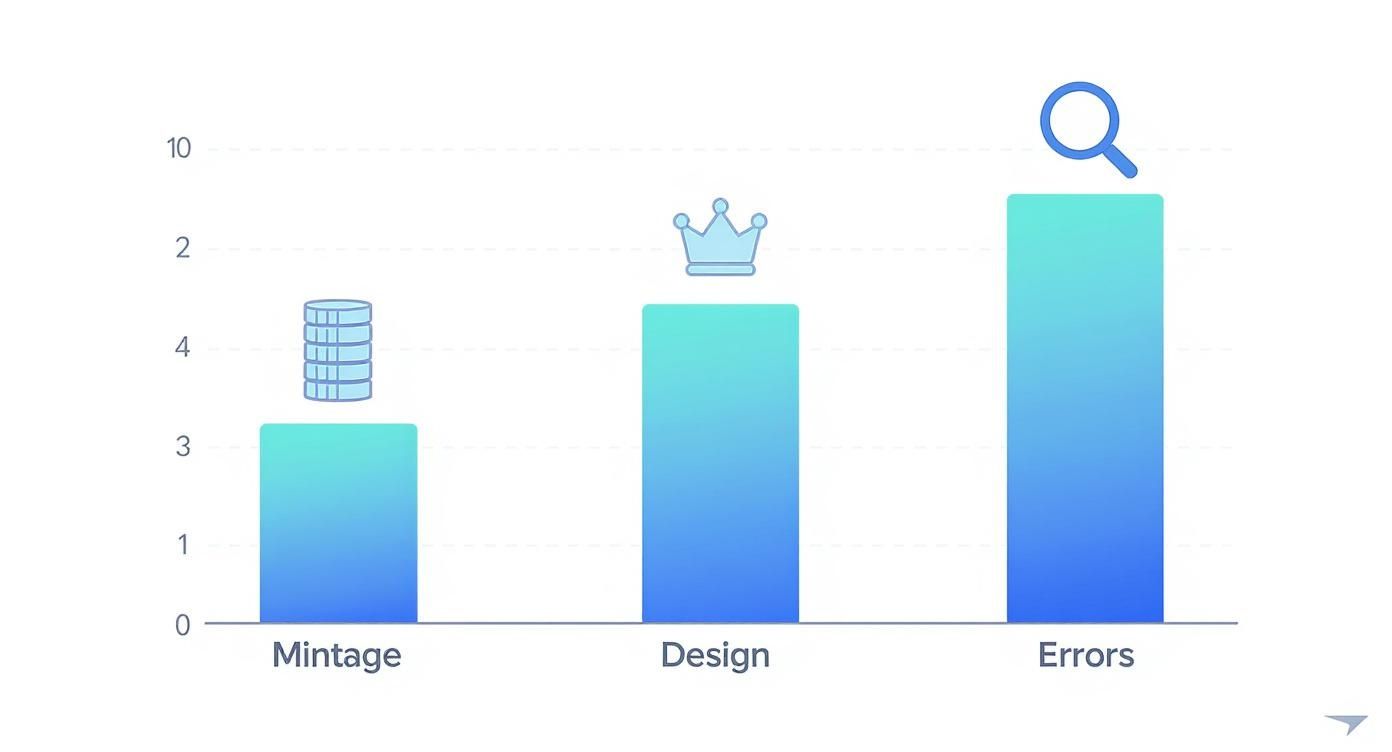
As you can see, a low mintage figure is almost always the biggest factor. The fewer coins made, the harder they are to find, and that scarcity is what collectors are willing to pay for.
The Undisputed Champion: The 2009 Kew Gardens 50p
For years, the 2009 Kew Gardens 50p has been the undisputed holy grail for UK coin collectors. Its fame boils down to one simple, powerful number: its mintage. A mere 210,000 of these coins were ever released into circulation, making them incredibly tough to find in the wild.
The coin was minted to celebrate the 250th anniversary of the Royal Botanic Gardens at Kew, and the design features the famous Chinese Pagoda. Because it’s so scarce, a circulated version can easily fetch between £150 and £250 on the open market. It's the one coin every collector dreams of finding.
The London 2012 Olympics Collection: A Modern Classic
The London 2012 Olympics series kicked off a nationwide coin hunt like never before. The Royal Mint released 29 different 50p designs, each one representing an Olympic or Paralympic sport. While many are common, a handful had much lower mintage figures, making them highly desirable today.
Here are the key Olympic coins you should be looking for:
- Football (The Offside Rule): This coin is famous not just for its low mintage of 1,125,500, but for its clever design explaining the offside rule. It’s a huge fan favourite and can sell for £10 to £20.
- Judo: With just 1,161,500 minted, the Judo 50p is another of the rarer Olympic designs. Its dynamic depiction of the sport makes it a popular find, valued at around £10 to £18.
- Triathlon: This one is interesting because an early version with water lines across the swimmer's face was quickly changed. The final design had a mintage of 1,163,500, but that original error version is the one collectors really want. A standard circulated coin is worth £8 to £12.
- Wrestling: Another low-mintage coin from the series (1,129,500), the Wrestling 50p is a prized part of any complete Olympic set. It typically sells for £8 to £15 in good condition.
While millions of Olympic coins were struck, the designs weren't distributed evenly. This meant certain sports instantly became rarities. Finding one of these in your change today is a real achievement for any collector.
The Charming Beatrix Potter Series
No guide to modern 50p coins would be complete without talking about the Beatrix Potter series. First released in 2016 to celebrate 150 years since her birth, these coins brought a whole new wave of people into the hobby.
While many were produced in huge numbers, some of the initial releases are getting tougher to find.
- 2018 Peter Rabbit: This coin, showing Peter Rabbit munching on radishes, had a lower mintage of 1,400,000. Its enduring popularity and relative scarcity have pushed its value up to the £4 to £8 range.
- 2018 Flopsy Bunny: Released alongside Peter Rabbit, the Flopsy Bunny coin also had a mintage of 1,400,000. It fetches a similar price and is a key piece for anyone trying to complete the set.
Top 10 Rarest Circulation 50p Coins by Mintage
To put it all into perspective, here's a look at the official top ten rarest 50p coins you could genuinely find in your change, ranked by their mintage figures from The Royal Mint.
| Rank | Coin Design | Year | Mintage Figure |
|---|---|---|---|
| 1 | Kew Gardens | 2009 | 210,000 |
| 2 | Olympic Football | 2011 | 1,125,500 |
| 3 | Olympic Wrestling | 2011 | 1,129,500 |
| 4 | Olympic Judo | 2011 | 1,161,500 |
| 5 | Olympic Triathlon | 2011 | 1,163,500 |
| 6 | Peter Rabbit | 2018 | 1,400,000 |
| 7 | Flopsy Bunny | 2018 | 1,400,000 |
| 8 | Paddington at the Palace | 2019 | 1,600,000 |
| 9 | Mrs. Tittlemouse | 2018 | 1,700,000 |
| 10 | The Snowman | 2018 | 1,700,000 |
This list proves that while the Kew Gardens coin is in a league of its own, there are plenty of other genuinely scarce coins circulating. Always check your change—you just never know when one of these modern rarities might turn up.
How To Buy And Sell Valuable Coins Safely
Finding a rare 50p in your change is a fantastic moment, but it's really just the start of the adventure. The next step is navigating the collector's market, which requires a bit of know-how to make sure you get a fair price when selling and don't get stung when buying.
This is your practical guide to trading valuable 50p coins with confidence. Whether you’re looking to cash in on a lucky find or add a specific coin to your collection, knowing where to go and what to watch out for is everything. The market is full of genuine enthusiasts, but there are a few pitfalls waiting for the unwary.
Where To Sell Your Valuable 50p Coins
So, you’ve found a valuable 50p. What next? You have a few options for selling it, and each has its own pros and cons depending on how much time you want to invest and how valuable your coin actually is.
- Online Marketplaces (like eBay): This is the go-to for many people. It gives you a massive audience, but the downside is that it's incredibly crowded. To succeed here, your listing has to really stand out from the crowd.
- Specialist Coin Dealers: A good coin dealer brings expertise and a quick, straightforward sale. They’ll know the coin's real market value and give you a fair offer. Keep in mind, this will be below the retail price, as they need to make a profit.
- Auctions: If you have an exceptionally rare or high-value coin, a specialist coin auction is often the best route. This is where serious collectors compete, which can drive the price way up.
For a deeper dive into these options, check out our complete guide on how to sell coins in the UK for success. It breaks down each method to help you pick the right one.
Creating A Listing That Attracts Buyers
If you decide to sell online, your listing is everything. A blurry photo and a vague description will have serious buyers scrolling right past, and you'll almost certainly get a lower price.
To give yourself the best shot at a great sale, follow these steps:
- Take High-Quality Photographs: Good lighting is key. Use natural daylight against a plain background. Get sharp, clear photos of the obverse (heads), the reverse (tails), and even the edge of the coin.
- Write An Accurate Description: Be honest and precise. State the coin's name, the year, and its condition. If it has any scratches or marks, say so—buyers appreciate transparency, and it builds trust.
- Set A Realistic Price: This is crucial. Before you list, research what similar coins have actually sold for. On eBay, you can do this by filtering your search to show "Sold Items." This shows you what people are willing to pay, not just the wishful-thinking prices some sellers list.
How To Spot Fakes And Replicas
Unfortunately, wherever there’s value, fakes are sure to follow. The boom in 50p collecting has led to a surge in counterfeits, especially for the big-ticket coins like the Kew Gardens 50p. Learning to spot a fake is a non-negotiable skill for any collector.
The most convincing fakes often get the basic design right but fail on the finer details. Genuine coins from The Royal Mint have a sharpness and quality that cheap copies just can't replicate.
Here’s a quick checklist to help you tell a real coin from a dud:
- Check the Weight: A genuine 50p coin weighs exactly 8.00 grams. Fakes are often made from cheaper metals and will be slightly lighter or heavier. A simple set of digital kitchen scales can be your best friend here.
- Examine the Strike Quality: Get up close and personal with the details. On a real coin, the Queen’s portrait, the lettering, and all the design elements will be crisp and well-defined. Fakes often look "soft," with mushy or blurry features.
- Review the Seller's Reputation: When buying online, always, always check the seller’s feedback and history. Someone with a long track record of positive reviews for selling coins is a much safer bet than a brand-new account with no history. If a deal looks too good to be true, it almost certainly is.
Beyond Your Change: Brilliant Uncirculated Coins
Finding a rare 50p in your change is a fantastic thrill, but it's really just the tip of the iceberg for collectors. Away from the hustle and bustle of tills and pockets, The Royal Mint creates special versions of these coins purely for the collecting world. These are a completely different breed.
These coins were never meant to be spent. They're crafted with a precision that goes far beyond their circulating cousins, offering a chance to own a perfect, untouched example of a design. For many people, this is the natural next step in their collecting journey.
Understanding Brilliant Uncirculated Quality
The most common entry point into this world is the Brilliant Uncirculated (BU) coin. Just picture a coin plucked straight from the production line before a single fingerprint or scratch can mark its surface. That's a BU coin in a nutshell.
They are struck using specially prepared dies and planchets (the blank metal discs) which results in a much sharper, more detailed finish. Unlike the coins you get in your change, which are jostled around in large bags, BU coins are carefully packaged to keep them in pristine condition. You can get the full story in our guide on what uncirculated coins are.
Think of it like this: a standard paperback book versus a signed, hardback first edition. Both tell the same story, but one is made for the masses, while the other is crafted for the enthusiast who values it in its original, flawless state.
This superior quality makes them incredibly desirable. While a commemorative 50p found in circulation will almost always have some wear and tear, the BU version is a perfect snapshot of the artist's original vision.
The Exquisite World of Proof Coins
If BU coins are a step up, then Proof coins are in another league entirely. These are the absolute pinnacle of the Mint's craftsmanship and are often seen as miniature works of art. Producing a Proof coin is a slow, meticulous, and labour-intensive process.
- Polished Dies: The dies used to strike Proof coins are hand-finished and polished until they have a perfect, mirror-like shine.
- Multiple Strikes: Each coin is struck several times at low speed and under immense pressure. This ensures every last detail of the design is captured with astonishing clarity.
- Frosted Finish: The final product is a coin with a stunning contrast—the background has a flawless, reflective finish, while the raised parts of the design have a beautiful frosted texture.
The production numbers tell the real story of their rarity. Royal Mint data reveals that while over 39.3 million 50p coins were minted for circulation in 2015 alone, the mintage for BU or Proof sets is often capped at just tens of thousands, or sometimes even less. It's a completely different scale of scarcity. You can dive into more UK 50p mintage figures on the Royal Mint's website.
Answering Your Top Questions About Valuable 50p Coins
When you first dip your toes into the world of valuable 50p coins, a few questions always seem to pop up. Getting them answered properly is the key to building a great collection and, more importantly, avoiding those simple but costly rookie mistakes.
Let’s get right into some of the most common queries we hear from new collectors.
Should I Clean My 50p Coins To Make Them More Valuable?
This is probably the number one question we get asked, and the answer is a resounding, emphatic no. You should never, ever clean a coin.
It sounds counterintuitive, but cleaning a coin will almost certainly destroy its value, sometimes completely. Serious collectors value a coin's original surface and the natural toning, or 'patina', that develops over decades. It's part of its history.
Using harsh chemicals or abrasive polishes strips this history away, leaving behind microscopic scratches that are instantly visible to an experienced eye. An unnaturally shiny, cleaned coin is immediately flagged as damaged goods. The best way to handle a potentially valuable coin is by its edges, and that's it.
How Can I Tell If A Rare 50p Is A Fake?
Spotting a fake is a vital skill for any collector. Thankfully, you can start with some simple checks. A genuine 50p should weigh exactly 8.00g and have a diameter of 27.30mm. A decent set of digital scales is a great investment for this very reason.
Once you’ve checked the stats, look closer at the design. Real coins from The Royal Mint have incredibly sharp, well-defined details, from the Queen's portrait to the lettering. Fakes, on the other hand, often look 'soft' or slightly blurry. The details just aren't as crisp. If you’re looking at a high-value piece like the Kew Gardens 50p, it’s worth spending time on collector forums online to see examples of known fakes.
When you're in any doubt, the best advice is to buy from a reputable, specialist coin dealer. Their expertise acts as your best line of defence, ensuring you’re actually buying a genuine piece of numismatic history and not a worthless copy.
Where Are The Best Places To Find These Rare 50p Coins?
The thrill of the hunt is a huge part of the fun, and you can start right where you are. Your first port of call should always be your own change. Check your pockets, rummage through that jar of coins on the side, and look in any old wallets you have lying around. Finding a treasure this way is the most rewarding feeling.
If you want to cast a wider net, try your local bank or Post Office. You can often ask to exchange banknotes for sealed bags of 50p coins, giving you a large batch to sift through. While the odds of finding a superstar like the Kew Gardens are long, plenty of other uncommon commemorative 50p coins worth money are still out there in active circulation, just waiting to be found.
Here at Cavalier Coins Ltd, we're a trusted source for both new and seasoned collectors looking for authenticated, high-quality coins. You can explore our extensive collection and start building your own piece of history today at https://www.cavaliercoins.com.