

A soft crinkle comes from the back of a relative's drawer as you lift out a faded note marked “10 shillings”. It may look like a modest old keepsake, but the Bank of England ten shilling note records one of Britain's most important currency changes.
The Small Note That Bridged Two Eras
A worn ten shilling note can look like a minor family keepsake. Its creases and faded ink suggest everyday spending, yet its history follows Britain through interwar uncertainty, wartime currency pressures, post-war change and the eventual shift away from pounds, shillings and pence.
The Bank of England first issued its ten shilling note on 22 November 1928, according to the Bank of England's withdrawn-banknotes record. The denomination remained in production until 1969. Its later Series C issue entered circulation on 12 October 1961 and ceased to be legal tender on 22 November 1970.
Those dates give collectors a useful first boundary. Old ten shilling notes are not one uniform group. Treasury wartime notes issued from 1914 to 1928 belong to a different chapter from the Bank of England notes that followed. Mixing the two can produce a wrong identification, misleading comparisons and unrealistic expectations about value.
An everyday note at a turning point
The denomination worked as a bridge between two monetary systems. It belonged to the pre-decimal world of shillings and pence, yet its withdrawal formed part of Britain's preparation for decimal currency. Its disappearance was tied to decimalisation, a story the next section traces in detail.
That context makes the note easier to study. A design change is not merely a visual variation, while a new signature or serial range can help place an example within the Bank's issuing history. Collectors gain more from these clues when they connect them to the wider reform of British money.
Collector's perspective: Start by asking which currency era the note belongs to, who issued it and where it fits in the sequence of monetary change. Value comes later, after identification and condition have been considered.
The note's final withdrawal also helps explain its appeal. It was made for ordinary transactions rather than display, passing through wallets, tills and hands during daily life. Surviving examples therefore preserve a small piece of pre-decimal Britain, while their dates and designs show how a familiar denomination adapted before the country changed its money.
Why the Ten Shilling Note Came into Being
The ten shilling note grew out of a practical problem: Britain needed paper money that could handle everyday payments without the bulk of larger notes. Before the Bank of England made the denomination its own, wartime financial pressure had already led to small-value Treasury notes. The history of the Bank of England ten shilling note separates those issues from the Bank's post-1928 notes, a distinction that can prevent a mistaken identification.
In the pre-decimal system, ten shillings equalled half a pound. That placed the note between pocket change and higher-value paper money. It was large enough for a meaningful purchase, yet convenient for wages, shopping and other routine transactions.
A denomination for ordinary spending
A single note might move from a pay packet to a market stall, then into a shopkeeper's till before the day ended. Repeated use shaped its surviving condition. Notes that circulated widely often show folds, rounded corners, handling dirt and stains. Examples kept in reserve, or never released into normal circulation, may retain crisp paper and clearer printing.
That difference matters to collectors because wear is part of the note's story, but it also affects market value. A heavily used example can document ordinary life more vividly than a pristine one, while a sharper specimen usually attracts closer attention during grading and comparison.
The issuer adds another layer of meaning. Treasury wartime notes belong to a period of shortage and disruption. The Bank of England's first issue in 1928 placed the denomination within a more settled national currency system. The printed value alone cannot show that change. The issuing authority, date and design sequence place the note within Britain's monetary development.
From shillings to decimal currency
Decimalisation eventually made the denomination unsuitable for the new currency structure. Pounds, shillings and pence followed relationships that did not fit decimal pricing, so the transition required people and businesses to work with both systems. Britain introduced a 50p coin in October 1969, well before decimal day on 15 February 1971. Because the coin arrived early, the paper ten shilling note and its 50p replacement overlapped in tills, while shopkeepers had to price goods in both systems during the changeover.
The note ceased to be legal tender on 22 November 1970, as recorded in the Bank of England's withdrawn-note register. Its final years therefore show how a familiar denomination was removed before the country fully adopted decimal money.
For collectors, the practical checks are straightforward:
- Identify the issuer first. A Treasury wartime note and a Bank of England note belong to different issuing histories.
- Place the note in the pre-decimal timeline. Its date and series indicate which design, signature and serial clues deserve attention.
- Assess wear in context. Folds and stains can record circulation, but historical interest does not automatically make a note scarce or valuable.
Series A, B and C Designs at a Glance
A ten shilling note can look familiar at first glance, yet its design places it within a specific stage of Britain's monetary reform. The three principal Bank of England series are easiest to separate by size, colour and Britannia's appearance. These clues provide a starting point before you examine signatures, serial numbers and watermarks.
Series A represents the early Bank-issued period. Series B makes the note smaller and more practical for everyday handling. Series C brings the strongest visual change, using brighter colour and a new treatment of Britannia. The Bank of England's withdrawn-banknotes record remains the reference point for checking official issue and withdrawal history.
A visual comparison
| Feature | Series A, 1928-1949 | Series B, 1949-1955 | Series C, 1961-1970 |
|---|---|---|---|
| General appearance | Larger format with an olive-green and brown palette | More compact note with a refined colour treatment | Strong red and orange palette |
| Reverse artwork | Britannia | Britannia retained | Stylised seated Britannia |
| First impression | Traditional and restrained | Smaller and more practical | Bolder and more modern |
| Collector's starting clue | Larger physical format and early Britannia design | Compact format without the later bold palette | Red-orange colouring and later portrait treatment |
Series A is associated with the first Bank of England ten shilling issue. Its reverse Britannia design gives it a traditional appearance, while the larger format helps distinguish it from later notes. A spacious layout with muted olive and brown tones is a useful first clue, though other details should confirm the identification.
Series B keeps Britannia but reduces the note's physical size. That change reflects the denomination's practical role in circulation. A smaller note was easier to handle, and its restrained colours separate it from the more vivid Series C design. Size is often the quickest way to distinguish Series B, but colour and artwork provide supporting evidence.
Recognising Series C
Series C is the design many people associate with the final “ten bob” notes. It entered circulation on 12 October 1961, using a striking red and orange palette with a stylised seated Britannia. Later issues also feature the Duke of Wellington's portrait, creating a clear visual separation from the earlier Britannia-focused designs. The Bank of England record linked above provides the official history for comparing these issues.
Colour alone can mislead. Fading, storage conditions and lighting may change how old paper appears, so check the note's dimensions, reverse artwork, signature panel and serial format as well.
Identification rule: Use the design to narrow the series, then use the signature and serial number to refine the issue. One clue rarely tells the whole story.
This comparison also explains why notes carrying the same denomination can attract different collector interest. Each series records a different step in the Bank of England's design history and Britain's movement toward decimal currency.
Signatures, Serials and Watermarks Explained
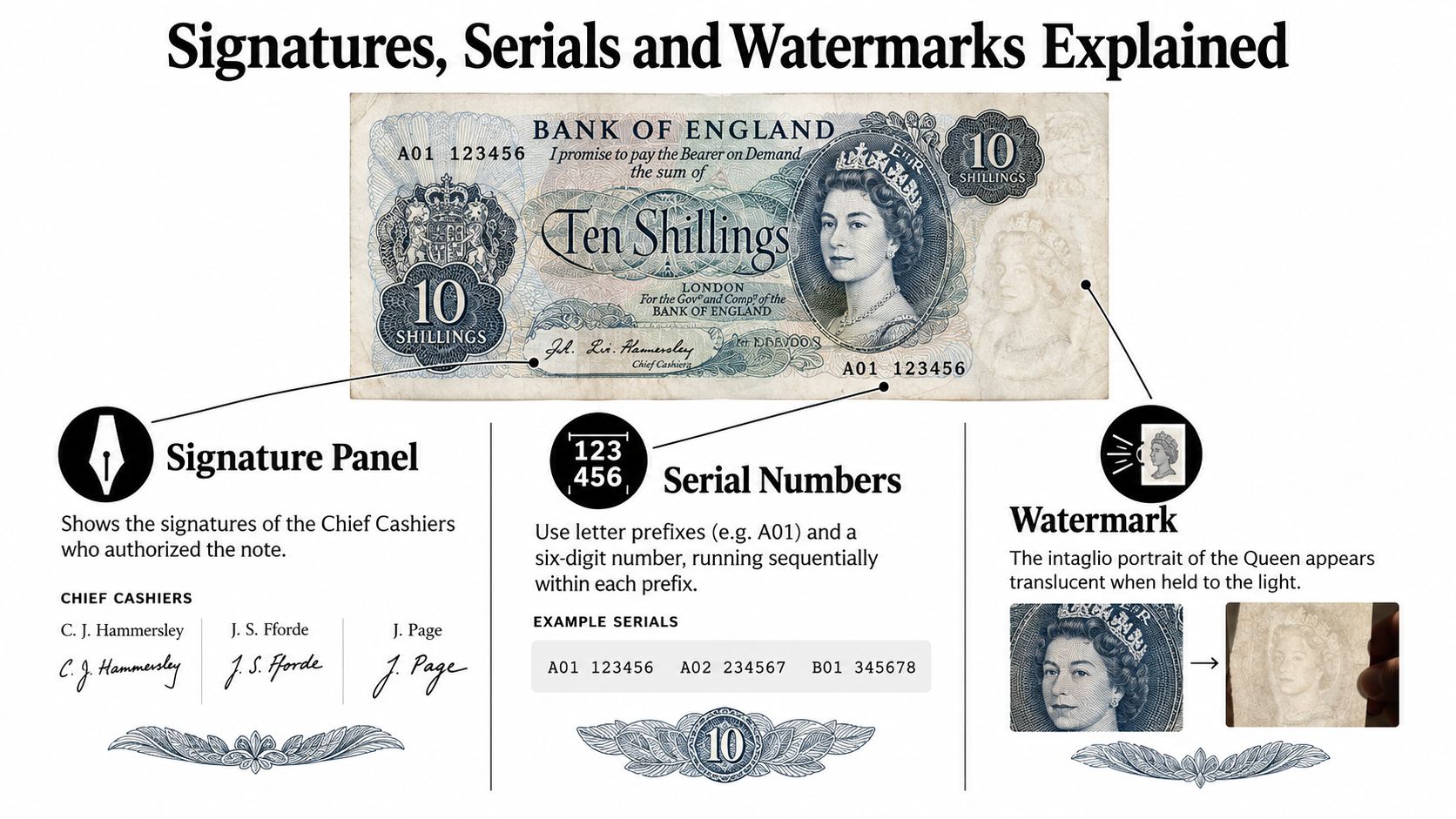
Once the broad design is clear, the smaller details help place a ten shilling note within Britain's monetary transition. The signature panel, serial number and watermark work like three clues on the same historical map. Together, they can identify an issue more precisely than the denomination alone.
Begin with the Chief Cashier's signature. Early pairings linked with C. P. Mahon and K. N. Pumphrey differ from later signatures such as O'Brien, Hollom, Page and Barrett. These changes mark different periods of issue and can narrow a note's place in the Bank of England's design history. Read the names as a pair, because the combination matters more than one signature viewed alone. The panel appears between the date and the obligation text.
For a practical comparison, use this guide to banknote security features and counterfeit detection. It can help you examine paper, printing and other features without treating one apparent detail as proof of authenticity.
Reading serial numbers
Serial formats provide another filter. Series A uses an original one-letter prefix system, while two-letter prefixes appear from Series C onward. Low or replacement serials may interest collectors, including examples associated with Z, M or occasional S-prefix replacement notes. Their significance depends on the correct series and printing context.
Examine the lettering closely. Character height, font weight and spacing between groups can distinguish notes that look alike at first glance. Differences between Bristol and London printings may also help. Use a magnifying glass, and photograph both sides in even, indirect light so that shadows do not create false differences.
An unusual sequence is only a clue. Match it to the design, signature and printing context before treating it as a rarity.
Checking the watermark
Hold the note against a soft, even light source, supporting it rather than bending it. The watermark may show a standing portrait of Britannia. Later issues can be identified by the segmented, helmeted Britannia watermark introduced in 1956, another sign of how the note's design changed before decimalisation.
A genuine watermark sits within the paper, appearing as a translucent image with natural changes in density. A surface mark may indicate damage, staining or alteration instead. Avoid pressing, rubbing or repeatedly folding the note, especially when its paper feels soft.
The watermark supports both identification and authenticity checks. Use it alongside the design and printed details, rather than relying on it alone.
Rarity, Condition and What Affects Value
A ten shilling note's value depends on the interaction between rarity, signature, serial format and condition. No single feature guarantees a high price. A scarce note with serious damage may attract less interest than a common design preserved in exceptional condition.
The rarity hierarchy is useful as a starting point. Ordinary circulated Series A examples are generally modest sellers, while wartime emergency 1940 issues with K or O serial prefixes can command four-figure sums. Unissued replacement serials may reach several hundred pounds, but the exact result depends on authenticity, grade and buyer demand.
Signature pairings matter too. Mahon and Pumphrey examples sit closer to the accessible end of the collecting market, while later Hollom or Page pairings can carry a premium when combined with scarcity and strong condition. Treat these as relative guides, not automatic price labels.
Condition is the multiplier
Dealers and collectors commonly describe condition through grades such as Good, Fine, Very Fine, Extremely Fine and Uncirculated. A Good note may show heavy wear, deep creases and limp paper. A Very Fine example should retain much more crispness, while an Uncirculated note should show no evidence of ordinary circulation.
A jump from Very Fine to Uncirculated can multiply value several times, particularly when the series or serial is already desirable. That's why a clean-looking note still needs careful inspection. A single hard fold, rounded corner or stain can change the grade.
| Factor | Typical impact on value |
|---|---|
| Series and issue | Establishes the historical and collecting category |
| Wartime or emergency status | Can create substantial scarcity when verified |
| Signature pairing | Helps distinguish more common and less frequently encountered issues |
| Serial prefix | May identify replacement or sought-after examples |
| Low or unusual serial | Can add interest when supported by the correct issue details |
| Centreing | Poor alignment can reduce desirability |
| Foxing or staining | Surface damage can lower the grade |
| Ink stamps and pinholes | Marks and punctures reduce eye appeal and collectability |
| Overall condition | Often determines the largest difference between ordinary and premium examples |
A home inspection checklist
Use a clean surface and examine the note without trying to improve it. Check the corners, fold lines, paper stiffness, foxing, edge tears, pinholes, ink marks and centreing. Photograph the front, back, signature panel and serial numbers before seeking an opinion.
Practical rule: Never clean, iron, press or repair a banknote to make it look more valuable. Treatment can destroy the evidence collectors use to judge originality.
The Cavalier Coins guide to ten shilling note value discusses the same core principle. Collectors are buying the combination of history and preservation, not just the old face value.
Looking After Your Note for the Long Term
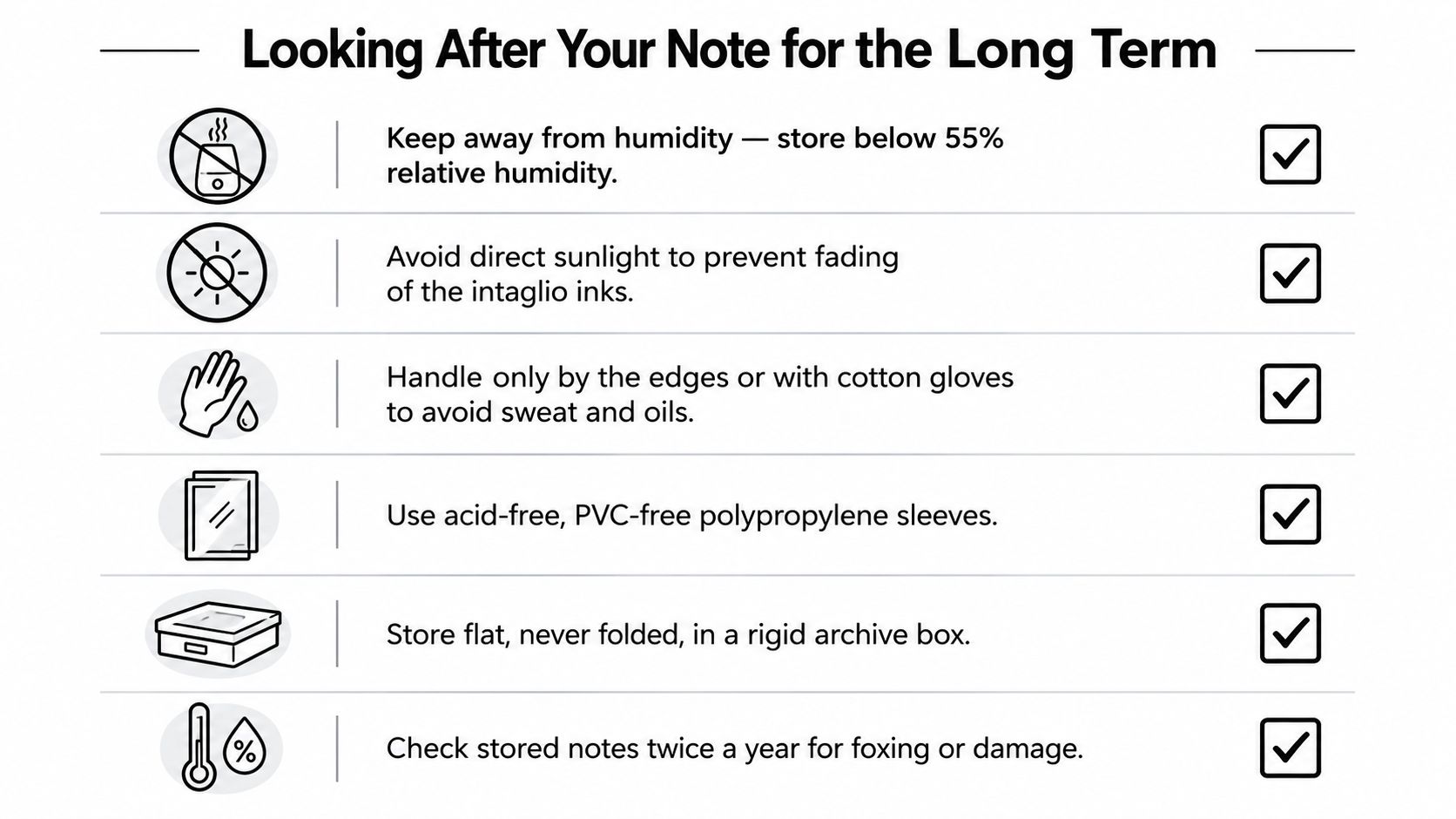
A ten shilling note records monetary reform, so preservation protects more than paper. Humidity can encourage foxing, sunlight can fade colour, and handling transfers oils to the surface. These effects are especially visible on a note whose paper remains crisp and whose printing is sharp.
Store the note flat in an archival polyester or Mylar sleeve, or in acid-free album pages made for paper money. A rigid archival holder adds protection for stronger examples. Ordinary plastic folders and PVC pockets may release chemicals that damage paper over time. Adhesive tape and laminating pouches can leave permanent marks.
Handle less, but handle properly
Clear the work surface before moving a note, and keep drinks, food and ink elsewhere. Hold it by the edges over a clean, soft cloth. Cotton or nitrile gloves may suit pristine pieces, but clean, dry hands often provide better control than gloves that reduce grip or shed fibres.
Never write on the note, attach an adhesive label or fold it to fit a container. Put identification details on the sleeve, or maintain a separate catalogue record.
A stable indoor room is safer than a loft, shed, conservatory or damp basement. Keep the collection away from direct light and sudden environmental changes. A fireproof safe or bank deposit box can provide stronger protection for especially important holdings than an unprotected drawer.
Keep a record
Record the series, signature combination, serial number and visible condition. Photograph both sides, the signature area and serial numbers before storage. Update the record whenever the note moves between holders. These details support future valuation, insurance discussions and family succession.
The guide to storing a paper money collection offers further practical advice. Preservation starts by preventing damage, because later correction can remove the evidence collectors use to assess originality.
Buying and Selling Through Trusted Channels
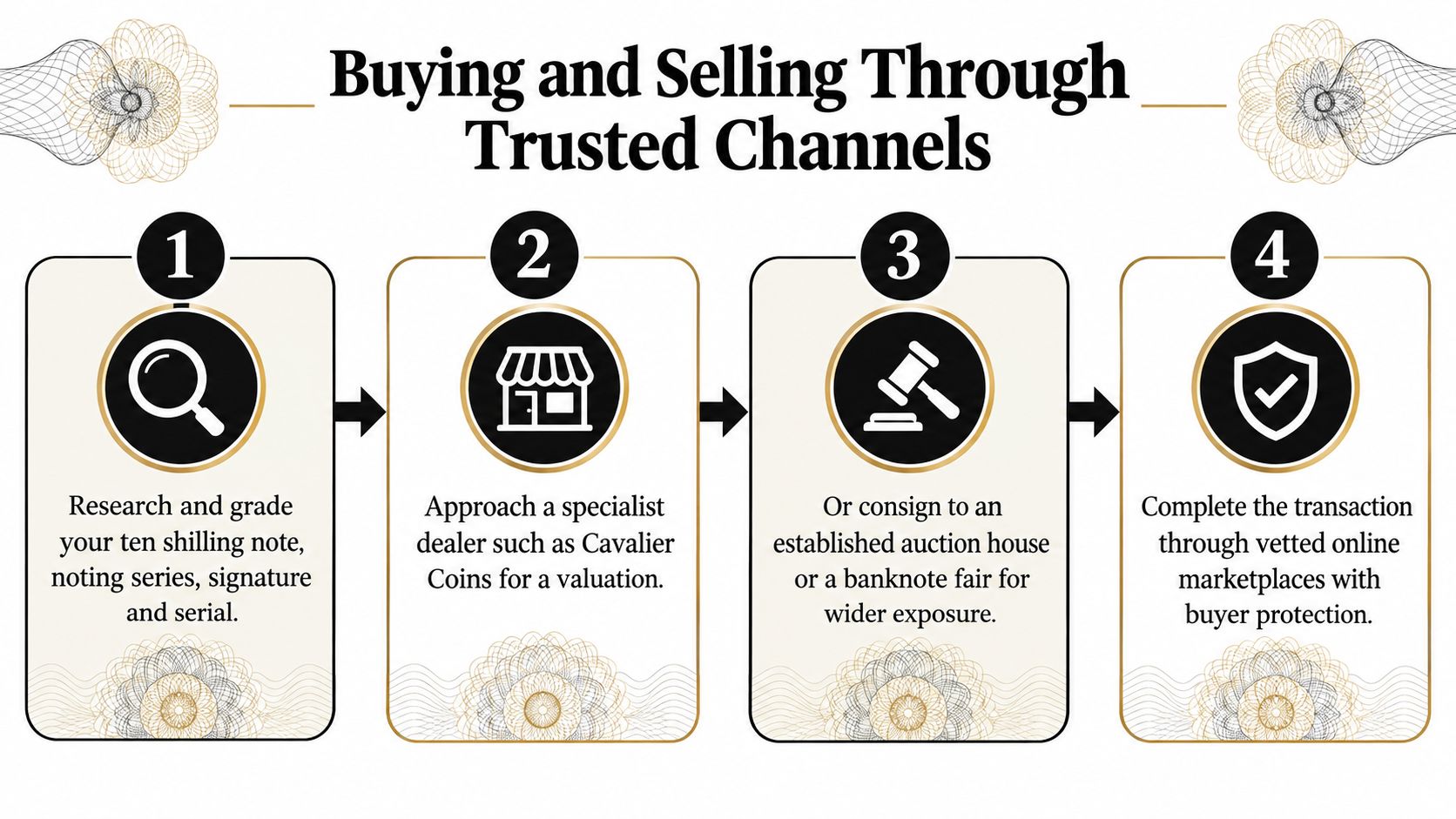
A ten shilling note's story should guide the selling route. A circulated example with a familiar design may suit a direct dealer offer. A scarce prefix, emergency issue or unusually fresh note may attract stronger interest through competitive bidding among specialist collectors. The channel should match the evidence, not merely the note's age.
A specialist dealer can provide a quick assessment and a direct decision. Clear photographs of the front, back, signatures and serial numbers make that first conversation more useful. Auction houses and banknote fairs offer wider exposure, although sellers should check commission, reserve and settlement terms before consigning.
Vetted online marketplaces reach a broad audience, while placing more responsibility on the seller. Describe the series and condition accurately, use buyer protection, and keep clear proof of dispatch. An old-looking design does not by itself establish rarity. The serial, signature, watermark, issue and condition must support the description.
Prepare before asking for a valuation
Organise the evidence before requesting an opinion:
- Photograph both sides: Use even lighting and avoid reflections across the paper.
- Record the signature pair: Transcribe both names carefully rather than relying on memory.
- Capture the serial prefix: Include the full serial where possible, especially any unusual letter combination.
- Describe condition accurately: Mention folds, stains, foxing, pinholes, edge damage and ink marks.
- Set expectations carefully: Base a reserve on comparable results and the note's actual grade, rather than an optimistic online listing.
Buyers can apply the same checks in reverse. Set a bidding ceiling before an auction, confirm that the description identifies the exact series and signature combination, and request further photographs if the serial or watermark is unclear. A low price may reflect undisclosed repairs or severe handling damage rather than a bargain.
Choosing a channel
Cavalier Coins Ltd offers buying and selling support for collectible coins and banknotes, including ten shilling notes. Auction houses, fairs and vetted marketplaces provide other established routes. This guide to where to sell old banknotes helps compare those options before a transaction.
The note's history gives the sale wider meaning. Research connects Treasury emergency money with Bank of England circulation, the move from shillings to decimal currency, and the replacement of the paper note by the 50p coin. For buyers and sellers, that context also helps separate an ordinary example from one with stronger collecting interest.
If you have found a Bank of England ten shilling note, photograph both sides and record its signature and serial prefix. Keep it flat in a suitable archival sleeve, then use its history and condition to begin an informed conversation with Cavalier Coins Ltd.