
You open a jar of old change and find a handful of coins that don't look quite like the shillings and pennies you remember. Some may be Britain's first decimal coins, but the dates and denominations can be confusing: decimalisation unfolded over several years, not in one sudden swap.
The easiest way to start is to identify the coin's denomination by its shape and measurements, then place its date in the changeover timeline. That approach helps separate coins issued before Decimal Day from the full introductory set, and gives you a sound basis for checking condition and authenticity.
The Six Denominations in Britain's First Decimal Coinage
Britain's first decimal circulation set comprised six denominations: the ½p, 1p, 2p, 5p, 10p and 50p. Under the new system, £1 equalled 100 new pence. If you're sorting loose change, begin with the coin's size and mass. Those physical features help distinguish denominations before you study the date or design.
The representative dimensions below match the specifications recorded in the 1967 Decimal Currency Bill record, which also describes the transition-friendly design of the 5p and 10p and the distinctive seven-sided 50p.
| Denomination | Metal | Diameter | Mass | Shape | Old-coin equivalent |
|---|---|---|---|---|---|
| ½p | Bronze | 17.10 mm | 1.78 g | Round | 1.2 old pence; no single pre-decimal coin |
| 1p | Bronze | 20.30 mm | 3.56 g | Round | 2.4 old pence |
| 2p | Bronze | 25.90 mm | 7.13 g | Round | 4.8 old pence |
| 5p | Cupro-nickel | About 23.6 mm | About 5.65 g | Round | Old shilling, 12 pence |
| 10p | Cupro-nickel | About 28.5 mm | About 11.31 g | Round | Old florin, 2 shillings |
| 50p | Cupro-nickel | About 30.0 mm across | About 13.5 g | Seven-sided, constant width | Old ten-shilling note |
The bronze coins followed a practical weight pattern. The 1p was intended to weigh twice as much as the ½p, and the 2p twice as much as the 1p, so a quick scale check can often separate the three before you look closely at the portrait or date.
The new 5p and 10p weren't wholly unfamiliar objects. They matched the size, weight and value of the shilling and florin, so shoppers and cash-handling equipment could continue to recognise familiar-sized coins. The 50p replaced the ten-shilling note as a high-value coin, and its constant-width, seven-sided shape made it easy to distinguish by touch and sight. That familiarity was part of the public lesson: Britain learned decimal values through coins that still behaved like money people already knew.
One date distinction matters when you're identifying an “original 1971 set”. The 5p and 10p had already entered circulation in 1968, and the 50p followed in 1969, while Decimal Day itself completed the set with the ½p, 1p and 2p. A coin can belong to the first decimal coinage without having been first issued on 15 February 1971.
Practical rule: Measure before you guess. A ruler can give you a useful first comparison, while callipers and a scale provide a more precise check.
How Decimalisation Was Phased In from 1968
Decimalisation wasn't a single-day replacement of old money. The National Archives account of the decimal currency system describes a staged transition designed to give people and retailers time to adjust.
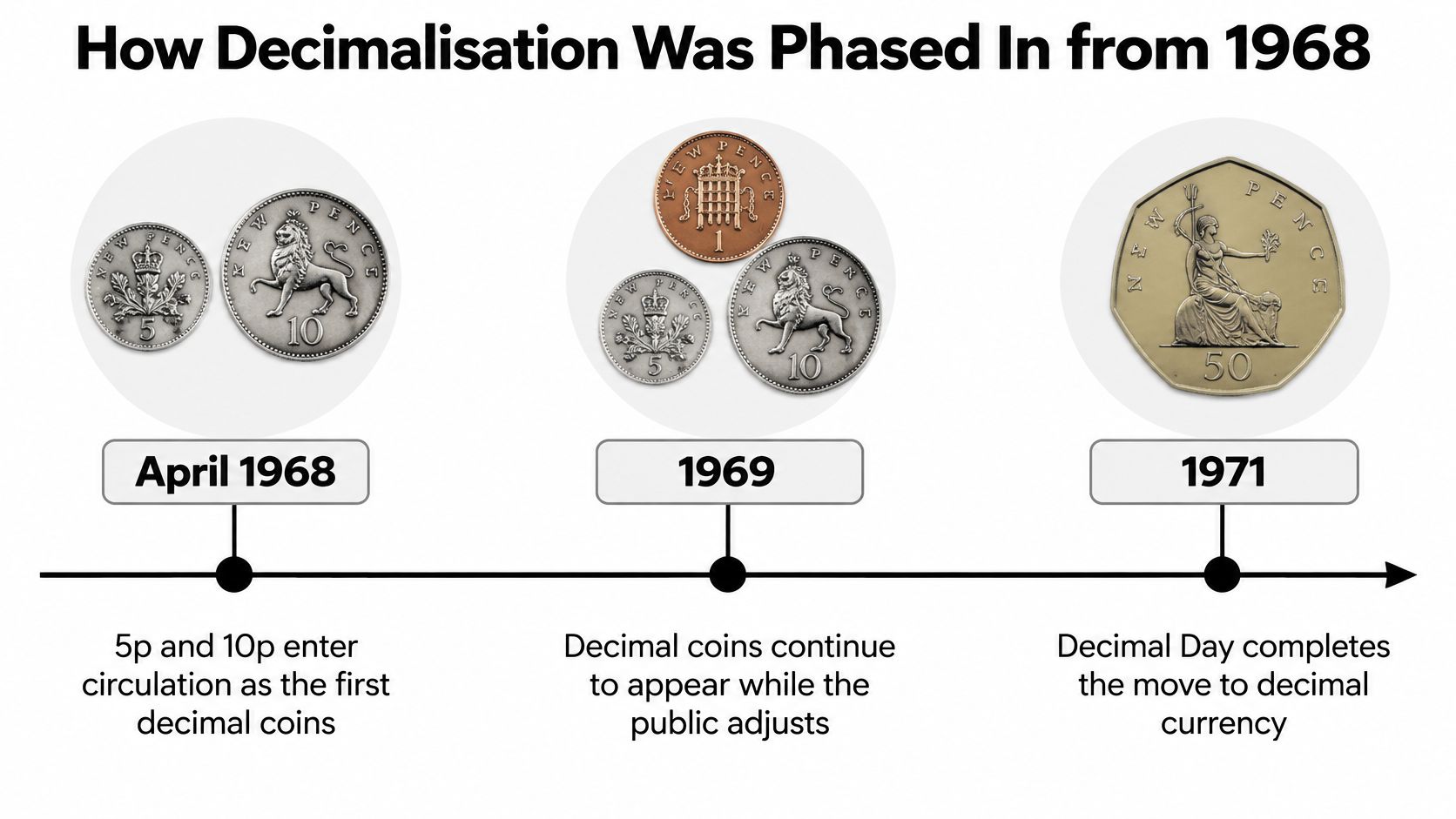
April 1968: The 5p and 10p were the first new decimal coins to enter circulation. Each had the same value as a familiar pre-decimal coin, the shilling or florin. That made them useful as a gentle introduction: a shopkeeper could see the new decimal value, while a customer could still recognise the coin's old-money equivalent.
1969: The 50p followed, replacing the ten-shilling note and providing a high-value decimal coin. Its arrival extended the new coinage in advance of Decimal Day, rather than leaving the public to encounter every denomination at once.
15 February 1971: Decimal Day brought the ½p, 1p and 2p into circulation and completed the introductory set. The old system divided a pound into 20 shillings, with 12 pence in each shilling. The decimal pound instead contained 100 new pence. For a broader historical overview, see a brief history of British coins.
The halfpenny helped with small price adjustments. A new penny was worth 2.4 old pence, making it a relatively large unit for some low prices; the smaller coin allowed finer changes without abandoning decimal values.
The transition also affected familiar old denominations. The sixpence remained legal tender for at least two years after Decimal Day, following strong public feeling about its proposed withdrawal. That detail is a reminder that “Decimal Day” marks a major milestone, not the instant disappearance of every pre-decimal coin.
For a collector, the dates answer a common question. A 5p dated to the early phase of decimalisation isn't an error just because it predates 1971. It belongs to the transition, but it won't be a complete Decimal Day introductory set.
How the Public Reacted and Why It Shaped the Coins
Decimalisation can sound like an easy, universally welcomed change: replace complicated arithmetic with a pound divided into 100 pence, and everyone moves on. The response was more complicated. The Royal Mint's account of public response to decimalisation describes strong public feeling in 1969 and early 1970, especially around the proposed withdrawal of the sixpence.
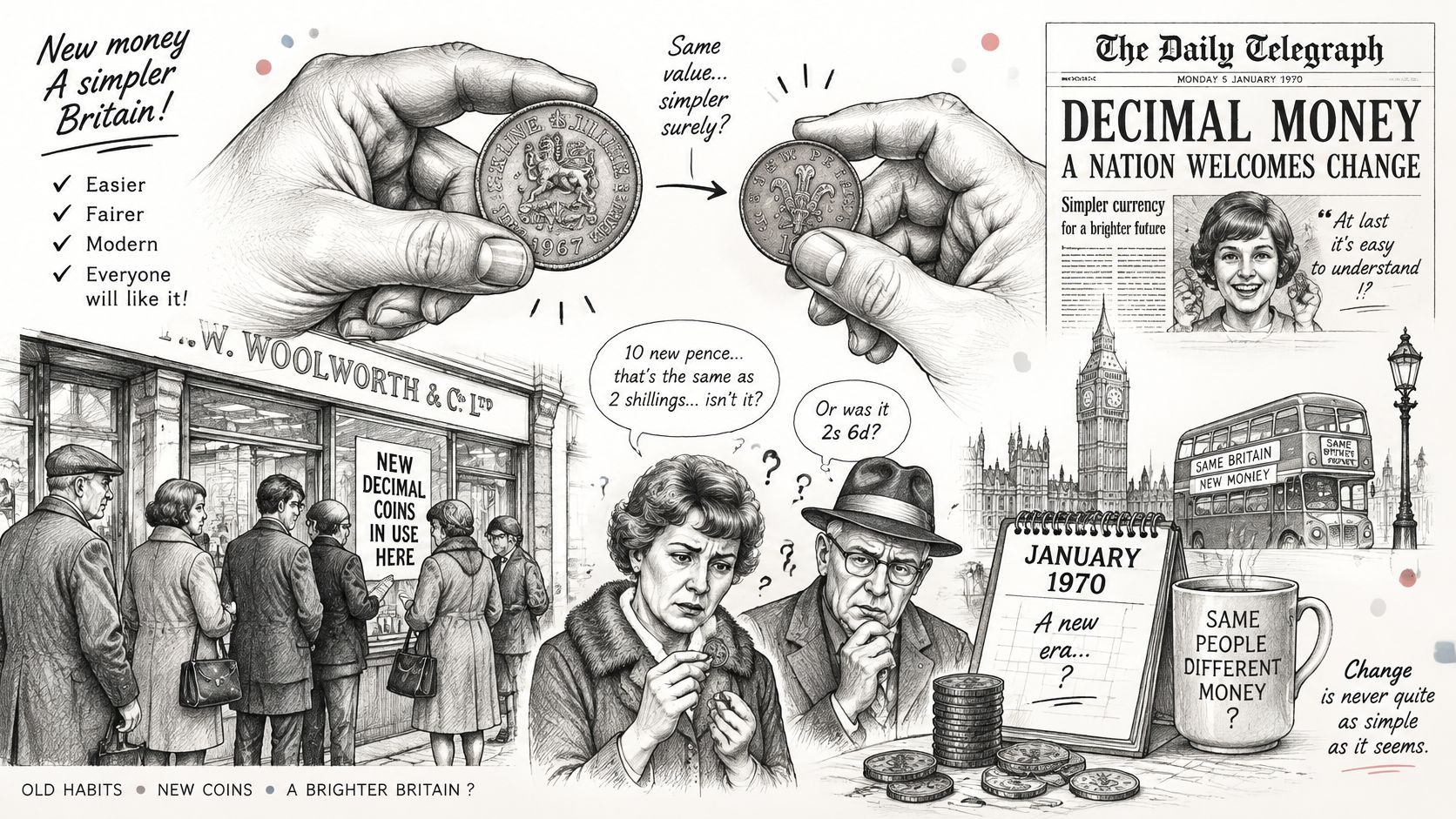
Much of that concern centred on specific consequences of the change rather than decimalisation as a whole. People could accept the new money and still object to losing a familiar coin they had used for years.
Understanding a system and liking every part of it are two different things.
The sixpence shows that difference plainly. Objection to its withdrawal was strong enough that the government let it remain legal tender for at least two years after Decimal Day. The extension gave households time to adjust rather than forcing a clean break with old denominations all at once, and it means sixpences kept circulating alongside decimal coins well into the changeover.
Familiar coins helped teach unfamiliar values
The design choices worked the same way. A 5p equalled an old shilling, and a 10p equalled an old florin, so a shopper could pick up a decimal coin that felt the same and spent the same while its face announced the new value. Introductory sets let households handle the denominations at home before the full conversion, which meant the first day of decimal shopping involved less guesswork at the till.
That is why these coins reward being read as more than monetary hardware. Their dimensions, denomination names and issue sequence all carried a message to the people expected to use them. The coinage itself worked like the printed instructions for a new appliance: it arrived early so that handling it could do the teaching.
For collectors, that history sits in ordinary, worn pieces. A heavily circulated 5p is not a rare object, but the wear on it records how the changeover reached everyday shopping and cash handling. Condition still drives value, yet a rubbed coin can document use in a way a mint-state example cannot.
Designers, Designs and the Introductory Set
Arnold Machin designed the obverse portrait, while Christopher Ironside created the reverse designs for the 1971 decimal coins. When you're identifying a coin, compare both sides with a reliable reference. A portrait or reverse that doesn't fit the decimal series deserves a closer look, although a design match on its own can't prove authenticity.
Check the set methodically
Royal Mint introductory sets were designed to familiarise the public with the new system. The set contained five coins: the ½p, 1p, 2p, 5p and 10p. It wasn't the complete group of six circulation denominations, because the 50p had entered circulation earlier.
A complete set is a useful record of the coins presented together to introduce decimal money. Check it in this order:
- Count the coins: Confirm that the halfpenny, 1p, 2p, 5p and 10p are all present.
- Inspect the packaging: Look for the original card or holder, and note tears, marks or missing parts.
- Compare condition: Check whether the coins have similar levels of wear, toning or tarnish.
- Avoid cleaning: Polishing can alter the surface and make a coin less attractive to collectors.
Packaging contributes to how buyers assess a set, but coins without their original card can still document the denominations. Describe what's present, including any missing pieces or visible discolouration, rather than treating an incomplete group as a complete original set.
How Many Were Struck and What Survives Today
The Royal Mint Museum records that just over 1.4 billion 2p coins dated 1971 and carrying the inscription NEW PENCE were struck in its response about the 1971 NEW PENCE 2p mintage. Treat that as a denomination-level figure: it shows the scale of one decimal coin, not the size of the whole 1971 issue.
The ½p, 1p, 5p, 10p and 50p are separate issues, so do not infer their rarity from the 2p figure. Survival works differently anyway. A coin can be common because huge numbers were made, yet scarce in a chosen format because few were saved carefully during the changeover.
| Format | What it is | Why collectors value it | Condition signs |
|---|---|---|---|
| Circulated coin | Worn coin from everyday change | Social history and complete date runs | Rubbing on high points, dulled edges |
| Introductory set | Original pack of the first decimal denominations | Complete record of the first circulating coins | Card condition, tarnish on individual coins |
| Uncirculated coin | Mint-fresh coin that never entered circulation | Sharp detail and original lustre | Full lustre, no contact marks |
| Proof coin | Specially struck coin with mirror-like fields | Crisp, high-quality striking | Mirror fields, no hairlines |
| Specimen or presentation issue | Coin issued in special packaging | Limited availability and presentation | Original packaging and certificate, if present |
Read the table as a set of routes by which 1971 coins reached today. Circulated pieces carry the evidence of use in ordinary decimal change. Sets, uncirculated coins and proofs were more likely to be put aside, so their surfaces and packaging matter as much as the date.
A common circulated coin and a proof coin can share a date and design yet appeal to collectors for different reasons. One may be valued as a record of everyday use, while the other is judged for the quality of its strike and surface. Keep format and condition separate in your description, and do not call a coin proof only because it looks shiny.
How to Identify a Genuine 1971 Decimal Coin
A coin's date is only one part of identification. Check its dimensions, mass, shape and inscriptions as a group, then compare its design with a trusted reference. Handle it gently throughout: surface marks can make later assessment harder.
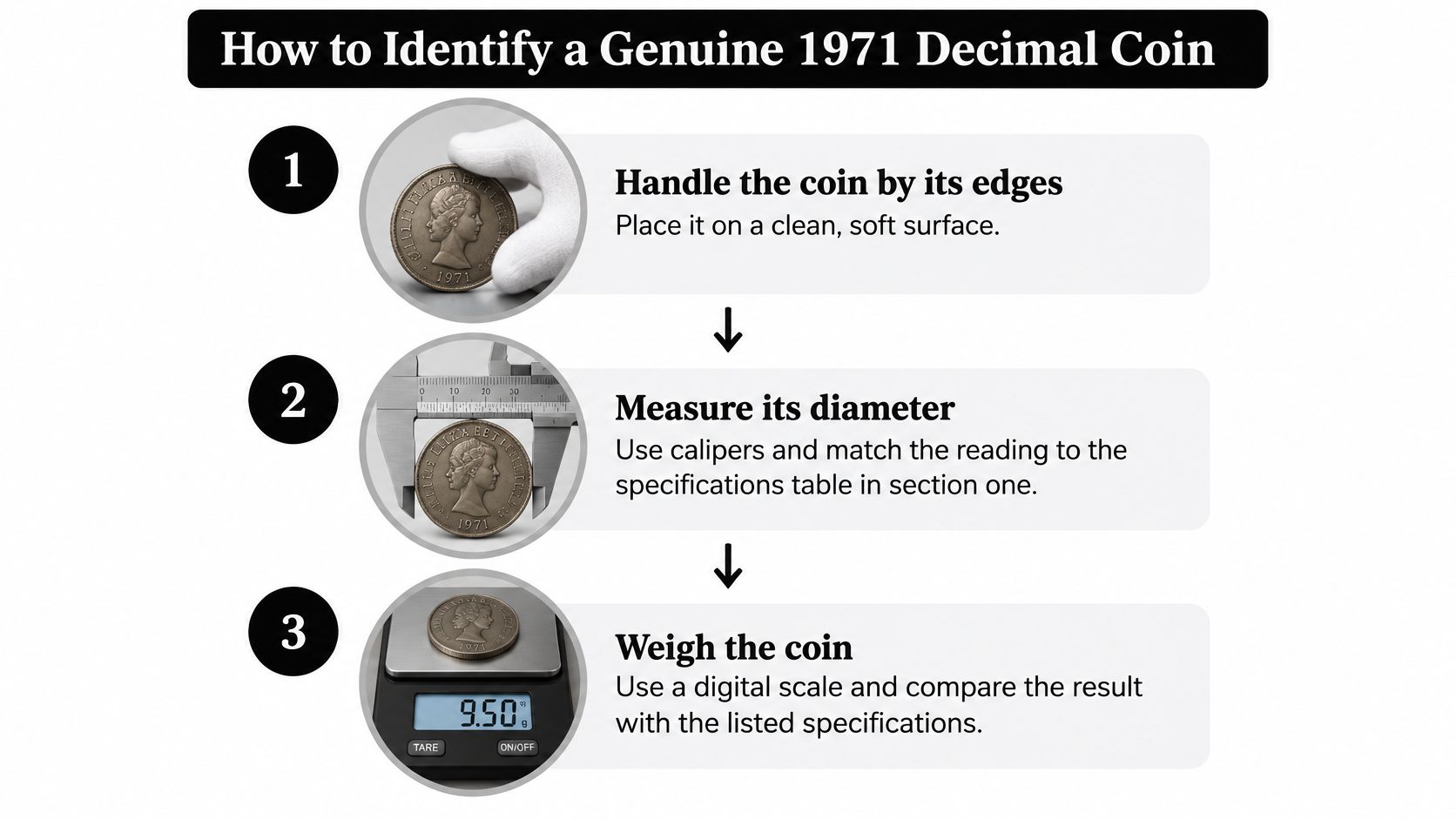
- Handle it by the edges. Place the coin on a clean, soft surface, rather than a hard table. This reduces the chance of leaving fingerprints or adding scratches while you inspect it.
- Measure the diameter. Use callipers and compare the result with the specifications table. Diameter narrows down the denomination, but a small difference alone doesn't establish that a coin is fake; wear, measurement technique and condition can affect your reading.
- Weigh it. Use a digital scale that reads to 0.01 g, then compare the result with the expected mass. For a practical guide to checking a coin's mass, see how UK coin weights help with identification.
- Check the shape and edge. The 50p should have seven sides and constant-width geometry. Round coins should remain round, not visibly flattened or oval.
- Read the date and inscription. Look closely at the lettering and date, and note whether the coin's design and denomination belong together. A 1971 2p should carry the inscription NEW PENCE.
- Compare both designs. Match the portrait and reverse against a reliable photograph of the same denomination and date. Check lettering, spacing and detail, not just the broad layout.
- Don't clean it or rely on a magnet. Cleaning can damage a coin's surface, while a magnet isn't a reliable test for the bronze and cupro-nickel compositions described here. If something looks wrong, pause rather than trying to improve the coin's appearance.
Inspection rule: Passing these checks supports identification, but it doesn't replace specialist authentication. If one feature doesn't match, seek an independent opinion before you pay for the coin or describe it as genuine.
Rarities, Varieties and What Drives Value
Decimalisation was run as a mass public exercise: coins were struck in enormous numbers and pushed into circulation so everyone could learn the new system. That history still shapes the market today. Most 1971 decimal coins are common, so the date alone doesn't make an example rare. Condition, format and verifiable unusual features are more useful starting points than a claim about scarcity.
The table below describes grading terms and their general effect on collector interest. Exact prices move with current demand and the individual coin's condition, so read the third column as a relative ladder rather than a set of fixed figures.
| Grade | Visible signs | Typical effect on value |
|---|---|---|
| Fine | Clear outline, heavy wear on high points | Usually trades close to face value |
| Very Fine | Moderate wear, main details clear | Small premium over face value |
| Extremely Fine | Light wear, most original detail sharp | Moderate premium; detail begins to drive price |
| About Uncirculated | Faint wear on highest points only | Noticeable premium for sharp detail |
| Uncirculated | No wear, mint lustre present | Strongest premium, especially with intact lustre |
| Proof | Mirror fields and frosted devices | Premium depends on set completeness and surface condition |
These descriptions are a practical guide, not a substitute for examining the coin under good light. Wear on the high points separates the circulated grades from each other, while contact marks, hairlines and damaged edges can reduce appeal even on a coin whose main detail is sharp.
Treat claimed errors with care
Die errors, misstrikes and planchet faults can attract collector interest, but a mark on a coin isn't automatically a mint error. Scratches, corrosion, cleaning and damage after circulation can imitate unusual features. Compare the coin with documented examples, and ask an independent specialist to assess any feature you can't explain.
Format matters in the same way. Because so many ordinary coins survive, buyers pay close attention to how a coin is presented, and a piece still sealed in its introductory-set packaging is judged differently from the same denomination loose in a jar.
Avoid pricing a coin by comparing it only with sellers' asking prices. Check recent sold prices for the same denomination, date, grade and format, and remember that a listed price isn't proof of what a buyer will pay. A guide to rare coin values and how to assess them can help you frame that comparison.
A coin may have personal or historical importance beyond its market value. Buyers usually judge the condition they can see and the provenance they can verify, not just the year printed on the coin. If you can't substantiate a rarity claim, describe the observable feature and leave the conclusion open.
Decide Whether to Value, Buy or Keep Your Set
Start by deciding what you have. If the coins are circulated, keep them in a labelled album or envelope and record the denomination and date. Their interest may lie in the history of the changeover rather than in a high resale price.
An introductory set is best kept in its original packaging if you have it. Don't polish or clean the coins, and get an independent valuation before selling if you're unsure how the set should be described. When buying, use a reputable dealer, check the returns policy and compare recent sold prices for similar coins rather than relying only on asking prices.
For storage, choose acid-free holders, keep coins away from humidity and handle them by their edges. Cavalier Coins Ltd offers vintage UK coins through fixed-price listings and weekly eBay auctions, and its team can advise on bulk purchases and collections.
Take these actions in order: measure and identify the coins, check their condition against the grading table, then decide whether to keep, sell or add them to your collection.
If you're sorting Britain's first decimal coins, start with their denomination, measurements and condition before deciding what belongs in a set. Visit Cavalier Coins Ltd to browse vintage UK coins and collectible sets, or to ask the team about a collection or bulk purchase.