
You've emptied a dusty jar of old pennies, half-crowns and unfamiliar copper pieces onto the kitchen table. The sensible question is whether any of it is worth more than face value. The better question is what you're looking at, because coin collecting combines history, art, manufacturing skill and practical market judgement.
Good coin collecting information helps you move from hopeful guessing to informed decisions. You learn to identify a coin, understand its condition, protect it, research genuine scarcity and choose the right place to buy or sell it. In the UK, that journey can lead from pocket change and inherited collections to hammered Tudor coins, Victorian pennies, milled George III issues, decimal proof sets and modern Royal Mint commemoratives.
What Coin Collecting Actually Looks Like Today
The jar on your table might contain ordinary change, a useful group of pre-decimal coins, or one piece worth investigating properly. A worn Victorian penny may be interesting because it connects you with an industrial age, while a sharply struck commemorative may appeal because its design, minting quality or theme fits a series you want to complete. Interest comes before value, and value depends on details that casual sorting often misses.
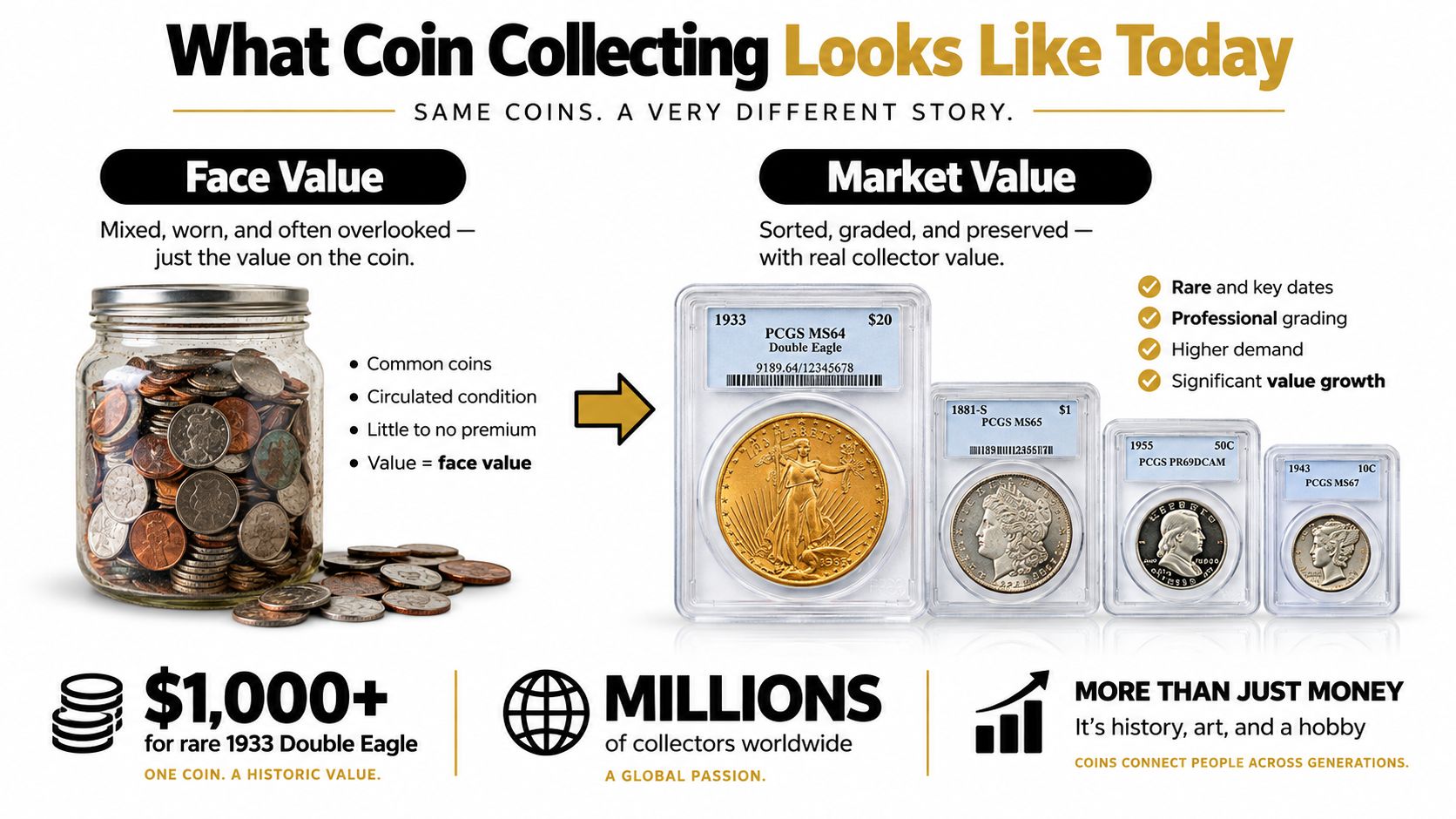
The UK has a collecting tradition that stretches well beyond modern retail releases. The British Museum's Money and Medals collection covers coinage from its origins in the 7th century BC to the present day and contains about 800,000 objects from around the world. Its institutional history includes Sir Hans Sloane's original 1753 bequest and the creation of a separate Coins and Medals department in 1860, placing today's hobby within a long scholarly and collecting tradition.
From pocket change to specialist rooms
Some collectors sort coins by date and denomination, then stop when the album is full. Others study hammered coins, where irregular flans and medieval minting methods make every example feel individual. A third group follows milled coinage from George III onwards, concentrating on monarchs, varieties, edge lettering or die changes.
The Royal Mint describes the 50p, introduced in 1969, as the UK's most collected coin. It has featured over 100 designs, while the first £1 coin appeared in 1983 and more than 4 billion have entered circulation. The £2 denomination has had 39 commemorative designs since the first bi-colour issue in 1997, with over 400 million entering circulation, according to the Royal Mint's collector resources.
That range explains the hobby's accessibility. You can collect designs from circulation, build a focused date run, buy historical pieces through a specialist dealer or research a rare variety for years. A UK survey cited by the Royal Mint found that 83% of 2,000 adults had collected something at some point, 57% still had an active collection, and the average amount spent among collectors was around £1,500. The same survey reported that 3.5% spent more than £10,000, showing how collecting can remain casual for one person and become financially substantial for another.
Core Numismatic Terms and Types of Coins to Collect
Before judging a coin, learn its visual vocabulary. Think of the obverse as the front cover of a book, usually the monarch's portrait or the principal design. The reverse is the back cover, where the denomination, emblem or commemorative scene appears.
A legend is the lettering around the design, rather like the title printed around a badge. The exergue is the lower area of a coin, often separated by a line and used for a date, denomination or minting detail. A mint mark identifies a mint or production location, while a die variety records a small difference in the tool used to strike the coin, such as lettering, spacing or a design feature.
A proof is a specially prepared coin made for presentation or collecting rather than ordinary circulation. It often has contrasting mirrored fields and frosted design elements, although appearance alone shouldn't replace careful identification.
Choose a collecting path
Collectors generally organise their goals in one or more of these ways:
- By country: British, Roman, European or world coins.
- By denomination: Pennies, half-crowns, crowns, 50p pieces or £2 coins.
- By monarch: Victoria, George III, George V, Elizabeth II or Charles III issues.
- By date and mint: A structured run that records every required date and production mark.
- By theme: Animals, military history, royal events, ships, buildings or national symbols.
- By error or variety: Striking differences, doubled features, unusual dates or die changes.
- By series: A defined family of related coins collected as a set.
UK beginners often start with pre-decimal denominations, including the crown, half-crown, florin, shilling, sixpence and threepence. Decimal coinage from 1971 offers a more familiar entry point, while Royal Mint commemoratives suit collectors who enjoy design and themes.
| Series | Period | Key features | Collector appeal |
|---|---|---|---|
| Pre-decimal denominations | Before decimalisation | Pounds, shillings and pence, with varied sizes and metals | History, monarchs and changing monetary systems |
| Hammered coins | Medieval and Tudor periods | Hand-struck designs, irregular flans and distinctive lettering | Individual character and historical depth |
| Milled coinage | George III onwards | More regular shapes and machine-made detail | Dates, varieties, edge designs and condition |
| Decimal circulation coins | From 1971 | Familiar denominations and changing portraits | Accessible collecting from everyday money |
| Royal Mint commemoratives | Modern issues | Themed designs, proof finishes and presentation packaging | Design-led collections and series completion |
Completeness and rarity aren't the same ambition. A completeness-driven collector may accept modest grades to fill gaps. A rarity-focused collector may buy fewer coins but spend more time checking mintage, condition and authenticity.
Grading and Authentication Explained
Grading describes condition, while authentication asks whether the coin is genuine. Keep those questions separate. A convincing counterfeit can be in excellent apparent condition, and an authentic coin can be heavily worn.
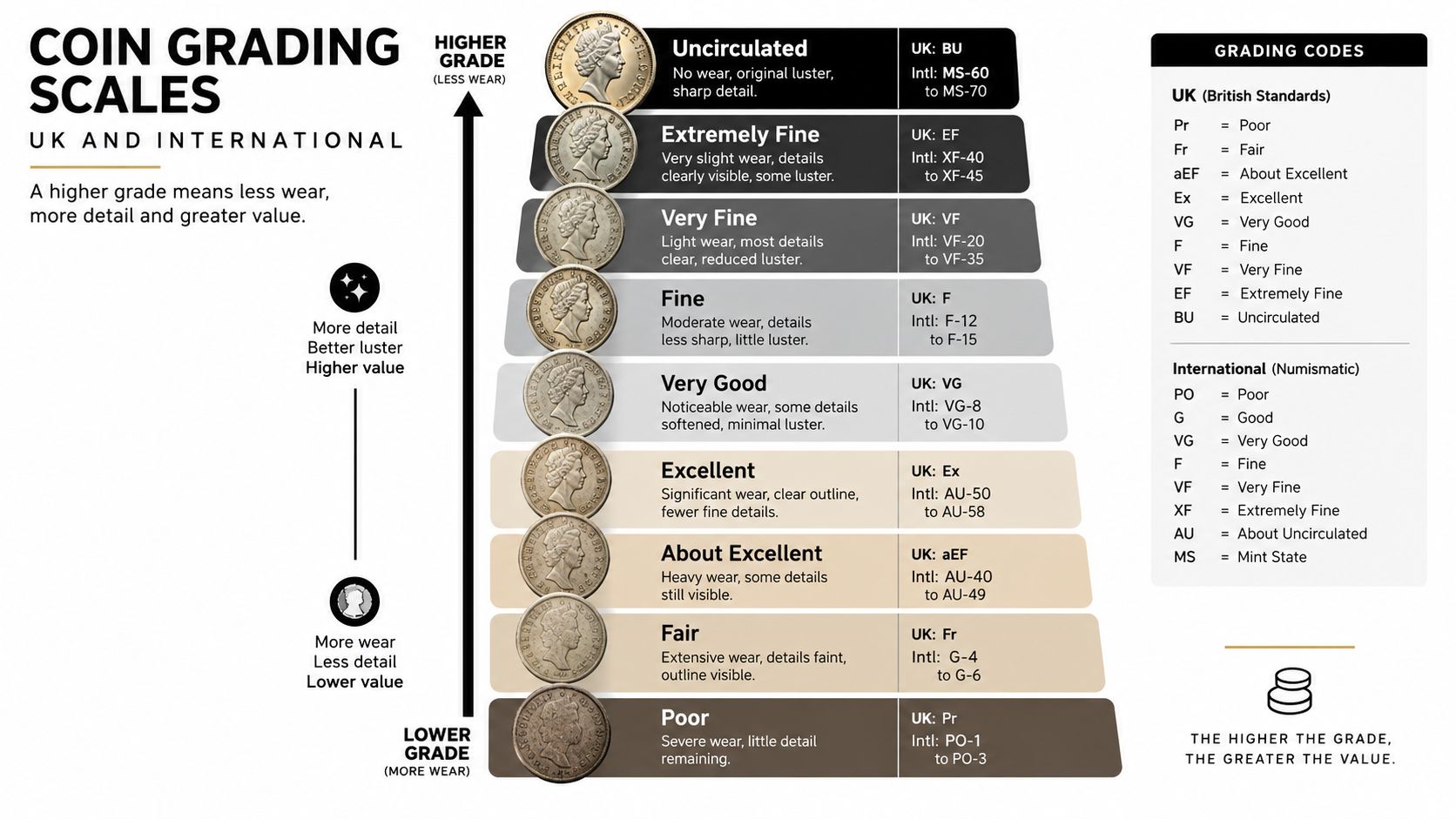
The Royal Mint's explanation of coin grading uses the common UK terms Fine, Very Fine, Extremely Fine and Uncirculated, with modifiers such as Nearly and About. Good can operate as an overgrade. International services often express condition numerically, but the underlying task remains the same: assess how much wear the coin has retained and how much original detail remains.
Read the wear, not the wish
A low-grade Victorian penny may show only the broad outline of the portrait and a readable date. A Fine example retains more lettering and design structure, but high points are visibly softened. Very Fine detail should remain clearer, while Extremely Fine pieces show limited wear on the raised areas. An Uncirculated coin should retain its original mint appearance, subject to strike quality and handling.
FDC, or Fleur de Coin, is used for an exceptionally fresh example, particularly in a presentation or proof context. Don't treat any bright coin as perfect. Cleaning can create unnatural brightness and hairline scratches, while weak striking can resemble wear.
Practical rule: Grade conservatively until reference photographs prove otherwise.
Authentication starts with basic measurements and observations:
- Weight and diameter: Compare them with a reliable catalogue specification.
- Edge details: Examine lettering, milling, seams and unusual joins.
- Metal and colour: A strange surface may indicate plating, corrosion or a modern replica.
- Die characteristics: Compare portrait details, lettering and alignment with confirmed examples.
- Strike quality: Genuine coins can be weakly struck, so one soft detail isn't proof of forgery.
Use a loupe, neutral lighting and clear photographs. Reference images matter more than optimism. For valuable pieces, professional services such as NGC and PCGS, alongside reputable UK specialists, can provide encapsulation and an independent assessment. Cavalier Coins' guide to how coins are graded can also help beginners become familiar with the language before approaching a specialist.
Storage and Long-Term Conservation
Coin conservation is a series of small battles against moisture, abrasion and reactive materials. British homes can offer plenty of damp conditions, especially in lofts, garages and cellars. Chards' coin-collecting guide advises a dry environment because moisture can cause toning and corrosion, with copper, bronze and silver particularly vulnerable to surface change.
Match the holder to the coin
Copper and bronze benefit from low-contact storage, such as archival paper envelopes, Mylar flips, suitable albums or capsules. Soft fabric wraps can work for individual pieces when the material is non-abrasive and free from chemicals. Circulation coins may sit safely in 2x2 cardboard holders with Mylar windows, provided the holder is archival and the coin isn't allowed to rub against another surface.
Proof coins need careful handling because hairlines can spoil reflective fields. Wear clean, soft cotton gloves when appropriate, but don't let gloves encourage clumsy handling. Hold every coin by its rim, not its obverse or reverse.
| Threat | What happens | Safer response |
|---|---|---|
| Humidity | Moisture encourages toning, corrosion and verdigris | Use a dry, stable location and replace silica gel when needed |
| Abrasion | Coins rub against one another or rough holders | Separate pieces with archival flips, trays or capsules |
| Reactive materials | PVC and unsuitable plastics can leave deposits and tarnish | Choose PVC-free, archival storage |
| Poor handling | Skin oils and pressure mark the surfaces | Hold the rim and work over a clean, soft surface |
Albums provide display, structure and an inventory record. Slabs offer tamper-evident protection and preserve a professional grading result, but they can take up more space and make direct examination less convenient. The right choice depends on whether you value access, presentation, security or compact organisation.
Airtight capsules can help when correctly sized, while cabinets and trays suit larger collections. Silica gel packs are useful in enclosed storage, but they aren't a substitute for a dry room. Store the collection away from temperature swings, condensation and direct sunlight.
Never clean a coin. A scratch, dip residue or unnatural surface can reduce appeal more than ordinary dirt.
For a practical review of holder choices and handling habits, see this guide to storage for coins. The handling rule takes thirty seconds: prepare a clean surface, lift the coin by its edge, inspect it under suitable light, return it to its holder and record what you observed.
How to Value and Price Coins Honestly
A coin's price usually comes from four interacting variables:
- Metal value: What the material contributes, especially for silver and gold.
- Scarcity: How many were made and how many remain available.
- Condition: The premium created by sharp detail, original surfaces and attractive appearance.
- Demand: Whether collectors currently want that particular date, design or series.
Mintage is useful, but it isn't a price tag. A large issue can become desirable in exceptional condition, while a low-mintage coin may struggle if few buyers want it. The UK guide to starting a coin collection recommends checking the exact mintage, studying sold eBay listings rather than asking prices and matching purchases to a defined collecting goal. It describes modern UK coins under 500,000 mintage as potentially scarce and those under 250,000 as potentially rare, but those thresholds still need context from grade, circulation and liquidity.
Compare like with like
A 1937 Coronation brass threepence with a mintage of 21 million may have limited scarcity appeal unless its condition or a recognised variety changes the picture. A 1952 George VI penny with a mintage of 35 million also needs more than a date check before anyone can judge its market position. By contrast, a 2014 First World War centenary £2 proof with a mintage under 30,000 can attract a premium because a smaller production figure supports a more limited supply. Those examples illustrate why “old” and “rare” aren't interchangeable.
| Variable | What it means | Example impact |
|---|---|---|
| Metal content | Intrinsic material value | Silver and gold issues may track bullion conditions |
| Mintage | Original production quantity | A lower issue can support scarcity, but doesn't guarantee demand |
| Grade | Wear, surfaces and detail | A sharp example may command more than a worn example of the same date |
| Demand | Current collector interest | Popular designs can sell more readily than obscure issues |
| Liquidity | How easily a buyer can be found | Common, well-understood items may be easier to trade |
For a realistic comparison, search the exact denomination, date, variety and grade. Check specialist auction archives and completed marketplace transactions. Ignore optimistic asking prices unless a buyer paid them.
Silver Britannias, sovereigns and other bullion-related pieces need a separate calculation. Their market can be influenced strongly by spot prices, but numismatic rarity, condition, proof status and packaging may still create a collector premium.
Where and How to Buy and Sell
No single buying channel suits every collector. A beginner often needs reassurance and a return policy, while an experienced buyer may accept more research risk in exchange for access to unusual lots.
Fixed-price dealers offer a clear description, a stated price and, when established, a straightforward route for questions and returns. They're useful when authenticity matters more than competitive bidding. A specialist shop can also help a beginner compare grades without the pressure of a live auction.
Auction houses suit collectors who enjoy research and competition. Traditional salerooms and online platforms can reveal unusual hammered, milled, ancient and world coins, but the hammer price isn't the final cost. Check the buyer's premium, postage, taxes and return terms before bidding.
Match the channel to the task
Coin fairs offer something photographs can't provide: the chance to inspect surfaces, edges and weight in person. They also let you meet dealers repeatedly, ask direct questions and compare several examples at once. A fair may be the best place to learn how two coins with the same date can differ in strike, colour and wear.
Direct-from-mint purchases work well for collectors who want a new commemorative, proof finish or official presentation. They don't automatically make a sound investment. Buy because the issue suits your collection, not because promotional language suggests effortless profit.
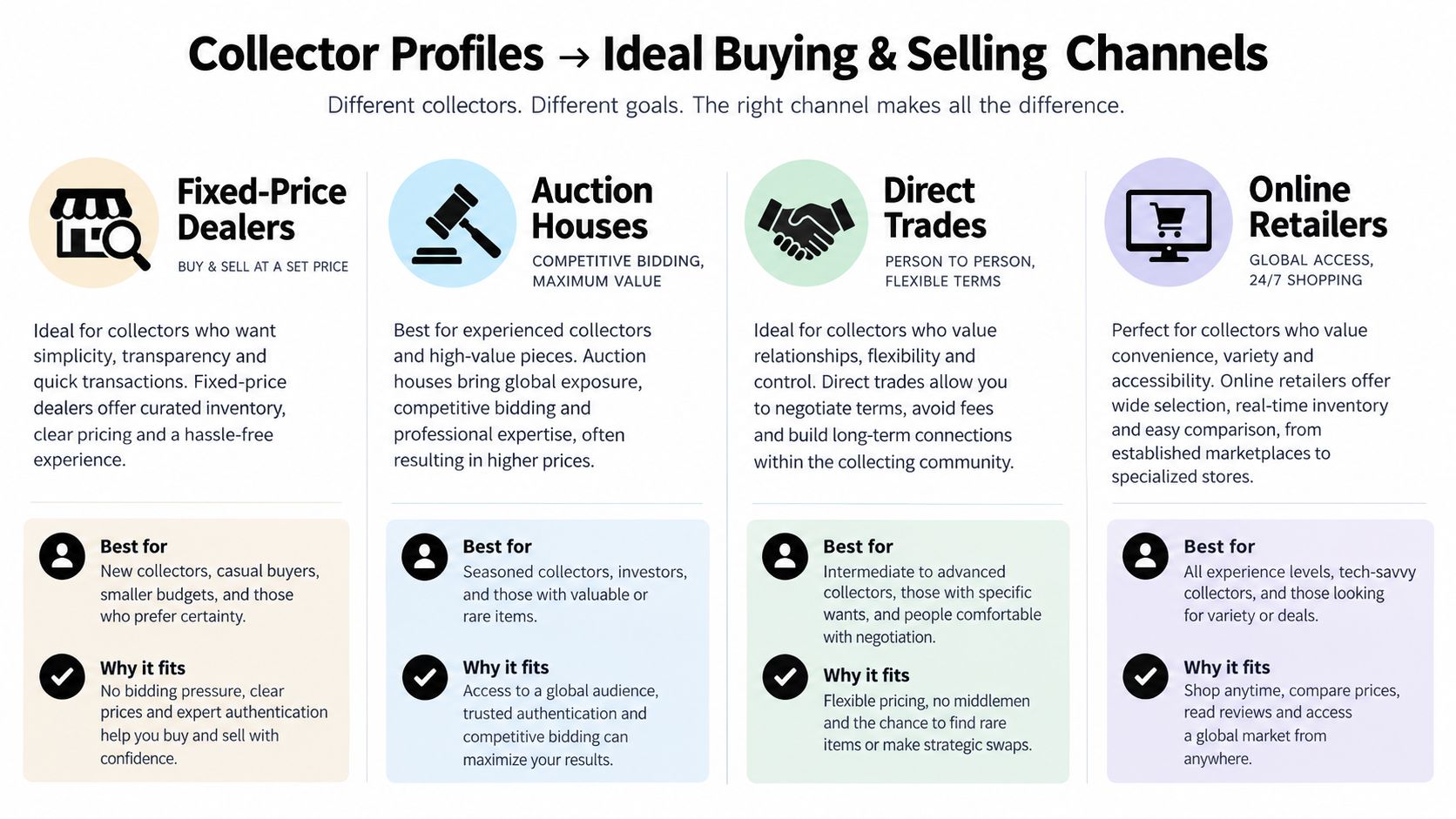
When selling, choose between speed, control and likely reach:
- A specialist dealer: Faster payment and less administration, but the offer reflects the dealer's need to resell profitably.
- A specialist auction house: Wider exposure for unusual material, with fees and a wait before settlement.
- A private listing: More control over presentation and price, but you handle enquiries, payment and delivery.
- A collector-to-collector trade: Useful for targeted exchanges, provided both sides document condition and value.
Keep provenance papers, certificates, purchase records and original packaging. Photograph the coin before dispatch. Cavalier Coins' coins for sale pages illustrate the fixed-price approach, while its online auction activity represents a different route for pieces that suit competitive bidding.
Bulk Sales, Charities and Reseller Workflows
A charity bag or inherited bulk lot shouldn't go straight to a scrap buyer. The first job is triage, because a mixed box can contain spendable modern money, collectible decimal issues, pre-decimal coins, silver and damaged base metal.
Sort before you price
Use separate trays or labelled bags:
- UK spendable coins: Current pieces that can be banked or exchanged through an appropriate route.
- Decimal collectables: Commemorative 50p and £2 pieces, proof sets and unusual varieties.
- Pre-decimal material: Pennies, half-crowns, florins, shillings, sixpences and threepences requiring identification.
- Bullion and precious-metal candidates: Silver-coloured or gold-coloured pieces that need testing before any sale.
- Damaged base metal: Corroded, bent or heavily worn coins with little collector appeal.
Don't melt or sell silver-content coins as ordinary scrap before checking them. A coin's date, denomination, purity, rarity and condition can matter more than its weight. Equally, don't assume every old-looking copper coin deserves individual listing. Time is a cost, and a practical workflow protects it.
Photograph representative items with a scale reference, record dates and denominations, and weigh clearly separated lots. Buyers can estimate more accurately when they know whether a bag contains mixed base metal, sorted pre-decimal pieces or potentially valuable silver. Keep donation records, seller details and payment documentation organised, especially when a charity needs an auditable trail.
Choose the right exit route
A scrap-metal buyer may suit low-value base-metal material after sorting. An online trade portal can suit clean, identifiable groups. A specialist auction house may be appropriate for rare or historically important pieces, while a dealer can provide a quick offer for a collection that needs discreet handling.
Chards, Silbury and heritage auction houses represent different buyer profiles, so send a concise inventory rather than an unlabelled photograph. State whether the coins are cleaned, separated, inherited or previously appraised. A hidden gem is more likely to be found when the recipient can see the relevant dates and denominations without guessing.
For resellers, create repeatable lots. Group items by series, condition and buyer interest, then retain a record of acquisition cost, preparation time, selling fees and postage. That turns a pile of donations into stock that can be evaluated accurately.
Trusted Resources and Your Next Collecting Steps
Reliable coin collecting information should help you verify, not merely excite you. Build a small reference library around the series you frequently handle. UK collectors can consult Spink catalogues, Coin Yearbooks, Royal Mint material and specialist auction records, then compare those references with confirmed realised prices.
Organisations such as the British Numismatic Trade Association and the Royal Numismatic Society can connect collectors with dealers, researchers and events. Regional fairs, including the London Coin Fair and Coinex, provide a useful setting for examining coins in person and learning how specialists describe strike, surfaces and provenance.
Online resources have a place, but use them carefully. eBay sold listings are more useful than unsold asking prices. Heritage Auctions can provide auction context for suitable material, while the Royal Mint remains a relevant destination for current releases. Catalogue images, specialist books and several independent comparisons are safer than trusting a single dramatic listing.
Turn research into a collecting record
Keep a simple spreadsheet with:
- Identification: Country, denomination, monarch, date and mint mark.
- Condition: Your grade estimate and any professional grade.
- Purchase details: Date, seller, price paid and fees.
- Provenance: Previous owner, receipt, certificate or auction reference.
- Storage location: Album page, tray, capsule or slab number.
- Next action: Research variety, upgrade condition or complete the series.
Set a goal that can guide decisions. You might collect one denomination across a monarch's reign, build a date run of Victorian pennies, study hammered Tudor types or follow Royal Mint commemoratives by theme. A narrow goal teaches you faster than buying unrelated pieces because their descriptions sound exciting.
Over the next twelve months, choose one series, buy one coin with a clear description or grade, attend one show or fair, and record every purchase. That process will teach you more than chasing unverified “rare coin” claims, because it connects identification, conservation, valuation and buying judgement in one practical habit.
Cavalier Coins Ltd offers fixed-price coins and banknotes, weekly eBay auctions, bulk purchasing options and a route for charities seeking to monetise donated collections. Visit Cavalier Coins Ltd to explore suitable pieces, discuss larger lots or take the next informed step in your collecting journey.