
You've found a large silver coin marked CROWN 1937, perhaps in a family collection, an online listing, or a dealer's tray. At first glance, it looks straightforward. The date is clear, the George VI portrait is recognisable, and the size gives it an immediate presence. The difficult questions come afterwards: is it an original Royal Mint issue, has it been cleaned, how much wear does it carry, and does its condition justify a premium over an ordinary circulated example?
The 1937 George VI crown rewards careful examination rather than guesswork. Its history is important, but so are its surfaces, edge, strike, toning and measurements. A sound attribution starts with the official specification, then moves to the physical coin in front of you.
Introduction to the 1937 George VI Crown
The 1937 coronation crown was born from an unusually rapid change in Britain's constitutional life. Edward VIII abdicated in December 1936, and his brother became King George VI. The coronation followed on 12 May 1937, creating the need for a new commemorative issue at short notice. The resulting crown recorded the accession of a monarch who had not expected to take the throne, and it carried that historical tension into a substantial piece of British silver coinage.
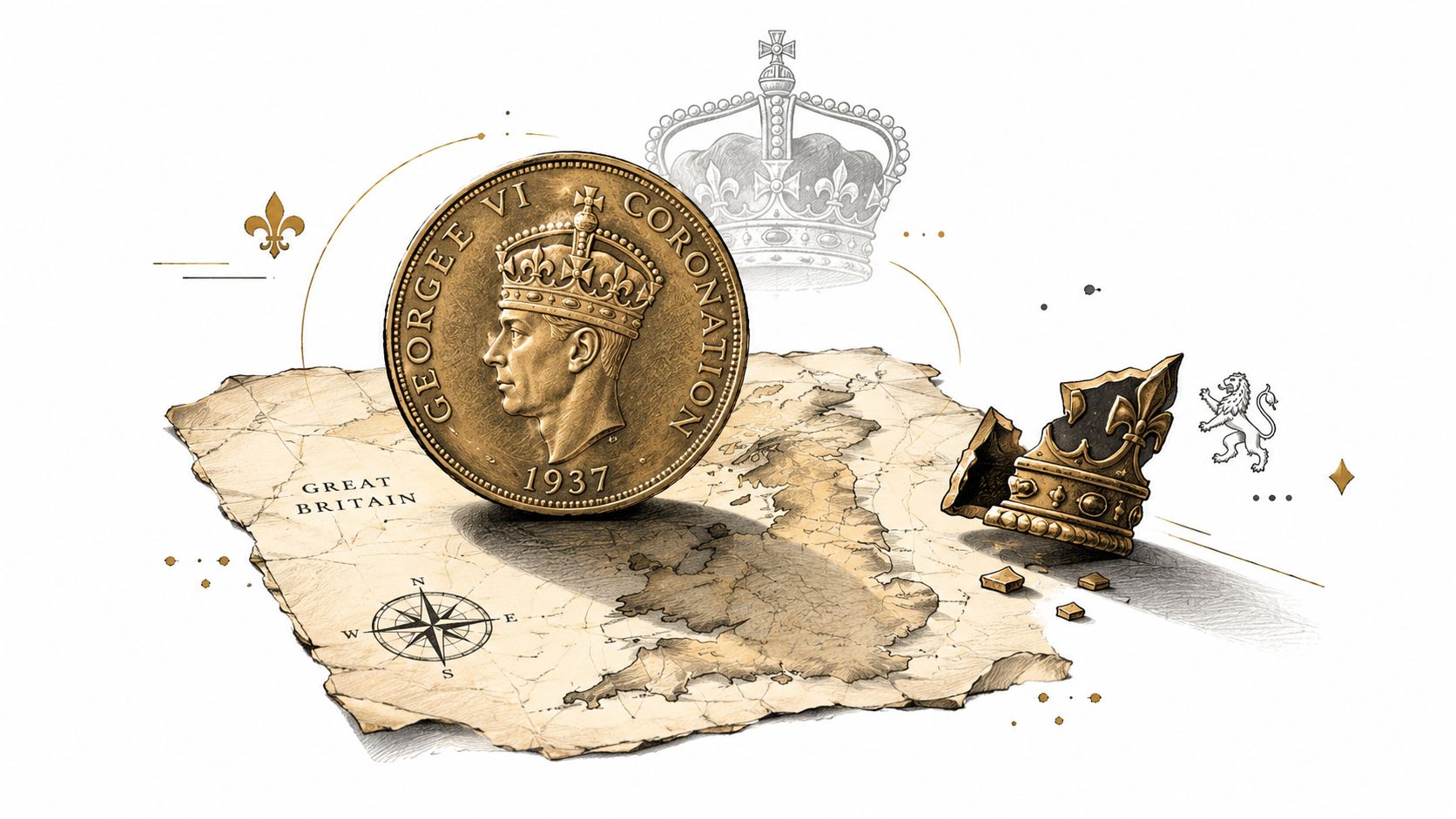
The obverse uses Humphrey Paget's left-facing, bare-headed portrait of George VI. It's a restrained image, without the elaborate headwear or dramatic symbolism found on some earlier British crowns. The reverse, designed by George Kruger Gray, presents a crowned shield with the simple legend CROWN 1937. That combination gives the coin a formal, almost medal-like character while retaining its identity as a Royal Mint crown.
For collectors, the piece sits between two categories. It was a commemorative coin with a clear royal purpose, but it also had an official monetary status. The Royal Mint records the denomination as Crown, while the coin remains remonetised at 25 pence under modern UK currency arrangements, as documented in the Royal Mint's 1937 George VI crown record.
Why the issue still attracts collectors
The crown's appeal isn't based on rarity alone. Collectors value the combination of constitutional history, a substantial silver planchet and a design that is easy to identify across a range of conditions. A worn example can still make an effective starting point for a George VI collection, while a sharply preserved piece gives more experienced buyers an opportunity to study lustre, contact marks and toning.
The practical danger is assuming that age automatically means scarcity. This issue is collectible and historically significant, but buyers still need to distinguish an ordinary circulated specimen from a coin with original surfaces and strong eye appeal. That distinction is where most of the meaningful evaluation begins.
Physical Specifications and Silver Composition
A genuine 1937 crown should first make sense as an object. The coin is large, heavy in the hand and made from .500 silver, meaning the alloy is half silver by fineness. The Royal Mint's published specification gives a weight of 28.00 g and a diameter of 38.61 mm, while specialist references and trade descriptions commonly record a measured weight around 28.28 g. That difference is important when assessing a loose coin, because scales, tolerance, dirt and wear can all affect a reading.
| Attribute | Specification |
|---|---|
| Denomination | Crown |
| Date | 1937 |
| Monarch | George VI |
| Alloy | .500 silver |
| Royal Mint published weight | 28.00 g |
| Common specialist recorded weight | 28.28 g |
| Diameter | 38.61 mm |
| Edge | Reeded |
| Obverse designer | Humphrey Paget |
| Reverse designer | George Kruger Gray |
| Orientation | Medal-aligned |
The 38.61 mm diameter is a useful first check, but it shouldn't be used alone. A counterfeit can copy the diameter reasonably well while failing on weight, edge construction, lettering or surface texture. Measure across the coin with digital calipers, avoiding pressure that could mark a soft or already damaged rim. Weigh it on a precision scale, record the result, and interpret it alongside the coin's visible wear.
The silver alloy also affects preservation. A .500 silver coin generally develops a different surface character from later cupronickel commemoratives. Original pieces may show grey, cream, champagne or darker cabinet toning, with colour concentrated around the rim or protected design areas. Silver can also reveal hairlines and rubbing more readily under angled light, especially across the broad fields.
Reading the design correctly
On the obverse, check the left-facing portrait, the bare head and the relationship between the lettering and rim. On the reverse, confirm the crowned shield and the straightforward CROWN 1937 legend. The reeded edge should be continuous and convincingly struck, not interrupted by a casting seam or irregular file marks.
The coin's physical identity should also be considered alongside the wider silver content of UK coins. That comparison helps prevent a common mistake, treating every old-looking British crown as though it used the same silver standard. The 1937 issue is specifically a .500 silver coin, not a sterling-silver crown.
A basic inspection with calipers, a scale, a ten-power loupe and a single strong light will identify many unsuitable pieces before you spend money on them. It won't replace expert authentication, but it gives you a disciplined starting point.
Historical Context and Official Mintage Figures
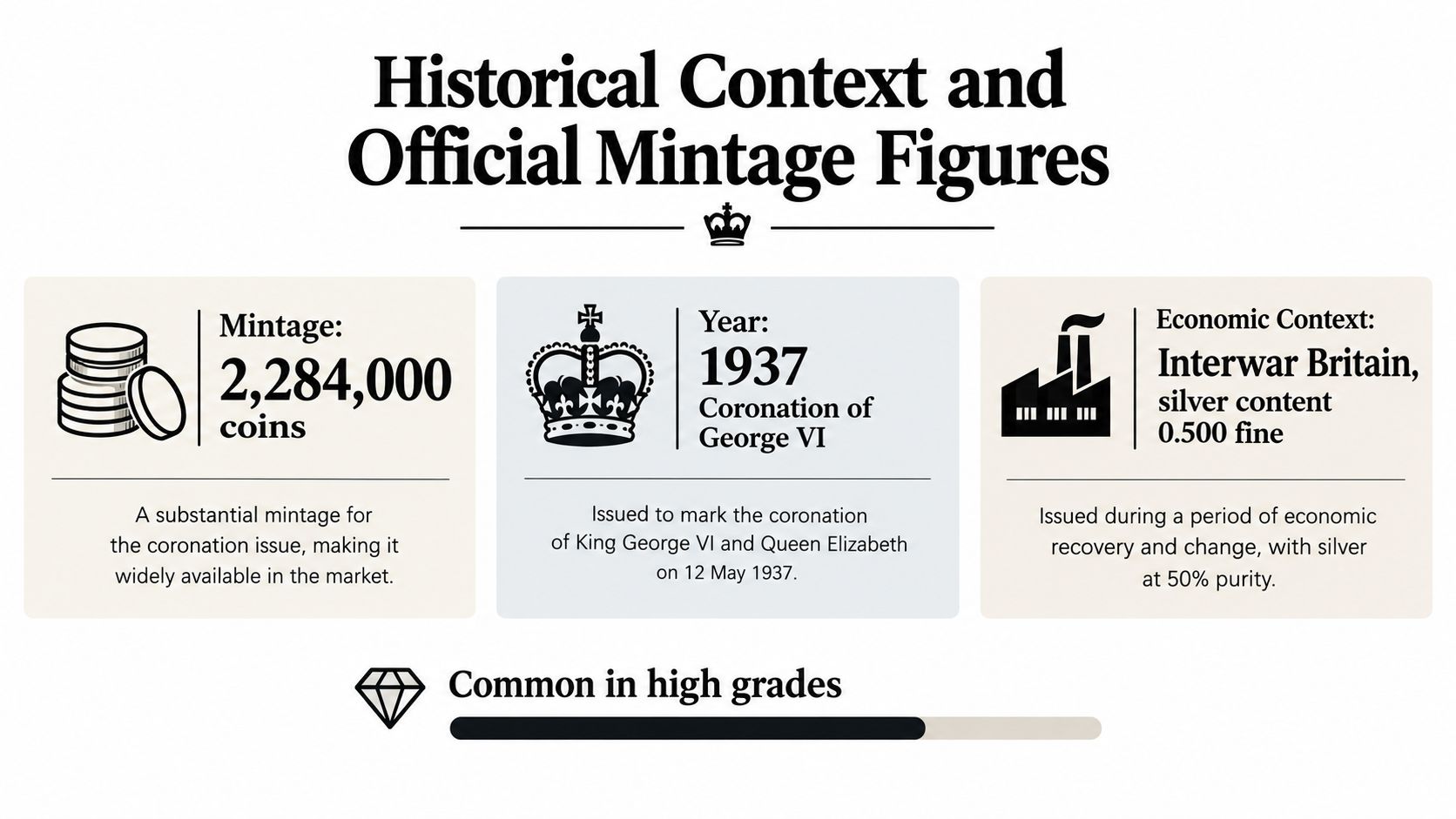
The mintage tells an interesting story, but it needs to be handled with care. One trade reference records 418,600 regular-issue pieces, while another records 418,699. Both figures place the issue in the low 400,000s, and the small difference most likely reflects catalogue treatment, rounding or the way surviving production records have been transcribed. The important conclusion is not the final digit. It's that the 1937 crown wasn't produced in the millions associated with many later commemorative issues.
That production level doesn't make every surviving coin rare. A crown is a large, recognisable object, and many examples were kept because they marked a coronation. Others were handled, stored loose with miscellaneous coins, exposed to damp environments or removed from circulation for their metal value. The original number struck therefore tells you less about the number of attractive, problem-free pieces available today than many buyers expect.
Mintage is not the same as availability
A worn crown can survive quite readily because its principal design elements remain visible after considerable handling. A high-grade coin faces a different survival problem. Broad fields show contact marks, the portrait attracts friction, and silver surfaces can be damaged by polishing or inappropriate storage even when the coin was never heavily circulated.
When examining a potential purchase, separate three questions:
- How many were made? Use the low-400,000 production range as the historical context, not as a guarantee of rarity.
- How many may survive? Treat this as uncertain unless a reliable population study is available.
- How many are attractive? Judge the actual coin for marks, wear, strike, lustre, toning and cleaning.
That framework explains why an issue can be obtainable in circulated grades yet noticeably harder to find with original, even surfaces. The market doesn't price an abstract mintage figure. It prices the quality, originality and presentation of the individual coin.
Practical rule: A lower mintage can support interest, but it never excuses weak authentication or an optimistic grade.
The coin's commemorative role also influenced how owners treated it. Some examples were placed in drawers or cabinets, producing gentle toning and occasional friction on the highest points. Others were polished for display, leaving bright but unnatural surfaces. Those two coins may have similar dates and measurements, yet collectors will usually view them very differently.
Identifying Known Varieties and Die Markers
The first attribution should be conservative. Most pieces offered as a crown coin 1937 are standard examples of the George VI coronation issue. Sellers sometimes describe ordinary die variation, a weak strike or reflective fields as a rare variety. That language shouldn't influence your assessment until the coin has been compared with an established reference or examined by a specialist.
A disciplined magnification routine
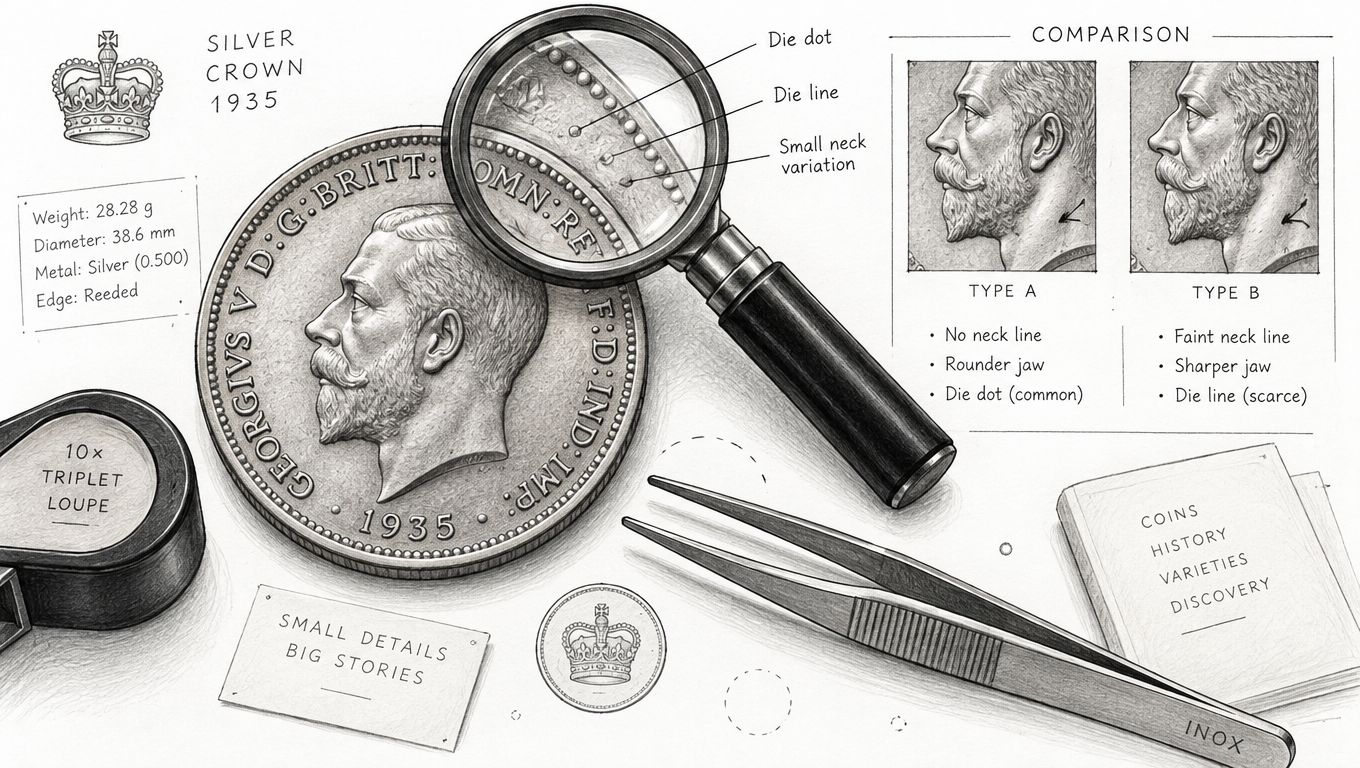
Start with the date and legend. Under magnification, look for shapes that are part of the die design rather than isolated scratches. A genuine die marker should normally have a consistent position and form. A random line that crosses the field, changes direction abruptly or interrupts the surface texture is more likely to be damage.
Next, inspect the portrait. Check the outline of the head, the hair detail and the junction between the relief and the surrounding field. Die deterioration can soften details without creating circulation wear, while a later contact mark usually cuts across the design or leaves a directional indentation. Don't mistake a weakly struck area for a separate variety.
Turn to the crowned shield. Examine the crown, shield outline, lettering and protected recesses. Look for repeated features that can be matched against a trusted photographic reference. A supposed lettering anomaly deserves particularly cautious treatment. It might be a genuine die characteristic, but it might also be a scratch, tooling, lighting effect or an inaccurate online description.
Reflective fields need careful interpretation
Some 1937 crowns show unusually reflective surfaces, especially when protected from circulation. That appearance alone doesn't establish a special striking method. A polished die, fresh original surface, later dipping or harsh cleaning can all create different forms of brightness, and they don't carry the same numismatic meaning.
Use angled light rather than a direct flash. Rotate the coin slowly and observe whether the surface displays coherent cartwheel movement, dead brightness, parallel hairlines or isolated patches. Avoid touching the fields, as fingerprints can complicate the inspection and leave deposits on the silver.
If a seller claims a proof or special issue, ask for the exact catalogue attribution and supporting photographs. Compare the fields, devices, rims and edge with a recognised example. Don't pay a proof premium for a coin that is merely bright, mirrored by cleaning or photographed under aggressive lighting.
What a marker can and cannot prove
A die marker can help confirm identity after a coin has passed the basic specification checks. It can't by itself prove that a coin is valuable, original or problem-free. The safest order is physical verification, design attribution, surface assessment and then variety research.
For an advanced collection, keep photographs of the obverse, reverse and edge of each important piece. Record the weight and diameter with the photographs. This creates a private reference library and makes it easier to recognise recurring die features without relying on memory or sales language.
Grading and Condition Assessment Standards
Large silver crowns are unforgiving to grade. Their fields are broad enough to reveal hairlines that would disappear on a smaller coin, and the high points of the portrait and shield receive attention from both circulation and collectors. A coin can look impressive from arm's length while showing friction, cleaning or contact damage under a single lamp.
Begin by separating wear from strike weakness. Wear usually appears as a smoothness that spreads across the highest relief, with a change in texture and a loss of fine detail. A weak strike leaves some areas soft from the moment of manufacture, while protected fields may still retain original lustre. The distinction matters because an uncirculated coin can have a weak strike, and a sharply struck coin can still be circulated.
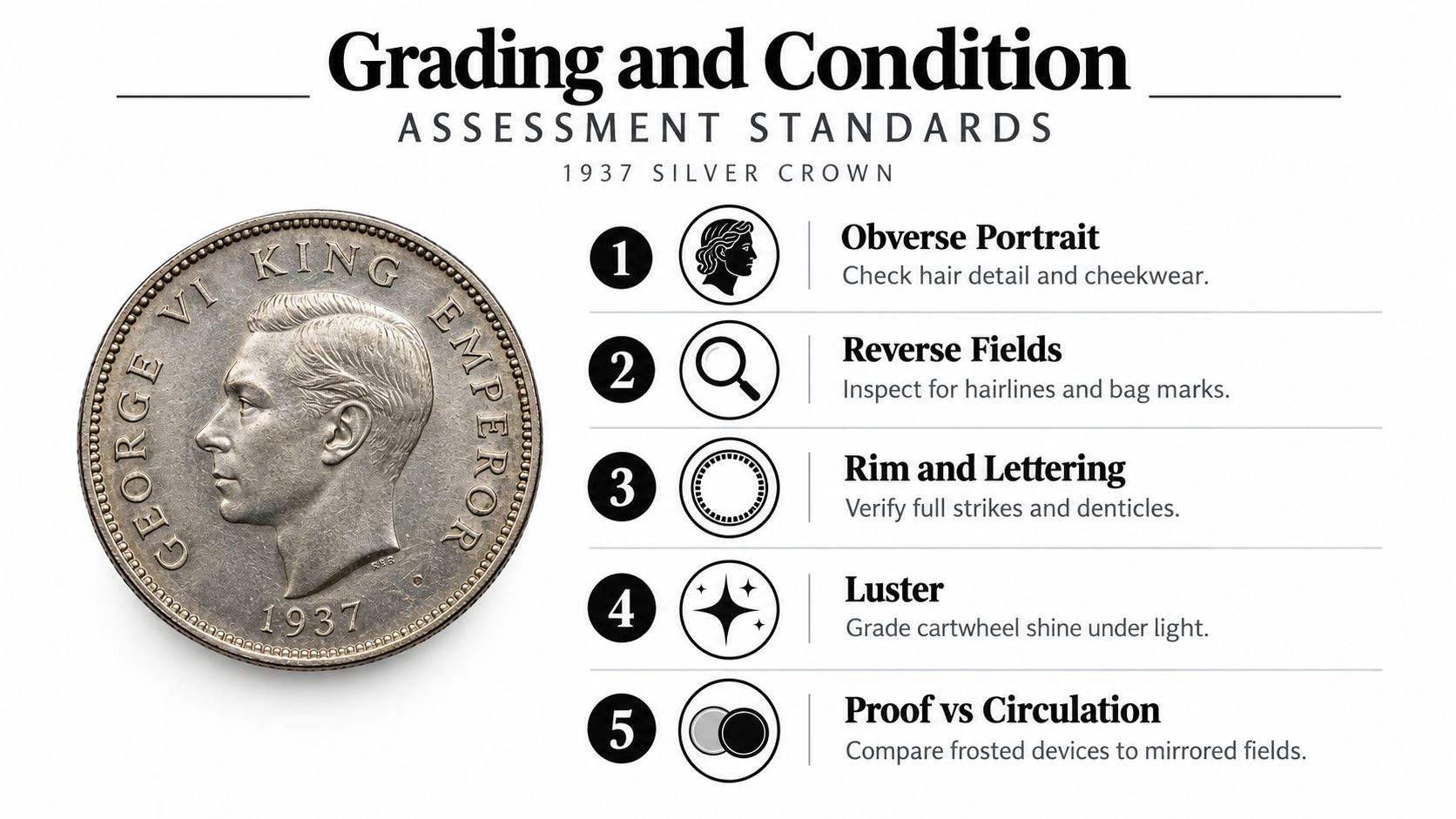
The obverse and reverse checkpoints
On Paget's portrait, examine the ear, hair above the brow and cheekbone. These areas can show the earliest friction, but they must be viewed in relation to the rest of the coin. If only the highest points are slightly dull while the fields retain natural movement, the piece may sit around the About Uncirculated range. If the smoothness spreads into the surrounding hair and facial relief, a lower grade is more appropriate.
On Kruger Gray's reverse, study the raised parts of the crowned shield and the lettering. The broad fields should be checked for contact marks, hairlines and patches of disturbed texture. A single prominent scratch may affect desirability more than several tiny marks, particularly if it runs across the open field.
A practical grade framework
- Extremely Fine: The main design is complete and attractive, with visible wear concentrated on the highest relief. Fine portrait and shield detail remains, but the coin no longer has the freshness of an uncirculated example.
- About Uncirculated: Only slight friction appears on the highest points. Protected areas retain substantial original texture, though cabinet friction or a few handling marks may prevent a Mint State assessment.
- Mint State: There's no evidence of circulation wear. The grade then depends on strike, lustre, contact marks, spots, toning and overall eye appeal. A coin with no wear can still be unattractive or impaired.
The European terms EF and AU describe the same practical condition categories that many collectors discuss alongside Sheldon-style numerical grades. The label is less important than applying it consistently and disclosing problems openly. The grading of coins guide is useful for establishing that broader vocabulary, but a photograph can't always reveal cabinet friction or hairlines accurately.
Cleaning changes the assessment
Original toning can be attractive, neutral or distracting, depending on colour and coverage. Cleaning is different. Rubbing, polishing and aggressive dipping can remove the original surface and leave fine parallel lines, unnatural brightness or dull areas around the devices. A cleaned coin may still be collectible, but it should be described as a problem coin rather than priced like an untouched example.
Market Values Across Different Grades
There isn't a responsible single price for the 1937 crown without seeing the coin. A worn, original example, a bright cleaned piece and a high-grade coin with appealing toning occupy different parts of the market. The same date can attract a modest collector price in circulated condition and a much stronger premium when preservation, originality and eye appeal come together.
That premium curve is steepest near the top. Buyers can find a meaningful difference between a coin with light friction and one retaining full mint-state surfaces, but the jump between two apparently uncirculated pieces may be just as important. Contact marks, weak strike, spots and unattractive toning often determine which coin receives the stronger offer.
What buyers actually pay attention to
A dealer or experienced collector will usually assess the following before discussing price:
- Originality: Has the surface retained its natural texture, or has it been polished or dipped?
- Wear: Are the portrait and shield merely weakly struck, or have they lost detail through handling?
- Surface quality: Are marks scattered and minor, or do hairlines dominate the fields?
- Toning: Does the colour look gradual and stable, or is it patchy, stark and suspicious?
- Presentation: Is the coin housed safely and photographed accurately, with the edge included?
Natural toning can support eye appeal when it is even and compatible with the coin's age. Collectors often respond positively to restrained grey, champagne or peripheral colour. Artificially toned surfaces, sudden colour transitions and residue around lettering tend to reduce confidence. A dipped coin may look bright in a listing photograph, but harsh light can expose the resulting hairlines.
Retail, auction and private-sale differences
Dealer retail prices include stock risk, expertise, overheads and the convenience of buying an assessed coin. Auction prices reflect competition, catalogue quality, buyer confidence and the final buyer's preferences. A private sale may look cheaper, but the purchaser takes on more uncertainty over grade and authenticity.
For a common circulated example, the cost of grading or specialist presentation may not make commercial sense. For an unusually well-preserved piece, a recognised assessment can make the coin easier to compare and sell. The decision should follow the coin's likely market level, not the hope that a holder will transform an ordinary crown into a rare one.
A problem-free, accurately graded coin is easier to sell than a brighter coin with an exaggerated description.
Compare several recent offerings of equally similar quality, not just the highest advertised figure. Ignore listings that omit the edge, use heavily edited images or describe ordinary reflectivity as proof quality. The market rewards confidence backed by evidence.
Authentication and Verification Guidance
Authentication should begin before purchase, especially when an online photograph makes the coin look unusually sharp or unusually cheap. The 1937 crown has a clear identity, so a counterfeit must reproduce its dimensions, alloy, edge, relief and surface behaviour at the same time. That's difficult to do convincingly, but no single home test can establish authenticity on its own.
A practical examination sequence
First, inspect the seller's photographs. Ask for straight, well-lit views of both faces and the reeded edge. Reject images that hide the rim, crop the date or rely on reflections that obscure the fields.
Next, measure the coin. Check the diameter with calipers and weigh it on a precision scale. Use the Royal Mint's published 38.61 mm diameter and 28.00 g official weight as reference points, while remembering that specialist records commonly give a slightly different measured weight for this issue. Wear, dirt and measurement equipment can account for small differences, but a conspicuous mismatch needs an explanation.
Then, study the edge. The reeds should be regular and continuous. A seam, filing, uneven spacing or a soft cast appearance is a serious warning sign. Edge inspection often exposes a counterfeit that looks acceptable face-on.
After that, examine the surfaces. Under angled light, look for porous texture, bubbles, unnatural depressions, tooling around letters and a date that appears disturbed. Tooling may create the impression of sharper detail, but it usually leaves directional marks or a different texture from the surrounding original relief.
Testing silver without harming the coin
A .500 silver alloy has a different density and acoustic response from many base-metal imitations. A specialist can use non-destructive methods, including specific-gravity testing, but home testing must be carried out carefully. Don't scratch the edge, apply chemicals or use an acid test on a potentially valuable coin.
A magnet test can help exclude some magnetic base-metal fakes, but a non-magnetic result doesn't prove silver. Similarly, a ringing sound is only an indication and can be affected by the test method, the coin's condition and nearby surfaces. Treat these checks as screening tools, not certification.
If doubts remain, use a professional service. Coin authentication services can provide a more reliable assessment when measurements, die work and surface originality need to be considered together. Keep the coin in its current state while arranging an evaluation. Cleaning or polishing can destroy the very evidence an expert needs to inspect.
Related Coins and Cross-References
The 1937 crown makes more sense when placed beside the British coins around it. It belongs to the pre-decimal crown tradition, but its .500 silver alloy distinguishes it from earlier sterling-silver issues. The size remains familiar, yet the reduced silver fineness reflects a different period in British monetary history.
The natural comparison is the 1935 George V Rocking Horse crown. That earlier commemorative is widely recognised for its distinctive reverse and strong artistic personality, whereas the 1937 piece uses a crowned shield and a more formal coronation vocabulary. Collectors who place both side by side can see how the Royal Mint moved from one commemorative design language to another within a short period.
Building a George VI group
A focused George VI collection doesn't need to begin with every denomination. The 1937 crown can serve as the large commemorative anchor, supported by the year's halfcrowns, florins and shillings. This approach creates a coherent type set and lets you compare portrait treatment, lettering, rims and strike quality across different denominations.
A practical collecting order is:
- Start with one honest crown: Choose an original example whose condition you understand rather than chasing an uncertain premium piece.
- Add the smaller 1937 denominations: Compare the king's portrait and the year's design conventions across the set.
- Upgrade selectively: Replace the first crown only when the later coin offers a clear improvement in surfaces, grade or eye appeal.
Later Elizabeth II commemorative crowns provide a useful contrast. Many were produced in cupronickel rather than silver, and their modern commemorative role differs from the pre-decimal George VI issue. They can be enjoyable companions in a British crown collection, but they shouldn't be assessed using the same expectations for silver surfaces, cabinet toning or metal value.
The most useful cross-reference is always physical comparison. Put the 1937 crown beside another British crown, check the diameter, examine the edge and observe how silver and base metal react to light. That exercise develops a better eye than relying on a headline valuation or a seller's grade.
Cavalier Coins Ltd offers fixed-price coins and banknotes, weekly eBay auctions, bulk purchasing options and valuation guidance for collectors examining unusual UK pieces such as the 1937 George VI crown. Visit Cavalier Coins Ltd to browse current stock or discuss a collection that needs identification, valuation or a practical route to sale.