
Before the UK rolled out its high-tech 12-sided replacement, an astonishing number of fakes were floating around in our change. At its peak, it's estimated that a whopping 1 in every 30 of the old round pound coins was a counterfeit. This incredible statistic isn't just a footnote; it’s a key chapter in our currency's story and makes spotting forgeries a fascinating skill for any collector.
The Counterfeit Crisis That Changed UK Coinage
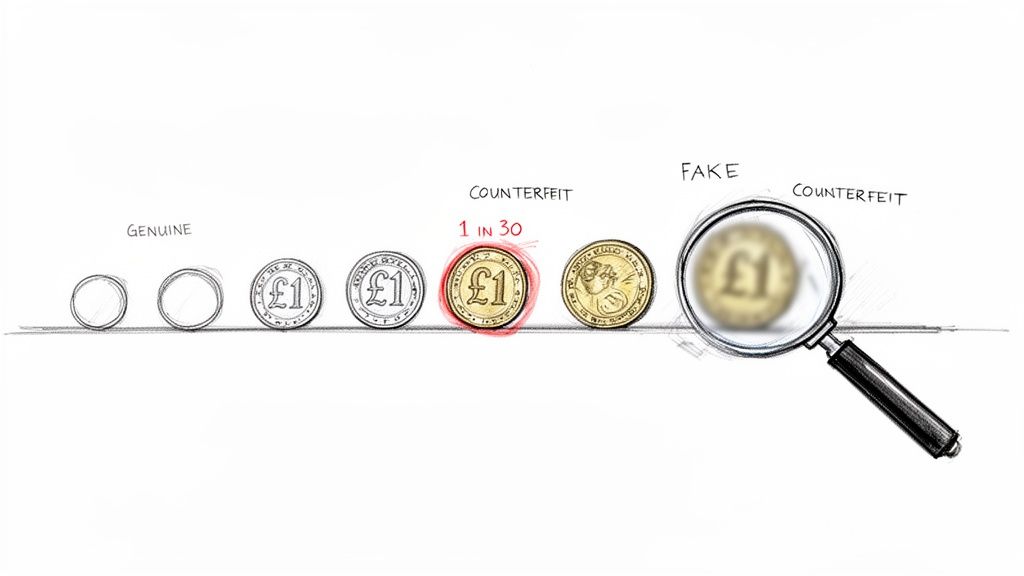
The tale of the fake £1 coin isn't just about crime. It's about a workhorse coin that became a victim of its own long-running success. When the round pound first appeared in 1983, it was a solid, reliable piece of currency. But after three decades, its security features were simply no match for modern counterfeiters.
This vulnerability swung the door wide open for forgers. By the 2010s, the problem had snowballed into a major national issue, shaking public confidence in the UK's money. The sheer number of fakes circulating was becoming impossible to ignore.
Understanding the Scale of the Problem
Official surveys from The Royal Mint painted a pretty grim picture. At its worst, the number of fake £1 coins in circulation was thought to be over 45 million. This wasn’t a small-time problem; it was a widespread crisis impacting shop tills, vending machines, and piggy banks across the country.
The quality of these fakes was all over the place, from comically bad copies to sophisticated forgeries that could easily trick most people. This flood of counterfeits was the final straw that forced the government to act.
The immense scale of the counterfeit problem was the main reason for the complete redesign of the pound coin. The UK Treasury and The Royal Mint knew that a small update wouldn't cut it. A brand new, highly secure coin was the only way to restore faith in our currency.
Why the Round Pound Was So Easy to Copy
The original round pound had a few weaknesses that, over time, made it a prime target for criminals. If you're a collector trying to spot fakes from this era, knowing these vulnerabilities is a huge advantage.
- Simple Construction: The coin was made from a single nickel-brass alloy. This one-metal design was far simpler and cheaper to copy compared to the bi-metallic coins we see today.
- Worn Details: After years of being passed from hand to hand, the fine details on genuine coins naturally wore down. This made it much tougher to tell the difference between a well-used official coin and a poorly made fake with blurry features.
- Inconsistent Edge Lettering: The writing on the edge was meant to be a key security feature, but forgers soon figured out how to mimic it. Plus, most people didn't know what the inscription was supposed to look like, so many fakes went completely unnoticed.
This whole counterfeit crisis was more than just a financial problem; it was a fascinating game of cat and mouse between The Royal Mint and an army of unknown forgers. For collectors today, this history adds a real layer of intrigue. If you want to see how this fits into the bigger picture, you can explore the brief history of British coins.
For any collector, identifying a fake round pound is like uncovering a small piece of this hidden history. It turns a simple bit of metal into a story of deception and innovation. Each counterfeit has its own unique tale to tell, separate from the official records of The Royal Mint, making it a truly interesting artefact.
Your Simple Toolkit for Coin Authentication
You don't need a high-tech lab to start spotting fake £1 coins. In fact, some of the most reliable methods boil down to using a few simple, affordable tools that can expose a counterfeit in seconds. Putting together a basic authentication kit is one of the smartest moves any collector can make.
It takes the guesswork out of the equation. With just a handful of items, you can run through a series of checks and build your confidence in spotting a dud, whether it’s an old round pound or the modern 12-sided version.
The Essential Gear for Every Collector
Getting started is easier and cheaper than you might imagine. You can find most of these tools online or in hobby shops for a small outlay, yet the information they give you about a coin's authenticity is immense.
Your core kit should include:
- A Digital Scale (Accurate to 0.01g): This is your single most powerful tool. Genuine coins are struck to incredibly precise weight specifications. A scale that measures to two decimal places will instantly flag a coin that's too heavy or too light—a classic calling card of a fake.
- Digital Calipers: Forgers often get the dimensions slightly wrong. Calipers let you measure the diameter and thickness with precision, which you can then check against the official Royal Mint specifications.
- A Small Magnet: This is your quickest first-line defence. Genuine round pounds are made from a non-magnetic nickel-brass alloy, so if one sticks, it’s a fake. The 12-sided coin is a bit more nuanced: the outer gold-coloured ring should be non-magnetic, but the inner silver-coloured disc should be magnetic.
- A Magnifying Glass or Jeweller's Loupe: The devil really is in the detail. A good magnifier helps you scrutinise the finer points of the design, the quality of the strike, and the edge lettering for the subtle imperfections that are invisible to the naked eye.
The Power of a Control Coin
Beyond your physical tools, one of your most crucial assets is a 'control coin'. This is simply a coin from the same year and of the same design that you know for certain is genuine. Having a real one on hand for a direct side-by-side comparison is invaluable.
You can compare the colour, the lustre, the sharpness of the Queen’s portrait, and even the sound it makes when dropped. This direct comparison often makes the subtle oddities of a fake £1 coin jump right out at you. When in doubt, a known-good example is your best friend.
A control coin acts as your benchmark for authenticity. It allows you to feel the correct weight, see the proper finish, and hear the right 'ring,' turning abstract specifications into tangible, real-world checks that are hard to fool.
Mastering these simple tools is a fundamental skill for any serious collector. For those looking to go deeper, understanding the proven methods for detecting counterfeit coins will give you even more techniques to protect your collection. This hands-on approach demystifies the whole process, making you a much more skilled and confident numismatist.
How To Spot a Fake Round Pound Coin
Even though the old round pound coin was officially taken out of circulation back in 2017, it's far from forgotten, especially among collectors. For us, these coins represent a really interesting challenge. The sheer number of fakes that flooded the country during their time makes knowing how to spot a genuine one an essential skill.
Just how bad was the problem? It was huge. By 2014, official surveys from The Royal Mint revealed a staggering 3.04% of all £1 coins in circulation were counterfeit. That was up from 2.74% the year before. With about 1,553 million genuine coins out there at the time, that meant over 47 million fakes were rattling around in pockets, purses, and vending machines across the UK. You can read up on just how widespread this issue became and the impact it had on the nation's currency.
This guide isn't about theory; it’s about practical, hands-on checks you can do to confidently tell a real round pound from a dud.
To make things easier, I've put together a simple decision tree. Think of it as a quick-start guide to see if a coin is worth a closer look.
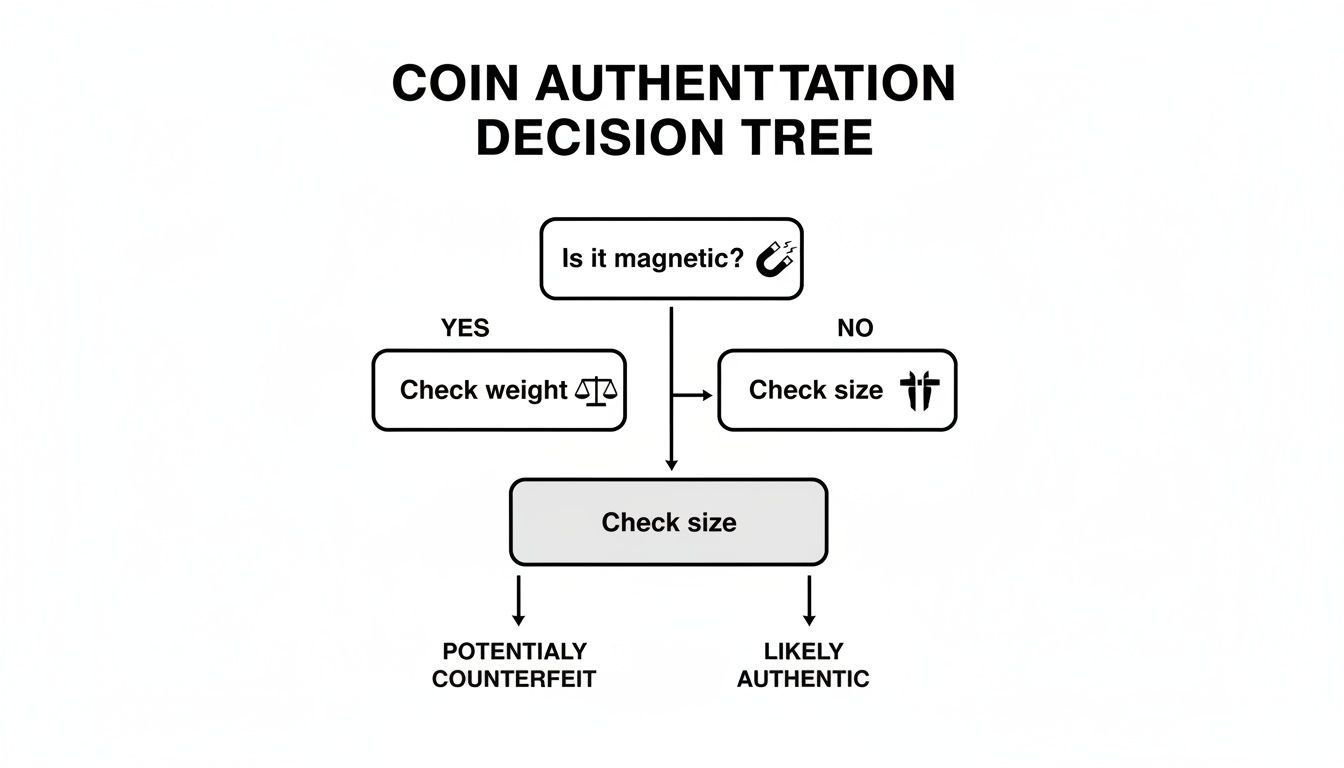
As you can see, your first few tests using basic tools like a magnet, scales, and callipers can weed out a surprising number of the more common forgeries right away.
Scrutinising the Queen’s Portrait
The first place I always look for trouble is the obverse—specifically, the portrait of Queen Elizabeth II. The Royal Mint strikes its coins with immense pressure, which creates incredibly sharp, well-defined details that are tough to replicate.
Counterfeiters, on the other hand, often rely on casting or use lower-quality dies. This almost always results in a portrait that looks soft, blurry, or what collectors often call "soapy." Grab a magnifying glass and pay close attention to the hair, the eyes, and the intricate details of the crown. A genuine coin will have crisp, clear lines, while a fake will often look slightly flattened or indistinct.
If the portrait seems to just melt into the coin's surface without any real definition, that’s a massive red flag.
The Critical Edge Inscription Check
The edge of a round pound is one of its most important security features and, luckily for us, a place where forgers frequently mess up. Most round pounds have an incuse (indented) inscription, like the classic "DECUS ET TUTAMEN" ("An ornament and a safeguard").
When you're examining the edge, keep an eye out for these common mistakes:
- Wrong Font or Bad Spacing: Forgers often get the font style wrong, and the spacing between letters can be all over the place. The letters might look too chunky, too thin, or just crude compared to a real one.
- Incorrect Inscription: Believe it or not, some fakes have a completely different phrase or even a design from another year's coin. A dead giveaway.
- Poor Quality: The lettering might be faint, filled in with metal, or have a rough, almost sandy texture from a poor casting process instead of a clean, stamped appearance.
A genuine edge inscription should always be crisp, evenly spaced, and look professionally struck. Any sloppiness in the font, spacing, or overall quality is a very strong sign you’re holding one of the many fake £1 coins from that era.
Performing the Die Axis Alignment Test
This is a simple but surprisingly effective test to see if the obverse (heads) and reverse (tails) are aligned correctly. The Royal Mint is incredibly consistent with its die axis alignment.
Here's how to do it: hold the coin between your thumb and forefinger with the Queen's portrait facing you and sitting upright. Now, simply flip the coin over 180 degrees on its vertical axis, like you're turning the page of a book. The design on the other side should also be perfectly upright.
If the reverse design is upside down or sitting at a wonky angle, the coin has a rotated die. While tiny rotations can sometimes happen on genuine coins (and can even be collectible errors!), a significant misalignment is a classic hallmark of a counterfeit.
Verifying Weight and Dimensions
This is where your digital scales and callipers really earn their keep. The official specifications for a coin are non-negotiable, and forgers using cheaper metals almost never get them right.
Before we get to the numbers, here's a quick reference table I've put together. It breaks down what you should be looking for versus the common flaws found on fakes.
Genuine vs Common Fake Round £1 Coin Characteristics
| Feature | Genuine Round £1 Coin | Common Counterfeit Signs |
|---|---|---|
| Portrait Detail | Crisp, sharp, well-defined features (hair, crown, eye) | Soft, blurry, "soapy" appearance; indistinct or flattened details |
| Edge Inscription | Clear, even font and spacing; professionally struck | Incorrect font, uneven spacing, faint or filled-in letters, rough texture |
| Die Axis Alignment | Obverse and reverse are perfectly aligned (180°) | Reverse is upside down or at an angle when flipped vertically |
| Metal Lustre | Consistent, uniform golden sheen | Often dull, discoloured, or has an unusual brassy/coppery tone |
| Overall Quality | High-quality strike, clean surfaces | Pitting, casting bubbles, off-centre strike, or a generally crude finish |
These visual cues, combined with physical measurements, give you a powerful toolkit for authentication.
Now, for the hard numbers. A genuine nickel-brass round £1 coin must meet these precise specifications:
- Weight: 9.50g
- Diameter: 22.50mm
- Thickness: 3.15mm
Pop the suspect coin onto your digital scales. If the reading is way off, that's a problem. A tiny variation (say, 9.48g or 9.52g) could just be down to circulation wear, but anything more is highly suspicious. Counterfeits are very often lighter, sometimes weighing as little as 8.8g, or even heavier if they've been made from cheap, lead-based alloys.
Next, get your callipers out and measure the diameter and thickness. Forgeries are frequently a bit too small, too large, or noticeably chunkier or thinner than a genuine coin. Any major discrepancy in these physical stats is compelling evidence of a fake. These tools take all the guesswork out of it and give you cold, hard data to back up your assessment.
Spotting Fakes in the Modern 12-Sided Coin
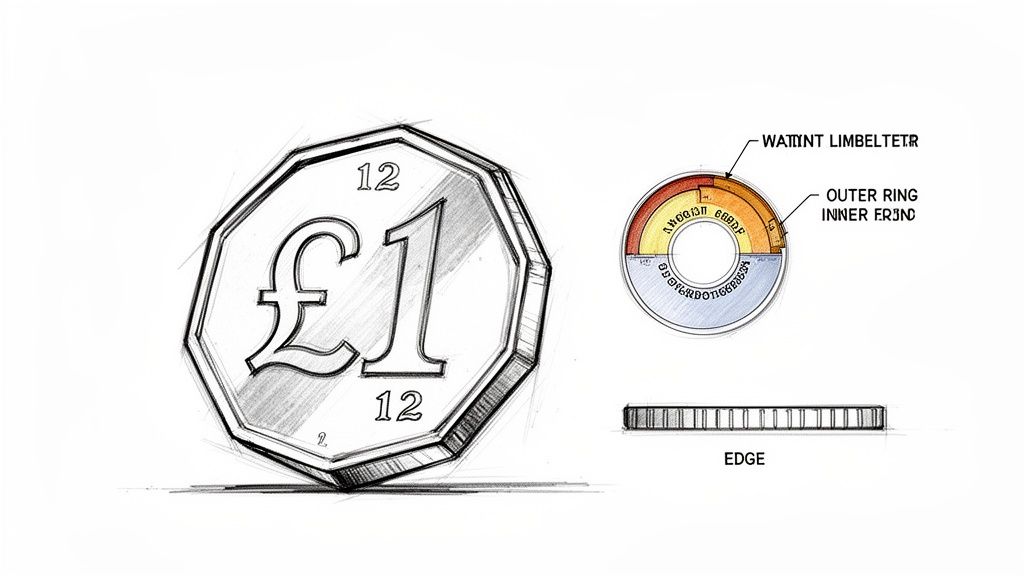
When The Royal Mint launched the 12-sided pound coin back in 2017, it was a direct shot at the counterfeiters who had a field day with the old round pound. It was even dubbed the most secure coin in the world, packed with features designed from scratch to make it a forger's nightmare.
But let's be realistic—determined forgers are nothing if not persistent. While modern fakes are far less common and generally much cruder than their round predecessors, they absolutely exist. Knowing the high-tech security features of the genuine article is your best defence in keeping your collection authentic.
This redesign wasn't just a facelift; it was a revolution in coin security. This 12-sided, bimetallic marvel was released on 28 March 2017, and by 15 October that same year, the old round pounds were officially obsolete. The threat was real; even with surveys showing the fake rate dropping to 2.55% in 2015, HM Treasury knew it was time for decisive action. If you're interested, you can discover more insights about the history of the pound coin and its security evolution.
The Ingenious Latent Image Feature
One of the most clever and telling security tricks is the latent image. It’s that small, hologram-like square just below the Queen's portrait, and it's often the quickest way to spot a dud.
Hold the coin up and tilt it in the light. As you rock it back and forth, the image should switch cleanly between a pound symbol (£) and the number '1'. Forgers really struggle to replicate this. On a fake, you’ll likely see a blurry mess that doesn't change, or perhaps both symbols will be vaguely visible at the same time. What you're looking for is a crisp, undeniable switch—that's the mark of a genuine coin.
Inspecting the Bimetallic Construction
The 12-sided coin is bimetallic, which simply means it’s constructed from two different metal alloys. You have the gold-coloured outer ring made of nickel-brass, and the silver-coloured inner disc, which is a nickel-plated alloy.
On a genuine coin, the join between these two metals is flawless. If you run your fingertip across it, it should feel perfectly smooth, with no raised edge or gap. This is where many counterfeiters slip up, leaving some obvious clues:
- Noticeable Gaps: You might spot a thin dark line or even a physical space between the inner and outer sections.
- Colour Bleeding: The colours can look 'off'. The silver or gold might seem to bleed into the other part, a sign of cheap plating.
- Uneven Finish: If the join feels rough or raised in certain spots, it's a clear red flag for a poor-quality fake.
The magnet test is a great double-check here. The outer gold-coloured ring is non-magnetic, but the inner silver-coloured disc is magnetic. If a magnet sticks to the whole coin, or to none of it, you can be almost certain you're holding a forgery.
Micro-Lettering and Edge Detail
The sheer level of fine detail on a real 12-sided coin is another hurdle for fakers. Grab a magnifying glass and take a closer look at the engraving.
Tucked away just inside the rim, you'll find incredibly small micro-lettering on both sides of the coin. On the obverse (heads), you should be able to read 'ONE POUND' around the lower edge of the inner disc. On the reverse, the year of minting is inscribed in the same fashion. This lettering needs to be tiny but perfectly sharp. Fakes often have lettering that is blurry, filled in, or simply not there at all.
Finally, have a good look at the edge. It isn't just milled or smooth; it alternates between the two. A genuine coin has six milled sections separated by six smooth sections. This is a complex pattern to get right. On a fake, the milling might be poorly defined and uneven, or the switch between the smooth and milled parts might be clumsy. A real coin's edge feels precise and crisp.
You Found a Fake Coin—What Happens Now?
Discovering you're holding one of the many fake £1 coins out there can be a surprisingly exciting moment for a collector. It feels like you've found a small, illicit piece of history. But once that initial thrill wears off, the practical question kicks in: what are you actually supposed to do with it?
First, let's get the legal bit out of the way. In the UK, the situation is pretty straightforward. Simply possessing a counterfeit coin isn’t a crime. In fact, many collectors and numismatists actively seek out well-made forgeries for study or as historical curiosities. The law only steps in if you try to spend it or pass it off as genuine.
Under the Forgery and Counterfeiting Act 1981, it is a criminal offence to knowingly pass, or attempt to pass, a counterfeit coin as genuine. The key word here is "knowingly." Accidentally spending a fake you got in your change is one thing; intentionally using a counterfeit you know is fake is another matter entirely.
This legal distinction gives you three clear, responsible options. What you do next really depends on whether you see the coin as a piece of criminal evidence or a unique collector's item.
Reporting the Counterfeit to the Police
The official and most civic-minded route is to hand the counterfeit coin over to the police. This is the action recommended by both The Royal Mint and the Bank of England. When you do this, you’re helping remove illegal currency from circulation and giving authorities data that helps them understand the scale of the problem.
If you choose this path, you'll need to take the coin to your local police station. Expect to fill out a short form detailing where and when you think you received it. Just be prepared for a couple of key outcomes:
- You will not be compensated. Handing in a fake coin means you are accepting the loss of its face value.
- You will not get the coin back. It becomes evidence and will eventually be destroyed.
This is the right choice if your primary concern is upholding the law and protecting others. For a collector, though, it means giving up what could be a very interesting artefact.
Keeping the Fake Coin as a Curiosity
For many of us, a counterfeit is more than just a dud—it's a story. A well-made fake round pound, for example, is a tangible link to a significant period in British currency history. If you decide to keep it for your collection, you are perfectly within your rights to do so, as long as you manage it responsibly.
The golden rule is to prevent it from ever re-entering circulation. You must clearly separate it from your genuine coins. I always recommend storing fakes in their own clearly labelled coin flip or a small bag. Get a permanent marker and write "COUNTERFEIT" or "COPY" directly on the holder. This simple step prevents any accidental mix-ups, especially if your collection is ever passed on to someone less familiar with it.
Keeping fake £1 coins allows you to use them as invaluable reference pieces. They’re excellent hands-on tools for teaching yourself and others how to spot forgeries, sharpening your authentication skills for the future. And for those curious about the value of other unusual coins you might find, our guide on where you can get coins valued can offer some useful pointers.
Safe and Responsible Disposal
What if you don't want to go to the police but also don’t want to keep the fake? You'll need to dispose of it responsibly. Just chucking it in the bin is a bad idea, as it could easily be found and put back into circulation.
The best method is to make sure the coin is permanently disabled. You can do this by damaging it in a way that makes it obviously unusable as currency. This could mean scratching it deeply, bending it with pliers, or otherwise defacing it so no one could mistake it for a real pound. Once it’s clearly destroyed, it can be disposed of with your household metal recycling. This ensures the fake is out of the system for good, without you having to formally report it.
Your Top Questions About Fake Pound Coins, Answered
Even after running through all the tests, you might still have a few lingering questions. It’s completely normal. Spotting fakes is a skill, and like any skill, it gets sharper with practice and knowledge.
Let’s tackle some of the most common queries that pop up.
Is It Illegal to Own Fake 1 Pound Coins in the UK?
This is a big one, and thankfully, the answer is good news for collectors. No, it is not illegal to simply own a counterfeit coin for your own private collection or for study. Many numismatists actively seek out forgeries because they tell a fascinating side-story about our currency.
The line is crossed when you knowingly try to spend it. That’s the offence. If you come across a fake, the right thing to do is either surrender it to the police or keep it for your collection—just be sure to label it clearly and store it away from your genuine coins to avoid any accidents.
Are Old Round Pound Coins Still Worth Anything?
Absolutely. They may have been demonetised back in 2017, but the old round pounds are far from worthless. For a start, you can still deposit them at most UK high street banks and Post Offices, so they hold their face value in that sense.
But for collectors, some are worth a lot more. Certain designs, especially those with low mintage figures from series like the floral emblems or city capitals, can command a decent premium over £1. This is particularly true if they're in brilliant, uncirculated condition. Always check the design and date before writing one off.
How Accurate Do My Scales Need to Be for Coin Weighing?
When it comes to weighing coins, precision is everything. Forgers often slip up on the weight, so it's a key tell. You'll need a digital scale that’s accurate to at least two decimal places (0.01g).
A genuine round £1 coin weighs a very specific 9.50g, and the newer 12-sided coin clocks in at 8.75g. A basic kitchen scale that only shows one decimal place might round up or down, completely hiding the tiny discrepancy that gives a fake away. A good jeweller’s scale is a small investment for some serious peace of mind.
Most counterfeits are made from cheaper metals like lead or steel alloys, and they’ll almost always be off the mark, even if just by a fraction of a gram.
Can a Magnet Really Help Identify a Fake Coin?
You bet. A simple magnet is one of the quickest and most effective tools you can have. But its real value comes from knowing how it should react with each type of pound coin.
- The Round Pound: A genuine round £1 is made from a nickel-brass alloy, which is completely non-magnetic. If your coin snaps to a magnet, it’s a fake—no question. It’s likely made of a cheap, steel-based core that’s been plated.
- The 12-Sided Pound: This one is a bit more clever. It’s bimetallic. The outer, gold-coloured ring should be non-magnetic, but the inner, silver-coloured disc is magnetic.
A word of caution, though. Just because a round pound isn't magnetic doesn't mean it's real; it could be a lead or pewter copy. That's why the magnet test should never be your only check. Always back it up with a weigh-in, a close visual inspection, and the other tests we've covered. It's this multi-layered approach that separates a casual finder from a confident collector.
At Cavalier Coins Ltd, we are passionate about helping both new and experienced collectors build their collections with confidence. From rare historical pieces to modern commemorative issues, we offer a vast selection of authenticated coins and banknotes. Explore our collection and find your next treasure today. Visit us at https://www.cavaliercoins.com.