
Most worn common farthings are worth only pence, while mint-state red examples typically bring about £15 to £100. Rare proofs and patterns can reach £500 to £30,000 or more, depending on the issue.
You may have found yours in a drawer, an inherited tin, or the bottom of an old collection box. It's small, dark, and perhaps difficult to read, so the natural question is whether you're holding a piece of history or little more than an old copper coin.
The answer depends on far more than age. A common, heavily circulated farthing may have modest value, while a well-preserved proof, scarce variety, or historically important pattern can belong to a very different market. Even two coins bearing the same date can sell for dramatically different amounts if one is a normal circulation strike and the other is a proof or specimen.
This guide will help you work through the process calmly. You'll learn what the farthing was, why its legal-tender history matters, how collectors judge condition, and why retail guide prices can diverge sharply from realised auction results. By the end, you should know what to photograph, what details to check, and when a specialist opinion makes sense.
Introduction What Your Farthing Might Really Be Worth
You find a farthing in an inherited tin. The date is partly worn away, the coin is dark, and its small size makes it difficult to judge. The sensible question is whether it is an old copper coin or an example collectors may value more highly.
Its spending value was one quarter of a penny, but that does not set its modern collecting price. Buyers pay attention to scarcity, preservation, design, historical context, and whether the piece is a normal circulation coin, a proof, or a pattern.
A common date with heavy wear usually occupies the lower end of the market. Scratched surfaces, weak lettering, and brown toning can indicate long circulation. Such a coin still records everyday history, yet its condition normally limits collector demand.
Condition can change the result dramatically. UK pricing guidance places mint-state red bronze farthings at about £15 to £100, while key Victorian proofs may bring £500 to £3,000. It lists a 1714 Queen Anne farthing at £500 to £15,000 and a known 1937 Edward VIII pattern farthing at £30,000 or more. The figures appear in UK farthing value guidance, but they should be read as guide ranges rather than guaranteed selling prices.
Why the same date can have different prices
The date identifies the coin but does not determine its price. A standard circulation strike and a proof from the same year can share the same date while differing in surface quality, purpose, survival rate, and likely buyers. A pattern may enter an even narrower market because it was made to test or propose a design rather than for ordinary use.
This creates two separate markets for one date. Retail guides may show an optimistic range for a rare proof or pattern, based on its appeal and specialist interest. Realised auction prices reflect the specific coin offered, including its grade, colour, originality, attribution, and the bidders present that day. Comparing a retail figure for a presentation piece with a worn circulation example is like comparing a display model with a used everyday tool.
Practical rule: Identify the coin first, grade it honestly second, and only then compare prices.
Leave the farthing uncleaned while investigating. Cleaning may add scratches or an unnatural surface, reducing collector interest. Start with the date, monarch, colour, and visible wear. Then check whether it appears to be an ordinary circulation piece or a proof, specimen, or pattern made for presentation.
History of the Farthing and Why It Matters for Value
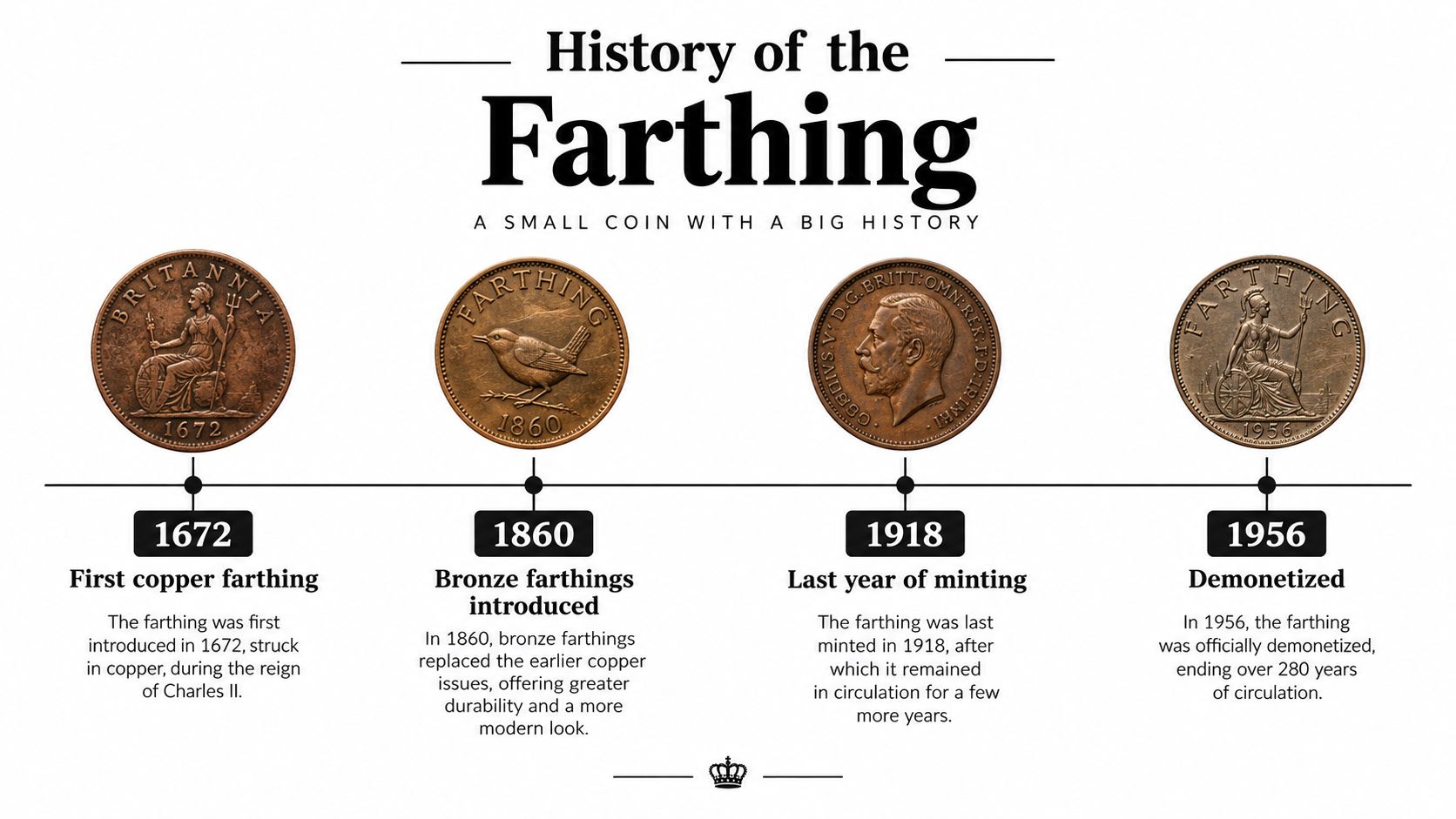
The farthing was the smallest regularly used UK coin in the pre-decimal currency system. It was worth one quarter of a penny, equal to 1/960 of a pound sterling, according to the historical summary of the British farthing).
That small denomination had practical value in everyday life, but its purchasing power changed over time. The same historical reference gives a range of roughly 12p to 0.2p in 2017 terms for the period from 1860 to 1971, illustrating how inflation altered what a farthing could buy. A UK collecting guide gives another useful comparison, stating that around 1900 a farthing bought roughly what 17p buys today. These comparisons don't turn into a modern selling price, but they explain why the coin mattered to earlier generations.
The important dates
The farthing's history contains several boundaries that collectors need to keep separate:
- Pre-decimal denomination: The coin formed part of Britain's old currency system, alongside denominations such as pennies and halfpennies.
- Last circulation strike: One UK reference states that the farthing was last struck for circulation in 1956, by which point its spending power had become negligible.
- Withdrawal from legal tender: The farthing was withdrawn on 1 January 1961, ending its status as spendable money.
- Decimalisation: British currency did not become decimal until 1971, a full decade after the farthing stopped being legal tender.
That gap matters because a farthing's collector life began before decimalisation. The coin didn't suddenly become collectible when Britain changed to decimal money. Its circulation value ended in 1961, creating a clear dividing line between its role as currency and its later role as a numismatic object.
Why history affects valuation
Collectors care about the monarch, metal, design changes, production purpose, and survival. Earlier copper issues may appeal because of their age and historical setting, while later bronze farthings can be more accessible but still valuable in exceptional colour and condition.
The farthing also sits within the wider story of British coinage. If you're building background knowledge, Cavalier Coins' brief history of British coins provides useful context for how denominations and designs changed over time.
Age helps create interest, but age alone doesn't guarantee a high price. A well-preserved scarce issue can outperform an older coin that survives in poor condition.
How Farthing Value Is Determined
A useful way to think about valuation is to compare it with valuing a house. The address matters, but so do the building's condition, its special features, and the number of buyers who want it. A farthing works in much the same way.
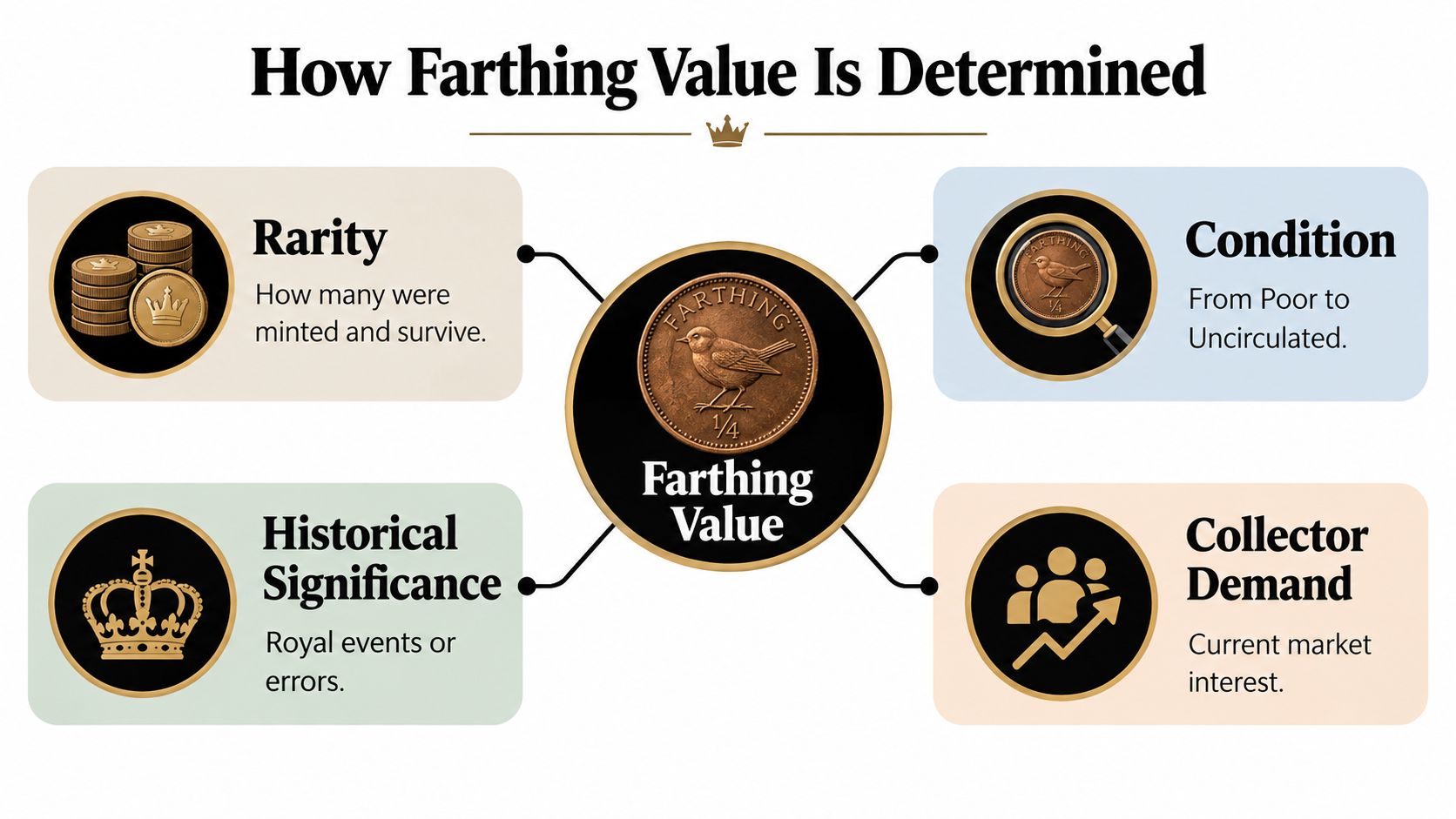
Four factors usually interact:
Date and monarch
The date places the coin within a particular reign and design period. The portrait and lettering can help distinguish an issue even when the date is difficult to read. A coin connected with a short or unusual reign may attract attention, but collectors still need to establish the exact type before assigning value.
Rarity and survival
Rarity isn't just a question of how old the coin is. Collectors want to know how many were made, how many survived, and how many are available in the required grade. A common date in worn condition may be easy to find, while the same date with sharp detail and original colour may be much harder to source.
Condition and colour
Condition describes how much wear the coin has experienced. A circulated farthing may show flattened hair, softened lettering, and loss of detail on the reverse design. An uncirculated example retains more of its original texture and definition.
Colour matters particularly for bronze farthings. A red example that has retained its mint appearance can appeal strongly to collectors, while a brown or damaged piece may sit in a lower price bracket. Colour doesn't replace grading, though. A bright-looking coin with scratches or chemical treatment isn't automatically valuable.
Variety, proof, and pattern status
Many valuation mistakes begin here. A regular strike was made for circulation. A proof was produced with special preparation and finish for presentation or collectors. A pattern is an experimental or proposed design, and a specimen may have been prepared or preserved in a special way.
Those formats can create separate markets for the same date. A normal strike may interest general collectors, while a proof or pattern attracts specialists who compare surfaces, edge details, die characteristics, and provenance.
Collector's shortcut: Ask, “What is it?” before asking, “What is it worth?” The answer should include the date, monarch, metal, condition, and production format.
A grading reference such as Cavalier Coins' coin grading guide for beginners and experienced collectors can help you understand the vocabulary. You don't need to assign a perfect grade at home. You do need to avoid calling a worn coin mint state or assuming a glossy surface proves originality.
The final factor is demand. A rare coin still needs interested buyers, and buyer interest varies by date, appearance, and collecting area. That's why published ranges are starting points rather than guarantees.
How to Identify Your Farthing and Assess Its Condition
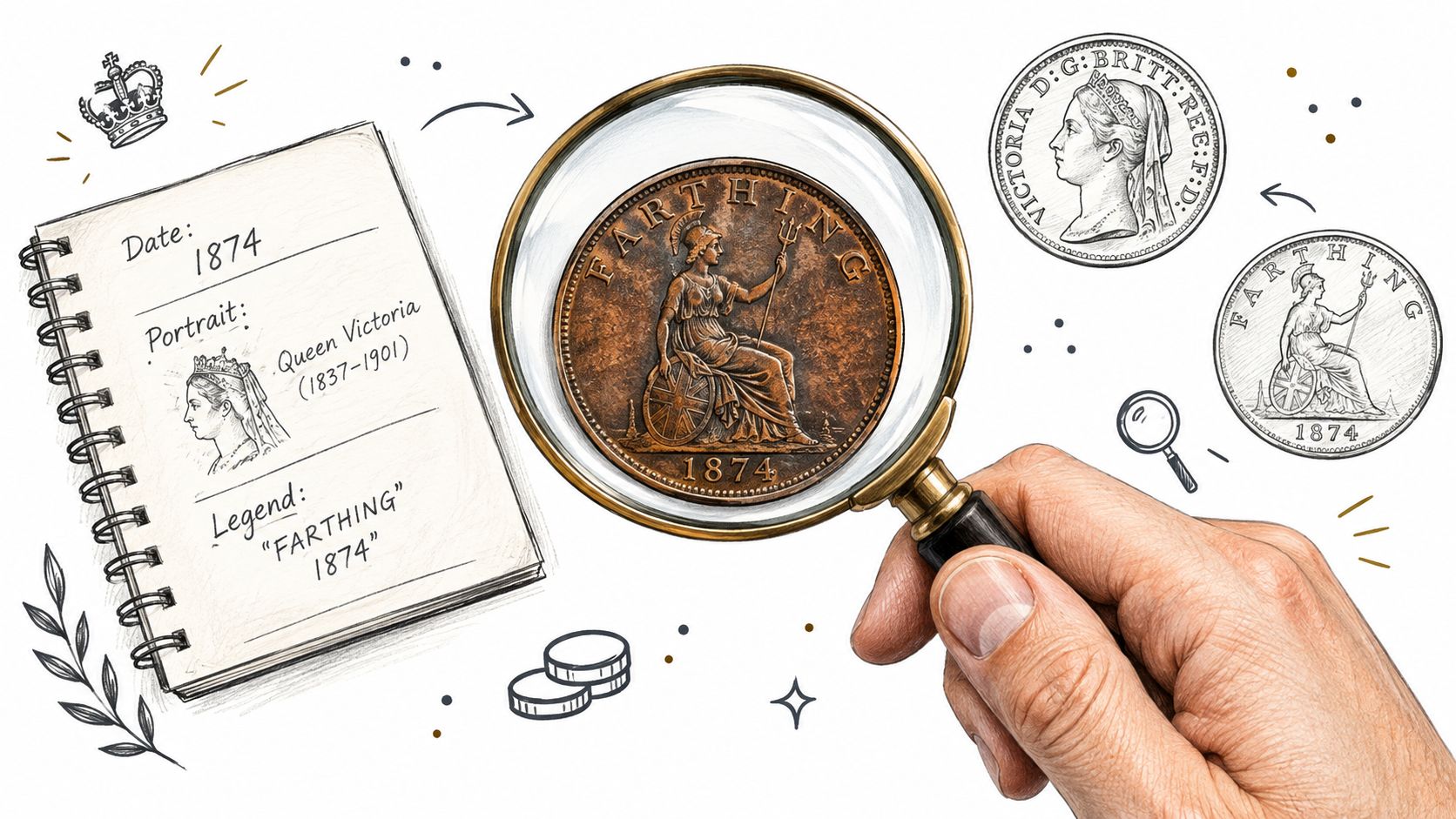
Start with the date, but don't stop there. Hold the coin under a bright, indirect light and tilt it gently rather than rubbing the surface. If the date is obscured, a magnifier can reveal the numerals without encouraging you to clean the coin.
The portrait and legend help confirm the monarch. Look at the shape of the head, crown, or other design elements, then compare the lettering with a reliable catalogue image. Earlier copper and later bronze issues can look similar after decades of toning, so metal and design details should be considered together.
A simple identification checklist
- Read the date: Record every visible numeral, even if one is worn or uncertain.
- Identify the monarch: Compare the portrait and surrounding legend with a specialist reference.
- Inspect the reverse: Look for design differences, lettering styles, and any unusual spacing.
- Check the edge: Note whether it appears plain, damaged, or otherwise different from reference examples.
- Look for varieties: Compare small details rather than relying on a general photograph.
- Record the metal appearance: A copper-coloured or bronze-toned surface can help place the coin, but colour alone doesn't identify it.
Condition assessment should begin with wear. Check the highest points of the portrait and reverse design, the lettering, and the fields around the main devices. A circulated coin will usually show friction on raised areas, while an uncirculated coin should retain sharper detail and original surface texture.
Colour, handling, and damage
Original red bronze colour can be desirable, especially when it remains bright and natural. Brown toning isn't automatically a defect, and a toned coin may still be attractive, but collectors distinguish natural colour from artificial brightness. Scratches, rim knocks, verdigris, corrosion, and cleaning hairlines can matter as much as wear.
Don't polish the coin to make the date easier to see. Place it in a suitable holder, handle it by the edges, and photograph both sides in neutral light. A ruler can help communicate scale, but avoid pressing objects against the surface.
At this stage, your goal isn't to produce a professional grade. It's to create an accurate description that a dealer or auction specialist can assess without guessing.
What Farthings Actually Sell For Today
You place two farthings with the same date on a dealer's counter. One is a worn circulation coin, the other a proof with sharper detail and a different finish. They may share a date, yet they belong to separate markets. A guide price describes a likely retail asking price, while an auction result records what a buyer paid for one specific coin in one specific sale.
That distinction matters most for proofs and patterns. UK pricing guidance puts common worn farthings in the pence range, while mint-state red bronze examples generally sit around £15 to £100. The same guide lists £500 to £3,000 for key Victorian proofs, £500 to £15,000 for a 1714 Queen Anne farthing, and £30,000 or more for a known 1937 Edward VIII pattern. The UK farthing price guide provides that tiered context.
Auction-linked catalogue data shows how sharply prices can separate within one date:
| Coin and format | Typical price range | Source context |
|---|---|---|
| 1950 HP regular strike | About $1 average | Auction-linked catalogue data for a standard strike |
| 1950 HP proof | About $560 average | Auction-linked catalogue data for the proof format |
| 1822 regular strike | About $110 average | Auction-linked catalogue data for a regular example |
| 1822 proof | About $1,100 average | Auction-linked data, with a UK hammer price of £1,900 |
The figures come from auction-linked farthing catalogue data. The record includes average figures and, for the 1822 proof, a UK auction hammer price. Treat these as evidence for the listed formats, not as an automatic offer for every farthing carrying the same date.
Why guides flatten the market
A broad catalogue entry may place regular strikes, proofs, and specimen pieces under one date. That is convenient for searching, but it can hide the feature that changes the value most. A proof buyer is choosing a different product from someone seeking a worn circulation coin.
The two markets also behave differently. Common-date farthings may attract limited attention at low prices, while specialist buyers compete for recognised proofs, patterns, and exceptional survivors. A strong auction result usually reflects several factors together: correct attribution, sound condition, trusted authenticity, and at least two motivated bidders.
A guide gives you orientation. A realised result gives you evidence, but only for a closely comparable coin.
Notable Rare and High Value Farthings to Know
At a dealer's counter, two farthings with the same date can receive very different valuations. One may be a worn circulation coin, while the other is a proof, pattern, or unusually well-preserved example. The date starts the conversation, but the coin's format, condition, and authenticity determine which market it enters.
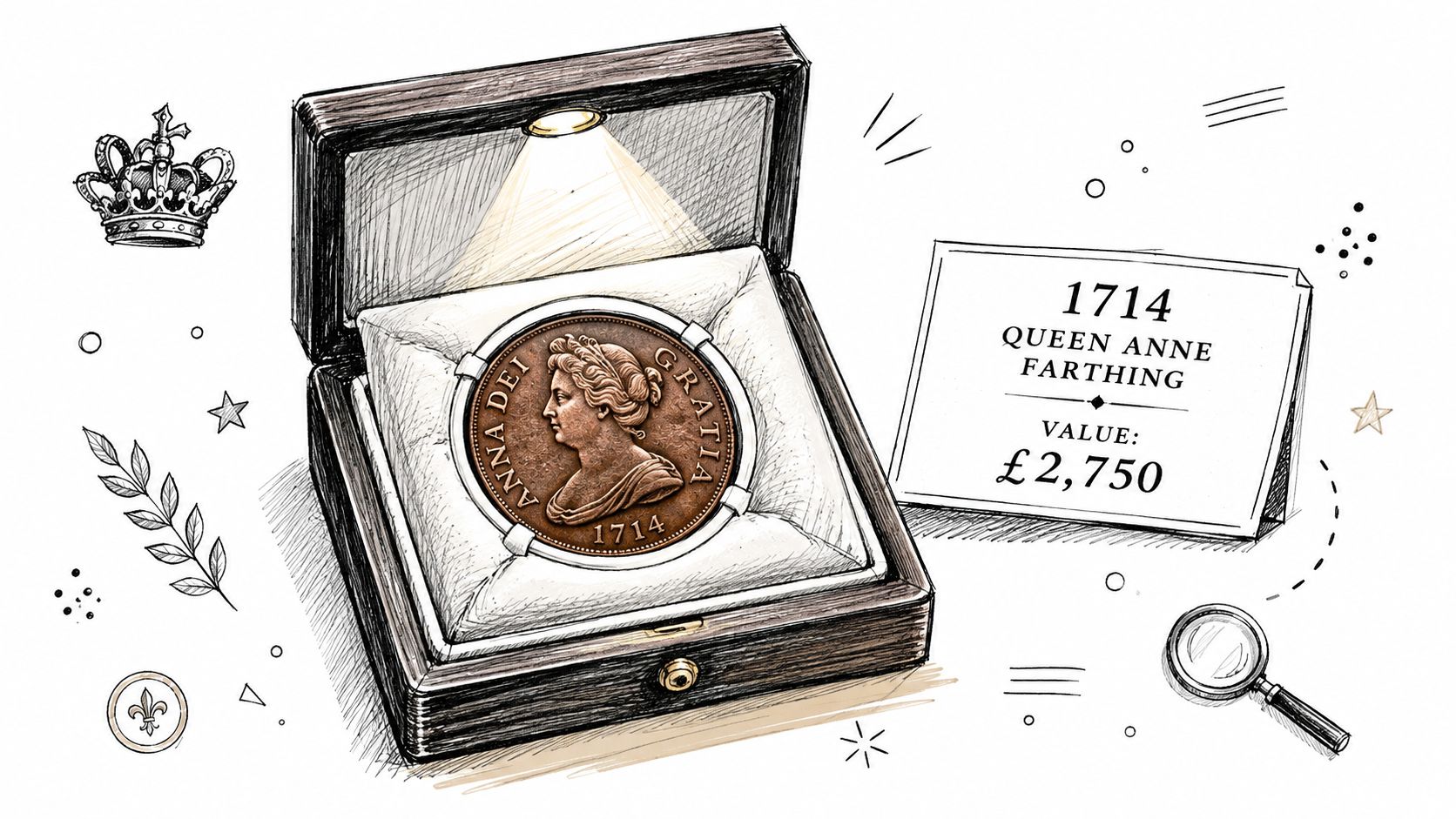
The 1714 Queen Anne farthing shows why broad price ranges need careful reading. UK pricing guidance places examples between £500 and £15,000, depending on the individual coin and its condition. A worn piece and a sharply preserved scarce example may attract entirely different buyers. Before treating the date as a guarantee of value, confirm the type and ensure the coin is genuine.
Proofs that change the comparison
Victorian proofs can command a premium because collectors value their special preparation, sharper detail, and presentation qualities. The UK guide places key Victorian proofs at about £500 to £3,000. That range applies to the proof format identified by the guide, not automatically to every Victorian farthing.
The 1822 example makes the split between the two markets clear. As shown in the auction-linked data cited earlier, the regular strike averaged about $110, while the proof averaged about $1,100, with a recorded UK hammer price of £1,900 for the proof format. These are different collecting objects despite sharing a date. Condition and demand then widen or narrow the gap within each format.
The 1950 HP offers the same warning. Auction-linked data lists about $1 for a regular strike and about $560 for the proof. A guide entry labelled “1950 farthing” can therefore flatten two markets into one line, making a retail reference price look inconsistent with an auction result.
Patterns and historical curiosities
The known 1937 Edward VIII pattern farthing is an especially striking case, with UK pricing guidance citing £30,000 or more. A pattern was made as a proposed design rather than issued for ordinary circulation. Its value rests on the historical setting, design interest, and extreme scarcity.
Use these examples as a checklist rather than a promise of payment. Age is only one clue. A later pattern may exceed the value of an older circulated coin, and a proof may outperform a regular strike from the same year. Clear photographs and specialist comparison can help establish whether the coin belongs in the ordinary circulation market or the much smaller proof and pattern market.
How to Sell or Get Your Farthing Appraised With Confidence
Begin by preserving evidence. Photograph both faces, the edge if relevant, and any unusual detail in clear light. Write down the date, apparent monarch, diameter if known, weight if available, and whether the coin has been cleaned or damaged.
A professional appraisal becomes more useful when you provide this information. Specialists can compare the coin with reference pieces, assess whether it is a regular strike or proof, and decide whether it belongs in a general sale or a specialist auction.
Choosing a selling route
- Fixed-price sale: Suitable when the coin has a clear identity and a realistic asking price.
- Auction consignment: Useful for scarce proofs, patterns, and coins likely to attract competing specialists.
- Direct dealer offer: Convenient when you prefer a straightforward transaction, especially for a mixed collection.
- Collection sale: Practical when common coins have limited individual value but form a coherent group.
Read the terms before agreeing to a sale. Ask about commission, photography, payment timing, return conditions, and whether the valuation is an asking price, an estimate, or a firm offer. Cavalier Coins Ltd also describes appraisal approaches and the details owners should provide in its guide to where to get coins valued.
Avoid the common mistakes
Don't clean the coin, don't overstate its grade, and don't rely on an unsourced online estimate. A dramatic result for a proof or pattern doesn't transfer automatically to a normal circulation strike. If several coins appear promising, keep them together until a specialist has reviewed the group, since shared history or matching characteristics may help with identification.
Use the date and format to narrow the comparison, then judge condition carefully. That process gives you a much more reliable view of farthing coin worth than face value or age alone.
Cavalier Coins Ltd offers coin and banknote buying, fixed-price listings, weekly eBay auctions, and appraisal guidance for collectors and people sorting inherited or donated collections. If your farthing may be a proof, pattern, scarce variety, or part of a larger group, visit Cavalier Coins Ltd to explore its services and submit the details needed for a specialist response.