

When you hold a modern Gold Sovereign, you’re holding a piece of history defined by a very specific number: 7.98805 grams. This isn't just a random figure; it's a standard that has been meticulously upheld for over 200 years, making it one of the first and most important checks for any collector or investor. For anyone serious about sovereigns, knowing this weight is step one in telling a genuine coin from a fake.
The Blueprint of a British Gold Sovereign
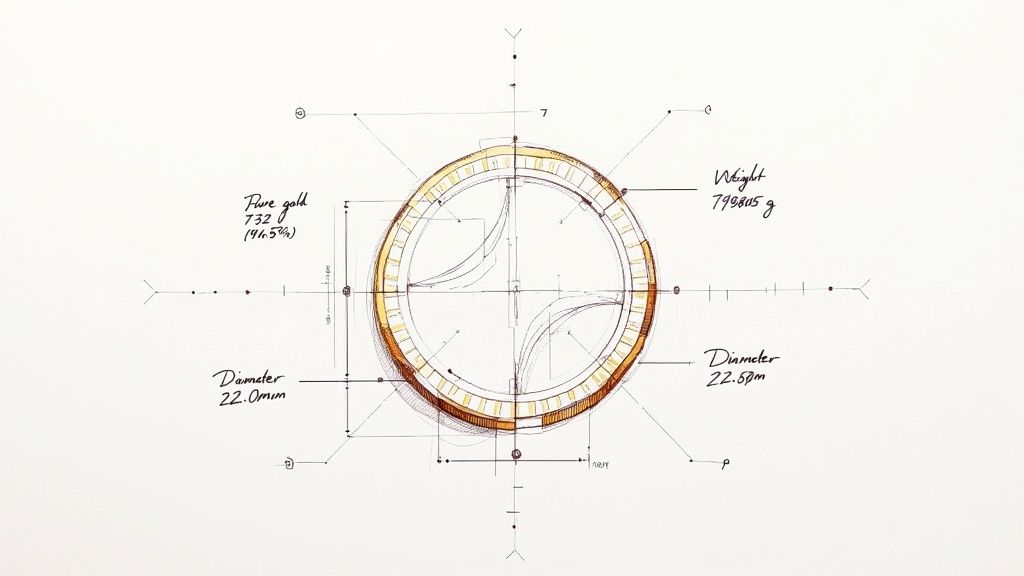
The precise specifications of a full sovereign are no accident. They are a direct result of the Great Recoinage of 1817, a huge undertaking to stabilise Britain’s currency after the Napoleonic Wars. This historical consistency is what gives the coin its trusted reputation today. If you're interested in the backstory, you can dive deeper into the sovereign's fascinating history and its two-century journey.
To make it easy to remember, here’s a quick-reference table breaking down the coin's official stats.
Official Full Sovereign Coin Specifications
For a quick glance, here are the key physical and compositional specifications you'll find on a modern British full sovereign.
| Specification | Official Measurement |
|---|---|
| Total Weight | 7.98805 grams |
| Pure Gold Content | 7.3224 grams (0.2354 troy oz) |
| Purity (Carat) | 22 carat |
| Fineness | 916.7/1000 (91.67% gold) |
| Diameter | 22.05 mm |
| Thickness | 1.52 mm |
These numbers act like a fingerprint for the coin. Each measurement is interdependent, creating an object that's surprisingly difficult for counterfeiters to replicate perfectly. A forger using a metal less dense than gold, for instance, would have to make the coin thicker or wider to hit the 7.988g weight, a dead giveaway to anyone with a pair of callipers.
The Science Behind Crown Gold
You might notice the sovereign isn't pure 24-carat gold. It's actually made from a special alloy called Crown Gold, which consists of 22 parts gold to two parts copper. There's a very good reason for this.
Crown Gold combines the intrinsic value of high-purity gold with the resilience of copper, creating a coin durable enough for circulation without sacrificing its precious metal content.
This specific mix (91.67% gold, 8.33% copper) not only gives the sovereign its signature reddish lustre but also makes it tough enough to withstand being handled and passed around. While the total full sovereign coin weight is 7.988 grams, the actual amount of pure gold inside is 7.32 grams. This figure, known as the Actual Gold Weight (AGW), is what determines its base bullion value. The rest of the weight is the copper, which provides the strength needed for a coin originally designed to be a workhorse of global trade.
Exploring Historical Sovereign Weight Variations
While the modern sovereign is a model of consistency, its ancestor was a completely different beast. To really get a handle on the full sovereign coin weight we know today, we have to travel back to the Tudor era, long before the familiar St George and the Dragon design ever existed. The story begins with a coin born from pure royal ambition.
The very first gold Sovereign was introduced by King Henry VII in 1489. This wasn't a coin for popping down to the market; it was a grand statement piece designed to project the power and stability of the new Tudor dynasty right across Europe. As you'd expect, its specifications were suitably impressive and a world away from its modern counterpart.
The Original Tudor Sovereign
This original coin was a heavyweight champion. The Tudor Sovereign tipped the scales at approximately 15.55 grams and was struck from high-purity 23-carat gold. That made it nearly double the weight and purer than the sovereigns that would follow centuries later. This huge difference in weight and purity really highlights its main job as a symbol of wealth, not a practical piece of currency for trade.
So, what prompted such a dramatic change? The answer lies in Britain's shifting economic landscape.
The transition from the heavy Tudor Sovereign to the lighter, standardised modern version reflects a major shift in purpose—from a symbol of royal prestige to a reliable instrument of international commerce.
The Great Recoinage and the Birth of the Modern Standard
The pivotal moment came with the Great Recoinage of 1816. After the immense financial strain of the Napoleonic Wars, Britain desperately needed to stabilise its currency and assert its economic dominance. The old, inconsistent coinage simply wasn't fit for purpose in an expanding global empire.
The Coinage Act of 1816 ushered in a new era of precision and reliability. It established the modern Sovereign with the strict specifications we recognise today, including its 7.98805-gram weight and durable 22-carat gold composition. This change transformed the coin into a trusted, fungible asset that could facilitate trade everywhere from London to Sydney.
This standardisation was so successful that it remained the benchmark for all subsequent issues, including the iconic coins of the Victorian era. The long reign of Queen Victoria saw a massive production of these new sovereigns, cementing their reputation worldwide. Exploring the nuances of Queen Victoria gold sovereign coins reveals just how influential this period was in cementing the coin's legacy as a cornerstone of global finance.
Ultimately, the evolution of the sovereign's weight tells the story of Britain's journey from a European kingdom to a world-spanning economic powerhouse.
How to Confidently Verify Your Sovereign's Authenticity
In the world of gold, knowing the official full sovereign coin weight is your first and best line of defence against fakes. Authenticity isn't just a label; it's a guarantee of value. Learning how to confirm it for yourself is a crucial skill for any owner, transforming you from a hopeful buyer into a confident collector.
Your most essential tool here is a high-precision digital scale, preferably one that measures to two decimal places (e.g., 0.01g). A brand new, uncirculated full sovereign should weigh almost exactly 7.98 grams.
Of course, a coin that has been handled or passed through circulation will naturally lose a tiny amount of metal over time. Don't be alarmed if an older coin weighs slightly less. Most experts agree that a weight down to 7.90 grams is perfectly acceptable for a circulated sovereign, simply reflecting genuine wear and tear.
Moving Beyond the Scale
While weight is the primary check, it isn't the only one. More sophisticated fakes, often made of tungsten (which has a remarkably similar density to gold), can sometimes mimic the correct weight. This is why you need to get the measuring tape out—or, more accurately, a set of digital callipers.
Using callipers, you can quickly check two other key specifications:
- Diameter: A genuine sovereign should measure 22.05 mm across.
- Thickness: The coin's thickness should be 1.52 mm.
A counterfeiter trying to pass off a different metal alloy will struggle to match all three measurements—weight, diameter, and thickness—at the same time. If one is correct but the others are off, that’s a massive red flag.
The image below shows just how far the Sovereign has come, from its heavy Tudor origins to the modern, standardised coin we verify today.
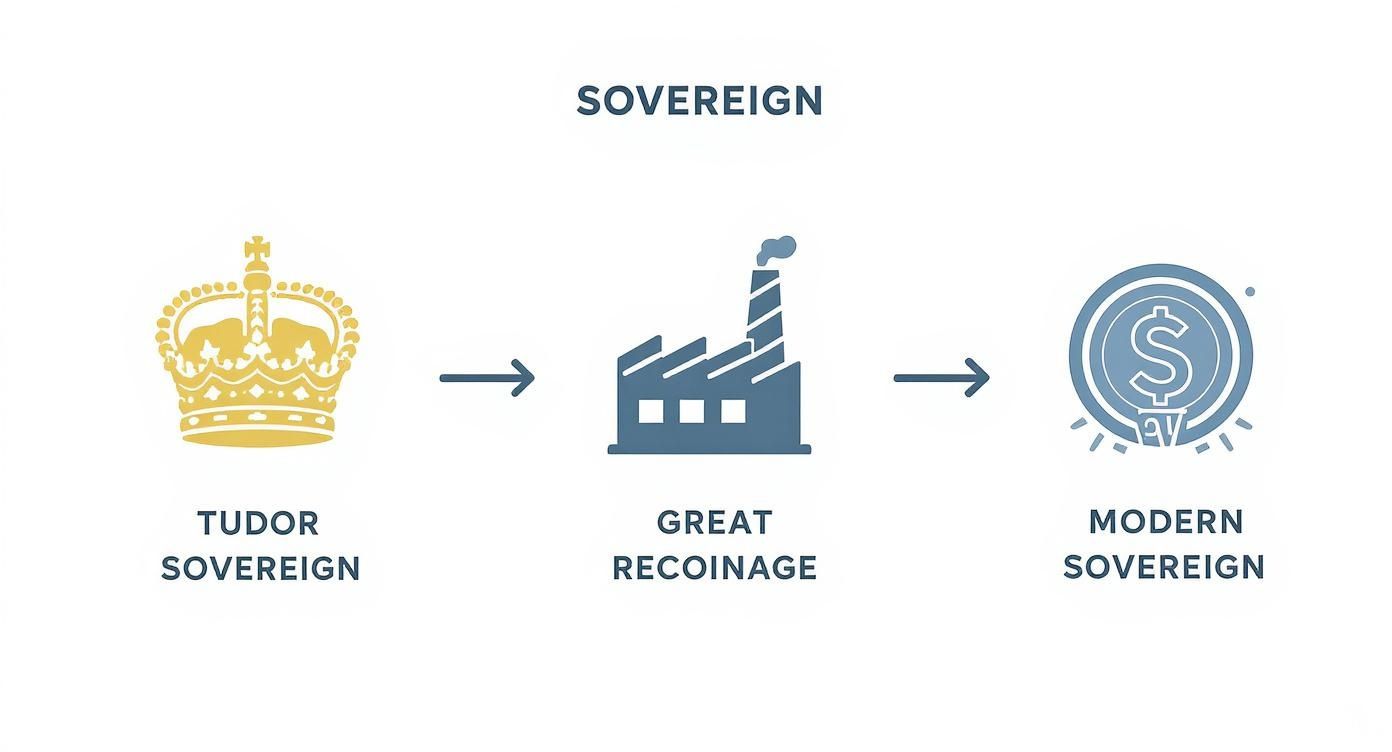
This long evolution highlights why today's precise specifications are so vital for authentication; they represent a standard of quality refined over centuries.
A Practical Checklist for Sovereign Verification
To make things easier, we've put together a simple checklist that summarises the key physical checks. This table gives you a quick reference guide for authenticating any full sovereign you come across.
| Verification Method | Expected Result | Tools Required |
|---|---|---|
| Weight | 7.98g (uncirculated) to 7.90g (circulated) | High-precision digital scale |
| Diameter | 22.05 mm | Digital callipers |
| Thickness | 1.52 mm | Digital callipers |
| Ping Test | A clear, high-pitched, ringing sound | A hard, non-abrasive surface |
| Visual Inspection | Sharp, well-defined details; correct mint marks | A magnifying glass or loupe |
Running through these steps takes only a minute or two but can save you from a costly mistake.
Advanced Verification Techniques
For an extra layer of security, seasoned collectors often rely on other simple yet effective methods. One of the most popular is the "ping test," which just involves gently tapping the coin and listening to the sound it makes.
A genuine 22-carat gold coin produces a distinct, high-pitched, and long-lasting ringing sound. Base metals used in fakes, by contrast, will create a dull, short "thud." This acoustic signature is remarkably difficult for forgers to replicate.
For those seeking even greater certainty, there are many more tools in the arsenal, from magnetic tests to specific gravity measurements. You can build your expertise by exploring a detailed breakdown of 7 proven methods for detecting counterfeit coins in 2025.
By combining these simple, practical checks, you can confidently verify the authenticity of your full sovereign, ensuring your investment is both genuine and secure.
Decoding Grams, Troy Ounces, and Pure Gold Content
When you step into the world of precious metals, you quickly realise you need to speak the language, especially when it comes to weight. The grams you see on a standard jeweller's scale aren't the same as the troy ounces used to price gold on the global markets. Getting your head around this difference is the first step to understanding a Sovereign's true worth.
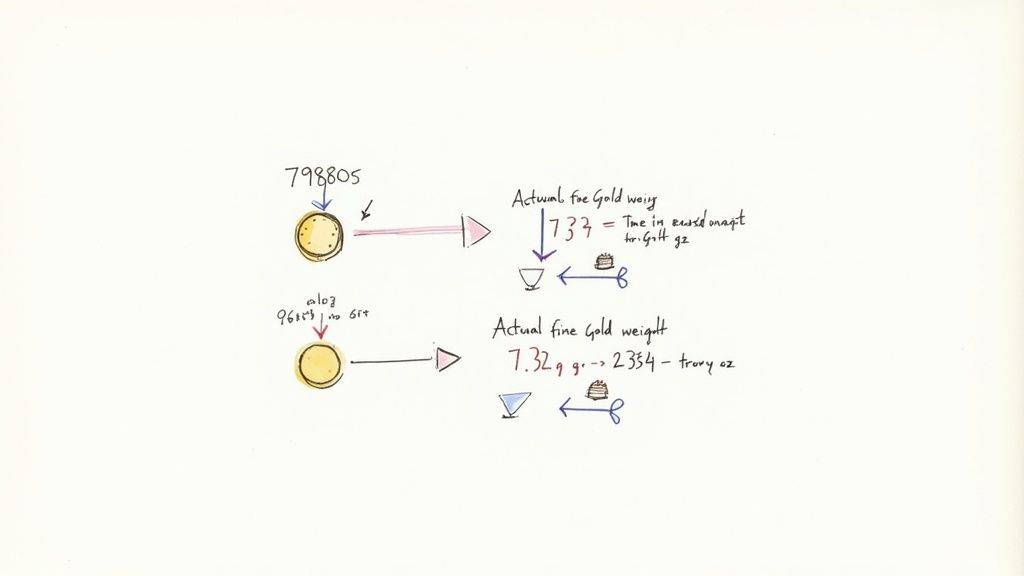
A full gold sovereign has an official total weight of 7.98805 grams. But here's the twist: the international gold market doesn't work in standard grams. It uses the troy ounce, a unit of measurement with roots stretching back centuries. One troy ounce equals 31.1035 grams.
It's a simple bit of maths to translate the full sovereign coin weight into the language of bullion traders. If you divide the coin's 7.98805 grams by 31.1035, you get 0.2568 troy ounces. This number is the coin’s total mass, which includes the small amount of copper alloy that gives it strength and durability.
Focusing on the Pure Gold
While the total weight is vital for checking if a coin is genuine, the bullion value of a Sovereign comes purely from its gold content. This is what we call its Actual Gold Weight (AGW).
The difference between a coin’s total weight and its Actual Gold Weight is the most important concept for an investor to grasp. The AGW is the figure used to calculate its real-time bullion value, stripping away the weight of any other metals.
Because a Sovereign is made from 22-carat gold (91.67% pure), its AGW is naturally a bit lower than its total weight. The pure gold inside the coin weighs exactly 7.3224 grams. Converted into the market's standard, that's 0.2354 troy ounces. This is the number that really counts when you look up the live gold price.
To figure out your Sovereign's basic 'melt' value, you just multiply its AGW in troy ounces (0.2354 oz) by the current spot price of gold. Mastering this quick calculation gives you the power to instantly assess the base value of any Sovereign you come across. It lets you separate its raw metallic worth from any extra collector value, which is fundamental for buying and selling with confidence.
Why Weight Is Just the Start of a Sovereign's Value
While confirming the correct full sovereign coin weight is the first, crucial step in checking a coin's authenticity, it really only tells you its base value in gold. For collectors and investors, this is merely the starting point.
The true worth of a Sovereign often lies in a fascinating set of details that can add a significant premium over its simple gold content.
Think of it like this: the gold weight is the canvas, but the history painted on it determines its final price. Two sovereigns can weigh an identical 7.98 grams, yet one could be worth hundreds of pounds more than the other. This extra value comes from factors that signal rarity and historical importance, which we call numismatic value.
Beyond Bullion: Mint Marks and Mintage
One of the most important factors is the coin's mint mark. As the British Empire expanded, Sovereigns were struck at various branch mints across the globe to help with trade and commerce. A tiny letter stamped on the coin—like an 'S' for Sydney, 'M' for Melbourne, or 'P' for Perth—tells you exactly where it was made.
Some of these mints produced far fewer coins than others in certain years. This scarcity makes their issues much more sought-after by collectors today. A coin from a specific mint in a low-production year is almost always more valuable than a common London-minted one from the same year.
Likewise, the total number of coins produced in a given year, known as the mintage, is vital. A Sovereign from a year with a very low mintage is inherently rarer and will command a higher price. This is especially true for modern proof sets made specifically for collectors. For instance, production numbers in the 1980s and 1990s often hovered between 4,000 to over 12,000 annually, but recent years like 2016 and 2022 saw mintages drop below 2,500, immediately increasing their rarity. You can explore more about the fluctuating mintage figures of proof Sovereigns on BritanniaCoinCompany.com.
The Crucial Role of Condition
Finally, the physical condition, or grade, of the coin plays a massive role in its value. A pristine, uncirculated Sovereign that looks as fresh as the day it was minted is far more desirable than one that shows obvious signs of wear, like scratches or smoothed-out details from being handled over the years.
A coin's grade is a direct reflection of its preservation. Top-grade coins are prized because they offer a perfect window into the past, showcasing the artist's original design without the damage of time.
This combination of mint mark, mintage, and grade creates a unique value profile for every single coin. Learning to spot these details is the key to unlocking its true potential. You can dive deeper into understanding these nuances by checking out our complete guide on how different factors influence sovereign coin values.
Common Questions About Sovereign Coin Weight
As you get to grips with the world of gold sovereigns, a few practical questions almost always pop up. It's one thing to know the theory, but quite another to have a coin in your hand. Let's tackle some of the most common queries to build your confidence when you're handling these incredible pieces of history.
What Is the Acceptable Weight for a Circulated Sovereign?
A brand-new, fresh-from-the-mint full sovereign is struck to a very precise 7.98805 grams. But what about a coin that's been around for a hundred years? Decades of being handled, carried in pockets, and changing hands will cause microscopic bits of gold to wear away, leading to a tiny loss of weight. This is completely normal and something every experienced dealer expects to see.
As a rule of thumb, reputable dealers generally look for a sovereign to weigh 7.90 grams or more. If you find a coin that drops much below this, especially if it's under 7.85 grams, it's a red flag. It could be a sign of extreme wear, deliberate "clipping" from centuries past, or worse, a modern fake.
Is a Half Sovereign Proportionally Lighter?
Absolutely. The half sovereign is a perfect miniature of its bigger brother. It's made from the exact same 22-carat (91.67%) gold alloy, and all its specifications are exactly half that of the full sovereign. It’s a beautifully consistent system.
Here are the vital statistics for a half sovereign:
- Official Total Weight: 3.99 grams
- Actual Gold Weight (AGW): 3.66 grams (or 0.1177 troy ounces)
Everything you learn about verifying and valuing a full sovereign applies directly to the half sovereign, just on a smaller scale. This consistency is a big reason why it remains such a popular and accessible coin for new and seasoned collectors alike.
Key Takeaway: Weight is your first line of defence when authenticating a coin. The Royal Mint has stuck to its strict specifications for over two centuries, and that unwavering consistency is precisely what makes weight such a powerful tool for spotting a genuine sovereign.
Why Is Weight So Important for Authenticity?
A coin's precise weight is one of the most powerful tools we have against fakes. For over 200 years, The Royal Mint has manufactured sovereigns to incredibly tight tolerances for their weight, diameter, and thickness. It’s this trifecta of measurements that counterfeiters find almost impossible to get right.
Think about it: if a forger uses a cheaper, less dense metal and plates it with gold, they have a problem. To match the official 7.98g weight, their fake coin would have to be noticeably thicker or wider than a real one. A quick check with a set of digital callipers would expose it instantly. That’s why confirming the full sovereign coin weight is the most crucial first step in proving you’re holding a genuine piece of history with its full gold content.
At Cavalier Coins Ltd, we provide authenticated, high-quality sovereigns for every type of collector. Explore our extensive selection of rare and investment-grade coins from around the world at https://www.cavaliercoins.com.