
The gold sovereign is far more than just a lump of gold. It's a slice of British history you can hold in your hand, struck from robust 22-carat gold and famous for its legendary St George and the Dragon design. For collectors and investors, it’s a tangible asset valued as much for its story as for its gold content.
An Introduction to Britain's Most Famous Coin
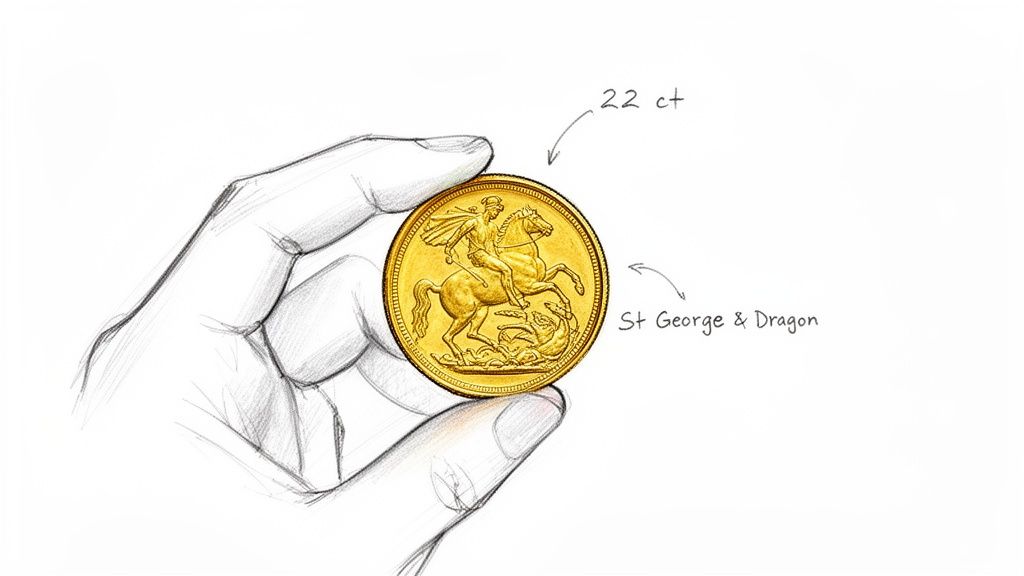
Picture holding a small, gleaming disc that has quietly witnessed centuries of history unfold. That's the magic of the gold sovereign. It sits in a unique spot in the world of precious metals, perfectly blending the straightforward appeal of gold investment with the rich narrative of a historical artefact.
For an investor, the sovereign is a reliable safe haven. Its composition is standardised and understood across the globe, making it an incredibly easy asset to buy or sell. But it offers something more than a simple gold bar ever could.
For the collector—the numismatist—each coin is a miniature time capsule. The monarch’s portrait, the year it was struck, and even a tiny, almost hidden mintmark tells a story of where it came from and the era it represents. It’s this dual identity that makes the gold sovereign so utterly compelling.
A Legacy in 22-Carat Gold
The sovereign’s staying power is built right into its metal. Struck in 22-carat gold, it has a purity of 91.67%. The rest is an alloy, mostly copper, which gives the coin its signature reddish-gold lustre and makes it much tougher than pure, 24-carat gold.
This wasn't an accident. It was a practical choice to ensure the coin could survive the rough and tumble of daily circulation without easily scratching or wearing away. This incredible durability has helped sovereigns survive for centuries, ready to be passed down through generations.
The dual nature of the sovereign—as both a bullion coin and a collectible—provides a unique advantage. Its intrinsic gold value acts as a safety net, while its numismatic potential offers the opportunity for significant appreciation over time.
Artistry and Iconography
At the very heart of the sovereign's appeal is Benedetto Pistrucci’s breathtaking engraving of St George slaying the dragon. First seen in 1817, this powerful and timeless design has become synonymous with the coin itself. It's a miniature work of art that has been meticulously reproduced for over 200 years, a true testament to its enduring power.
So, what really defines a gold sovereign?
- Dual Appeal: It draws in both investors looking for a hedge against economic jitters and collectors passionate about history.
- Durable Composition: Its 22-carat gold makeup means it can withstand handling and circulation far better than pure gold.
- Iconic Design: The St George and the Dragon motif is a celebrated piece of coin art, recognised the world over.
- Historical Significance: Every single coin connects its owner to a specific moment in British and world history.
This perfect blend of real value and historical story sets the stage for a fascinating journey. Whether you're looking to start a collection or make a sound investment, getting to know the gold sovereign is the essential first step.
The History of Britain's Most Famous Coin
Every gold sovereign is a piece of history you can hold in your hand, a direct link to Britain's past. Its story isn't one of ancient myth, but of modern strength, born from the aftermath of war and designed to put the nation's economy back on solid ground. The sovereign we know and love today was first struck in 1817, a direct result of the Great Recoinage Act of 1816.
This landmark legislation was a response to the economic chaos that followed the Napoleonic Wars. Britain desperately needed to restore trust in its currency, and the sovereign was intended to be the very foundation of that new confidence. It wasn't a coin that merely represented value; it was value, struck in reliable 22-carat gold.
From George III to Global Dominance
The first of these modern sovereigns featured the famous portrait of King George III, kicking off a numismatic legacy that would continue through every British monarch since. This new coin didn't stay local for long; it quickly grew into a global economic powerhouse.
As the British Empire expanded, the sovereign went with it. It became the unofficial currency for international trade, trusted in ports from Sydney to Cape Town and from Hong Kong to Ottawa. It was, without a doubt, the world's chief coin—a universally accepted standard for payment and a safe haven for wealth.
The gold sovereign’s global acceptance wasn't just a by-product of the empire's reach. Its weight and purity were so incredibly consistent that merchants everywhere trusted it on sight, often without even needing to test the gold. It was the 19th-century equivalent of the US dollar.
This worldwide demand led The Royal Mint to establish branch mints in key imperial territories, including Australia, Canada, India, and South Africa. Each of these mints produced sovereigns that were identical to their London counterparts, set apart only by a tiny mintmark—a detail that now creates a fascinating world of opportunity for collectors.
How World Events Forged Rarity
The production of the gold sovereign has always mirrored major world events. Mintage numbers rose and fell in direct response to economic booms, recessions, and global conflicts, creating the very fluctuations that define rarity for today's collectors.
A perfect example is the outbreak of the First World War in 1914, which effectively spelled the end of the sovereign as a coin for everyday circulation. Gold was urgently needed for the war effort, and the public was encouraged to swap their gold coins for paper banknotes. After 1917, sovereigns were primarily struck for settling international debts and stocking central bank reserves, not for use in shops.
These historical pressures had a huge impact on mintage figures. The sovereign's reintroduction in 1817 aimed to standardise the currency at 7.98805 grams (with 7.32238 grams of pure gold) to restore confidence after wartime inflation. Initial production was massive; in 1821, over 9.4 million sovereigns were struck. But people often preferred the convenience of banknotes, causing demand to collapse. In 1819, only 3,574 coins were made—a drop of over 99% from the year before, creating one of the coin's most famous rarities.
- Victorian Era Expansion: High mintages were common during Queen Victoria's reign to support the vast trade network of the empire.
- Wartime Contraction: Production of sovereigns for circulation in Britain stopped completely during WWI as gold was stockpiled.
- Post-War Hiatus: Bullion sovereign production was paused for several years after the war before eventually being revived for investors.
Understanding this history is key for any collector. Each coin tells a story—not just of a monarch or a year, but of the global forces that shaped its journey. By learning to read these stories, you can truly appreciate the depth and value of every sovereign in your collection. For a wider view, you might find our article on a brief history of British coins and their evolution interesting.
How to Identify Different Sovereign Coins
Learning to identify a gold sovereign is like learning to read a piece of history. Each coin holds clues that tell its unique story, from its physical makeup to the classic artwork adorning its faces. Once you know what to look for, you can confidently tell different eras and types of sovereigns apart, unlocking the secrets held within its gold.
The starting point for any sovereign is its precise physical specifications. Since the Great Recoinage of 1816, the full gold sovereign has been struck to an incredibly exact standard. It’s made from 22-carat gold, which is an alloy of 91.67% pure gold mixed with a small amount of copper or other metals. This blend not only gives the coin its signature rich lustre but also makes it tough enough to last for centuries.
This specific composition leads to a standard weight of 7.98 grams. That consistency is a huge part of why the coin became so trusted all over the world. When you're examining your own coins, it helps to apply the same principles used to identify valuable antiques, as the process of verification and appraisal is very similar.
This timeline gives you a great visual overview of the sovereign's long and fascinating history.
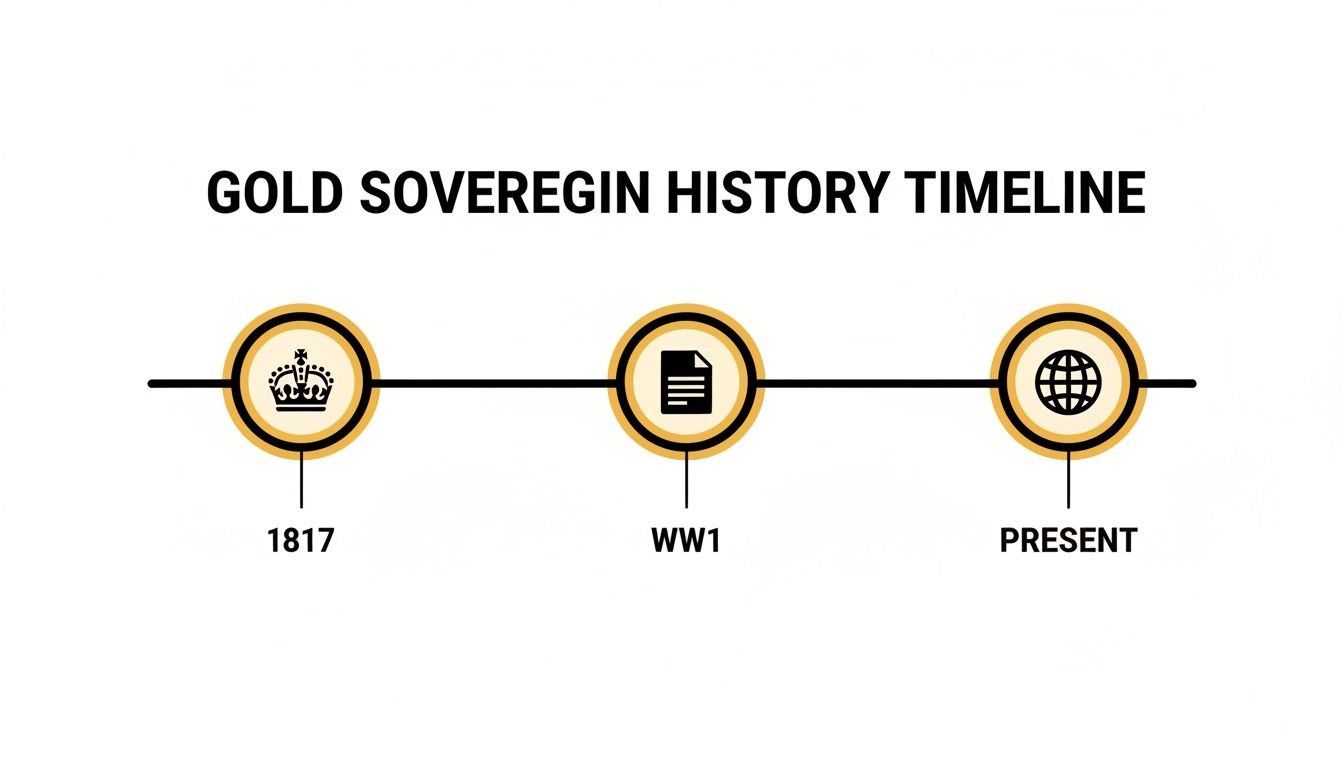
You can see how the coin evolved from everyday currency into a globally recognised investment, its journey shaped by major world events.
Artistry and Monarch Portraits
Beyond its weight and purity, the sovereign's artistry is its most recognisable trait. The obverse (the 'heads' side) always displays the portrait of the reigning monarch at the time it was minted. This is your first and best clue to a coin's age, as the portrait changed with each new king or queen, from George III all the way to King Charles III.
The reverse ('tails') side is just as telling. Most famous, of course, is Benedetto Pistrucci’s legendary depiction of St George slaying the dragon. It's a powerful and dynamic image that has become synonymous with the gold sovereign, appearing on the coin since 1817.
But that's not the only design you'll come across. For a period during Queen Victoria's reign, a more formal 'Shield Back' design was used. This intricate shield, topped with a royal crown, is a key identifier for early-to-mid Victorian sovereigns and is a real favourite among collectors.
The Sovereign Family A Comparison
The full sovereign is the most famous member of its family, but it's not the only one. The Royal Mint also produces smaller denominations, which are perfect for collectors and investors working with different budgets. They all share the same 22-carat gold purity and iconic designs, but their physical specs are quite different.
One key takeaway for identification is that all genuine sovereigns, no matter the size, have an amazing level of sharp, intricate detail. If the monarch's portrait or the St George design looks blurry or soft, it’s often a big red flag for a counterfeit.
Getting these variations straight is vital for properly identifying and valuing your coins. To make it simple, the table below breaks down the core specifications for each coin in the sovereign family.
Gold Sovereign Family Specifications
Here's a side-by-side look at the specifications for the full, half, and quarter sovereign. Notice how the weight and diameter scale down, but the all-important gold purity remains constant across the entire family.
| Specification | Full Sovereign | Half Sovereign | Quarter Sovereign |
|---|---|---|---|
| Total Weight | 7.98 grams | 3.99 grams | 1.99 grams |
| Diameter | 22.05 mm | 19.30 mm | 13.50 mm |
| Gold Purity | 22 Carat (91.67%) | 22 Carat (91.67%) | 22 Carat (91.67%) |
| Fine Gold Content | 7.32 grams | 3.66 grams | 1.83 grams |
This table provides a quick and easy reference, making it simple to distinguish one coin from another at a glance. It's a handy tool for any collector to have.
Why Mintmarks and Mintage Matter
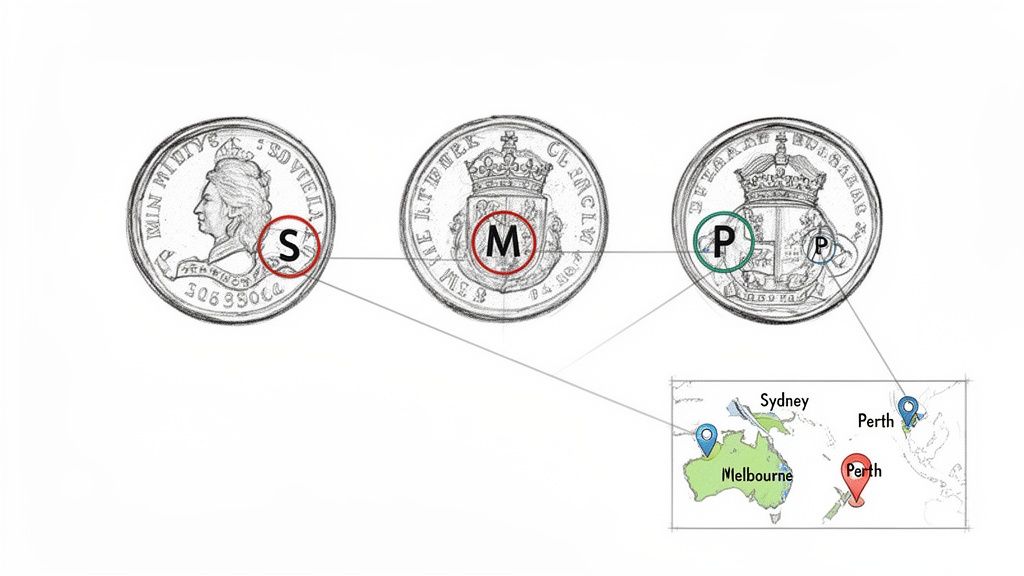
What separates a common-or-garden gold sovereign from a genuine numismatic treasure? While the date is always a good place to start, the real secret often lies in a tiny detail you could easily miss: the mintmark.
This small letter, stamped onto the coin, tells you which of The Royal Mint’s global branches actually produced it. It might seem like a minor detail, but it can have a huge impact on a coin's scarcity and, ultimately, its value.
Think of it like this. Two identical-looking classic cars might roll off the production line in the same year. But if one was part of a limited run of only 100 vehicles and the other was one of a million, their long-term value would be worlds apart. It's exactly the same principle with sovereigns.
A mintmark is like a coin’s birth certificate. It doesn’t just tell you when it was made, but where. As the British Empire grew, sovereigns were needed to keep trade flowing across the globe. To meet this demand, branch mints were set up in key locations, and each one added its own unique mark to the coins it struck.
Locating the Elusive Mintmark
Finding the mintmark on a gold sovereign definitely requires a keen eye. On most of the classic St George and the Dragon designs, you'll find it on the reverse side, tucked away on the small patch of ground right underneath the dragon. For the older Shield Back sovereigns, it’s usually found just below the shield itself.
These marks are subtle. It’s easy to overlook them if you don't know where to search, so using a magnifying glass or a proper jeweller's loupe is a good idea to get a clear look.
The most common mintmarks you'll encounter from the British Empire's branch mints are:
- S for Sydney, Australia
- M for Melbourne, Australia
- P for Perth, Australia
- C for Ottawa, Canada
- I for Bombay (now Mumbai), India
- SA for Pretoria, South Africa
Sovereigns struck in London, which are by far the most common, typically have no mintmark at all. The moment you spot one of these letters, you know the coin has a different story to tell. If you want to dive deeper into these fascinating details, you can learn more about what mintmarks on coins mean and why they’re so crucial for collectors.
How Mintage Figures Drive Value
Once you’ve identified the mint and the year, the next piece of the puzzle is the mintage—the total number of coins that specific mint produced in that particular year. This is where the concept of rarity really comes to life. A coin’s value isn’t just about its gold content; it’s about simple supply and demand.
Take an 1887 sovereign from the London mint, for example. It’s quite common, with over a million struck. But find an 1887 sovereign with an 'S' for Sydney, and you have something much rarer, as far fewer were made there. That scarcity instantly makes the Sydney version more desirable to collectors and, as a result, more valuable.
The core principle for collectors is simple: lower mintage almost always equals higher value. A specific combination of year and mintmark can transform a standard gold sovereign coin into a key-date rarity worth many times its weight in gold.
One of the most legendary examples is the 1819 sovereign. With a mintage of just 3,574, it stands as one of the rarest and most sought-after dates in the entire series. Finding one is the dream of many a numismatist.
Other factors can create rarity, too. Sometimes, specific die numbers—tiny numerals used to track the dies during production—were only used for a very short run. A coin with a rare die number can command a high premium, even if the overall mintage for that year and mint was large. This is the kind of detailed knowledge that helps you spot the hidden gems others might just pass over.
Bullion vs Proof Sovereigns: What's the Difference?
Not every gold sovereign that leaves The Royal Mint is made for the same reason. To really get a feel for the coin's value, you have to understand the crucial difference between two main types: the bullion sovereign and the proof sovereign. This isn't just a minor detail; it’s a fundamental split that defines a coin's purpose, its look, and what it’s ultimately worth.
Let's try a car analogy. A bullion sovereign is your high-performance, mass-produced vehicle—it’s built to be a dependable and efficient way to hold value. Its worth is tied almost entirely to its gold content. It’s a workhorse, made for investors who want a solid, easily-traded asset that follows the price of gold.
A proof sovereign, on the other hand, is the limited-edition, hand-finished supercar. It's a piece of art, meticulously crafted for collectors. Its value starts with the gold, sure, but it quickly shoots past that, driven by rarity, aesthetic perfection, and demand from fellow coin enthusiasts.
The Craftsmanship Behind a Proof Sovereign
The real difference starts with how each coin is actually made. A bullion sovereign is struck just once with a high-speed press, giving it a clean, durable finish that’s perfect for investment. The whole process is efficient, designed to churn out a large number of identical coins.
Proof coins go through a much more intensive, delicate process. The coin blanks, called planchets, are polished to a mirror shine before being hand-fed into a press. They're then struck multiple times at low speed but with immense pressure. This technique brings out an incredible level of detail and creates a very distinctive finish.
A proof sovereign is instantly recognisable by its cameo effect: the raised parts of the design have a frosted, matte appearance, which stands in sharp contrast to a flawless, mirror-like background. This beautiful finish is the hallmark of a true collector's piece.
This painstaking manufacturing process means that proof sovereigns are made in far smaller numbers. They aren't meant for circulation or for stacking away in a vault; they're created to be admired and kept in perfect condition.
Mintage Numbers: The Key to Collector Value
The biggest factor separating a proof from a bullion sovereign is the mintage figure—the total number of coins produced. Bullion sovereigns are often minted in the millions each year to meet global investment demand. Proof sovereigns are, by their very nature, incredibly scarce.
This scarcity is particularly obvious in the modern era. Under Queen Elizabeth II, for instance, all proof gold sovereigns have been struck exclusively by The Royal Mint in Llantrisant since 1975, and the production numbers really highlight their rarity. While 50,000 proofs were minted in 1979, these figures soon dropped off a cliff. By 1982, only 20,000 were produced, and in 1984, a mere 12,880 single sovereigns were struck.
Even more importantly, between 1983 and 1999, The Royal Mint produced no bullion sovereigns at all. This makes every coin from that period a proof-only issue, dramatically increasing its collectibility. You can explore detailed mintage data for proof sovereigns to see just how low these numbers got.
It's this blend of a superior finish and exceptionally low production numbers that explains why proof sovereigns command a significant premium over their bullion cousins. An investor buys a bullion coin for its gold, but a collector buys a proof coin for its rarity and beauty, making it a completely different class of asset in the world of coin collecting.
A Practical Guide to Buying and Selling Sovereigns
Stepping into the sovereign market, whether you're buying or selling, requires a bit of know-how and a clear plan. If you're looking to add a rare piece to your collection, your goals will be very different than if you're cashing in on an investment. Getting the best value, either way, comes down to understanding the process.
For buyers, it's all about confidence. That journey begins with knowing where to look. Reputable dealers, whether you find them online or at a bustling coin show, bring expertise and a guarantee of authenticity to the table. While you might snag a bargain at an online auction, the risk of fakes is much higher, making it critical to vet your seller thoroughly.
Before you even think about pulling out your wallet, get hands-on and verify the coin's basics. A full gold sovereign should tip the scales at 7.98 grams and boast sharp, well-defined details. Any hint of a soft, mushy design or an off-kilter weight is a massive red flag.
Smart Buying Strategies
To make smart moves, you need to think like a seasoned collector. Focusing on a few key areas will help you sidestep common mistakes and build a collection you can be proud of.
- Authentication First: Always start here. Check the weight, diameter, and design against a known genuine example. If you're eyeing a high-value coin, professional grading is your best bet for absolute peace of mind.
- Understand the Grade: A coin's condition—its 'grade'—has a huge impact on its value. Take the time to learn the difference between terms like 'Fine', 'Very Fine' (VF), and 'Uncirculated' (UNC). It’s the reason two seemingly identical coins can have wildly different price tags.
- Know Your Source: Stick with established dealers who have a solid reputation to uphold. They have a vested interest in selling authentic coins and providing accurate information, which gives you a layer of protection you just won't find in a private sale.
Follow these simple rules, and you can build your collection with confidence, knowing every sovereign you acquire is a genuine piece of history.
Maximising Your Returns When Selling
When it's time to sell, the game changes. Now, your focus is squarely on getting the best possible financial return. It doesn't matter if you're selling a single rare sovereign or an entire collection you've inherited; a methodical approach will always pay off. The first step is to get organised, cataloguing what you have and flagging any key dates or rare mintmarks that might fetch a premium.
As you prepare to sell, it’s vital to understand how to price your gold sovereigns effectively. A key part of this is knowing how to determine the price of a product for profit. This knowledge helps ensure you aren't leaving money on the table.
Your selling price for a standard bullion sovereign will be tethered to the live gold spot price. For the more collectible numismatic coins, however, value is all about rarity and condition—factors that can send its price soaring far beyond its basic gold content. Always check what comparable coins have sold for recently.
If you're dealing with a larger collection, selling in bulk to a reputable dealer is often the most straightforward route. You might get a slightly lower price per coin than selling them one by one, but you'll save a huge amount of time and effort. For a deeper dive, you might find our guide on understanding the price of gold sovereigns when selling helpful.
At the end of the day, whether you're buying or selling, being well-informed is your greatest asset.
Your Gold Sovereign Questions Answered
As we wrap up our guide, you've likely got a few questions buzzing around. That's a good thing! Whether you're just starting out or fine-tuning your investment plans, this final section tackles the most common queries we hear about gold sovereigns. We'll give you clear, practical answers to help you move forward with confidence.
Are Gold Sovereign Coins a Good Investment?
In a word, yes. They can be a fantastic addition to any portfolio. What makes the gold sovereign so appealing is its dual value—a unique advantage you won't find in many other assets.
At its core, a sovereign's value is tied to its intrinsic gold content. This creates a solid price floor linked directly to the global gold market, making it a reliable way to protect your wealth against inflation and economic jitters.
But that's only half the story. There's also its numismatic, or collector, value. Sovereigns with rare dates, specific mintmarks, or those in pristine condition can fetch prices far beyond their simple metal worth. For UK residents, there's another major perk: their status as legal tender makes them exempt from Capital Gains Tax (CGT), a significant financial benefit.
The sovereign's real strength lies in this two-pronged value. You get the security of a bullion asset with the potential upside of a rare collectible—a combination that's tough to beat.
How Can I Tell if My Gold Sovereign Is Real?
Spotting a fake sovereign is all about careful checking. Your first port of call should always be the coin's physical specifications. A genuine full sovereign must weigh 7.98 grams and have a diameter of 22.05 mm. If it's noticeably off, that’s a huge red flag.
Next, get up close and personal with the coin's details. Authentic sovereigns have incredibly sharp, intricate designs. Pay close attention to the monarch's portrait and Pistrucci's iconic St George and the Dragon. Fakes often look soft, blurry, or have details that seem mushy or incorrect. If you have any doubt at all, especially with a coin that could be valuable, the smartest move is to consult a reputable dealer for a professional opinion.
What Is the Best Way to Store My Gold Sovereigns?
Proper storage isn't just a good idea—it's essential for protecting the condition and value of your collection. The best practice is simple: place each sovereign in its own individual, acid-free (non-PVC) capsule. This one small step prevents scratches, fingerprints, and damage from the environment.
If you have a larger or more valuable collection, these capsules should then be kept somewhere secure and climate-controlled. A high-quality safe at home is a solid choice, but for ultimate peace of mind, nothing beats a bank's safe deposit box. Lastly, don't forget to have your collection properly insured against loss, damage, or theft. It’s the final step in safeguarding your investment.
At Cavalier Coins Ltd, we're passionate about helping collectors and investors find the perfect pieces for their collections. From rare numismatic treasures to investment-grade bullion, we have something to suit every goal. Explore our collection or get in touch for expert advice on buying and selling your gold sovereigns by visiting us at https://www.cavaliercoins.com.