
A sixpence might be worth anything from less than £1 to several thousand pounds. It's a massive range, and it all comes down to the specific coin you're holding. For most of the modern, post-1946 cupronickel coins you might find rattling in a drawer, the value is modest, usually between £1 and £3.
The real money, however, is in the older coins. Their value is a fascinating mix of age, silver content, rarity, and physical condition.
What Determines a Sixpence Coin's Worth
To really understand what your sixpence is worth, you have to look beyond the "six pence" stamped on its face. The journey this little coin has taken from everyday currency to a collector's keepsake has created two very different types of value.
Think of it like a classic car. Its value isn't just the price of its scrap metal. To an enthusiast, its history, rarity, and condition create a value that’s entirely different. The same is true for a sixpence. It has a base value tied to its metal, known as bullion value, and a collectible value driven by the market, called numismatic value.
Bullion Value vs Numismatic Value
A coin's bullion value is quite simple—it’s the raw value of the precious metal it's made from. For a sixpence, this only really comes into play for coins minted before 1947, as those were the ones containing silver.
A sixpence minted before 1920 is made from 92.5% sterling silver. This means its value will never dip below the current market price of that silver, giving it a solid price floor.
Numismatic value is where things get interesting. This is the premium a collector is willing to pay beyond the metal's worth, and it's all about scarcity and demand. The key factors influencing this are:
- Rarity: How many were made in the first place? A perfect example is the 1952 George VI sixpence. It’s incredibly rare because very few were ever produced, making it highly valuable.
- Condition: Is the coin battered and scratched from years in circulation, or does it look like it just left the Royal Mint? A common coin in pristine, uncirculated condition can easily be worth more than a very rare coin in poor shape.
- Historical Significance: Coins tied to specific monarchs or important moments in British history often attract a lot more interest from collectors.
The table below gives you a quick snapshot of how these factors come together to create such a wide range of potential values.
Sixpence Value at a Glance
Here’s a rough guide to what you might expect for sixpence coins from different eras, based on their general condition.
| Era and Metal Content | Condition | Common Circulated Value | High-Grade Collector Value |
|---|---|---|---|
| Elizabeth II (Cupronickel) | Circulated | £0.50 – £3 | £5 – £15+ |
| George V/VI (50% Silver) | Circulated | £1.50 – £8 | £15 – £50+ |
| Victorian (92.5% Silver) | Circulated | £5 – £50 | £75 – £200+ |
As you can see, the older the coin and the higher the silver content, the more potential it has. But condition is the great multiplier—a top-grade Victorian sixpence can be a truly valuable find.
The Story of the Sixpence in British History
To really get a handle on how much a sixpence coin is worth, you first need to appreciate its incredible story. This isn't just a piece of old money; it's a small, tangible piece of British history. Think of it as a miniature time capsule that’s seen over 400 years of social upheaval, economic booms, and wartime hardship. Its journey from a Tudor-era innovation to a cherished modern keepsake is the very foundation of its value.
The story kicks off in 1551 under the reign of King Edward VI. The kingdom's coinage was in a complete mess. His father, Henry VIII, had been funding his lavish lifestyle by drastically reducing the silver content in coins, an event known as the "Great Debasement." Unsurprisingly, this destroyed public trust in the currency. To fix things, a new, reliable coin was introduced: the sixpence, struck from high-quality 92.5% sterling silver.
From Sterling Silver to Post-War Austerity
For more than 350 years, the sixpence—often affectionately called a 'tanner' or 'sixpenny bit'—was a trusted workhorse of daily life. It was worth half a shilling in the old £sd (pounds, shillings, and pence) system, making it the perfect denomination for all sorts of everyday purchases. This long, stable run meant the coin became deeply woven into the fabric of British life.
But the immense financial pressure of the First World War changed everything. By 1920, with silver prices rocketing and national debt at an all-time high, the government made the tough call to slash the coin's silver content to just 50%. This wasn't just a change in metal; it was a direct reflection of the country's economic struggles.
The final nail in the coffin for the silver sixpence came after the Second World War. Facing yet another period of intense austerity, the UK government removed silver from the coin altogether. From 1947 onwards, every new sixpence was made from cupronickel (a simple copper and nickel alloy). This marked the end of an era, transforming the coin from a piece of precious metal into a purely symbolic token.
This infographic shows how a sixpence's age, silver content, and rarity all come together to determine its final value.
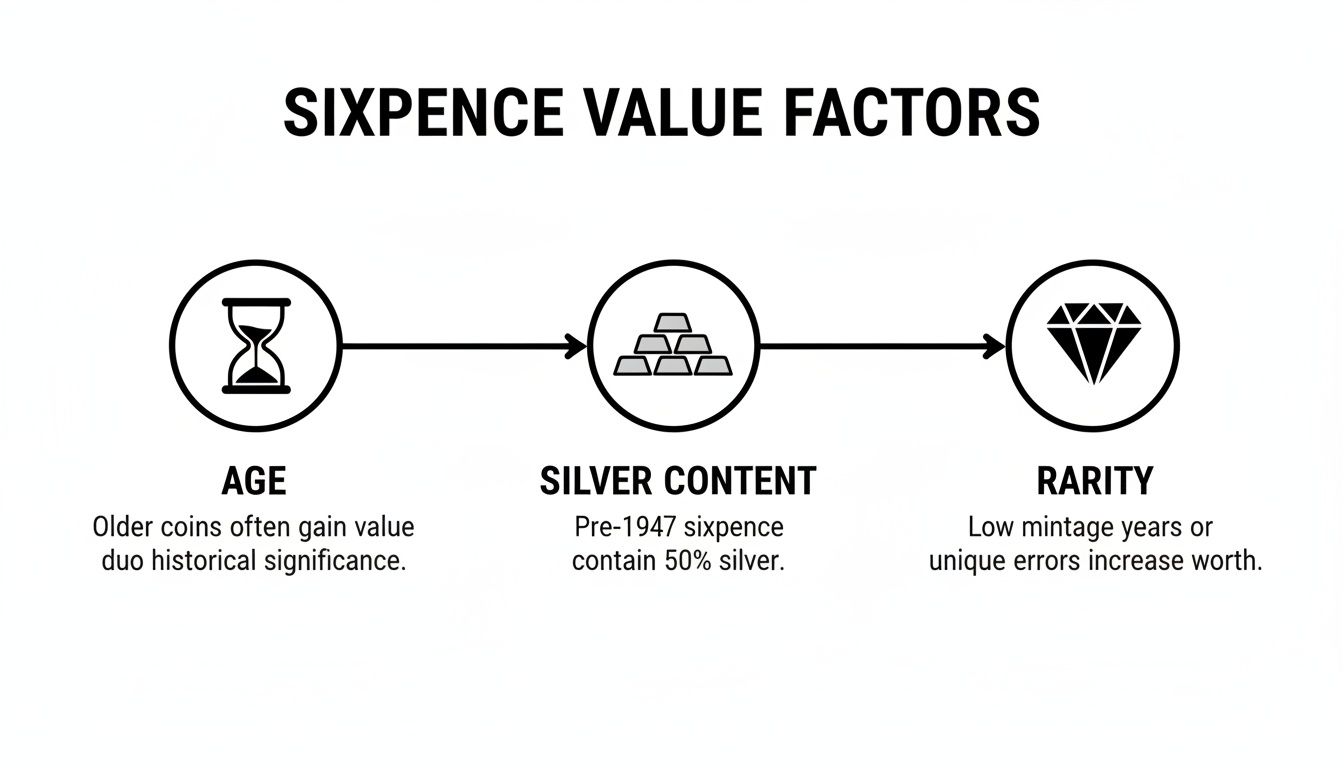 As you can see, the major shifts in the coin's composition line up perfectly with major world events. For a collector, understanding this is key to assessing its worth.
A Cherished Symbol
Despite all these changes, the public's love for the sixpence never faded. It became a powerful good luck charm, famously tucked into a bride’s shoe as part of the "Something old, something new" wedding tradition.
The cultural significance of the sixpence adds a layer of sentimental value that often elevates its collectability beyond its physical composition. Its role as a lucky charm ensures a constant demand from people outside the traditional numismatic community.
This affection was so strong that even after Britain went decimal in 1971, the sixpence wasn’t immediately scrapped. It was re-tariffed at 2.5 new pence and, due to huge public demand, remained legal tender all the way until 1980. This unique legacy is a crucial part of its story, adding to its cultural appeal and influencing what a collector is willing to pay.
You can delve deeper by exploring a brief history of British coins and their evolution. Understanding this timeline isn't just trivia; it’s the first step to becoming a truly knowledgeable collector.
Identifying Key Dates and Rulers for High Value
Not every sixpence you stumble across will be a hidden treasure. The real secret to unlocking a coin’s potential lies in its date and the monarch it features. This is where you graduate from being a casual owner to a knowledgeable collector, learning to spot the subtle clues that separate a common coin from a rare find.
Think of mintage figures—the number of coins produced in a given year—as a simple measure of supply. When millions of coins are struck, the supply is high, and the value for a regular, circulated example stays low. On the flip side, a year with a low mintage creates scarcity, which in turn drives up demand and price. It’s the most fundamental rule of the coin market.
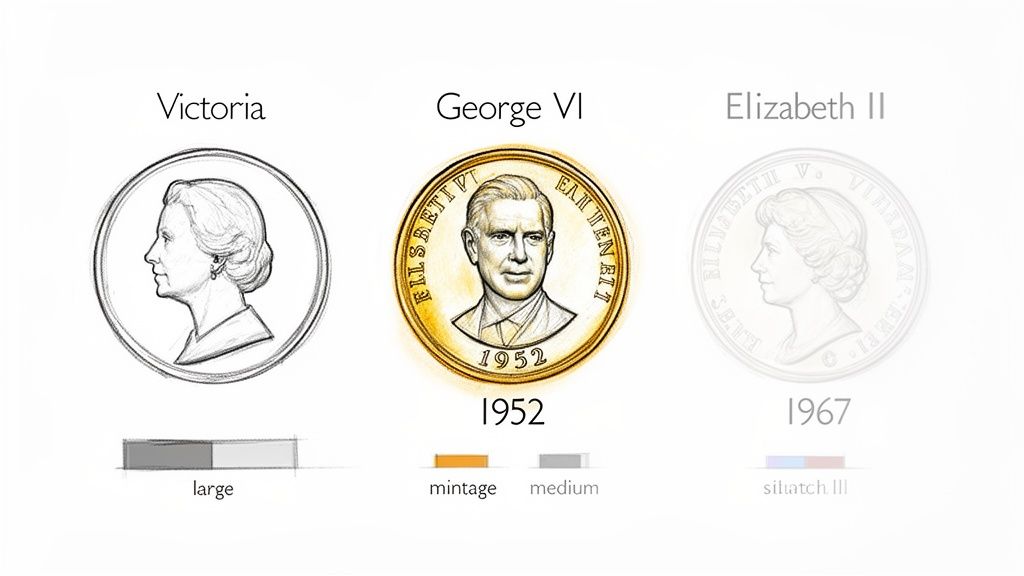
This simple principle is why a 1967 Elizabeth II sixpence is incredibly common, while certain Victorian or Edwardian dates are much tougher to track down. History, war, and economic conditions all had a say in how many coins the Royal Mint produced each year.
The Reigns That Matter Most
Certain monarchies are hotspots for valuable sixpences. Collector interest often gravitates towards specific periods, whether for their historical importance, beautiful designs, or the simple rarity of the coins themselves.
- Queen Victoria (1837-1901): Her long reign saw several different designs, including the popular 'Young Head', 'Jubilee Head', and 'Old Head' portraits. While many dates are common, finding any Victorian sixpence in top-notch condition is a real challenge, making well-preserved examples quite valuable.
- Edward VII (1901-1910): A shorter reign means fewer years of production. While not exceptionally rare, his coins are popular among collectors trying to build a complete set of British monarchs.
- George V (1910-1936): This reign is a perfect example of how mintage figures tell a story. For instance, production went through the roof in 1927 when a staggering 68,939,873 sixpences were minted to meet the demands of post-WWI Britain. This makes the 1927 date very common in circulated grades. You can learn more about the history of the British sixpence on Wikipedia).
By focusing on these key periods, you can start sifting through a mixed bag of coins with a much more discerning eye.
Pinpointing Specific Key Dates
Beyond just the monarch, specific dates can turn an ordinary coin into a real prize. These are the dates that get a collector's heart racing, where the value is driven almost entirely by extreme scarcity.
A prime example is any sixpence from the reign of Edward VIII. He abdicated in 1936 before any of his coins officially entered circulation, so any genuine patterns that exist are exceptionally rare and valuable.
The Holy Grail of Modern Sixpences: The 1952 George VI If there's one date modern collectors dream of finding, it’s 1952. King George VI passed away in February of that year, and the production of coins bearing his portrait was stopped immediately. Crucially, no sixpences from 1952 were ever released into circulation in the United Kingdom.
The only coins made were a tiny batch destined for overseas territories, primarily Jamaica. This twist of fate created one of the greatest rarities in the entire sixpence series. Finding a genuine 1952 sixpence is the numismatic equivalent of finding a needle in a haystack; authenticated examples command prices well into the thousands of pounds.
While you’re unlikely to find a 1952 sixpence in an old change jar, its story perfectly illustrates how a unique historical event can create immense value. It teaches us to always check the date, because you never know what rare story you might uncover. Learning to spot these key rulers and dates gives you the confidence to assess any sixpence and understand its true potential.
How to Grade Your Sixpence Like an Expert
Forget age and rarity for a moment. The single biggest factor driving a sixpence’s value is its physical condition. It’s the truth of the hobby: a common-date coin in pristine, untouched condition can easily fetch more than a rare one that’s been knocked about in circulation for decades.
Learning to grade a coin is like learning to read its life story. It’s the key to truly understanding how much a sixpence coin is worth. Think of it like two classic cars rolling off the same production line. One is driven every day for 50 years, picking up dents, rust, and scratches. The other is tucked away in a climate-controlled garage, never seeing the road. Their values will be worlds apart, and the exact same principle applies to coins.
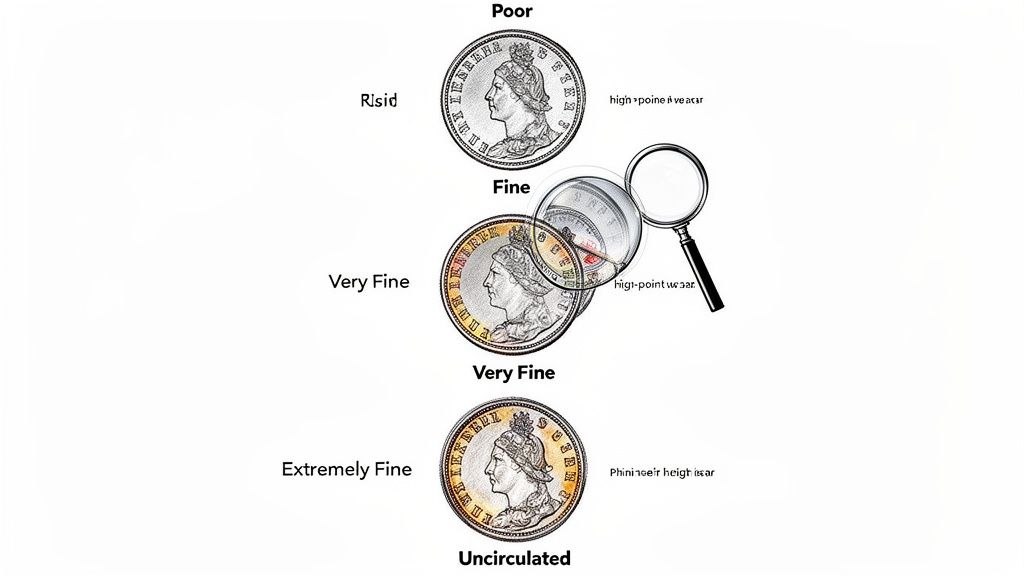
This section is your practical guide to grading. We'll demystify the official scales and show you how to spot the subtle differences that can multiply a coin’s price. You don't need to be a seasoned professional to start; you just need to know what to look for.
Understanding the Main Coin Grades
Coin grading is a spectrum, but collectors rely on a few key grades to classify a coin's state of preservation. As a coin is passed from hand to hand, the highest points of its design—think the monarch's hair or the delicate lines on a shield—are the first to show wear.
Here are the most common grades you'll come across:
- Fine (F): The main design is clear, but there’s significant and obvious wear across the whole coin. The monarch's portrait will look quite flat, with most of the fine details smoothed away.
- Very Fine (VF): A big step up from Fine. You’ll see much more detail here, with around half of the original intricate details still present, especially in the more sheltered parts of the design.
- Extremely Fine (EF): This coin shows only light wear, and you’ll usually only see it on the very highest points of the design. The overall look is sharp, with nearly all the mint's original detail intact.
- Uncirculated (UNC): This is for a coin that looks just as it did the day it left the Royal Mint. It shows no signs of wear whatsoever, though it might have tiny imperfections like small scuffs (called "bag marks") from contact with other coins during production.
Learning to tell these grades apart is a fundamental skill. For a deeper dive, our expert guide to British numismatic value offers more detailed insights into the finer points of UK coin grading.
To help you get your eye in, here's a quick reference table showing what to look for on a typical sixpence.
Sixpence Coin Grading Guide
This table provides a practical overview of what defines each grade when you're looking at a sixpence. Pay close attention to the high points of the monarch's portrait and the details on the reverse.
| Grade | Description of Wear | Key Details to Check | Typical Value (Common Date) |
|---|---|---|---|
| Fine (F) | Heavy wear, major details are flat but legible. | Monarch's hair is mostly flat. Wreath or shield details are worn smooth. | £1-£2 |
| Very Fine (VF) | Moderate wear, but still has some clear detail. | Some strands of hair are visible. Leaves in the wreath show some shape. | £3-£5 |
| Extremely Fine (EF) | Light wear only on the highest points. Sharp overall appearance. | Most hair detail is sharp. Shield or wreath details are clear. | £8-£15 |
| Uncirculated (UNC) | No wear at all. Looks brand new, often with original mint lustre. | Full, sharp detail everywhere. A visible sheen (lustre) across the surfaces. | £20+ |
This is a general guide, of course. A rare date in Fine condition will still be worth more than a common date in Uncirculated, but it shows just how much condition alone can multiply a coin’s value.
Beyond Wear: What Else to Look For
While wear is the main factor in grading, other characteristics can make or break a coin's appeal and value. A skilled collector learns to spot more than just scratches.
The Golden Rule of Coin Collecting Whatever you do, never clean your coins. Cleaning strips away the coin's natural surface, known as its patina, and leaves behind tiny, abrasive scratches. This permanently damages the coin and can reduce its value to almost nothing in the eyes of a serious collector.
Here are a few other key terms to get familiar with:
- Lustre: This is that original satiny sheen a coin has when it’s freshly minted, caused by light reflecting off microscopic flow lines in the metal. A true Uncirculated coin will have full, unbroken lustre.
- Toning: This is the natural colour a coin develops over time from reacting with its environment. Toning can range from a light golden hue to deep, iridescent blues and purples. While ugly, patchy toning can hurt the value, attractive, even toning can sometimes increase it.
- Bag Marks: These are the small nicks and scratches an Uncirculated coin gets from bumping against other coins in the large cloth bags used to transport them from the mint.
Take Queen Elizabeth II's sixpences from 1953 to 1967. The mintages were huge, with an incredible 240,788,000 struck in 1967 alone. Most circulated examples you find are only worth around £2. But find one in a flawless, Uncirculated state with full mint lustre? It instantly becomes a desirable collector's piece worth significantly more.
Learning to spot these subtle but crucial details is what separates a casual owner from a knowledgeable collector—and it's the secret to accurately assessing your sixpence to unlock its true value.
The Smart Way to Sell Your Sixpence Coins
Once you've got a good handle on your sixpence's history and grade, you might be thinking it’s time to sell. Knowing how much a sixpence coin is worth is the first step, but turning that potential into cash requires a bit of strategy. This section will give you a clear roadmap to getting the best possible price for your coins.
Choosing the right place to sell is your first big decision. Your options generally fall into three camps, each with its own pros and cons. The best choice really depends on the type and value of the sixpence you’re holding.
Choosing Your Selling Platform
Not all sales venues are created equal. A common cupronickel sixpence has a very different ideal market than a high-grade Victorian silver piece, and you need to pick your platform accordingly.
-
Online Marketplaces (like eBay): These platforms give you incredible reach, putting your coin in front of thousands of potential buyers all over the world. They’re a great fit for common-date coins, circulated silver sixpences, and 'lucky' sixpences that people buy for weddings. The catch is that you’re in charge of everything: taking photos, writing descriptions, handling payments, and shipping. Fees can also take a bite out of your final profit.
-
Specialist Coin Dealers: A reputable dealer brings expertise and convenience to the table. They can assess your coin accurately and will often make you a direct offer. This is an excellent path for higher-value coins where an expert appraisal is a must. While the offer might be a little less than you could get at auction, the process is quick, secure, and completely hassle-free.
-
Auction Houses: For the truly rare or exceptionally high-grade sixpences (think a 1952 George VI), a specialist numismatic auction house is your best bet. These houses have established networks of serious collectors who are ready to pay top prices for premium items. The auction house handles all the marketing and logistics, but they will take a significant commission in the form of a 'buyer's premium' and a 'seller's fee'.
Understanding these options helps you match your coin to the right audience, which is key to a successful sale.
Preparing Your Coins for a Successful Sale
How you present your sixpence can make a huge difference to its final sale price, especially online where a buyer can’t inspect it in person. Good preparation is everything.
First and foremost, your photography has to be on point. Use natural, indirect light to avoid any glare. Take clear, high-resolution photos of both the front (obverse) and back (reverse) of the coin. It’s also a good idea to photograph the edge, as this can sometimes show important details. Your goal is to capture the coin's true condition, showing off its details without trying to hide any flaws.
The Golden Rule of Selling Coins Never, ever be tempted to clean your coins. Cleaning strips away the natural surface patina and leaves behind tiny, abrasive scratches that are immediately obvious to a trained eye. This permanently damages the coin and can completely destroy its numismatic value. A naturally toned, uncleaned coin is always more desirable than a harshly cleaned one.
When you're selling valuable coins online, secure shipping is absolutely essential. When shipping your items, understanding what is proof of delivery becomes crucial for protecting both yourself and the buyer, ensuring the transaction is secure from start to finish.
Finally, write an honest and detailed description. Mention the year, monarch, and what you believe its grade to be (e.g., "appears to be in Very Fine condition"). The more accurate and transparent you are, the more confidence you’ll build with potential buyers.
For a complete walkthrough of the process, you can find more tips in our guide on how to sell a coin. By following these steps, you present your sixpence professionally, ensuring you attract the right buyers and achieve the best possible price for your piece of history.
Sixpence FAQs: Your Questions Answered
As we get to the end of our deep dive into the world of the sixpence, it’s only natural that a few questions might still be swirling around. We get asked about these little coins all the time, so we’ve put together the most common queries to clear up any final points.
These quick-fire answers should give you the confidence to assess any sixpence you come across.
Are All Sixpence Coins Made of Silver?
No, they aren't, and this is probably the most important factor affecting a sixpence’s baseline value. The metal used to make these coins changed dramatically over the years, and the date on the coin tells you everything you need to know. Crucially, only sixpences minted before 1947 have any silver in them at all.
Here’s a quick rundown of the key dates:
- Pre-1920: These are the most sought-after from a purely metallic standpoint. They are made from 92.5% sterling silver.
- 1920–1946: In the economic turmoil following the First World War, the silver content was slashed to just 50%.
- 1947 Onwards: Silver was removed completely. From this point on, all sixpences were made from cupronickel (a mix of copper and nickel) and have no precious metal value.
Checking the date against this timeline should always be your first step.
What Is the Lucky Sixpence Tradition?
Ah, the "lucky sixpence"! It’s a lovely British tradition that has really cemented the coin's place in our culture, quite separately from its value to a collector. Most people know the old wedding rhyme: "Something old, something new... and a silver sixpence in her shoe." The custom was believed to bring the bride good fortune and a wealthy marriage.
It wasn't just for weddings, either. Finding a sixpence in your Christmas pudding was a sign of good luck for the year ahead, and they were often given as christening gifts.
This enduring cultural significance creates a steady demand for sixpences from people who aren't coin collectors. Many seek them out for sentimental reasons, especially for weddings, which helps keep the market for common-date coins ticking over nicely.
Does Cleaning a Sixpence Increase Its Value?
Absolutely not. In fact, it’s one of the worst things you can do to an old coin. Cleaning will almost certainly destroy its value to a serious collector. Experienced numismatists look for a coin’s natural patina—that subtle toning and surface character that builds up over decades. It's the visual proof of its age and history.
Scrubbing or polishing a coin strips this story away, often leaving tiny, hairline scratches and a harsh, unnatural shine that stands out a mile to a trained eye. Always, always leave your coins as you found them.
How Should I Sell My Sixpence Coin?
The right way to sell your sixpence really depends on what you have. For very common cupronickel coins or silver ones in poor condition, online marketplaces like eBay can be a good way to reach a wide audience.
However, if you think you might have something special—a rare date, a key variety, or a coin in Extremely Fine (EF) or Uncirculated (UNC) condition—then you should really speak to a professional. A trusted coin dealer or a specialist auction house can give you an accurate appraisal and help you reach serious collectors who are prepared to pay a proper premium for quality pieces.
Whether you're trying to identify a family heirloom, sell a collection, or track down that one elusive coin for your set, the experts at Cavalier Coins Ltd are here to help. Feel free to browse our wide selection of rare coins and banknotes or get in touch for a professional valuation. Visit us today at https://www.cavaliercoins.com.