
It's a question we get asked all the time: are any of my one pound coins worth more than face value? The short answer is yes, absolutely. But the longer, more useful answer is that while a few are worth a pretty penny, the vast majority are still just worth £1.
The real trick is knowing how to spot the difference. Finding a valuable £1 coin isn't about luck; it's about knowing what to look for. Certain designs, tiny minting mistakes, or historically important issues can turn that everyday coin into something collectors will pay a premium for.
Discovering Which Pound Coins Are Worth Money
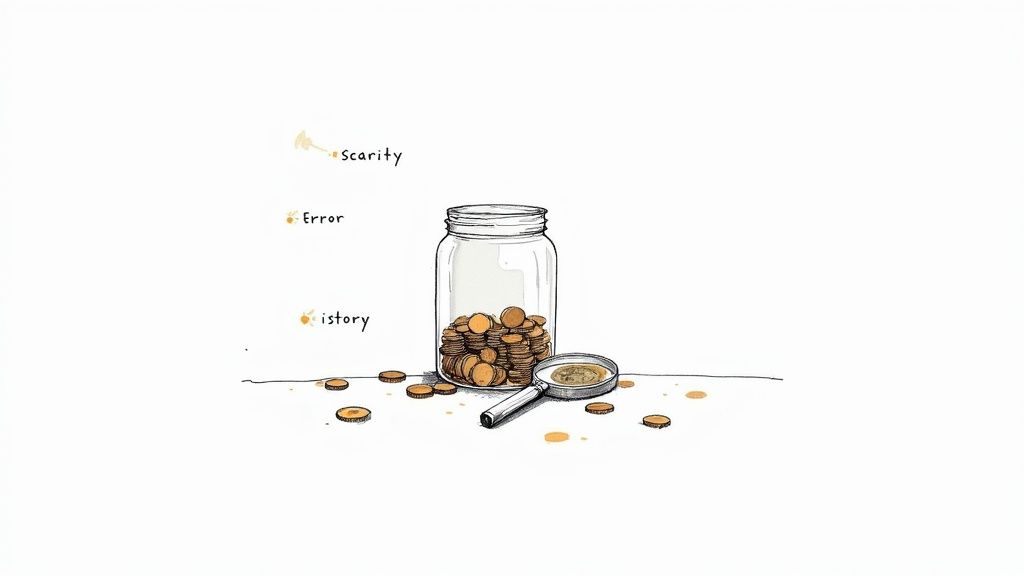
Ever found yourself staring at a handful of change, wondering if you're holding onto a small fortune? Most of the time, a pound is just a pound. But every now and then, a truly special one slips into circulation.
Think of it like finding a first-edition book tucked away on a shelf of modern paperbacks. To the untrained eye, it's just another book. But to someone who knows what they're looking for, its rarity transforms it from ordinary to exceptional. The same principle applies in the world of coin collecting, or numismatics.
A few key factors are the secret sauce that elevates a simple piece of metal from pocket change into a collector's prized possession. Once you get a handle on these, you'll know exactly what to look for when you're sorting through your change jar.
Key Drivers of a £1 Coin's Value
So, what separates a standard quid from one that gets collectors excited? It almost always boils down to a few core traits that drive up demand.
The table below gives you a quick snapshot of the most important things to look for.
Top Factors That Increase A £1 Coin's Value
| Factor | What It Means For Collectors | Example |
|---|---|---|
| Low Mintage | The Royal Mint produced very few of a particular design. Fewer coins in existence means higher rarity and demand. | The 2011 Edinburgh City coin, with only 935,000 minted. |
| Minting Errors | A mistake was made during production, like an incorrect date, a misaligned strike, or mismatched designs (a "mule"). | A coin struck on the wrong type of metal or with a double-stamped design. |
| Significance | The coin commemorates a major event or has regional importance, often with a limited production run. | The 2010 London City coin, which had a very low mintage and is part of a popular series. |
Essentially, the value of a coin is all about supply and demand. If a coin has a tiny mintage figure, an interesting error, or belongs to a sought-after series, more collectors will be chasing fewer coins. That's what pushes the price up.
By focusing on these factors, you can quickly learn to spot the coins that have the greatest potential value. It’s less about luck and more about knowing which patterns and dates to watch for.
This guide is your starting point for spotting these hidden gems. If you want to dive deeper, you can explore this detailed list of valuable one pound coins to see exactly which treasures might be hiding in your pocket.
What Makes A One Pound Coin Truly Rare
Ever pulled a £1 coin from your change and wondered if it’s special? You might have two that look almost identical, yet one could be worth a tenner while the other is just a pound. What gives? The answer isn't some secret code; it all comes down to a few key ideas that drive the entire world of coin collecting.
Get your head around these concepts, and you'll be well on your way to spotting a genuine treasure in your pocket.
The single biggest factor, without a doubt, is mintage. This is simply the number of coins of a particular design and year that The Royal Mint produced for circulation. The rule is simple: the lower the mintage, the rarer the coin.
Think of it like concert tickets. A small, intimate gig with only 1,000 tickets is going to be a much tougher ticket to get than a stadium show with a million seats. The same logic applies directly to one pound coins. A design with a tiny production run is immediately on the radar for collectors.
The Power of Scarcity
When The Royal Mint issues a new coin, the number they make can be all over the place. Some commemorative designs might have a mintage of 20 million or more, making them common as muck. But others? They’re produced in much smaller batches, sometimes under a million.
These are the ones you need to keep an eye out for. A classic example is the 2011 Edinburgh City £1 coin, which had a mintage of just 935,000. Now, compare that to the workhorse Royal Arms £1 from 1983, of which a staggering 443 million were minted. Suddenly, you can see why that Edinburgh coin is a prize.
Key Takeaway: A coin's rarity is almost always tied to its mintage figure. If you think you've found something interesting, the first thing you should do is check its mintage. It’s the most reliable clue you have.
Understanding the different factors that can drive up a coin's worth is a huge part of the fun. You can dig deeper into the core principles of rare coin values to really build up your knowledge.
Beyond Mintage: Minting Errors
While mintage is king, it's not the only game in town. Every now and then, something goes a bit wrong during the production process at the mint, creating what we call minting errors. These are the happy little accidents of the coin world.
Think of it like a stamp printed with a plane flying upside down. The mistake is what makes it unique and, for collectors, incredibly desirable. These aren't fakes; they are genuine coins that just happened to escape the mint with a quirky flaw.
A few common types of errors you might encounter include:
- Off-Centre Strikes: The design isn't stamped dead in the middle of the coin, leaving a blank, crescent-shaped area on one side.
- Die Cracks: A tiny crack in the die (the stamp) leaves a raised, jagged line on the coin's surface.
- Mules: This is the big one. A "mule" is a very rare and valuable error where a coin is struck with two different dies that were never meant to be paired. For example, the "heads" side from one coin design is matched with the "tails" side of a completely different one.
Finding a genuine error coin is like finding a needle in a haystack, but it absolutely happens. These ‘mistake’ coins often fetch far higher prices than their perfectly-made brothers and sisters, purely because they are so exceptionally rare.
Regional Designs and Special Editions
Another thing that creates scarcity is the release of coins specific to the UK's home nations. Over the years, The Royal Mint has issued wonderful series celebrating England, Scotland, Wales, and Northern Ireland, often with beautiful, symbolic designs.
These territorial series tend to have much lower mintage figures than the standard, UK-wide designs. Collectors are often passionate about completing these sets, which pushes up demand—and prices—for the harder-to-find coins in the series. The "Capital Cities" set, for instance, contains some of the most sought-after round pounds precisely because certain cities had very small production runs.
At the end of the day, finding valuable £1 coins starts with understanding these fundamentals. If you combine a bit of knowledge about mintage figures, keep a sharp eye out for unusual errors, and get to know the special regional sets, you can turn a simple pocketful of change into a proper treasure hunt.
The Most Valuable Round £1 Coins To Find
Before the sleek 12-sided £1 coin landed in our pockets back in 2017, the classic 'round pound' was the king of British change for over thirty years. While most of these older coins are now just keepsakes with a face value of one pound, a select few are genuine collector's items. These are the coins that can turn a rummage through an old piggy bank into a proper treasure hunt.
Their value boils down to one simple factor we've already touched on: low mintage. The Royal Mint simply didn't produce huge numbers of them, making them scarce from day one. This scarcity is exactly what makes certain designs the crown jewels of any one-pound coin collection.
The following infographic gives you a great visual on how a coin's mintage directly affects its rarity and, ultimately, its potential value.

As you can see, a lower production number sends a coin's rarity through the roof. This makes it far more desirable for collectors trying to track down those elusive final pieces for their sets.
The Famous Capital Cities Series
Some of the most sought-after round pounds come from the "Capital Cities" series, which celebrated the four capitals of the United Kingdom. Three of these coins were minted in exceptionally low numbers, instantly making them the ones to watch out for.
-
2011 Edinburgh City: This is often seen as the holy grail for collectors of circulating £1 coins. Featuring the city’s coat of arms, it had a tiny mintage of just 935,000. Its incredible scarcity means it can command prices between £10 to £20 even in good circulated condition.
-
2011 Cardiff City: Representing the Welsh capital, this coin also has a very low mintage of 1,615,000. Showcasing the Cardiff coat of arms, it's another key piece for any serious collection, typically valued between £8 and £15.
-
2010 London City: The first of this rare trio, this coin features the crest of the City of London. With a mintage of 2,635,000, it's a bit more common than its Edinburgh and Cardiff cousins but still highly desirable, often fetching £5 to £10.
You might be wondering about the fourth coin. The 2010 Belfast City coin had a much higher mintage of over six million, which makes it far more common and generally only worth its face value.
Other Notable Rare Round Pounds
Beyond the famous capitals, a few other designs stand out because so few were made. Finding any of these in your change would be a very good day indeed.
The 2008 Royal Arms
This coin is a fascinating anomaly. The Royal Arms design is usually one of the most common you'll find, but the 2008 version had a surprisingly low mintage of only 3.9 million. This makes it the rarest of its type and a sleeper hit among collectors, often valued at £4 to £7.
The 2014 Thistle and Bluebell (Scotland)
Part of the final floral series for the home nations, the Scottish Thistle and Bluebell coin from 2014 is another one to look for. Its mintage was 5.1 million, making it less common than the English, Welsh, and Northern Irish coins from the same series. You can expect it to be worth around £3 to £5.
These specific low-mintage coins are valuable precisely because they are genuine and scarce. This contrasts sharply with the issue of counterfeit round pounds, which were surprisingly common before 2017.
The prevalence of fakes became a huge headache for the UK's currency system. By 2013, The Royal Mint estimated that fake £1 coins made up about 3.04% of all £1 coins in circulation, with rates even higher in some areas. This widespread issue undermined public confidence and was a key reason for introducing the more secure 12-sided coin. You can dive deeper into this challenge and find detailed stats on The Royal Mint's official website.
Your Checklist For Valuable Round Pounds
When you're sorting through a jar of old round pounds, keep this quick reference guide handy. It lists the top coins to look for, their mintage figures, and a realistic value you might expect to get if you decide to sell one.
| Coin Design | Year | Mintage Figure | Estimated Value (Circulated) |
|---|---|---|---|
| Edinburgh City | 2011 | 935,000 | £10 – £20 |
| Cardiff City | 2011 | 1,615,000 | £8 – £15 |
| London City | 2010 | 2,635,000 | £5 – £10 |
| Royal Arms | 2008 | 3,910,000 | £4 – £7 |
| Thistle & Bluebell | 2014 | 5,185,000 | £3 – £5 |
Just remember, these values are for coins you'd find in your change – good, circulated condition. Any pieces that are in exceptional, near-uncirculated condition could be worth significantly more to the right collector. Happy hunting
Rare 12-Sided £1 Coins In Circulation Today
When The Royal Mint rolled out the new 12-sided £1 coin back in 2017, it felt like the end of an era for change-checkers. Billions of these shiny new coins flooded the country to replace the old round pounds, and it was easy to think that "new" automatically meant "common."
But that’s a myth that’s ripe for busting.
Even with these massive production figures, certain years and oddball errors have created a whole new generation of valuable one-pound coins. Treasure hunting isn’t just about digging through dusty old jars anymore; it’s happening right now, with sought-after coins still waiting to be found in your pocket. As always, the trick is knowing exactly what to look for.
Low Mintage Years To Watch For
The initial 2017 launch saw a staggering 1.5 billion new £1 coins pour into circulation, but the years that followed tell a very different story. The Royal Mint only produces what’s needed, so when demand for new currency dips, they make smaller batches. This is what creates instant scarcity for collectors.
A perfect example is the 2022-dated £1 coin. This one is a big deal because it was the final year Queen Elizabeth II's portrait appeared on a circulating pound coin before the switch to King Charles III. With a mintage of just 7.735 million, it's a whole lot scarcer than its cousins from other years, making it a must-have for modern collectors.
But another coin has already smashed that record. The 2025 Bee £1 coin is officially the rarest circulating one-pound coin in the UK, with an unbelievably low mintage of just 170,000. To put that in perspective, the Mint released over 30.8 million new £1 coins in 2025, but this specific bee design is almost impossible to find. It’s the top prize for anyone checking their change. You can read more about the UK's current rarest coin and why its value is only expected to climb.
Modern Minting Errors
It's not all about mintage figures. The world of modern £1 coins is also full of fascinating—and valuable—minting errors. The coin's complex 12-sided, bi-metallic design actually creates more chances for things to go wrong at the mint. These slip-ups are what turn a regular coin into something special.
For a collector, an error isn't a flaw; it's a feature. A simple mistake during production can transform a coin worth one pound into a collectible worth many times more, all because it's unintentionally unique.
Some of the most common errors to keep an eye out for on 12-sided £1 coins include:
- Misaligned Dies: This happens when the heads (obverse) and tails (reverse) designs aren't lined up correctly. A noticeable rotation can make a coin quite valuable to the right collector.
- Dual-Dated Coins: A famous error from 2017 involves coins that were accidentally struck with a tiny micro-engraved date of 2016. These are genuinely rare and always fetch a premium.
- Planchet and Striking Errors: Every now and then, a coin is struck on a faulty planchet (the blank metal disc). Sometimes the inner silver-coloured core is missing completely, creating what collectors call a "fried egg" error.
These little quirks prove that even the most high-tech, secure coins aren't perfect. Paying close attention to the details of the coins you get in your change is the best way to spot one. The hunt for valuable pound coins is far from over; in many ways, it’s only just beginning.
How To Check Your Coins And Estimate Their Value
So, you’ve stumbled across a £1 coin that looks a bit different. Maybe it’s a design you don’t recognise, or perhaps you’ve heard the date has a low mintage figure. How do you turn that hopeful hunch into a real, confident valuation? The good news is, becoming your own coin assessor is easier than you might think. It just takes a little patience and a sharp eye for detail.
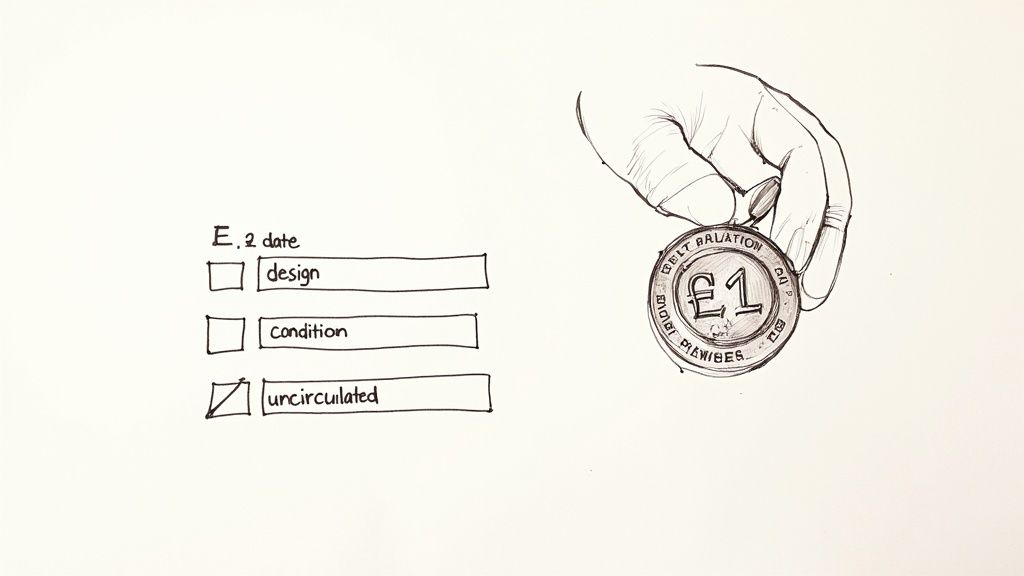
This isn’t about guesswork; it's a methodical process of checking a coin’s key features. By running through a few simple steps, you can quickly gather the clues needed to figure out if you're holding something special or just a standard pound.
Your Step-by-Step Inspection Checklist
Before you can figure out what a coin might be worth, you need to know exactly what you’ve got. Grab a magnifying glass if you have one—even the magnifier on your phone will do the trick—and find a good, bright light source. Here’s what to look for:
- Identify the Date and Design: This is your first port of call. The year the coin was minted is the most critical piece of information you need to check its mintage numbers.
- Examine the Overall Condition: Take a close look at the coin’s surface. Are the details sharp and clear, or have they been worn down by years in circulation? Keep an eye out for any major scratches, dings, or damage to the rim that could drag its value down.
- Search for Errors: Carefully inspect both sides. Look for anything that seems off, like a misaligned design, a slight rotation between the heads and tails (known as a 'rotated die' error), or any unusual marks left over from the minting process.
Understanding Coin Condition And Grading
In the world of coin collecting, the physical condition is everything. This is what we call its grade. While professional grading is a meticulous science, you can use a few basic categories to get a solid idea of where your coin fits in.
- Uncirculated (UNC): Think of a coin in perfect, mint condition. It looks brand new, showing no signs of wear at all, as if it just rolled out of The Royal Mint. These are usually found in special collector sets.
- Good Circulated: The coin shows some light wear on its highest points, but all the main details are still crisp and easy to see. This is often the best condition you can realistically hope for from your pocket change.
- Heavily Circulated: The design is worn and smooth, with many of the finer details faded or completely gone. Most older coins you find in daily use will fall into this category, which naturally lowers their value.
A coin's grade can have a massive impact on its final value. Two identical coins with the same low mintage date can have vastly different prices based purely on one being in pristine condition and the other showing heavy wear.
For those serious about getting a precise valuation, it’s worth exploring how to get coins graded professionally. This can be essential for any particularly rare or valuable finds.
Finding A Reliable Market Value
Once you know your coin's date, design, and general condition, it’s time to see what the market thinks it’s worth. Remember, a coin is only ever worth what someone is willing to pay for it.
A fantastic place to start is by checking the 'sold' listings on online marketplaces like eBay. This is crucial because it shows you the real-world prices that people have actually paid for coins similar to yours, not just what sellers are asking for.
Historical context can also be a huge factor. Take the 2022-dated £1 coin, for example. It’s highly collectible as it was the last one to feature Queen Elizabeth II before King Charles III's portrait was introduced. Its relatively low mintage of 7.735 million makes it a key coin for modern collectors, marking a major transition in UK currency.
To get a feel for how value is determined across different types of collectibles, you might even find some surprising parallels in a practical pricing guide for meteorites.
Common Questions About Valuable £1 Coins
As you dive into the world of coin collecting, it’s only natural for questions to pop up. The hunt for valuable one-pound coins can feel a bit complex at first, but getting a few clear answers can make all the difference. We’ve pulled together some of the most common queries to clear things up and get you started with confidence.
Think of this as your go-to guide for those practical "what if" moments, from what to do with a potential rare find to the best places to sell.
Are 'Trial' £1 Coins From 2016 Valuable?
Yes, a genuine 2016 trial £1 coin can be quite valuable, but you have to tread very carefully here. These coins were never meant for your pocket money. They were sent out to businesses across the UK to help them recalibrate vending machines and other equipment before the new 12-sided coin officially launched.
Of course, some of these trial pieces slipped through the cracks and found their way into public hands. While authentic trial coins are highly sought-after by specialists, the market is unfortunately flooded with fakes. It's absolutely essential to get any suspected trial coin professionally authenticated before you start thinking about its value.
Does Cleaning Old £1 Coins Increase Their Value?
This is a big one, and the answer is a firm and absolute no. Whatever you do, you should never, ever try to clean your coins. Polishing or rubbing them, even gently, creates tiny microscopic scratches on the surface—something collectors call 'hairlines'. This damage can completely tank a coin's collectible value, sometimes slashing its worth by 90% or more.
To a serious collector, a coin's natural toning or 'patina'—that subtle colour it picks up over decades—is a beautiful sign of its history and originality. Always leave your coins exactly as you found them to preserve their story and their value.
The best way to handle them is by their edges, and then get them into safe storage.
Where Is The Best Place To Sell A Rare £1 Coin?
Your selling strategy really depends on what you've got. For the more common-but-still-rare coins that might be worth between £5 and £20, an online marketplace like eBay can be a great option. A top tip is to always check the 'sold' listings to see what people are actually paying for them, not just the hopeful asking prices.
However, if you think you have a truly rare or high-value coin, your best bet is to talk to a reputable coin dealer or an auction house. They offer professional grading and can connect you with serious buyers who are prepared to pay a premium. It’s the safest way to ensure you get the best possible price for a special find.
What Is A 'Mule' Coin And Are There £1 Mules?
A 'mule' is one of the most exciting and rare types of error coins you can find. It happens when a coin is accidentally struck with mismatched dies. In simple terms, the heads (obverse) design and the tails (reverse) design are from two completely different coins that were never supposed to be paired together.
One of the most famous modern examples is a 2014 'round pound' that was struck with the wrong floral emblem for its nation on the reverse. These kinds of errors are incredibly prized by collectors because they're so rare and have such a unique story. It’s a great reason to always check both sides of your coins carefully for anything that looks out of place for the date.
Whether you're looking to identify, value, or sell a rare find, Cavalier Coins Ltd offers the expertise and resources you need. Explore our extensive collection of world coins and banknotes or contact our team for specialist advice. Visit us at https://www.cavaliercoins.com to continue your collecting journey.