

Finding a fake pound coin in your change always feels a bit off, doesn't it? It’s a small, clunky reminder that the trust we place in our everyday cash isn't always foolproof. The problem of fake pound coins became a massive headache in the UK, especially with the old round £1 coin. This guide will walk you through how to spot them, starting with just how big the problem got – big enough to force a complete redesign of the coin.
The Enduring Problem of Fake Pound Coins
For decades, the round pound was a familiar sight in our pockets and purses. It was introduced back in 1983 and did its job well, but over time, its security features just couldn't keep up. Forgers got better, and the coin became an easy target. This wasn't a minor inconvenience; it snowballed into a genuine currency crisis.
As counterfeiters got more sophisticated, they churned out fakes that were good enough to fool most people. A flood of these dud coins entered circulation, making everyone from shopkeepers to collectors wary. The problem got so bad that it started to seriously undermine public confidence in the £1 coin itself.
A Flood of Forgeries
Just how bad was it? In the years before the new 12-sided coin appeared, the sheer number of fakes in circulation was staggering. The Royal Mint’s own estimates painted a grim picture of the challenge they were up against.
Before the new 12-sided coin launched on 28th March 2017, it was estimated that an incredible 1 in 30 £1 coins in circulation was counterfeit. That works out to roughly 3% of all 1,528 million round pounds out there at the time. You can dig into more of the data on the 12-sided coin's impact to see the difference it made.
That single statistic tells you everything you need to know about why a new coin was so urgently needed. For collectors and resellers, this period is a fascinating chapter in our recent numismatic history. It’s the reason you'll find a fair few duds in any large bag of old round pounds and why checking them is still so important.
Why This Still Matters Today
Even though the round pound was officially taken out of circulation in 2017, these fakes are still very much around. People find them in old coin jars, and charities are constantly finding them in donation buckets. Knowing how to spot a fake is a useful skill for anyone who handles old change.
This guide is here to give you the confidence to:
- Spot a counterfeit round pound coin quickly.
- Understand the security features that make the modern 12-sided coin so tough to fake.
- Protect yourself from accepting worthless metal.
- Appreciate the story behind one of the UK's biggest-ever currency shake-ups.
Learning a few simple checks turns that moment of doubt into a feeling of expertise. Whether you're sorting a collection, cashing up a till, or counting donations, you’ll know exactly what you’re looking at.
Why the Round Pound Was a Counterfeiter's Dream
To get good at spotting a fake, you first have to understand why the original round £1 coin became such a playground for forgers. When it first popped into our pockets back in 1983, its security was perfectly fine for the time. But over its thirty-odd years in circulation, technology moved on, and criminals got smarter, slowly unpicking its defences.
It’s a bit like having an old, simple lock on your garden shed. For years, it does the job. But eventually, determined thieves figure out how to pick it in seconds, making it pretty much useless. The round pound suffered the same fate; its simple, single-metal design was just too easy to copy on the cheap.
Simplicity Became Its Downfall
The biggest weakness of the old round pound was its very construction. It was made from a single nickel-brass alloy, which counterfeiters found relatively easy to mimic, at least well enough to fool someone in a hurry. Unlike the complex, bi-metallic coins we see today, forgers didn’t need state-of-the-art minting gear to churn out a believable copy.
This basic design meant that the key security features were also quite straightforward to imitate, even if the copies weren't perfect.
- Edge Lettering: On a real coin, the words inscribed around the edge are crisp and sharply defined. Fakes often had mushy, poorly spaced, or even wonky lettering.
- Milled Edges: The fine, vertical grooves around the coin’s edge were often a giveaway. On counterfeits, they could be shallow, uneven, or inconsistent.
- Design Detail: The intricate details on the Queen’s portrait and the various reverse designs often looked soft and lacked the sharp definition of a genuine coin—a classic sign of a poor-quality mould.
Combine these flaws with easily accessible metal casting and pressing technology, and you had a perfect storm. Forgers could mass-produce fakes that, while far from flawless, were just good enough to disappear into the noise of daily transactions.
How a Small Problem Became a National Crisis
As the forgers' methods got better, the number of pound coins counterfeit in circulation began to explode. What started as a minor nuisance soon spiralled into a full-blown currency crisis. Over its 34-year life, the round £1 coin became a sitting duck.
By May 2014, the situation was alarming. The Royal Mint estimated the counterfeit rate had hit a staggering 3.03% of all £1 coins in use. Decades of these fakes flooding the system meant that by the time it was finally withdrawn, a mind-boggling 1 in every 30 round pounds was a dud.
This wasn't just a few dodgy coins changing hands down the pub; it was a systemic problem that was chipping away at public confidence in our money. Every time someone handed you a £1 coin, there was a real risk it was just a worthless lump of metal.
This timeline shows just how the situation escalated, eventually forcing the coin out of circulation entirely.
Timeline of the Round Pound's Vulnerability
| Year | Event | Significance for Collectors and Resellers |
|---|---|---|
| 1983 | The round £1 coin is introduced, replacing the £1 banknote. | Marks the beginning of the coin's circulation life. Early-year coins are now of historical interest. |
| c. 2002 | The Royal Mint's surveys begin showing a steady rise in counterfeits, hitting around 1%. | This is the point where awareness of fakes starts to grow, making condition and authenticity checks more important for older coins. |
| 2009 | The counterfeit rate doubles to 2%, sparking wider media attention and public concern. | Increased scrutiny means more fakes were likely identified and removed, but also highlights the scale of the problem for anyone handling bulk coins. |
| 2014 | The rate hits an all-time high of 3.03%. The Treasury announces a new, highly secure 12-sided coin. | This announcement solidifies the historical context of the round pound's failure and signals its eventual demise, creating a new focus for collectors. |
| 2016 | The final round pound design, "The Last Round Pound," is issued. | This becomes a key date for collectors, marking the end of an era. Fakes of this specific design are less common but still exist. |
| 2017 | The new 12-sided £1 coin enters circulation. The round pound ceases to be legal tender on 15th October. | This is the cut-off date. Any round pounds acquired after this are purely for collection, and their authenticity is paramount to their value. You can learn more about this on a brief history of the pound coin. |
The escalating crisis left the Royal Mint with no choice but to act decisively. Tinkering around the edges wasn't an option; a complete overhaul was needed to slam the door on the counterfeiters for good. For collectors and resellers, this backstory is crucial. It explains the dramatic jump to the 12-sided coin and adds a fascinating, if slightly notorious, chapter to the story of any pre-2017 pound in your collection.
Your Guide to Spotting a Fake Round Pound
With millions of counterfeit round pounds still knocking about, knowing how to spot one is an essential skill for any collector or reseller. Think of it as developing a numismatist's eye; you’re learning to pick up on the subtle clues that separate a genuine Royal Mint coin from a cheap imitation. This hands-on guide will walk you through the key visual and physical checks, turning you into a confident authenticator in no time.
We'll break it down into simple, repeatable steps. The best part? You don’t need any special equipment—just your eyes, your hands, and a bit of know-how. By the end of this section, you'll have a mental checklist to run through whenever an old round £1 coin crosses your path.
This decision tree shows just how the round pound's older security features and the rise of new copying technology made it so vulnerable to counterfeiters.
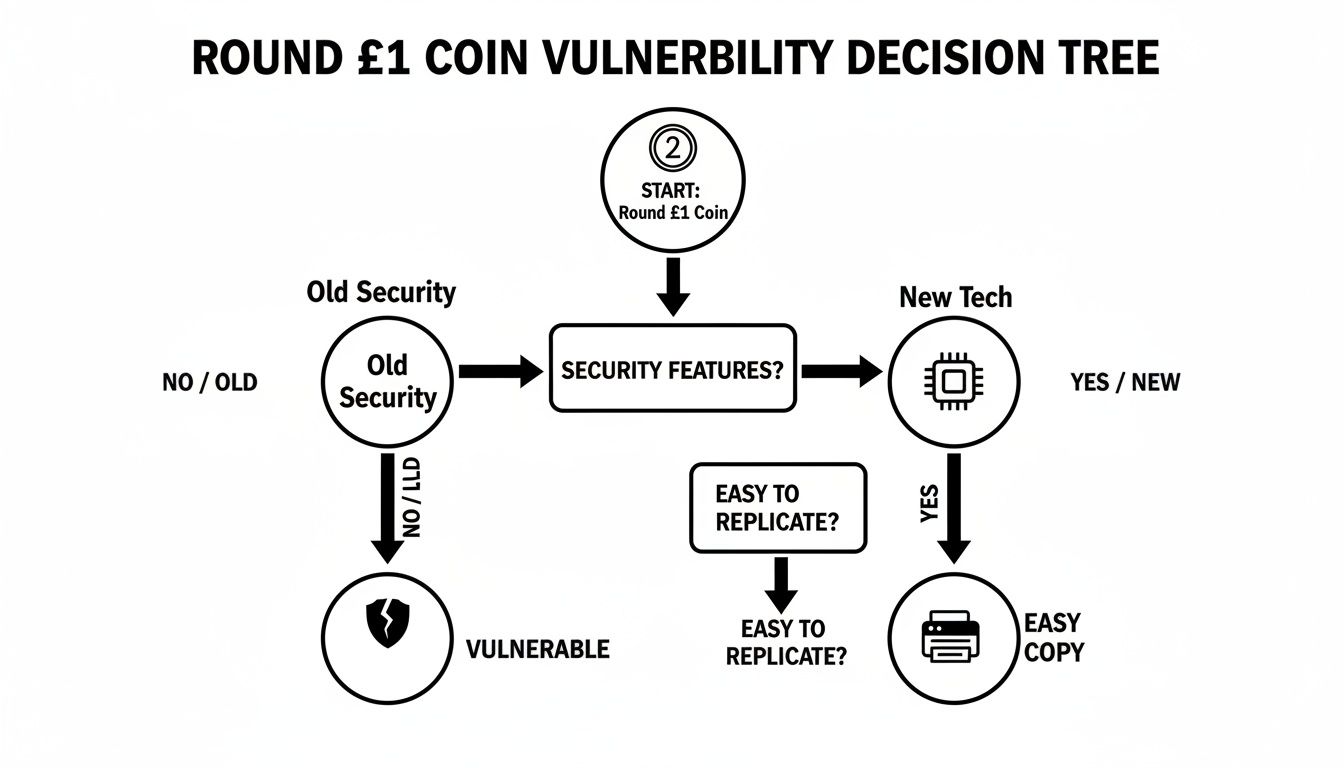
As you can see, the combination of outdated security and accessible tech created the perfect storm for forgery, leaving us with a mountain of fakes to sift through.
The Initial Visual Inspection
Your first port of call should always be a quick visual scan. Counterfeiters often cut corners, and their mistakes are usually plain to see if you know what you’re looking for. Hold the coin under a good light source and examine both sides closely.
A genuine round pound has sharp, well-defined details. Take a look at the Queen's portrait—the lines in her hair and the intricate details of the crown should be crisp and clear. Flip it over and inspect the reverse design; whether it's the Royal Arms or a thistle, every element should be distinct.
Many fakes just look "mushy" or soft, almost as if they’ve been poorly cast from a mould. The details blur together, and the whole coin has a flat, lifeless appearance compared to a real one. Also, check the colour. Fakes can have a strange, overly brassy shine or a dull, leaden look that just feels wrong.
Examining the Edge Lettering and Milling
The edge of a round pound is one of the biggest giveaways. The Royal Mint used this area for a key security feature: inscribed lettering. Depending on the year and design, it will have words like "DECUS ET TUTAMEN" ("An ornament and a safeguard") stamped into the edge.
On a genuine coin, this lettering is precise, evenly spaced, and perfectly formed.
- Counterfeit Flaw 1: The lettering on fakes is often a mess. You might see incorrect spacing, letters that are too shallow or too deep, or even glaring spelling mistakes.
- Counterfeit Flaw 2: The font is often wrong. Forgers rarely get the typeface exactly right, resulting in letters that look slightly "off" to the trained eye.
- Counterfeit Flaw 3: Check the milled (grooved) edges that flank the lettering. On a real coin, these are uniform and sharp. Fakes often have weak, uneven, or sometimes non-existent milling.
A classic mistake forgers make is with the coin’s alignment. Hold the coin with the Queen's head perfectly upright, then rotate it vertically between your fingers. The design on the other side should also be perfectly upright. If it's skewed at an angle, you've almost certainly got a fake on your hands.
Simple Physical Tests You Can Perform
Beyond just looking at it, a few simple physical tests can tell you a lot about a coin's authenticity. These tests work by exploiting the differences in metal composition and manufacturing quality between genuine coins and their dodgy copies.
First up is the weight and feel. A real round pound coin has a specific weight of 9.5 grams. Counterfeits made from cheaper metals often feel noticeably lighter, though some can be heavier. While you might not have a precision scale with you, with a bit of practice, you can get a good feel for the correct heft.
Next, try the sound test. Balance a coin you know is genuine on your fingertip and give it a gentle tap with another coin. It will produce a clear, ringing sound. Now, do the same with a suspected fake. Counterfeits often make a dull, clunking thud because they're made from softer, lower-quality base metals.
To help you put all this information together, here's a quick checklist comparing genuine coins to common fakes.
Genuine vs Counterfeit Round £1 Coin Checklist
| Feature | Genuine Coin Characteristic | Common Counterfeit Flaw |
|---|---|---|
| Overall Detail | Sharp, crisp, and well-defined designs on both sides. | "Mushy," soft, or blurred details; a flat appearance. |
| Colour & Lustre | Consistent, natural-looking nickel-brass alloy colour. | Often too shiny, too brassy, or has a dull, lead-like look. |
| Edge Lettering | Precise, evenly spaced, and correctly spelled text. | Messy, uneven spacing, spelling errors, or the wrong font. |
| Edge Milling | Uniform and clearly defined grooves. | Weak, inconsistent, or missing milled edges. |
| Die Alignment | Obverse and reverse designs are perfectly aligned (180°). | Misaligned designs when the coin is flipped vertically. |
| Weight | Specific weight of 9.5 grams. | Noticeably lighter or heavier than the official weight. |
| Sound | Produces a clear, high-pitched ringing sound when tapped. | Emits a dull "thud" or clunking noise. |
Running through these checks will give you a much higher degree of confidence when handling these older coins.
While this guide focuses on pound coins, the general principles of counterfeit detection apply widely. For instance, you can find valuable insights from resources offering tips to identify fake gold, which also rely on weight, sound, and visual checks. The techniques are often transferable, and for a deeper dive into more advanced methods, you can explore our detailed guide on detecting fake money.
By combining these visual and physical checks, you create a robust authentication process. No single test is foolproof on its own, but when a coin fails several of these checks, you can be highly confident that you're dealing with one of the many pound coins counterfeit still in existence.
How the 12-Sided Coin Became a Bimetallic Fortress
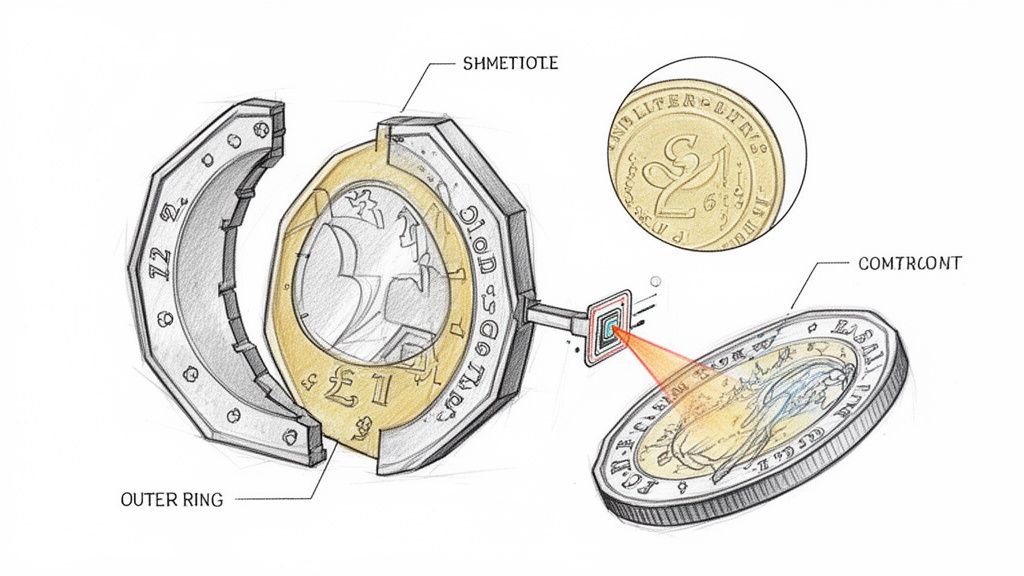
The spiralling crisis of the old round pound forced The Royal Mint to go back to the drawing board. Simply tweaking the old design wasn't going to cut it; they needed to create a coin so complex and layered with security that it would become a counterfeiter's worst nightmare.
The result, introduced in 2017, was the 12-sided £1 coin—a marvel of modern minting technology.
Think of it as upgrading from a simple garden shed padlock to a high-tech bank vault. While the old coin had one layer of defence, the new one has multiple, interconnected security systems. This multi-pronged approach is precisely why it’s been hailed as the most secure circulating coin in the world, effectively shutting down the widespread production of pound coins counterfeit.
The Strength of Two Metals
The most obvious change is the coin's bimetallic construction. It has a gold-coloured outer ring made of nickel-brass and a silver-coloured inner disc made of a nickel-plated alloy. This two-part design immediately presents a major hurdle for forgers.
Fusing two different metals together seamlessly requires specialised, high-pressure minting equipment that is far beyond the reach of a typical counterfeiting setup. Poor-quality fakes often show a visible gap or uneven seam between the two parts, or the colours look painted on and quickly wear away. The exact makeup of these metals is also a closely guarded secret. If you're interested in common coin materials, you can explore this detailed overview of what coins are made of.
Tiny Details with a Big Impact
Beyond its dual-metal body, the coin incorporates several subtle yet powerful features that are incredibly difficult to replicate accurately. These details are designed to be checked quickly by eye, providing an immediate layer of verification for anyone handling the coin.
- Micro-Lettering: Look closely at the inner rim of the coin. On the Queen's head side, you'll see tiny lettering spelling out "ONE POUND". On the reverse, the year of minting is inscribed in the same microscopic font. This lettering is so small and precise that it becomes blurred and unreadable on most fakes.
- A Latent Image: Below the Queen’s portrait is a small panel that works like a hologram. When you tilt the coin, the image changes from a '£' symbol to the number '1'. Replicating this effect requires advanced minting technology, and fakes either lack this feature entirely or have a static, poorly defined image that doesn't change.
These overt features act as the first line of defence, allowing the public and retailers to spot a dud with a simple glance and a tilt.
The new coin wasn't just designed to be secure; it was designed to make security accessible. By building in features that anyone can check in seconds, The Royal Mint empowered the entire country to become part of the fight against counterfeiting.
The Hidden Internal Fortress
The final layer of security is completely invisible to the naked eye. Embedded within the coin is a hidden material that can only be detected by high-speed, automated currency validation machines.
This top-secret feature allows banks, vending machines, and businesses to verify thousands of coins per minute with near-perfect accuracy. It’s the coin's ultimate trump card.
Even if a forger could somehow replicate the bimetallic design, the micro-lettering, and the latent image, their counterfeit would still be instantly rejected by any modern machine. It is this combination of visible and hidden security that makes the 12-sided pound a true bimetallic fortress, restoring trust in the UK's most iconic coin.
So, you’ve found a dodgy coin in your change. It’s an annoying situation to be in, and your first thought might just be to get rid of it. But what you do next matters, and there are some clear legal and ethical lines you shouldn’t cross.
The golden rule is simple: do not try to spend it or pass it on.
Knowingly using a counterfeit coin, even to palm off a small loss onto someone else, is a criminal offence. Think of it like finding out an electrical appliance is faulty and then selling it on eBay without mentioning the problem. You're knowingly passing on a risk – in this case, to the wider financial system. The law is very clear on this, and for good reason: it’s what stops fake money from flooding the market.
Your duty, then, is to take that fake coin out of circulation for good. It’s a small act, but it protects other people from getting ripped off and helps the authorities get a better picture of the scale of the problem.
The Correct Way to Hand It In
Once you're sure you have a fake, the right thing to do is straightforward. Just take the counterfeit coin down to your local police station.
They’ll likely ask you for any details you can remember about where and when you think you received it. Don't worry if you can't be specific; any little bit of information can be useful for their intelligence gathering. You’ll be given a receipt to prove you’ve handed it over.
Another option is to take it to your bank. They have a similar process, where they'll take the coin and give you an acknowledgement form before passing it on to the National Crime Agency. One thing to be clear on, though: you won't be reimbursed. A counterfeit has zero monetary value, and the loss, unfortunately, always lands on the last person holding it.
Surrendering a counterfeit isn't about getting into trouble; it's a civic duty. By handing it over, you are playing a small but crucial part in maintaining the integrity and security of the UK's currency.
A Special Case for Collectors
Now, for those of us in the world of numismatics, the perspective is a little different. For coin collectors, some fakes – especially older ones – are fascinating historical artefacts in their own right. These are what we often call ‘contemporary counterfeits’ – fakes that were made and used during the same period as the genuine coins they were copying.
There’s a clear line between illegally spending a fake and legally keeping one as a numismatic curiosity.
- Illegal Action: Trying to use the coin in a shop or selling it to someone as if it were the real deal.
- Legal Action: Keeping an identified counterfeit as part of a private collection, as long as it's clearly marked and stored separately from your genuine coins. The crucial thing here is your intent. You're preserving it as a piece of history, not with any plan to defraud someone.
If you’re a collector, this is an important distinction. These pieces tell a fascinating story about the economic pressures and criminal activities of a specific time. But be warned: if you ever decide to sell an item like this, you absolutely must describe it clearly and explicitly as a contemporary counterfeit. Anything less could be considered fraud. By being responsible, you protect yourself and the integrity of the hobby.
How Counterfeits Impact Coin Collectors and Resellers
For the passionate collector and the serious reseller, the sheer number of counterfeit pound coins out there presents both a risk and a fascinating challenge. The legacy of the fake round pounds, in particular, has left a permanent mark on the numismatic market. It’s turned what should be a simple transaction into an exercise in constant vigilance.
If you’re buying bulk lots of old £1 coins, perhaps from a charity collection or an estate sale, you can almost guarantee a certain percentage will be fakes. This reality hits your bottom line directly. A reseller can't just value a bag of 100 round pounds at £100; they have to account for the likely loss from weeding out the duds. In unsorted batches, this loss can be as high as 3-5%.
Authentication as a Cornerstone of Business
For anyone buying or selling coins for profit, being able to spot a fake isn't just a neat skill—it's non-negotiable. Trust is the most valuable currency we have in the numismatic world. Unknowingly passing on a fake, even by accident, can destroy a seller’s hard-earned reputation overnight. This is why every serious reseller must also be an amateur authenticator.
The skills we've talked about in this guide—checking the edge lettering, spotting poor die alignment, and feeling for the wrong weight—aren't just for hobbyists. They are essential business practices that protect your investment and your credibility. It's also why many professional dealers turn to third-party grading for high-value coins. If you want to dive deeper into this, you can learn about how to get coins professionally graded and understand the extra layer of security it provides.
In the world of coin collecting, knowledge is your best defence. Turning a blind eye to the possibility of counterfeits is the fastest way to devalue your collection and your reputation. Vigilance isn’t paranoia; it’s professionalism.
The Niche Appeal of Historical Fakes
Interestingly, some fakes actually have value in their own right. These are what we call ‘contemporary counterfeits’—forgeries made during the same period the genuine coins were circulating. Collectors seek these out as historical artefacts because they tell a unique story about a specific era's economy and its criminal underworld.
However, dealing in these items demands absolute transparency. They must be clearly and unequivocally sold as contemporary counterfeits, never to be mistaken for the real thing. While our focus here is on UK currency, the wider battle against fake goods requires robust defences across all markets. You can explore some effective strategies for brand protection against counterfeiters to see the bigger picture.
Ultimately, understanding the world of counterfeit pound coins is about turning knowledge into power. By applying these lessons, you can build your collection with confidence, navigate the risks, and appreciate the rich history—both genuine and illicit—that every coin represents.
Common Questions About Fake Pound Coins
When you're dealing with old coins, a few questions always pop up, especially with the notorious counterfeit round pounds. Let's clear up some of the most common queries so you can handle any fakes you find with confidence.
Is It Illegal to Keep a Counterfeit Pound Coin for a Collection?
This is a bit of a grey area, but generally, no. While it's absolutely illegal to knowingly spend a fake coin or pass it off as genuine, simply keeping one for a private collection isn't something law enforcement is concerned about.
The key is intent. The law is designed to stop people from defrauding others. If you have a fake coin that you’ve clearly identified and stored away from your main currency, you're not breaking the law. Just be sure you never try to sell it as the real deal or use it in a transaction. For collectors, these fakes are historical curiosities, and transparency is everything.
Can I Get My Money Back for a Fake Coin?
Unfortunately, the answer here is a firm no. Counterfeit currency has zero monetary value, so there's no way to get reimbursed for it. Once you've accepted a fake coin, you've taken the financial hit. It's a tough lesson, but it’s exactly why checking your change is so important.
Trying to get your money back by passing the fake coin to someone else isn't just unethical; it's a crime. The only right and responsible thing to do is to hand the counterfeit over to your local police or bank. They'll take it out of circulation for good.
Have They Faked the New 12-Sided Coin?
The Royal Mint really pulled out all the stops with the 12-sided £1 coin, and it's widely seen as one of the most secure coins on the planet. Its complex features—the two-metal design, tiny micro-lettering, the hologram-like latent image, and a hidden internal security feature—make it a nightmare for forgers to copy convincingly.
So far, we haven't seen any widespread, high-quality fakes of the new coin enter circulation. The very few that have been spotted were laughably bad and easy to identify, even if you don't know what you're looking for.
How Can Charities Check Large Donations of Old Coins Efficiently?
Charities often end up with huge bags of old round pounds, and sorting through them needs to be quick and easy. A two-step approach usually works wonders for handling large volumes.
- A Quick Visual Scan: First, just spread them out and look for the obvious duds. Anything with blurry details, a strange colour, or messed-up edge lettering can be pulled out straight away.
- The Magnet Test: This is the real time-saver. Many old pound coin counterfeits were made with cheap, magnetic metals like steel or iron. A genuine round £1 coin is made from a non-magnetic nickel-brass alloy. Simply run a strong magnet over the pile, and you'll quickly fish out a large number of the fakes.
At Cavalier Coins Ltd, we understand the ins and outs of coin collecting, from spotting a fake to authenticating a rare treasure. Whether you're a seasoned numismatist or just starting out, have a look at our extensive selection of world coins and banknotes at https://www.cavaliercoins.com.