

It's a simple, unfortunate truth: millions of fake pound coins are still floating around out there. This is mostly a hangover from the days of the old round £1 coin, which was notoriously easy to forge.
While the new 12-sided coin is a world away in terms of security, getting a handle on the history and sheer scale of the problem is the first step in protecting yourself.
The Lingering Problem of Fake Pound Coins
For decades, the UK battled a serious threat to its currency. The classic round pound, in our pockets for over 30 years, became a counterfeiter's dream thanks to its simple design and lack of modern security features. This wasn't just a minor issue; it grew into a widespread problem that damaged public trust and hit everyone from small businesses to individuals in the pocket.
The numbers involved were genuinely staggering. By the time the Royal Mint decided to act, it was estimated that a massive 45 million forged £1 coins were in circulation. Some experts even suggested that up to 3% of all round pounds were fakes. You can find out more about the coin's journey and these issues in this brief history of the pound coin.
Why Was the Round Pound Such an Easy Target?
The old pound coin, while iconic, was a product of its time. Its simple, single-metal construction and basic milled edge were child's play for forgers to copy with surprising accuracy.
As the years went by, counterfeit operations got slicker, churning out fakes that could easily trick you, me, and even some vending machines. This meant fake coins were accepted and passed on without anyone realising, keeping the cycle going.
This ever-growing threat is what finally pushed the Royal Mint to announce a replacement back in 2014. The new 12-sided, bi-metallic coin that appeared in 2017 was a direct answer to the crisis, packed with banknote-level security to make a counterfeiter's job much, much harder. This is just one small part of the broader challenge of copycatting that affects all sorts of products.
For collectors and resellers, this history isn't just trivia. It’s a crucial reminder of why authenticating every coin is so important. When you come across an old round pound, you have to assume there's a statistically significant chance it could be a dud.
Understanding this backstory is essential for anyone handling older currency. It’s why spotting fakes is still a valuable skill, protecting not just your wallet but the integrity of your collection. The legacy of the great round pound forgery era is a constant reminder of both the ingenuity of criminals and our need to stay vigilant.
Mastering Your First Line of Defence: Visual Checks
Your eyes are your best and fastest tool for spotting a fake pound coin. Forget about scales and magnets for a moment; a quick visual once-over can often expose a forgery in seconds. Counterfeiters almost always slip up on the small details. Learning what to look for is the most crucial first step in your authentication toolkit.
Most forgeries, especially of the old round pound, just don't get the finer points right. A great place to start is the portrait of the Queen. On a genuine coin, the details are crisp and well-defined – you can see the individual lines in her hair and the delicate features of her face. A fake, on the other hand, often looks soft, blurry, or slightly distorted, almost like a bad photocopy of the real thing.
The coin's overall finish and lustre can also be a dead giveaway. Real coins from The Royal Mint have a consistent, high-quality sheen. Many fakes, particularly those made from cheaper lead-based alloys, have a dull, greyish, or unusually shiny appearance that just looks wrong. They might also show signs of premature wear, with the plating rubbing off to reveal a different coloured metal underneath.
The infographic below really drives home just how widespread this issue became, reinforcing why these checks are so important.
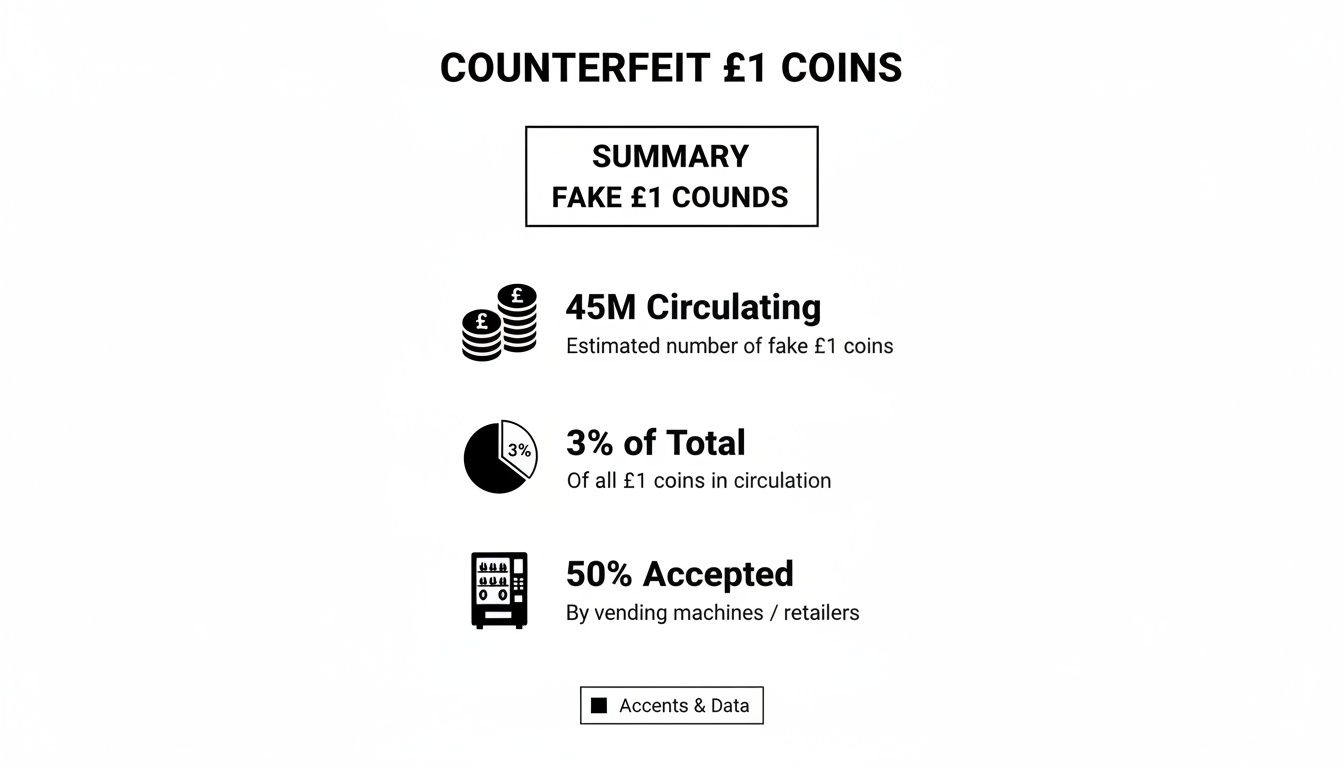
This data reveals that with an estimated 45 million fakes in circulation at its peak, making up roughly 3% of the total, your chances of coming across one were surprisingly high.
To make things easier, here's a quick comparison of what to look for.
Authentic vs Fake Pound Coin Visual Cues
This table provides a simple, at-a-glance reference for comparing genuine coin features against common counterfeit traits.
| Feature | Genuine Coin Characteristics | Common Fake Coin Characteristics |
|---|---|---|
| Queen's Portrait | Sharp, detailed, and well-defined features. | Blurry, soft, or distorted with a "photocopied" appearance. |
| Overall Finish | Consistent, high-quality lustre and sheen. | Dull, greyish, or unnaturally shiny; may feel greasy or soapy. |
| Edge Lettering | Crisp, evenly spaced, and properly aligned inscription. | Muddy, shallow, or unevenly spaced letters; incorrect alignment. |
| Date & Design | Date on the coin correctly matches the official reverse design. | Mismatched date and design for the year of issue. |
| Wear and Tear | Even, natural wear patterns over time. | Premature wear; plating flakes or rubs off easily. |
Keep this mental checklist handy, and you'll quickly train your eye to spot the obvious duds.
Inspecting the Edge Lettering
The edge of a round pound coin is another area where forgers consistently mess up. The inscription, such as "DECUS ET TUTAMEN" (An ornament and a safeguard), should be crisp, evenly spaced, and correctly aligned.
Common errors on counterfeit pound coins include:
- Blurry or shallow lettering: The letters might look muddy and lack the sharp definition of a genuine coin.
- Incorrect spacing: Look for letters that are either jammed too close together or have awkwardly large gaps between them.
- Wrong alignment: On many fakes, the inscription doesn't start and end cleanly, or it may be oriented the wrong way up in relation to the Queen's head.
Here’s a little trick I always use: run your thumbnail along the edge. On a fake, you can often feel an uneven or rough texture where the lettering is poorly stamped. That’s a massive red flag.
Checking the Date and Design
Finally, make sure the date on the coin actually matches the reverse design for that year. The Royal Mint issued different designs for most years, and a mismatch is a dead certain sign of a forgery.
For example, a coin dated 1993 should have a Royal Arms design, not a Welsh Dragon. A quick search online for "UK pound coin designs by year" will pull up an easy reference chart.
While you're building these skills, it's a great idea to broaden your knowledge. You can learn more about fake money detection techniques that apply to both coins and banknotes. It’s an essential skill for any serious collector or reseller.
Simple Hands-On Tests Anyone Can Perform
Visual checks are a great starting point, but sometimes you just need to get a coin in your hand to know for sure. The good news is, you don't need any fancy equipment to run some of the most reliable physical tests for spotting fake pound coins.
These simple, tactile methods are perfect for a quick check, whether you're a collector sorting a new batch, a charity worker counting donations, or just sifting through your change. They work because forgers almost always use cheaper, different metals than the specific alloys used by The Royal Mint, and these metals behave differently.
Think of these hands-on techniques as the next step after a visual check has raised a red flag. By bringing your other senses into play, like hearing and touch, you can often pick up on flaws the eye might have missed.
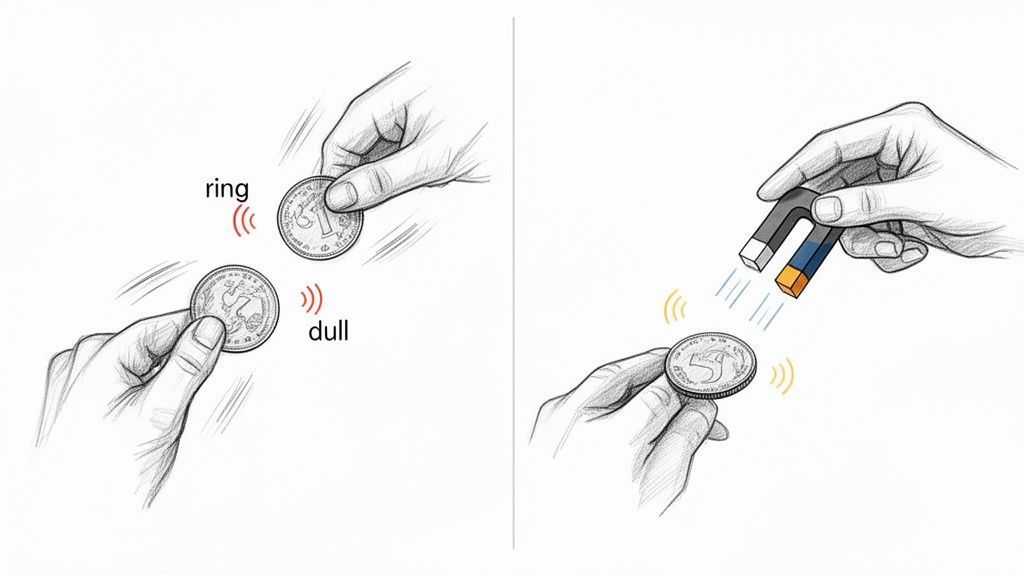
The Two-Coin Sound Test
This is one of the oldest tricks in the book for a reason—it’s surprisingly effective. All you need is a pound coin you know is genuine to act as your control.
Hold the suspect coin and the real one between your thumb and forefinger. Now, drop each one from about six inches onto a hard surface, like a tabletop. A genuine coin is made from a nickel-brass alloy and will give off a clear, relatively high-pitched ringing sound.
By contrast, many fakes are made from lead-based alloys, which are much softer and denser. When you drop one of these, you'll hear a dull, low-pitched thud. Once you hear the difference, it's often unmistakable.
The Magnet Test
This is another beautifully simple test that can unmask a fake in seconds. Genuine round pound coins were minted from a nickel-brass alloy, which is not magnetic. A real round pound simply will not react to a magnet.
Counterfeiters, on the other hand, frequently use cheaper, steel-based metals that contain iron. These are almost always magnetic. If you touch a magnet to a round pound and it sticks, you’ve found a fake. End of story.
A couple of things to bear in mind:
- Use a decent magnet: A weak fridge magnet might not cut it. A small neodymium magnet, which you can get easily online, works best.
- The new £1 coin is different: Remember, the modern 12-sided £1 coin is bi-metallic. Its outer gold-coloured ring (nickel-brass) is not magnetic, but the inner silver-coloured part (nickel-plated alloy) is magnetic.
The Edge and Feel Test
Finally, don't underestimate your sense of touch. Run your finger or thumbnail around the milled edge of the coin. The grooves on a genuine coin are precisely engineered and feel perfectly uniform and crisp.
Forgers really struggle to replicate this level of detail. Their fakes often have edges that feel poorly defined, uneven, or even slightly greasy to the touch.
Combining these quick physical tests with your initial visual checks gives you a really solid defence against fakes. For those who want to take their skills even further, it’s worth exploring some of the other proven methods for detecting counterfeit coins, which cover a wider range of techniques.
Advanced Checks for the Serious Collector
Sometimes, a visual once-over just won’t cut it. When you're dealing with potentially valuable coins or you just have that gut feeling that a fake is a bit too convincing, you need to go a step further. For the serious numismatist who needs absolute certainty, it’s time to pull out the precision tools.
These methods take you beyond educated guesswork and into forensic-level detail, letting you check a coin against its official specifications. Even the most sophisticated counterfeiters find it nearly impossible to perfectly replicate a coin's exact physical properties. This is where your digital calipers and scales earn their keep, providing cold, hard data that can confirm or deny a coin’s authenticity in an instant.
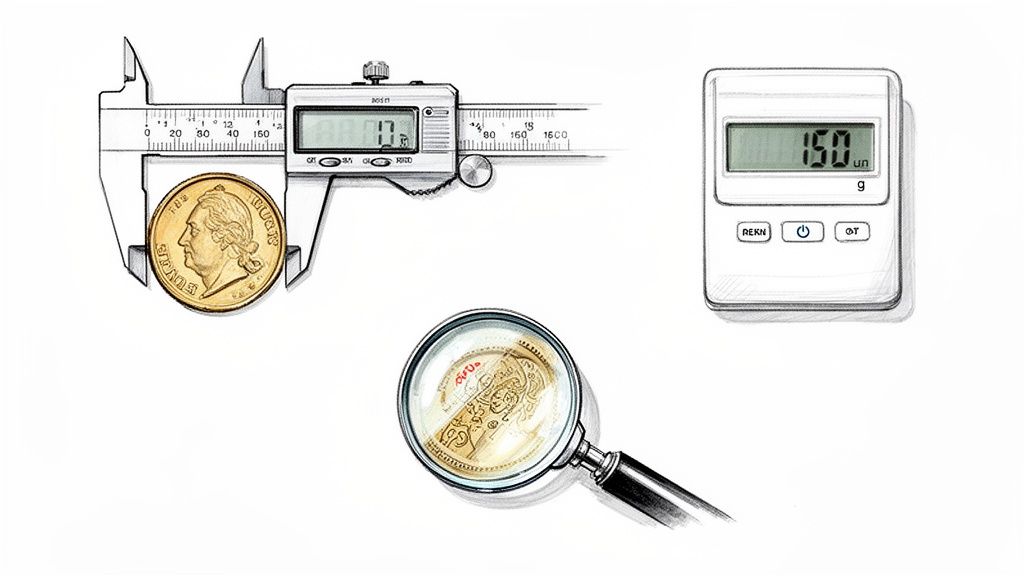
Precision Measurement and Weight
The Royal Mint doesn’t do "close enough." Their coins are produced to incredibly strict standards. A genuine round pound coin, for instance, should weigh exactly 9.50 grams and have a diameter of 22.50 mm. Counterfeits, which are almost always struck from cheaper metal alloys, rarely hit these numbers on the nose.
To get the real story, you’ll need two key tools:
- A Digital Scale: Make sure it’s accurate to at least two decimal places (0.01g). Pop the coin on the scale. Any significant difference from the official weight is a massive red flag.
- Digital Calipers: Use these to carefully measure the coin's diameter and thickness. A fake might be a fraction too thick, a touch too thin, or have an uneven diameter.
There’s no room for error here. A coin that is off-spec is almost certainly a fake. The specific metals used in minting dictate these precise properties, and understanding what coins are made of gives you a much deeper appreciation for why these tests are so reliable.
Scrutinising Micro-Details
The final frontier in counterfeit detection is magnification. With a good jeweller's loupe (a small but powerful magnifying glass), you can inspect the tiny details that even the best forgeries get wrong.
Get up close and personal with the micro-lettering on the new £1 coin, or trace the fine lines in the Queen’s portrait. You'll be amazed at what you can see.
Under a loupe, the crisp, machine-perfect finish of a genuine Royal Mint coin becomes glaringly obvious. Fakes often betray themselves with tell-tale signs like casting bubbles, soft or blurry edges, or a generally crude appearance that’s invisible to the naked eye. This is how you gain ultimate confidence in your assessment.
The challenge of spotting high-quality forgeries is nothing new. Organised crime has a long history of producing incredibly convincing counterfeit currency. Some operations created millions of pounds worth of fake banknotes that were so good they even managed to infiltrate banking systems. Digging into the history of major counterfeiting operations in the twentieth century shows why these meticulous checks are still absolutely essential for collectors today.
What to Do When You Find a Fake Coin
Finding a fake coin in your change is always a bit of a letdown. Your first thought might be to discreetly palm it off at the next shop or drop it in a charity tin. Resist that urge. Knowingly passing on counterfeit currency isn't just a bit dodgy—it's illegal, and it just pushes the problem onto someone else.
The second you've confirmed you've got a dud, the right thing to do is take it out of circulation for good. Yes, it means you're out the quid, as nobody reimburses you for fake money. But think of it as doing your small part to keep our currency trustworthy.
The Official Reporting Process
The official procedure for dealing with a counterfeit coin is actually quite simple. You just need to take it to your local police station or hand it over at any high-street bank.
You'll be asked to fill out a quick form, noting down where and when you think you received the coin. It's often hard to remember the exact moment, but any information you can provide helps the authorities piece together how these fakes are spreading.
Here’s what to expect when you hand it in:
- You'll fill out some paperwork: It’s a standard form to document the find.
- They'll take the coin: The fake will be confiscated and sent off for analysis and destruction.
- You won't get your money back: Unfortunately, the loss of the coin's face value is part of the process.
Don't worry about being treated like a suspect for handing in a single fake coin. The authorities are well aware that most people get them by accident. They see your cooperation as a civic duty, not an admission of guilt.
Advice for Collectors and Resellers
For a serious collector or a reseller, finding a forgery in your stock is more than just a minor hiccup. It's a risk to your business and, more importantly, a learning opportunity. The immediate step is the same—the coin has to be surrendered—but your follow-up should be much more thorough to protect your collection and your professional reputation.
First off, document everything. Take sharp, high-quality photos of the fake, focusing on the specific flaws that gave it away. Jot down its weight, diameter, and any other measurements you took. This builds your own personal reference library of forgeries, which is an absolutely priceless tool for honing your eye. Over time, you'll develop a real gut feeling for spotting even the most convincing fakes.
If you can trace the coin back to its source—maybe a particular auction lot or a trade—it's good practice to let them know. Just frame it as a helpful, professional heads-up rather than an accusation. It’s a courtesy that helps protect everyone in the community. For anyone dealing in collectibles, understanding how to report counterfeit products effectively is a vital skill that extends beyond just coins.
At the end of the day, treat every fake as a lesson. Each one you catch sharpens your skills and makes you a better, more knowledgeable numismatist.
Your Questions Answered: Getting to Grips with Fake Pound Coins
Even after you've learned the key checks, you'll likely still have questions swirling around about the murky world of pound coin fakes. This is completely normal. Let's tackle some of the most common queries we hear from collectors, business owners, and anyone who handles cash regularly.
Are the New 12-Sided Pound Coins Being Faked?
When The Royal Mint launched the 12-sided £1 coin, it was billed as the 'most secure coin in the world'. While no currency is ever 100% immune to forgery, the good news is that fakes of the new bimetallic coin are incredibly rare and usually glaringly obvious.
The official coin is packed with security features that are a nightmare for counterfeiters to replicate:
- The Latent Image: You'll see a clever hologram-like feature that flicks between a '£' symbol and a '1' as you tilt the coin.
- Micro-Lettering: On both sides, there's incredibly fine lettering etched into the lower inside rim. This is extremely difficult to copy with any accuracy.
- Bimetallic Construction: The two-metal design, with its distinct silver-coloured inner circle and gold-coloured outer ring, is very tough to fake without leaving tell-tale signs.
Simply put, any forgeries of the new pound you’re likely to come across will be of exceptionally poor quality. A quick glance is often all it takes to spot something is wrong.
Can I Get My Money Back for a Fake Pound Coin?
Unfortunately, there's no way to get your money back for a counterfeit coin. Fake currency has no value, so if you hand one in to the police or your bank, it's simply taken out of circulation and you bear the loss.
This is exactly why being vigilant is so crucial, particularly for businesses, charities, or anyone who handles a lot of change. The only real defence you have against financial loss from fakes is to check coins as you receive them.
Is It Worth Keeping Fake Pound Coins for a Collection?
This is a grey area for numismatists. While it's illegal to knowingly hold or pass on counterfeit money, some dedicated collectors do keep forgeries for study or historical reference. They see them as tangible examples of a particular type of counterfeit from a specific era.
If you ever consider doing this, you must tread very carefully. Any fake coin in your possession should be clearly identified as a counterfeit and stored completely separately from your genuine collection. Most importantly, you can never try to sell it or spend it. For almost everyone, the right and safest thing to do is always to hand any fakes over to the authorities.
How Can Charities and Bulk Handlers Protect Themselves?
For organisations that see huge volumes of coins—like charity collection tins or a reseller's cash drawer—checking every single one by hand can feel like an impossible task. However, a few simple tools can make a world of difference.
Investing in a digital coin scale and a set of callipers can make the verification process much, much faster. Alongside tools, good staff training on the key visual and physical checks we've discussed is absolutely vital. For bigger operations, it might be worth considering an automated coin-counting machine with built-in counterfeit detection. It can be a highly effective line of defence to filter out duds and protect your funds.
At Cavalier Coins Ltd, we know that authenticity is everything. Whether you're a lifelong collector or just beginning your journey, our hand-picked selection of genuine coins and banknotes gives you the quality and confidence you need. Explore our collection and build your portfolio with peace of mind.