
You’ve probably heard stories about a simple £1 coin being worth a small fortune. It’s true – some pound coins can be valued far beyond their £1 face value, sometimes fetching hundreds or even thousands of pounds. This isn't just luck; it's down to a few key factors: scarcity, minting errors, and special commemorative designs. These unique characteristics are what turn everyday change into genuinely sought-after collectibles.
Why Some Pound Coins Are Worth More Than Face Value

Ever glanced at the change in your hand and wondered if you were holding a hidden treasure? It’s a thought that crosses most people’s minds, and the secret lies in understanding that a coin's value often has very little to do with its age. Instead, its real worth is tied to its story and, most importantly, its rarity.
Think of it like a first-edition book compared to a modern paperback. Both tell the same tale, but the tiny print run of the first edition makes it a prized possession for collectors. The exact same principle applies to pound coins.
The Core Drivers of a Coin's Value
Three main factors can elevate a standard £1 coin into a valuable collector's piece. Learning to spot them is the first real step in your treasure hunt.
-
Low Mintage Numbers: This is the big one. The Royal Mint produces coins in different quantities each year, a figure known as the 'mintage'. When a coin has a very low mintage—meaning not many were ever struck—it’s instantly scarcer and far more desirable. Simple supply and demand.
-
Minting Errors: Every now and then, mistakes happen during production. These aren't just damaged coins; they are unique flaws that create incredibly rare variations. We’re talking about things like mismatched dates, misaligned designs, or even coins struck on the wrong metal. These imperfections are exactly what collectors look for.
-
Commemorative Designs: The UK loves to celebrate, and we often release special coins for major events, anniversaries, or cultural icons. These are typically produced in limited numbers and capture the public's imagination, driving up demand from people who want to own a small piece of history.
To help you get a quick sense of what to look for, here's a simple breakdown of the features that can signal a valuable £1 coin.
Quick Guide to Valuable £1 Coin Features
| Feature Type | What to Look For | Potential Value Indicator |
|---|---|---|
| Scarcity | Low mintage figures (e.g., under 1 million) | High |
| Minting Error | Misaligned die, mule coin, incorrect metal | High (Varies by error rarity) |
| Commemorative | Limited edition anniversary or event designs | Medium to High |
| Condition | Uncirculated, minimal marks or wear | Increases value across all types |
This table is just a starting point, but it shows how a combination of rarity and desirability is what really sets a coin apart.
A coin's journey from simple currency to a collector's item is all about its uniqueness. Scarcity, whether created by design or by accident, is the fundamental ingredient that lifts its value far beyond what’s stamped on its surface.
Ultimately, these factors create a fascinating market where a coin’s true value is decided by how many are out there and how many people want to own one. For a deeper dive into this, you can explore more about rare UK coin values in our detailed guide. It’s a great way to get to grips with the basics before we look at specific pound coins.
Hunting for Rare Round Pounds Still in Circulation
While the modern 12-sided £1 coin is what we see in our change today, the classic round pound, used from 1983 to 2016, has become a hot ticket for collectors. Even though they've been demonetised, these coins didn't just disappear. Instead, they've started a second life as sought-after collectables.
The decision to pull them from circulation back in 2017 had an interesting side effect. Millions were handed back into banks and melted down, which meant the number of certain designs left in the wild dropped sharply, making them rarer almost overnight. It's turned hunting for these old coins into a seriously rewarding challenge.
The Power of Scarcity: The Cities Series
The best way to think about the rarest round pounds is like a limited-edition art print. Once the print run is done and the original plates are destroyed, that's it – no more can ever be made. This fixed supply means that as demand from collectors grows, the value naturally climbs. The same logic applies perfectly to these retired coins.
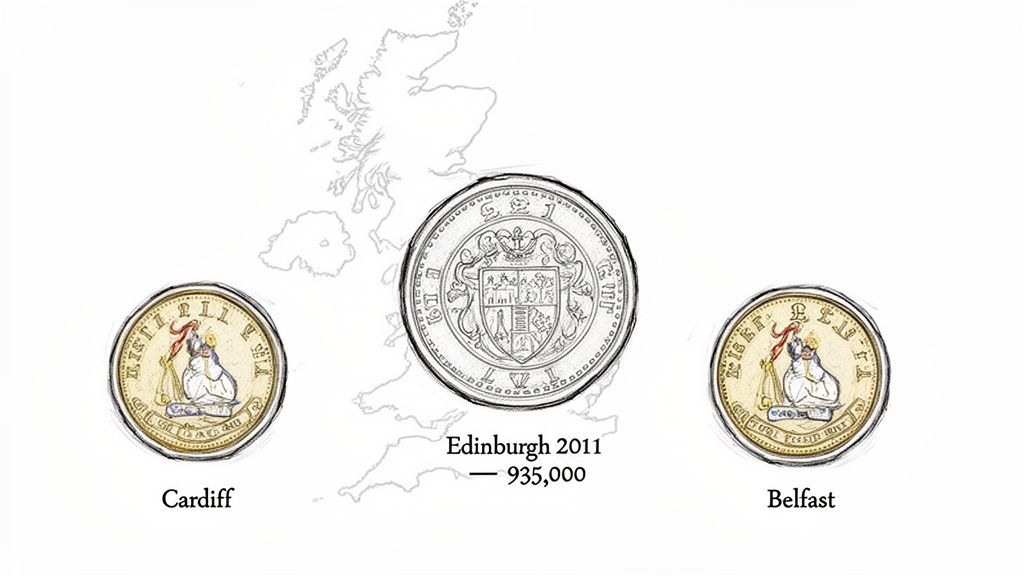
Without a doubt, the stars of the round pound show are the coins from the 'Capital Cities' series, which were issued in 2010 and 2011. These coins celebrate the four capital cities of the UK, and their incredibly low mintages have made them modern classics. If you’re looking for pound coins that are worth money, this series is the best place to start.
The Holy Grail: The 2011 Edinburgh Pound
Sitting right at the top of every collector's wish list is the 2011 Edinburgh City £1 coin. It is, quite simply, the rarest circulating round pound ever made, making it a true treasure.
The Royal Mint released just 935,000 Edinburgh coins into circulation. To put that into perspective, most round pound designs had mintages in the tens of millions. This extreme scarcity is why it has become the holy grail for round pound enthusiasts.
Between 1983 and 2016, The Royal Mint pumped out 25 different round £1 designs. Some now trade for many times their face value on the UK's secondary market. The absolute standout is the 2011 Edinburgh City £1. In circulated condition, you'll often see dealers and auction sites listing this coin for between £10 and £20, with high-grade examples fetching even more. For a live look at the market, you can always check out how the rarest £1 coins are performing on Change Checker's scarcity index.
This massive difference in production numbers is exactly what fuels its value. Finding one tucked away in an old coin jar or a forgotten piggy bank is the kind of lucky break that makes coin hunting so addictive.
Other Valuable Round Pounds to Find
While the Edinburgh coin is the undisputed champion, several other round pounds from that same series can command impressive prices. You'll want to keep a sharp eye out for these designs too, as they are all much scarcer than their common cousins.
- 2011 Cardiff City: This is the second-rarest in the series, with a mintage of only 1,615,000. Its low numbers make it a very desirable find.
- 2010 London City: Representing England's capital, this one had a mintage of 2,635,000. It's considered a key piece for any serious UK collection.
- 2010 Belfast City: Celebrating Northern Ireland's capital, this coin is also quite scarce, with just 6,205,000 minted.
Even though you can no longer spend them in shops, these coins are far from worthless. They represent a fascinating little chapter in our coinage history, where low production runs have turned everyday money into genuine modern rarities. It's well worth checking old savings, asking relatives, and sorting through any forgotten pots of change – you just might uncover one of these valuable pieces.
Finding Valuable Errors on Modern 12-Sided Coins
When the 12-sided £1 coin landed in our pockets in March 2017, it was celebrated as the most secure coin in the world. But even the most advanced minting technology isn't foolproof. Mistakes happen. These production flaws aren’t just damage; they are fascinating errors that can make a seemingly ordinary coin a sought-after collectible.
It’s crucial to understand the difference between a genuine minting error and a coin that’s just been knocked about. A coin scratched in a pocket or dented in a washing machine is simply damaged. A true error, however, is a mistake made during the coin's birth at the Royal Mint. Think of it like a rare misprinted stamp – the imperfection is part of its original story, and for collectors, that’s what makes it special.
Learning to spot these errors turns checking your change into a bit of a treasure hunt. You need a sharp eye and a little knowledge, but the thrill of finding something unusual is well worth the effort.
The Famous 2016/2017 Mule Coin
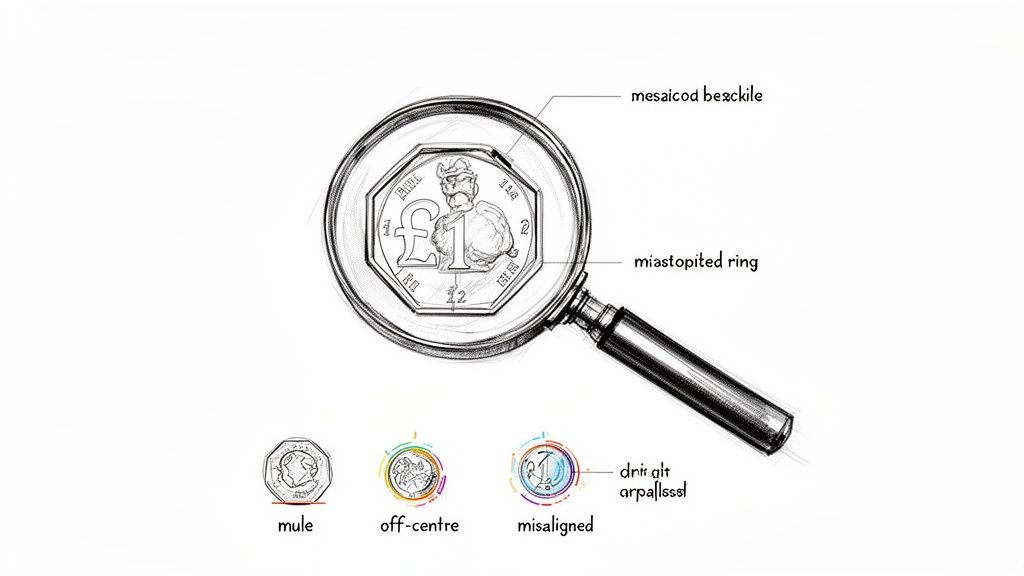
The undisputed star of 12-sided pound errors is the legendary "mule" coin. In the coin world, a mule is a hybrid coin struck with two dies that were never meant to be paired together. In this case, a small number of coins were accidentally struck with a 2016-dated obverse (the Queen's head) and a 2017-dated reverse (the design side).
This isn't just a rumour; it's a significant and confirmed error from the Royal Mint. The transition to the new bimetallic design in 2017 created the perfect storm for this mistake to occur, making it one of the most desirable modern pound coins out there. Depending on its condition, experts suggest a genuine mule could fetch up to £3,000 at auction.
A mule coin is like a creature from mythology—a hybrid that shouldn't exist but occasionally does. It’s this defiance of the normal production process that makes it so exceptionally rare and valuable to those who find one.
Other Bimetallic Errors to Spot
While the mule coin grabs all the headlines, other errors can pop up on the 12-sided pound. Because it's a bimetallic coin—made of an outer gold-coloured ring and an inner silver-coloured core—it's prone to some very specific types of mistakes.
Keep an eye out for these potential flaws:
- Off-Centre Strikes: This happens when the blank coin isn't sitting perfectly when it's struck. The result is a design that's off-centre, often leaving a crescent-shaped blank area. The more dramatic the shift, the more interesting it is to collectors.
- Misaligned Bimetallic Rings: Sometimes the inner disc isn't perfectly centred within the outer ring. Minor misalignments are fairly common, but a significant shift that cuts into the design is much harder to find.
- Missing Design Elements: Look closely at the lettering or the details of the Queen's portrait. Occasionally, a flaw in the die means that small details are missing right from the start.
The value of these errors varies enormously. A slight misalignment might only add a few pounds to the coin's value. But a dramatic off-centre strike or another major, confirmed error could be worth hundreds. For a deeper dive into the kinds of mistakes you can find, check out our guide to discover valuable error coins and their hidden treasures.
Ultimately, it all comes down to rarity and visual appeal. The more obvious and unusual the mistake, the more a collector will want it.
Spotting Low Mintage Commemorative Coins
Value isn't just about age or minting mistakes; sometimes, scarcity is built right in. Away from the world of errors and old round pounds, some of the most collectible modern coins are commemoratives The Royal Mint intentionally released in smaller numbers. These are the coins that celebrate key moments, figures, and symbols of British life.
You can think of it like a limited-edition trainer release. The manufacturer knows that by making fewer pairs, they create an instant desirability that a mass-produced shoe just can't match. The Royal Mint plays by similar rules with certain designs. The key to spotting these is understanding the idea of low mintage.
A coin's mintage is simply the total number of identical coins produced for circulation. While many designs are churned out in their tens of millions, a low mintage release might see fewer than five million coins enter circulation, making them harder to find from day one.
The Three Pillars of Commemorative Coin Value
For a commemorative coin to really be worth a premium, it usually needs to have three key things going for it. Having just one might add a little value, but when all three come together, you could be holding something genuinely special.
- Low Mintage Figures: This is the foundation. As a rule of thumb, any £1 coin with a mintage below 5 million is considered scarce and worth a closer look. The lower that number gets, the higher its potential value soars.
- Pristine Condition: A shiny, almost-new coin will always fetch more. Collectors have a grading system, and a coin described as Brilliant Uncirculated (BU) has never been handled by the public and still has its original gleam. Even a coin that’s only been lightly circulated with minimal marks is far more appealing than a heavily worn one.
- Strong Public Interest: Some themes just capture the imagination more than others. Coins that celebrate beloved figures, national symbols, or major historic events tend to attract a bigger crowd of collectors. This drives up demand and, in turn, the coin's value.
A low mintage figure gets a coin into the race, but its condition is what determines where it places. A rare coin in poor shape is like a classic car left to rust—the potential is there, but much of its value has been lost to time and wear.
New Opportunities with King Charles III Coinage
The changeover to the new King Charles III coinage has opened up an exciting new front for collectors. It's not just about errors; the first or limited issues of new designs often attract a premium, especially when you find one in top condition. Early King Charles III £1 coins, including new designs like the bee motif, have entered circulation in much smaller quantities than the familiar Elizabeth II types. This has led many UK dealers to flag them as ones to keep an eye on. To see which coins are hot right now, you can learn more about the most collectible £1 coins for 2025 and beyond.
Preserving the Value of Your Finds
If you get lucky and find a promising commemorative coin, how you handle it from that moment is crucial. A single fingerprint can permanently mark a coin's surface, and even light scratches from rattling against other coins can seriously downgrade its condition and value.
Here are a few simple rules to protect your potential treasures:
- Handle with Care: Always hold a coin by its edges, pinched between your thumb and forefinger. Never touch the flat faces – the obverse (head) or reverse (design).
- Isolate It Immediately: Get the coin out of general circulation. Don’t let it jangle around in a pocket, purse, or change jar with other coins.
- Use Proper Storage: For just a few pounds, you can buy protective coin capsules or acid-free flips. These give your coin a safe, transparent home, shielding it from scratches and the environment.
- Never, Ever Clean Your Coins: It’s so tempting to polish a grubby coin to make it shine, but this is the cardinal sin of coin collecting. Cleaning leaves microscopic scratches and strips the coin of its natural patina, effectively destroying its collectible value.
By sticking to these simple preservation tips, you'll ensure that if you do find one of these low-mintage gems, you’re keeping it in the best possible condition for the future.
How to Value and Sell Your Pound Coins Effectively
So, you've sifted through your change and think you've struck gold. What now? Finding a potentially rare pound coin is the exciting part, but turning that discovery into cash is where a bit of know-how comes in. Let's walk through how to figure out what your coin is worth and the best way to sell it.
The very first thing to look at is the coin's condition, or its grade. This is simply a measure of how much wear and tear it has seen, and it makes a massive difference to the final value. A rare coin that's been rattling around in pockets and tills for years will be worth a fraction of the same coin in perfect, shiny condition.
Understanding Coin Condition and Grade
In the world of coin collecting, condition is everything. A tiny difference in how well a coin has been preserved can lead to a huge gap in its price. Collectors have a formal grading scale, but for most of us, it’s easier to think about it in simpler terms.
A circulated coin is exactly what it sounds like – one that’s been out in the wild, used for transactions. It'll have signs of a life lived: light scratches, softened details, or a duller surface. Most coins you find in your change will fall into this category.
On the other hand, a Brilliant Uncirculated (BU) coin has never seen the inside of a cash register. It was probably taken straight from a mint bag and kept safe. These coins still have their original shine and crisp details, making them far more appealing to serious collectors.
Think of it like a vintage car. A well-driven classic with a few bumps and scrapes is still valuable, but an identical model with zero miles on the clock, stored perfectly in a garage since it was made, is in a completely different league. The same principle applies to your pound coins.
For a deeper dive into all the factors that determine a coin's worth, you can learn more about how to value coins in our in-depth article.
Choosing the Right Place to Sell Your Coins
Once you have a good idea of your coin’s condition, it’s time to decide where to sell it. Every option has its pros and cons, and the best choice really depends on whether you're chasing the highest possible price or just want a quick, easy sale.
The flowchart below breaks down the key ingredients that make a commemorative coin valuable – a crucial thing to understand before you even think about selling.
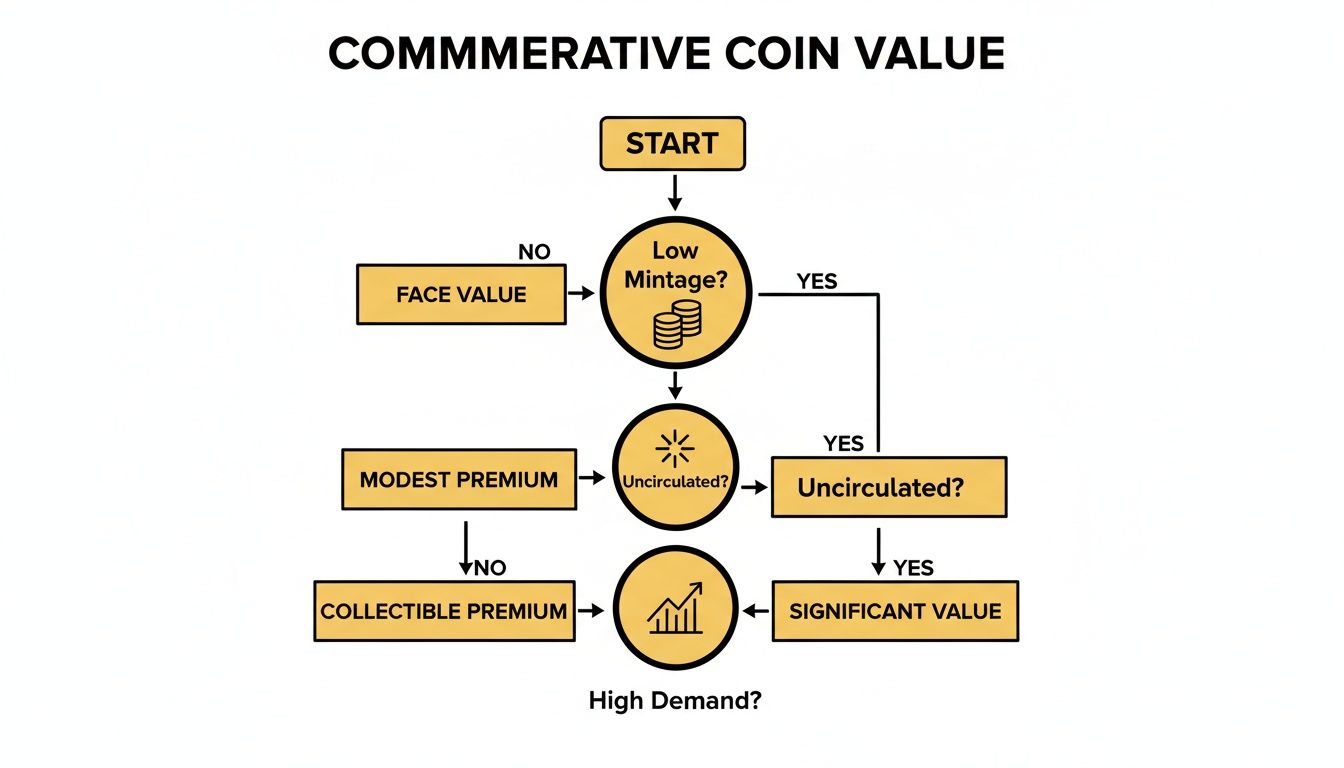
As you can see, the magic recipe for a truly valuable coin is a mix of low mintage figures, uncirculated condition, and high collector demand.
-
Online Auctions (e.g., eBay): Sites like eBay open your coin up to a massive global market of collectors, which can often get you the highest price. The trade-off is the effort involved. You’ll need to take great photos, write a clear description, deal with packing and postage, and swallow the seller fees, which are often over 12% of the final price.
-
Specialist Coin Dealers: Selling to a reputable dealer like us at Cavalier Coins is the fast, secure, and hassle-free route. A professional dealer will assess your coin and make a fair offer based on current market rates. While the price might be a bit less than the absolute peak of an auction, you get an immediate, guaranteed payment without any of the extra work.
Presenting Your Coin for a Successful Sale
Whether you're listing online or showing your coin to a dealer, presentation matters. Good photos and an honest description build trust and are your best tools for getting a fair price for your find.
- Take Excellent Photos: Use natural light and a plain, neutral background. Get sharp, high-resolution pictures of both sides – the obverse (the monarch's head) and the reverse (the design). Don't forget to get a clear shot of the coin's edge, too.
- Write an Honest Description: Clearly state the coin’s year and design. Be completely upfront about its condition, pointing out any obvious marks or wear. If you’re lucky enough to have a rare error coin, describe the error accurately.
- Set a Realistic Price: A bit of research goes a long way. Search for recently sold listings of the exact same coin in a similar condition to see what people are actually paying. Beyond coins, understanding the general principles of how to price items for resale can really boost your chances of a successful sale.
Got Questions About Valuable Pound Coins?
As you start sifting through your change, you're bound to have questions. It’s only natural. Getting the right answers from the get-go is the best way to avoid the common traps and build your confidence as a collector. Here are a few of the most common queries we get from both newcomers and seasoned coin hunters.
Are All the Old Round Pounds Worth a Fortune Now?
Not quite. The simple truth is that the vast majority of old round pounds are only worth their face value. A coin's value isn't tied to its age, but to its rarity. The ones you should really be hunting for are the coins with known low mintage figures.
You’ll want to keep your eyes peeled for the ‘Cities’ series, especially these four heavy hitters:
- 2011 Edinburgh: The undisputed champion of rarity, a true collector's prize.
- 2011 Cardiff: The second scarcest and always in high demand.
- 2010 Belfast: A low mintage coin that’s tough to track down in good shape.
- 2010 London: A popular and scarce coin representing England's capital.
Everyday designs, like the Royal Arms, aren't going to command a premium unless they are in perfect, uncirculated condition—which is incredibly unusual for a coin that's been rattling around in pockets and tills for years.
How Can I Tell if a Coin Has a Real Error or Is Just Damaged?
This is a crucial skill for any collector to develop: telling a genuine minting error apart from post-mint damage. A real error is a mistake that happened during the coin's birth at the Royal Mint, while damage is something that happened after it went out into the world.
A genuine error is part of the coin's original story, like a birthmark. Damage is like a scar acquired later in life. Collectors value the former and are put off by the latter.
True errors often look clean and consistent—think of a perfectly off-centre strike or letters neatly missing from an inscription. Damage, on the other hand, is usually just random scratches, dings, and uneven wear and tear. If you suspect you've found a genuine error, a great first step is to compare it to verified examples online. For a definitive verdict, though, nothing beats consulting a reputable coin dealer.
Will Cleaning My Coin Make It More Valuable?
Absolutely not. In fact, it's one of the cardinal sins of coin collecting. Cleaning a coin will almost always destroy its value, often significantly.
Using polishes, harsh chemicals, or even an abrasive cloth can leave behind a web of microscopic scratches and permanently ruin the coin's original surface. Collectors call this 'hairlining', and it’s a massive red flag. The natural toning and patina a coin develops over decades is part of its history and authenticity. It’s always best to leave a potentially valuable coin just as you found it.
What's the Best Way to Sell a Rare Pound Coin?
The right way to sell really depends on your main goal. If you're chasing the highest possible price and don’t mind a bit of legwork, an online auction site like eBay can be a fantastic choice. It opens your coin up to a global audience, but you’ll need to take excellent photos and write a very clear, detailed description.
For a fast, guaranteed, and hassle-free sale, your best bet is to approach a specialist coin dealer. They'll give you an immediate offer based on the current market. And for those exceptionally rare, high-value finds, a dedicated numismatic auction house might be the most suitable route to take.
At Cavalier Coins Ltd, we specialise in helping collectors value and sell their finds. Whether you have a single rare coin or an entire collection, our team offers expert appraisals and fair, transparent offers. Visit us at https://www.cavaliercoins.com to learn how we can assist you.