
Yes, some UK pound coins are absolutely valuable—worth a lot more than the pound in your pocket. It all comes down to low production numbers, unique designs, and the occasional rare minting error. Some of the most sought-after examples can fetch over ten times their original face value.
How to Spot a Valuable Pound Coin Instantly
Ever sifted through your change and wondered if you were holding a small treasure? It’s a common thought, and the answer is simpler than you might expect. While most pound coins are just that—a pound—a select few are the numismatic equivalent of a limited-edition print. Spotting them is a skill you can learn right now.
Think of The Royal Mint like any other factory. Most of the time, it’s churning out millions of identical items. But every so often, it produces a much smaller batch, maybe for a commemorative design or during a year with lower demand. This is what creates scarcity. Just like in any market, when the supply is low and collector demand is high, the value skyrockets.
The Core Principles of Coin Value
To figure out if you've got a valuable £1 coin, you only need to look for a few key signals. Forget the complicated jargon; it all boils down to two main things: rarity and condition.
A coin's rarity is mostly about its mintage—the official number of coins struck for circulation. The lower that number, the harder the coin is to find.
Beyond the mintage, keep an eye out for anything unusual. This includes:
- Minting Errors: These are mistakes made during production, like a misaligned strike or incorrect design elements. They're the happy accidents of the coin world.
- Specific Dates and Designs: Certain commemorative designs, like the 2011 Edinburgh City £1, were made in exceptionally small numbers.
- Coin Condition: It's common sense, really. A shiny, well-preserved coin will always be worth more than one that's scratched and worn from years of use.
Checking Mintage Figures
The single most important piece of information for any collector is the mintage figure. Thankfully, The Royal Mint publishes these figures, making it easy to check if your coin is a common workhorse or a rare find.
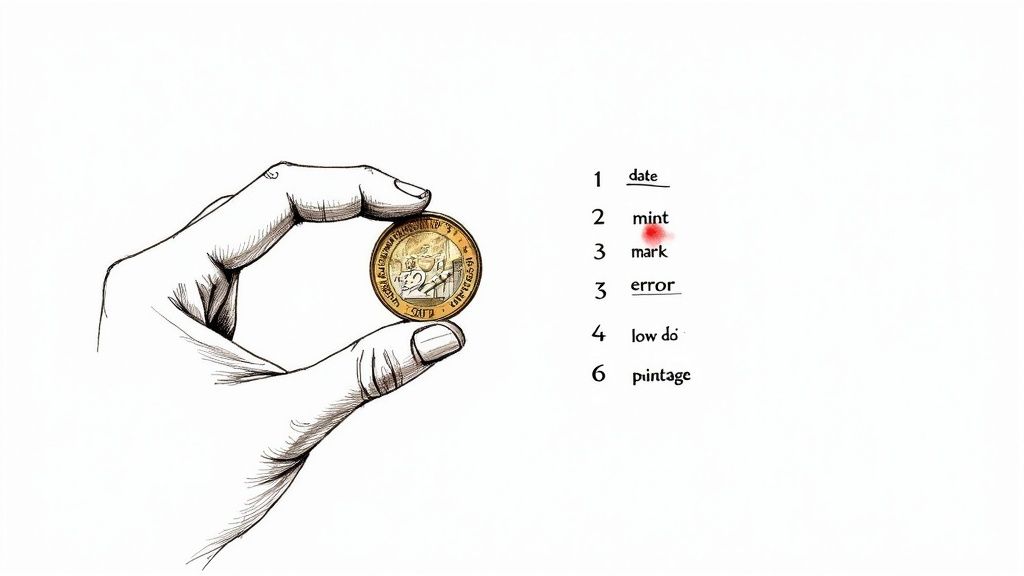
This data instantly shows why some coins, like the famous Kew Gardens 50p, are legendary for their low numbers, while others from the same year are incredibly common. By getting into the habit of checking the date and design of the coins that pass through your hands, you’ll start to train your eye to spot the ones that are genuinely scarce and potentially valuable.
To make this even easier, here's a quick reference guide to the key factors that drive a coin's value.
Quick Guide to Identifying a £1 Coin's Value
| Key Factor | What It Means for Collectors | Impact on Value |
|---|---|---|
| Mintage | The number of coins produced. Lower is always better. | High (The lower the mintage, the higher the potential value). |
| Condition | The physical state of the coin (e.g., shiny vs. worn). | High (Uncirculated or near-mint coins fetch premium prices). |
| Design/Commemorative | Special one-off designs or those from a specific series. | Medium to High (Popular or rare designs increase demand). |
| Minting Errors | Mistakes made during production, creating a unique variant. | High (Significant, verifiable errors are highly sought after). |
| Collector Demand | How popular a particular coin is among enthusiasts. | Medium (High demand can drive up prices even for common coins). |
This table sums up the essentials. Rarity and condition are king, but a compelling design or a unique error can turn a simple pound coin into a collector's prize.
Why Low Mintage Numbers Create Real Value
In the world of coin collecting, if there's one word that truly matters, it's mintage. It’s the single biggest factor that can turn a simple piece of metal into something a collector will treasure. But what does it actually mean?
Put simply, a coin’s mintage is the total number of that specific coin that The Royal Mint produced for circulation. Grasping this concept is the key to understanding why some pound coins are worth far more than others.
Think of it like this. Imagine two books. One is a paperback bestseller you see everywhere, with tens of millions of copies printed. The other is a limited first edition with only a thousand copies in existence. Which one do you think a book collector would hunt for? It's the same principle for the coins in your pocket.
A low mintage figure means fewer coins are out there, making them much harder to find. This creates a natural scarcity, which is the very foundation of collecting. When more collectors want a coin than there are coins available, its value will inevitably climb far beyond its one-pound face value.
Supply and Demand: The Coin Collector’s Mantra
The relationship between mintage and value is pure economics—supply and demand. Coins with high mintage figures, often in the tens or even hundreds of millions, are the workhorses of our currency. They are everywhere, easy to find, and because of that, they hold no extra value for a collector.
On the other hand, a coin with a mintage below a few million—and especially under one million—is a completely different beast. These coins become immediate targets for collectors trying to complete their sets. The hunt to find one becomes a real challenge, and it's that rarity that gives the coin its premium.
Scarcity is the engine of collectability. For pound coins, the mintage figure is the fuel. A coin isn't valuable just because it's old; it's valuable because it's difficult to find, and low production numbers are the primary reason for that difficulty.
Take the older round pounds from the 1980s and 90s. Many of these were produced in enormous numbers. The 1983 Royal Arms £1, for instance, had a mintage of over 443 million. It’s a historically important coin, being the first modern pound, but its sheer abundance means it’s not a valuable find.
How Modern Coins Become Instant Rarities
This isn’t just a rule for old coins. The Royal Mint’s decisions are still creating modern rarities today. The introduction of the 12-sided £1 coin in 2017 started a whole new chapter for collectors, with production numbers changing wildly from one year to the next. This creates some fantastic opportunities for anyone checking their change.
A perfect example is the contrast we see in recent mintages. While some new designs are pumped out in huge quantities, others are released in surprisingly small batches, making them sought-after almost overnight.
Just look at these recent figures:
- The 2022 Nations of the Crown £1 has a confirmed circulating mintage of 7,735,000 coins.
- In stark contrast, the 2025 Bee £1 was released with an initial circulation of just 170,000 coins.
That massive difference shows how certain dates become valuable almost immediately. The 12-sided £1 has produced a huge range of mintage figures, creating rare-date coins that drive the collector market. If you want to dive deeper, you can discover more insights about the rarest modern coins and see how these figures stack up.
The Magic Number for Mintage
So, what kind of mintage figure should you be looking out for? While there's no hard and fast rule, a good guideline can help new collectors spot a potentially valuable pound coin.
Coins with mintage figures under 5 million are definitely worth a second look. If you find one with a figure under 2 million, it’s almost certainly collectible.
And the real holy grail for modern circulating coins? Anything with a mintage below 1 million. A coin that scarce is a genuine prize. The most famous example from the old round pound series is the 2011 Edinburgh City £1, with a mintage of just 935,000. It remains one of the most sought-after pound coins ever made, purely because so few exist.
Ultimately, the mintage number tells a story of scarcity. It’s the official record of just how rare your coin is. By paying attention to these figures, you stop being someone who just spends coins and become someone who understands what makes them truly valuable.
Your Collector's Checklist for Valuable £1 Coins
Right, you now understand how mintage figures can turn an ordinary coin into a rare find. It's time to put that knowledge to good use. Think of this as your practical field guide for spotting the valuable pound coins you might genuinely find rattling around in your change.
We’ve pulled together a definitive checklist of the key coins to hunt for, detailing their year, design, and that all-important mintage figure. This isn't just a dry list of numbers, though. For each coin, we'll get into the story behind its rarity, whether it was a special commemorative release or just a surprisingly low production run. Keep this guide handy when you're sifting through your wallet or piggy bank.
This handy visual breaks down just how rare the truly valuable coins are.

As you can see, most coins are just standard pocket change. But that tiny sliver of rare and valuable finds is exactly what makes the hunt so addictive.
The Most Sought-After Round Pound Coins
The original round pound coin, which was in circulation from 1983 to 2017, gave us several key rarities that collectors are always desperate to get their hands on. Millions are still hiding away in jars and drawers, but only a handful of designs are actually worth more than a quid.
Here are the champions of the round pound world you should be looking for:
- 2011 Edinburgh City £1: With a mintage of just 935,000, this coin is the undisputed king. It was part of a series celebrating the UK's capital cities, and its incredibly low production number makes it the one everyone wants.
- 2011 Cardiff City £1: The Welsh entry in the capital cities series is also a fantastic find. At 1,615,000 minted, it’s a bit more common than its Edinburgh counterpart but still a top-tier discovery.
- 2010 London City £1: Representing England's capital, this one had a mintage of 2,635,000. The classic design featuring the city's crest makes it a real favourite among collectors.
As your collection starts to grow, keeping a detailed inventory is absolutely essential. It's well worth learning how to catalogue coins properly to track your finds and monitor their condition.
A coin's story is just as important as its mintage. The Capital Cities series, for example, is a snapshot of national pride, and the low mintages for Edinburgh and Cardiff turned them into accidental treasures.
The thrill of finding something genuinely scarce isn't unique to coin collecting. Collectors in other fields get the same buzz from things like rare meteorites, which share that same magic of scarcity and a unique story.
Notable Modern 12-Sided Pound Coins
When the new 12-sided £1 coin landed in 2017, it kicked off a whole new playground for collectors. While most are minted by the tens of millions, The Royal Mint has already released a few with surprisingly low numbers, creating instant modern rarities.
One of the most talked-about recent releases is the 2025 Bee £1. Initial figures suggest a circulating mintage of just 170,000, which would make it one of the rarest UK coins ever put into circulation. These numbers can sometimes be updated, but it just goes to show that new valuable pound coins are always on the horizon.
Top UK £1 Coins to Find in Your Change
To make your treasure hunt a bit easier, we've put together this table. It gives you a clear, at-a-glance overview of the most important coins to look for, their mintage figures, and what makes them special.
| Coin Name and Year | Mintage Figure (Circulation) | Key Identifying Features | Estimated Value Range |
|---|---|---|---|
| 2011 Edinburgh City £1 | 935,000 | Round pound design featuring the Coat of Arms of Edinburgh. | £10 - £15 |
| 2011 Cardiff City £1 | 1,615,000 | Round pound with the Coat of Arms of Cardiff. | £8 - £12 |
| 2010 London City £1 | 2,635,000 | Round pound showcasing the Coat of Arms of the City of London. | £5 - £8 |
| 2014 Thistle & Bluebell £1 | 5,185,000 | Round pound from the floral emblem series, representing Scotland. | £3 - £5 |
| 2010 Belfast City £1 | 6,205,000 | Round pound with the Belfast City Coat of Arms. | £3 - £5 |
| 1988 Crowned Shield £1 | 7,118,825 | An early round pound featuring the Royal Arms within a crowned shield. | £3 - £5 |
Keep in mind, these values are for coins in decent, circulated condition. If you find one that looks almost brand new, it could be worth significantly more. The market for valuable pound coins is always changing, so treat these figures as a solid guide rather than a fixed price. Happy hunting
Finding Rare Errors and Unique Variants
Forget the official designs and mintage figures for a moment. There's a whole other world of valuable pound coins out there: minting errors. These are the fascinating, and sometimes very valuable, mistakes made right in the factory.
Collectors don't see them as flaws. Instead, these slip-ups are viewed as unique, one-of-a-kind treasures that are, by their very nature, incredibly rare.
Think of The Royal Mint as a high-precision machine. While its quality control is second to none, when you're striking billions of coins, tiny imperfections are bound to slip through. We're not talking about post-mint damage, like scratches from a till drawer, but genuine mistakes that happened as the coin was being made.
Spotting them adds a real treasure-hunting thrill to your search. Learning to identify these quirks trains your eye to catch the subtle details most people miss, giving you a huge advantage in finding genuinely valuable pound coins.
Common Types of Minting Errors
Some errors are glaringly obvious, but many are far more subtle. Getting to know the different kinds of mistakes is the first step to finding one. You can discover valuable error coins and their hidden treasures in more detail, but here are a few of the key types you might find on UK pound coins.
-
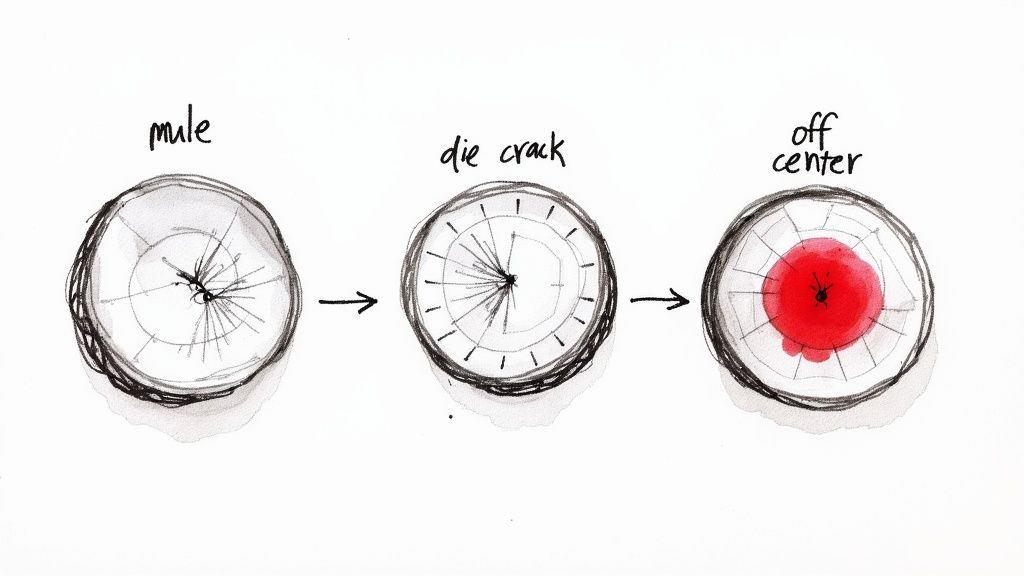
Mule Coins: This is probably the most famous type of error. A 'mule' is a hybrid coin struck with the obverse (heads) from one coin and the reverse (tails) from another. It’s like a book printed with the wrong cover—a combination that should never have existed.
-
Off-Centre Strikes: This happens when the coin blank isn't sitting perfectly in place when it gets struck. The result is a design that's shifted to one side, often leaving a crescent-shaped blank area. Minor off-centre strikes are pretty common, but dramatic ones are very sought after.
-
Die Cracks: The dies used to stamp coins are under immense pressure and can develop tiny cracks over time. These cracks then get transferred to the coins as raised, squiggly lines, looking a bit like lightning bolts across the surface.
Famous Pound Coin Errors to Look For
One of the most legendary UK error coins is the 2014 Royal Arms £1 ‘Mule’. This coin was accidentally struck using the standard obverse but paired with the reverse design meant for the Isle of Man’s Tower of Refuge £1 coin. It's a tiny difference, but for someone who knows what to look for, it's a huge find.
The new 12-sided pound coin is another hotbed for errors. Its bi-metallic nature creates new ways for things to go wrong. For instance, the so-called 'fried egg' error occurs when the inner silver-coloured cupro-nickel disc is badly misaligned with the outer nickel-brass ring. Slight misalignments are normal, but coins where the inner circle is dramatically off-centre can be worth a pretty penny.
A genuine minting error is a story captured in metal—a permanent record of a fleeting mistake in the manufacturing process. This uniqueness is what makes them so compelling to collectors, often valuing them far higher than a perfectly struck coin.
Ultimately, hunting for errors is a game of patience and a keen eye. Always check your change carefully, especially any coin that looks a bit 'off'. Look for misaligned designs, strange lines, or doubled lettering. Most oddities will just be everyday wear and tear, but that one genuine error could be the most valuable pound coin you ever find.
How a Coin's Condition Determines Its Worth
Finding a rare, low-mintage pound coin is an incredible thrill, but honestly, that's only half the story. The coin's physical condition—what collectors call its 'grade'—plays a massive role in its final value. Two identical rare coins can have wildly different price tags based purely on how well-preserved they are.
Think of it like collecting vintage comic books. A first edition with crisp pages and a vibrant cover is a prized possession. The exact same comic, but with torn pages, faded ink, and a folded cover, is worth a fraction of the price. The same logic applies directly to what makes certain pound coins valuable.
A coin that's been rattling around in pockets, tills, and vending machines for years will show its age. It will have scratches, dings, and a general dullness from wear and tear. In contrast, a coin that was saved straight from a mint bag and never touched human hands looks pristine, with sharp details and a brilliant shine. This difference is everything.

From Worn to Flawless: Understanding Coin Grades
In the world of numismatics, a coin's condition is formally graded on a scale. While the official scales can get pretty complex, for our purposes, we can simplify them into a few key categories. Getting your head around these will help you manage your expectations when buying or selling.
- Poor/Fair: The coin is heavily worn, with many details smoothed away. The date and main designs are likely readable, but only just.
- Good/Fine: This describes most coins you find in your change. The coin shows significant wear, but all major design elements are clear.
- Very Fine (VF): Details are much sharper now. You'll see moderate wear on the highest points of the design, but the coin still looks relatively crisp.
- Extremely Fine (EF): The coin shows only light wear on its highest points. Much of the original mint lustre (that unique shine of a new coin) is still visible.
- Uncirculated (UNC): This coin has no signs of wear at all. It looks as it did the day it left The Royal Mint, with full lustre and perfect details.
A rare date in 'Good' condition might be worth a few pounds. That very same coin in 'Uncirculated' condition could be worth ten or even twenty times more. You can explore a more detailed breakdown to better understand the specific grades of coins and how professionals assess them.
How to Protect Your Valuable Finds
Once you've found a potentially valuable pound coin, how you handle it is critical. Every touch and scrape can reduce its grade and, therefore, its value.
A coin's condition is a fragile thing. The moment it enters circulation, its journey towards a lower grade begins. Protecting a high-grade find is just as important as identifying it in the first place.
Follow these simple rules to preserve your coins:
- Hold it by the Edges: Never touch the flat faces of the coin. Oils and acids from your fingertips can permanently damage the surface and destroy its lustre.
- Use Proper Storage: Don't just throw a rare coin back into a jar with other change. Use individual coin flips, capsules, or albums designed for long-term protection.
- Never Clean Your Coins: It might be tempting to polish a dull coin, but don't do it. Cleaning a coin, even gently, leaves microscopic scratches and removes its natural patina, instantly destroying most of its collector value.
By understanding the importance of condition, you’ll be much better equipped to accurately assess your finds and protect their potential worth.
The Story Behind the Modern Pound Coin
To really get a feel for which pound coins are worth keeping an eye out for, it helps to know a bit about their backstory. The modern £1 coin we use today didn't just appear out of nowhere; its tale is one of constant evolution, driven by security needs and a desire to reflect our national identity.
It all started on 21 April 1983, when the original round pound coin made its debut. Before then, we had a £1 banknote, but it just wasn't holding up. The average note lasted a mere nine months in circulation, prompting a switch to a far more durable coin. This chunky, nickel-brass coin was built to last for decades and quickly became a British icon.
The Battle Against Fakes
For all its charm, the round pound had a fatal flaw: it was remarkably easy to counterfeit. By the time the 2010s rolled around, it was estimated that a staggering 1 in 30 pound coins in circulation were fakes. This wasn't just a minor issue; it was a serious threat to the integrity of our currency. The Royal Mint knew it had to act, setting out to create what it dubbed "the most secure circulating coin in the world."
The answer arrived in March 2017: the 12-sided, bi-metallic pound coin we know today. This new design was far more than just a visual refresh; it was packed with clever security features.
- A latent image: A nifty hologram-like feature that switches between a ‘£’ symbol and a ‘1’ as you tilt it.
- Micro-lettering: Incredibly small lettering etched onto the inner rim on both sides.
- Milled edges: Distinctive grooves on alternate sides, making it a nightmare to copy accurately.
This shift from the classic round shape to the high-tech 12-sided version was a huge moment in the coin's history, born entirely out of the fight against fraud.
A Canvas for the Nation
Beyond just being money, the pound coin has always doubled as a miniature canvas celebrating the UK. From the very first Royal Arms design to the beautiful series featuring the floral emblems of the four home nations—the English oak, Scottish thistle, Welsh leek, and Northern Irish flax—every design tells a part of our shared story. The changing portraits of Queen Elizabeth II, and now King Charles III, also serve as a living record of our monarchy.
This story of change is reflected in the coin's technical details. The old round pound was officially withdrawn on 15 October 2017, a decision sealed by its vulnerability to fakes. The difference is clear when you compare the old, heavy nickel-brass coin with the lighter, more complex bi-metallic structure of its successor. You can dive deeper and learn more about the pound coin’s specifications to see the technical journey behind its transformation.
Answering Your Top Questions About Valuable Pound Coins
Once you start looking through your change, a lot of practical questions pop up. It’s natural. Whether you think you’ve stumbled upon a real treasure or are just curious about the hobby, getting good answers is key. Here are some of the most common things people ask about their pound coins.
Where Should I Sell My Valuable Pound Coin?
If your coin is in the £10-£50 bracket, online marketplaces like eBay are a great place to start. You get access to a massive audience of potential buyers, which is fantastic. Just remember to factor in the listing fees and postage costs, as they will take a bite out of your final profit.
For a more serious find, however, your best bet is to approach a reputable coin dealer or a specialist auction house. These professionals can properly authenticate your coin and have connections to dedicated collectors who are willing to pay a fair price. Don't leave serious money on the table by trying to go it alone.
The right selling strategy really depends on the coin's value. A common collectible is perfect for a quick online sale, but a genuinely rare piece deserves an expert’s touch to get the best possible return.
Are My Old Round Pound Coins Worth Anything?
I get asked this all the time. The short answer is, sadly, most are not. The old round pound was taken out of circulation back in 2017, so the vast majority are now only worth their face value at a bank, or even just their scrap metal value.
The only real exceptions are the genuinely scarce, low-mintage designs like the 2011 Edinburgh City £1, or coins with confirmed, significant minting errors. Unless you’ve got one of those specific rarities, the old round pounds in your piggy bank are probably not the key to your fortune.
How Can I Get My Coins Officially Valued?
For a professional valuation you can trust, you’ll want to find a member of the British Numismatic Trade Association (BNTA). Dealers who are part of the BNTA adhere to a strict code of conduct, so you can be confident they have the expertise to give you an accurate, market-based appraisal.
If you believe you have an exceptionally rare or high-value error coin, you might want to take it a step further. Third-party grading services will authenticate, grade, and seal your coin in a protective slab. This official certification can dramatically boost its credibility and value among serious collectors.
Ready to start or expand your collection? Cavalier Coins Ltd offers a curated selection of rare and collectible coins from around the world. Explore our collection today.