
The biggest mistake people make with a Queen Victoria penny is assuming the monarch's portrait does the heavy lifting. It doesn't. Queen Victoria penny value depends on the exact portrait type, the metal, the date, the variety, and, above all, the grade. A worn common bronze penny can be a low-value coin, while a scarcer diagnostic piece in strong condition can move into the hundreds or more, so the essential question is never “Is it Victorian?”, it's “Which Victorian penny is it?”
Understanding Victorian Penny Values
A Victorian penny can be old, attractive, and still worth very little. Age provides context, not a price. In the UK market, value is shaped by the coin's portrait type, metal, date, diagnostic variety, and grade, with realised prices often falling well below optimistic online asking prices. The Royal Mint identifies two principal phases, the copper pennies of 1839 to 1860 and the bronze pennies from 1860 onward (Royal Mint reference).
Why broad price lists mislead
A worn, common circulation coin usually belongs at the modest end of the market. A scarcer portrait or variety in strong condition can be a different proposition entirely. Recent UK collector guidance places common Bun Head pennies from 1860 to 1894 at about £1 to £5 in circulated grades, while Old Head pennies from 1895 to 1901 commonly sit around £3 to £25 in low-to-mid grades (UK collector guide).
Those bands are starting points, not guaranteed sale prices. Eye appeal, colour, surface marks, cleaning, and the buyer's confidence in the attribution can all change the outcome. An online listing shows what a seller hopes to receive. A completed transaction shows what the market accepted.
Year-based lists also hide the features that specialists inspect. The 1860 beaded-border type, the 1869 penny, and the 1882 no-mintmark variety are separated in collector references because their value can stand well above ordinary examples (old penny value guide). The date narrows the search, but the portrait, composition, and small design details decide whether the coin is routine or worth further examination.
Practical rule: treat a common, worn, ordinary penny as a modest collector coin until its type and variety have been checked.
Start with the portrait and metal. Confirm the date, inspect diagnostic details, then judge the grade and surfaces. That sequence prevents an inflated asking price, or a missed variety, from dictating your valuation.
Copper Versus Bronze and the 1860 Transition
The copper-to-bronze change in 1860 matters less as a date boundary than as a sorting test. Two pennies bearing 1860 can belong to different collecting categories, with differences in metal, edge treatment, and reverse detail affecting both attribution and value. The Royal Mint's records provide the production context, including the later use of Tower Hill for Victorian pennies struck between 1895 and 1901 (Royal Mint reference).
The border is the first close-up check
Turn the coin over and examine the border around the reverse design. On a beaded-border example, the border appears as a line of rounded beads. A toothed-border version shows sharper, more regular projections. Wear can flatten either feature, so inspect several sections under magnification rather than judging from one damaged area.
Check three points:
- Are the border elements rounded and bead-like, or pointed and tooth-like?
- Do they remain consistent around the reverse, or do they change where wear or damage is strongest?
- Does the border style match the rest of the design and the coin's metal?
This close-up work separates a routine-looking transitional penny from one that deserves comparison with a specialist reference. It also reduces the risk of treating a worn, unusual subtype as an ordinary date coin.
Why the composition changes the valuation
Copper and bronze behave differently in the hand and on the surface. Copper pieces tend to show darker brown or reddish colour, while bronze can develop a wider range of brown tones depending on storage, handling, and cleaning. Colour alone proves nothing. A cleaned coin may look bright but still grade poorly because the surface has lost its original texture.
A materials primer on what coins are made of is useful when comparing weight, colour, and surface response. Weighing can support an attribution, but it should not replace examination of the design and border.
Production figures need context
Recorded mintages help explain why some dates appear more often than others. The figures for 1841, 1853, and 1854 differ markedly, while the first bronze production was substantial. Those totals describe original output, not the number of attractive surviving coins. Hoards, corrosion, cleaning, and heavy circulation all reduce the supply of pieces that collectors want.
For valuation, identify the metal first, then inspect the border and surface. A confirmed transitional variety can move into a different market bracket from a standard circulated penny, even where the date is identical. That combination of composition and diagnostic detail is why 1860 remains a specialist sorting point rather than just another entry in a year-by-year list.
Identifying the Three Main Portrait Types
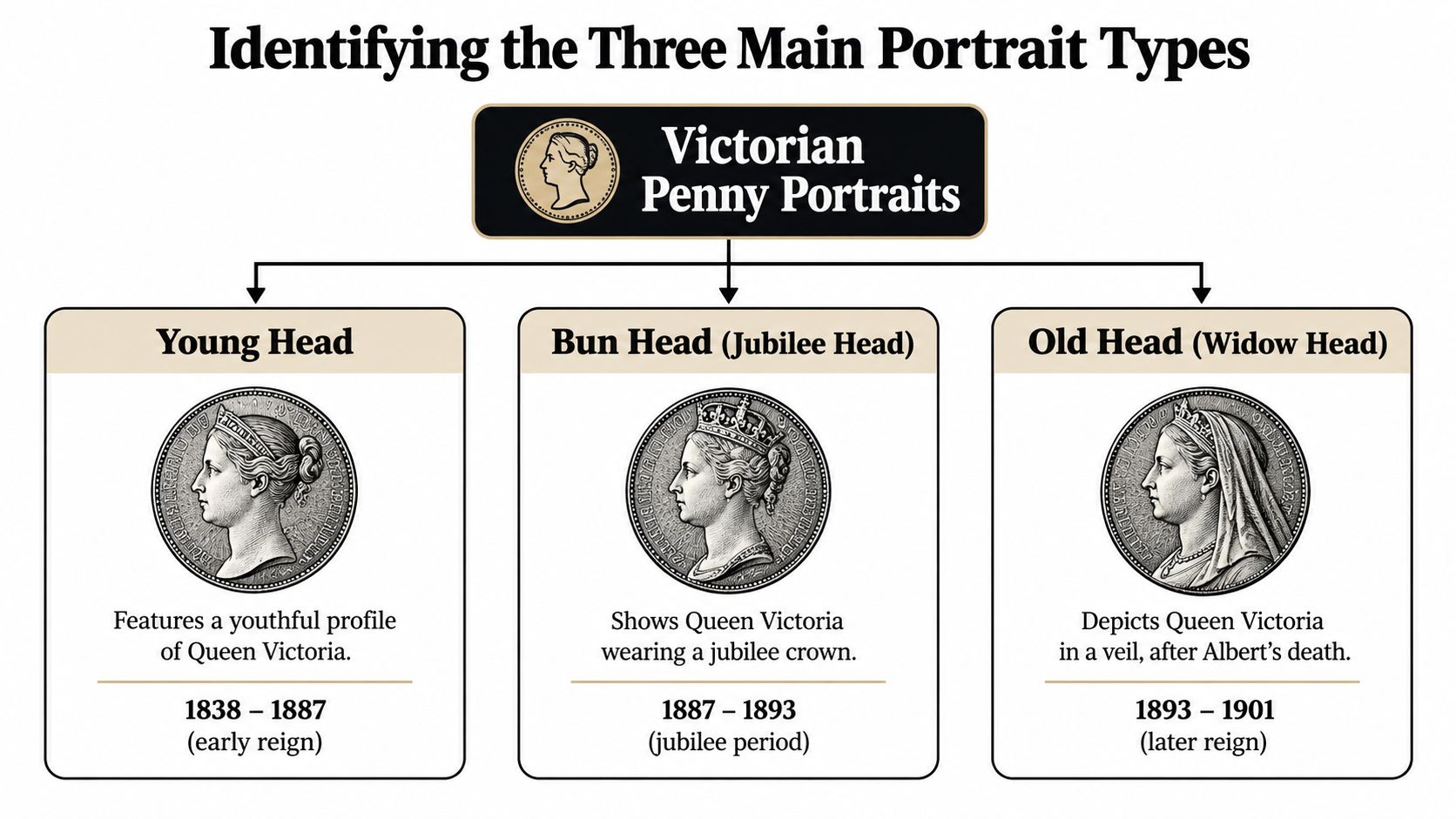
Portrait type is the quickest way to sort a Victorian penny. Identify the bust before reading the date, and a mixed lot becomes much easier to organise. The three main groups are Young Head, Bun Head or Jubilee Head, and Old Head or Widow Head. These categories provide the starting point for judging whether a coin is common or worth closer examination.
Start with the portrait first
Young Head shows Victoria as a youthful monarch, usually with a comparatively thin wreath. Bun Head shows the hair tied into a prominent bun and generally has a broader border. Old Head, the final Victorian portrait, shows an older, veiled bust. Check the bust first before spending time on the date or minor lettering.
The Young Head belongs to the earlier Victorian penny series. The Bun Head dominates the later nineteenth-century bronze issues, while the Old Head covers the final Victorian phase. Common coins in each group are often modestly priced, but a scarce date, border style, or other confirmed variety can be much more desirable than a standard example from the same portrait family (Victorian penny value guide).
Use the specification as a sanity check
A portrait match does not prove authenticity. The Royal Mint specification lists the Queen Victoria penny at 1p, with a weight of 9.450g and a diameter of 30.86mm (Royal Mint specification). These measurements help identify a piece that is too light, too large, or otherwise inconsistent with an original circulating penny.
A coin that looks right but feels wrong deserves a second look.
Weight and diameter are checks, not substitutes for examining the design. A worn coin can vary slightly through damage or metal loss, while a cleaned or altered piece may still appear convincing in photographs. If the portrait, dimensions, and surface do not agree, set it aside for closer examination rather than assigning value immediately.
A practical sorting routine
- Identify the bust style first: separate Young Head, Bun Head, and Old Head.
- Check the date range next: early copper pennies and later bronze issues should not be assessed in the same valuation group.
- Inspect the border and lettering: unusual beads, spacing, or details may indicate a variety.
- Measure coins that feel unusual: compare them with the Royal Mint specification before accepting a seller's description.
This method turns a pile of pennies into a useful numismatic sort, with the most promising pieces ready for detailed grading and variety checks.
Market Prices by Grade and Portrait Type
Year alone gives a poor estimate of a Queen Victoria penny's value. Portrait type, metal, grade, and buyer demand all affect the result. A worn Bun Head penny and a sharply preserved example may share a date, yet they appeal to different parts of the market. UK collector guidance places common Bun Head pennies from 1860 to 1894 at about £1 to £5 in circulated grades, £10 to £30 in EF, and £50 to £150 in mint state. Old Head pennies from 1895 to 1901 generally sit higher in lower grades, then separate more clearly as condition improves (UK collector guide).
Average UK market values by portrait and grade
| Portrait Type | Circulated (VF) | Extremely Fine (EF) | Uncirculated (UNC) |
|---|---|---|---|
| Bun Head | £1 to £5 | £10 to £30 | £50 to £150 |
| Old Head | £3 to £25 | £30 to £60 | £70 to £120 |
These bands are working estimates for ordinary examples, not guarantees. A coin with weak detail, surface cleaning, verdigris, or damage can sell below the stated grade range. A well-coloured, sharply struck coin with attractive surfaces may reach the upper end, particularly when collectors are competing for it.
The table also shows why portrait type matters. Bun Head pennies are commonly encountered across the bronze period, so ordinary examples usually have a broad supply. Old Head pennies are later issues, and higher-grade pieces can command a clearer premium. Metal composition matters as well: early copper and later bronze pieces should be compared within their own groups rather than treated as one continuous price series.
Condition creates the price spread
A separate old penny comparison lists an 1869 Victoria penny at over £4,900 in uncirculated grade, while 1901 is listed at £15 in uncirculated grade (old penny value guide). The gap reflects scarcity, preservation, and collector demand, not just the monarch or denomination.
Online listing data gives another warning. Victoria penny prices range from £1.39 to £3,066.70, with an average of £87.06 across 96 listings, as shown alongside the comparison data above. These are asking prices, so they indicate seller expectations rather than confirmed realised values. Treat unusually high listings as claims to investigate, not evidence that a typical penny is worth the same amount.
Practical rule: start with the lowest realistic grade band for worn coins, then move upward only when the fields, portrait, lettering, and remaining detail justify it.
Sellers can charge more for a sharply struck, well-preserved coin. Buyers should focus on the coin's actual surfaces and detail, because overgraded descriptions create a greater risk than the ordinary penny itself.
Key Dates and High Value Varieties
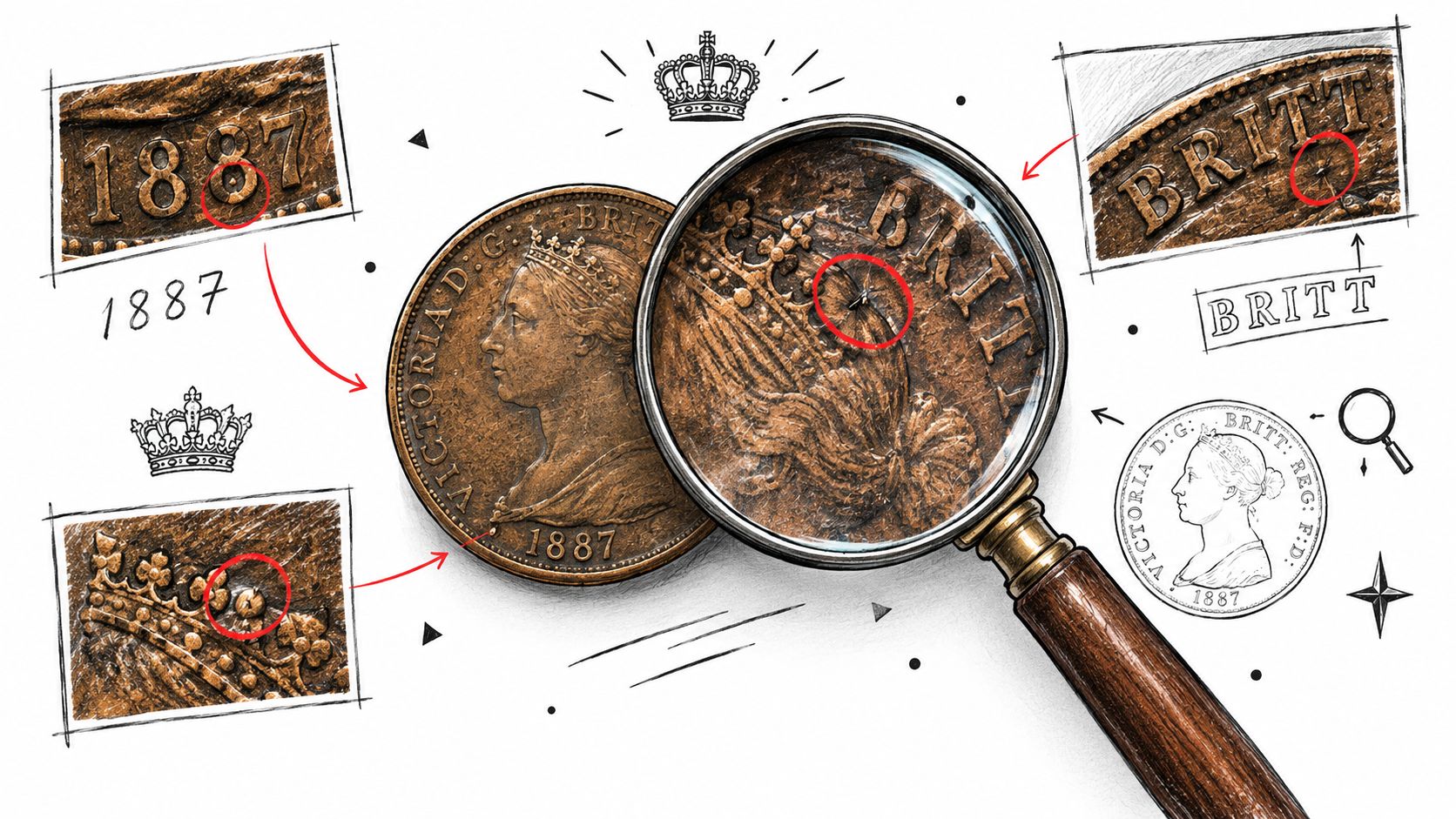
A Victorian penny becomes interesting when its diagnostics support the date. Year-only lists create false confidence. The same date can represent a routine circulated coin, a scarcer metal type, or a variety that deserves specialist comparison. Sort by portrait and composition first, then confirm the date and die details.
1860: inspect the border and metal
The 1860 beaded-border type is a key transitional issue, with published guidance placing examples at £200 to £1,000+ (UK collector guide). That range is a guide, not a guaranteed selling price. Worn, damaged, cleaned, or misidentified coins can fall well below an optimistic online listing.
Start with the rim. On a suspected beaded-border example, examine the individual beads around the obverse and reverse with a loupe, checking whether they are clearly separated and consistently formed rather than softened, merged, or created by damage. Confirm the colour and weight against the copper or bronze group before treating the coin as a genuine transitional piece. A date alone is not enough.
1869: confirm the coin before valuing it
The 1869 penny attracts attention, with one guide giving a range of £30 to £150, while better-preserved or scarcer examples can receive stronger offers. Use a 10x loupe to inspect the date, especially the edges of the numerals, for doubling, tooling, or an altered final digit. Compare the spacing and shape with an authenticated reference, then check the reverse lettering and portrait for a consistent die impression.
This step matters because rare-date claims are often repeated from asking prices rather than confirmed transactions. A genuine 1869 with honest wear is a different proposition from a damaged coin described as rare.
1882: check below the date for the H
The 1882 no-mintmark variety is listed at £40 to £200 in one market guide (Victoria penny value guide). On the reverse, inspect the area directly below the date for the Heaton mintmark. An H identifies the marked version, while its absence requires careful comparison with a reliable reference because dirt, weak striking, or surface wear can obscure small details.
Photograph both sides in even light before cleaning. The coin's metal, portrait type, surface quality, and diagnostic feature should agree. These key varieties and their market ranges are summarised in the UK collector guide.
A practical sorting order is portrait, metal, date, then variety. That method filters out ordinary pennies quickly while giving genuine premium pieces the close examination they warrant.
Grading Victorian Bronze Pennies Accurately
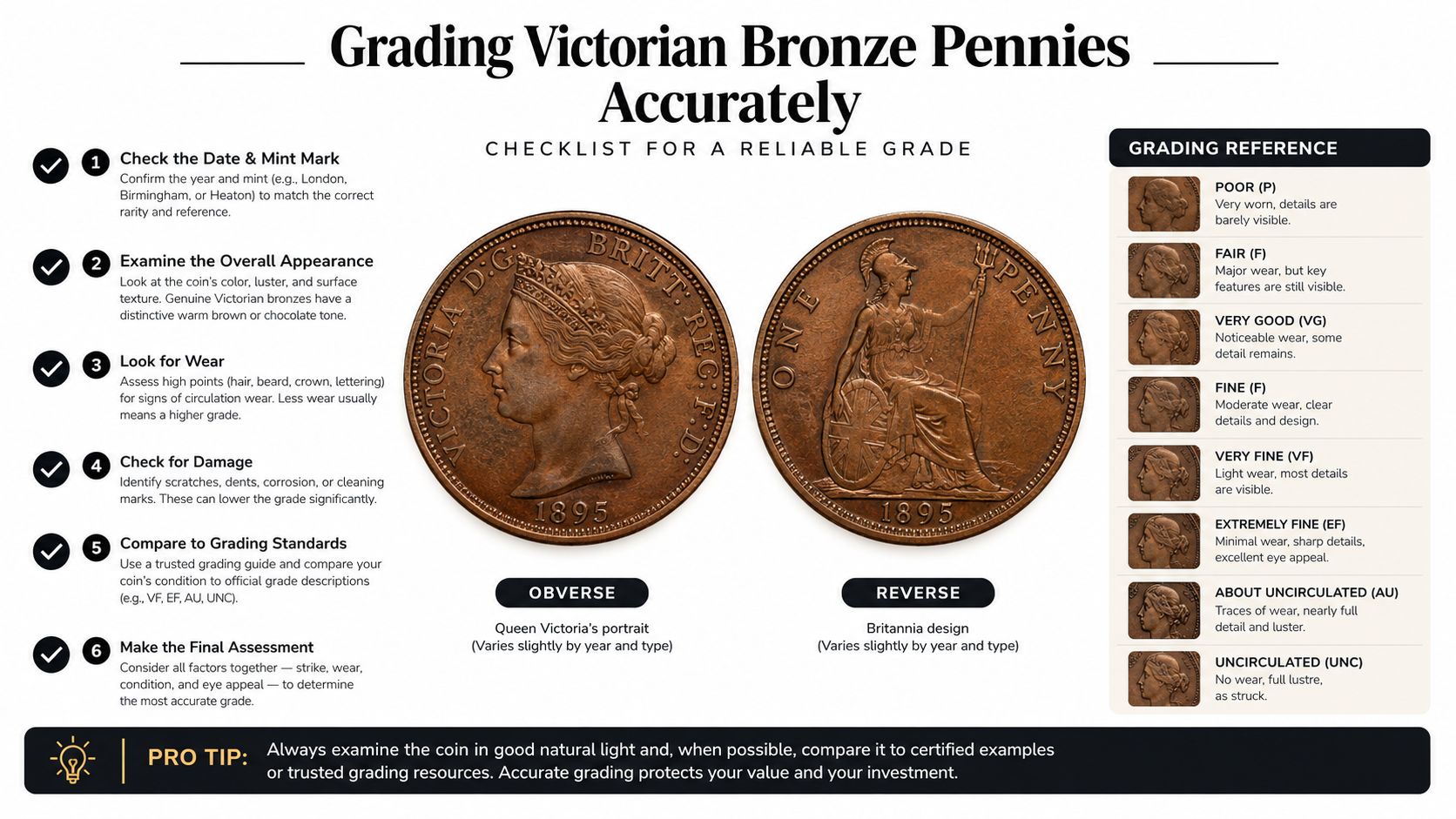
Grading is where most arguments about value begin, because bronze pennies are brutally sensitive to surface detail. Two coins with the same date and type can sit in different bands if one has honest wear and the other still carries crisp detail. For a beginner, the safest route is to inspect the highest points first, then decide whether the coin is noticeably sharper than average.
Where wear shows first
On Victorian bronze pennies, wear usually shows on the Queen's hair, the laurel wreath, and Britannia's shield. If those high points are soft or flat, the coin is no longer in the higher grades even if the fields look decent. That is why a coin that seems “nice” at arm's length can still grade far lower under close inspection.
The European grading language used by UK collectors typically runs from Very Fine through to Extremely Fine and Uncirculated, and the jump in value can be steep once original lustre survives. Common circulated pieces may still be perfectly collectable, but they won't price like a coin with full detail and clear surfaces. For a beginner-friendly primer on standards, see coin grading guidance.
What to look for in practice
- Hair detail: check whether the finer strands remain distinct or have merged into a smooth patch.
- Wreath definition: sharp leaves and edges usually indicate a stronger grade.
- Shield surfaces: the clearer the shield design, the better the coin has survived handling.
A coin with dull brown surfaces can still be attractive, but it shouldn't be sold as mint state unless the metal, strike, and detail support that claim. That caution matters because overgraded bronze pennies are everywhere, especially in online listings where photos are flattering but not revealing.
The coin itself tells you the grade if you slow down long enough to read the high points.
If you are building a collection, I'd rather buy a correctly graded VF coin than a badly described UNC coin. The former is honest, the latter is usually just expensive disappointment.
Navigating Asking Prices Versus Realised Value
Online asking prices can distort Victorian penny value badly. A listing is not a sale, and a high sticker price doesn't prove that a buyer will pay it. Recent UK marketplace data shows Victorian pennies advertised at widely different levels, from low-cost common pieces to individual coins listed around £40, £600+, and much higher for scarcer dates or varieties, but those are asking prices rather than completed-sale evidence (eBay listing page).
Ask three different questions
The first question is what the seller wants. The second is what a dealer would retail it for. The third, and most important, is what a knowledgeable collector paid. Those are three different numbers, and a lot of confusion comes from treating them as one.
I'd use completed sales, auction results, and reputable dealer stock together, then compare them against the coin's exact type and grade. If the coin is a common circulated example, asking-price inflation is especially common because sellers hope the age alone will carry the listing. It usually doesn't.
Reading the market properly
The current UK market has a clear split between retail display prices and realised value. Some pages now lean harder into condition and diagnostics, which is a sensible shift, because broad “Victoria penny value” ranges hide too much variation (Victoria penny value guide). A better approach is to compare like with like, same portrait, same diagnostic type, same grade, same market channel.
For structured comparison work, comparable sales data is the right habit to build. It helps separate a genuine premium from a hopeful listing that's been sitting unsold for months.
Useful test: if the asking price has no obvious link to grade or variety, treat it as a wish, not evidence.
That rule protects both buyers and sellers. Buyers avoid overpaying, and sellers avoid pricing a coin so high that it never moves.
Strategies for Buying and Selling Collections
The best results come from sorting before selling, not after. A mixed box of Victorian pennies should be divided into common circulated coins, better-grade examples, and possible varieties before any valuation is attempted. Once that is done, the pricing conversation gets much clearer.
Buy the right way
If you are buying, favour clear photographs, full date visibility, and sellers who don't blur the diagnostic details. Reputable dealers matter because authentication and accurate description save money later, especially on 1860 transition pieces and other varieties where a small feature can change the value bracket. Weekly auctions can also be useful for harder-to-find pennies, because they expose you to real market behaviour rather than a fixed catalogue price.
For bulk buyers and charity sellers, Cavalier Coins Ltd is one option that handles fixed-price listings, weekly eBay auctions, and bulk purchases from charity collections. That mix suits collectors who want visible inventory and sellers who need a practical route for large mixed lots.
Sell with the market in mind
A collection sells better when it is grouped by value logic. Keep common dates separate from key varieties, and don't mix cleaned coins with original surfaces if you can avoid it. Buyers will pay more confidently when the lot is easy to understand.
A simple selling checklist works well:
- Separate by portrait and date: the big categories tell buyers where the coin sits.
- Flag possible varieties: 1860 transitional pieces and 1882 no-H examples deserve closer inspection.
- Describe the grade accurately: understatement is safer than overclaiming.
- Choose the right venue: strong coins often suit auction, while common pieces may fit fixed-price sale better.
The best transactions happen when the seller knows what the coin is before the buyer has to explain it.
Common Questions from Collectors and Charities
Charities do not need to value every Victorian penny individually. A practical first pass should separate ordinary worn copper and bronze from coins that are unusually sharp, well preserved, or visibly different from the rest. That keeps specialist time focused where it can affect the result.
What about metal detecting finds
Detected Victorian pennies remain collectable, although soil exposure can damage them more severely than normal circulation. Encrustation, corrosion, and a worn surface may obscure the date or portrait details. Avoid aggressive scraping. Record the find as recovered, photograph both sides, and seek advice before attempting any cleaning or conservation. A bright reverse does not prove strong condition if the raised design has already flattened.
Should you clean bronze pennies
Leave them uncleaned in most cases. Cleaning can remove the original surface, create unnatural brightness, and reduce buyer confidence. Even gentle polishing may leave hairlines that are more damaging than the dirt. Store the coin safely and ask a professional about conservation only when the deposit threatens the surface or prevents identification.
How should charities handle donated coin collections
Use a simple three-stage workflow:
- Bag: keep loose groups in separate small bags or trays, rather than mixing copper, bronze, and visibly better pieces.
- Label: record the donor, the contents, and any dates or unusual features that can be read. Mark damaged, cleaned, or heavily corroded items clearly.
- Photograph: take clear images of the obverse and reverse in consistent light, with close-ups of unusual marks or lettering.
This creates a usable record before coins are moved between volunteers, offices, or valuers. Pull out stronger-looking examples, 1860 transition pieces, and unusual no-mintmark coins for closer review. Leave common mixed material together until a specialist advises whether sorting it further is worthwhile.
Where do beginners usually go wrong
The common mistake is treating an online asking price as evidence of value. A listing shows what a seller hopes to receive, not what a buyer has paid. Charities should record offers, auction results, or completed transactions separately from unsold listings, then use that distinction when setting expectations.
For a collection or donation lot, Cavalier Coins Ltd offers fixed-price coins, weekly auctions, and bulk buying. That gives charities and collectors practical options for comparing ordinary Victorian pennies with potentially scarcer examples before choosing a sales route.