
When you look at a modern shilling coin's value, you have to forget its original face value entirely. Today, it’s all about collectability. A common shilling from the 20th century might just be worth its weight in metal, but a rare, older version in mint condition could be worth hundreds, or even thousands, of pounds.
Getting to Grips with the Historic Shilling
Before we can even think about valuing a shilling, it’s worth taking a moment to understand what it actually was. For centuries, this coin was a real workhorse of British currency, a vital cog in the old pounds, shillings, and pence system (£sd).
Think of the old £sd system like a classic recipe. You need specific amounts of different ingredients to make the final product. The British pound was no different.
- The Pound (£): This was the main unit, the finished cake, if you will.
- The Shilling (s): You needed 20 shillings to make up one pound.
- The Penny (d): And you needed 12 pence to make one shilling.
This meant a single pound was made up of a whopping 240 pence. The shilling was that crucial middle-man, linking the biggest and smallest units of currency together. Its long and fascinating story began back in the early 16th century under Henry VII. Those first shillings were called 'testoons' and were some of the very first English coins to feature a true-to-life portrait of the king. You can dig deeper into its origins by exploring the history of the shilling.
This image shows a table breaking down the mintage figures for shillings under various monarchs.
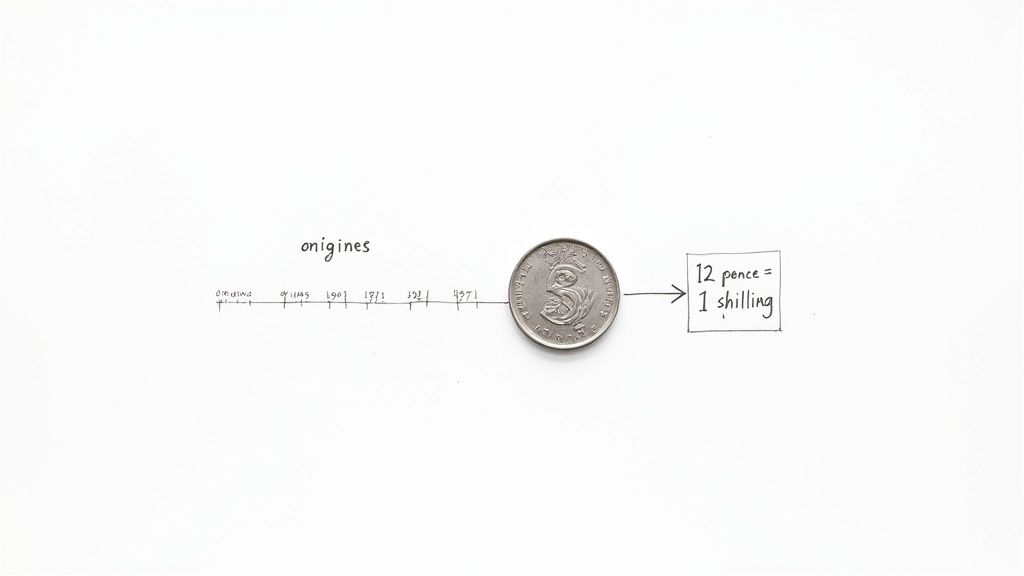
As you can see, the production numbers swung wildly over the years. This is a massive factor for collectors, as it directly impacts how rare—and therefore how valuable—a particular coin is today.
The Four Key Factors Driving a Shilling's Value
Figuring out what an old shilling is worth has very little to do with its original face value. It's more like being a detective, looking for the crucial clues that separate a common coin from a real find. For numismatists (that’s the official term for us coin collectors!), there are four main things to look for.
Getting a handle on these is the first step to understanding what your collection might actually be worth. It's the way these factors play off each other that makes valuing coins so interesting. For instance, a common date in absolutely perfect condition could easily be worth more than a very rare date that's seen better days.
Date and Reign
The first and most obvious clue is right there on the coin: its date. The year it was made and the monarch on the throne are the starting point for its value. Shillings from monarchs with long reigns, like Queen Victoria or George V, were generally pumped out in huge numbers, so most dates are quite common.
On the flip side, coins from a monarch who wasn't on the throne for long are a different story. Take Edward VIII, who was king for less than a year in 1936. No shillings with his portrait ever officially made it into circulation, so if you stumble upon one, it’s exceptionally rare and valuable. This simple rule of scarcity applies to any monarch with a short reign.
Mint Mark and Mintage
Beyond just the date, you need to look at where the coin was made and just how many were struck. A tiny letter or symbol, known as the mint mark, tells you its origin. Most British shillings came from the Royal Mint in London, but some were produced at other branch mints, and this can make a big difference to their scarcity.
The mintage is simply the total number of coins of that specific type and date that were produced.
A low mintage number is probably the single biggest indicator of scarcity. As a classic example, the 1950 English shilling had a mintage of just over 2 million. Compare that to the 1955 English shilling, which had a mintage of over 38 million. That massive difference makes the 1950 coin much, much harder to track down.
Condition and Grade
Think of it like comparing two old books. One is a battered paperback you’d find at a car boot sale, with a creased cover and worn pages. The other is a crisp first edition that looks like it's never been opened. The difference in value is huge, and it's exactly the same with coins.
A coin's condition, or grade, is just a way of measuring its wear and tear. A shilling that’s been jingling in pockets for decades will have its details worn smooth, giving it a low grade and a low value. But an "Uncirculated" coin, one that still has its original shine from the mint and sharp details, is what collectors dream of, and it will always fetch a premium.
Rarity and Varieties
Finally, rarity isn't just about low mintage figures. It also covers fascinating little quirks known as varieties or errors—mistakes made during the minting process that create a unique version of an otherwise standard coin. Some examples include:
- Overdates: This is where you can see one date stamped over another.
- Die Cracks: These show up as small, raised lines on the coin's surface, caused by a crack in the mould (the die).
- Misstrikes: These are coins that weren't hit properly, leaving the design off-centre or incomplete.
Finding one of these imperfections can turn a shilling worth a few quid into a collector's piece worth hundreds. It’s the coin equivalent of finding a misprinted stamp—a happy accident that creates a treasure.
How To Grade Your Shilling's Condition at Home
Working out the condition of your shilling is one of the biggest steps in figuring out what it’s worth. The good news is, you don’t need to be a professional to get a pretty good idea. With a sharp eye and maybe a magnifying glass, you can do a basic check right from your kitchen table.
The secret is to look for wear on the highest points of the coin’s design.
Picture the monarch’s portrait on the front. On a brand-new shilling, details like the hair, the ear, and the crown are crisp and clear. But as a coin gets passed around, these high points are the first bits to get rubbed smooth. The same idea applies to the other side, where the fine details of the shield or royal crest show the first signs of handling.
The infographic below breaks down the main things that drive a shilling's value, and you can see how condition is a massive piece of that puzzle.
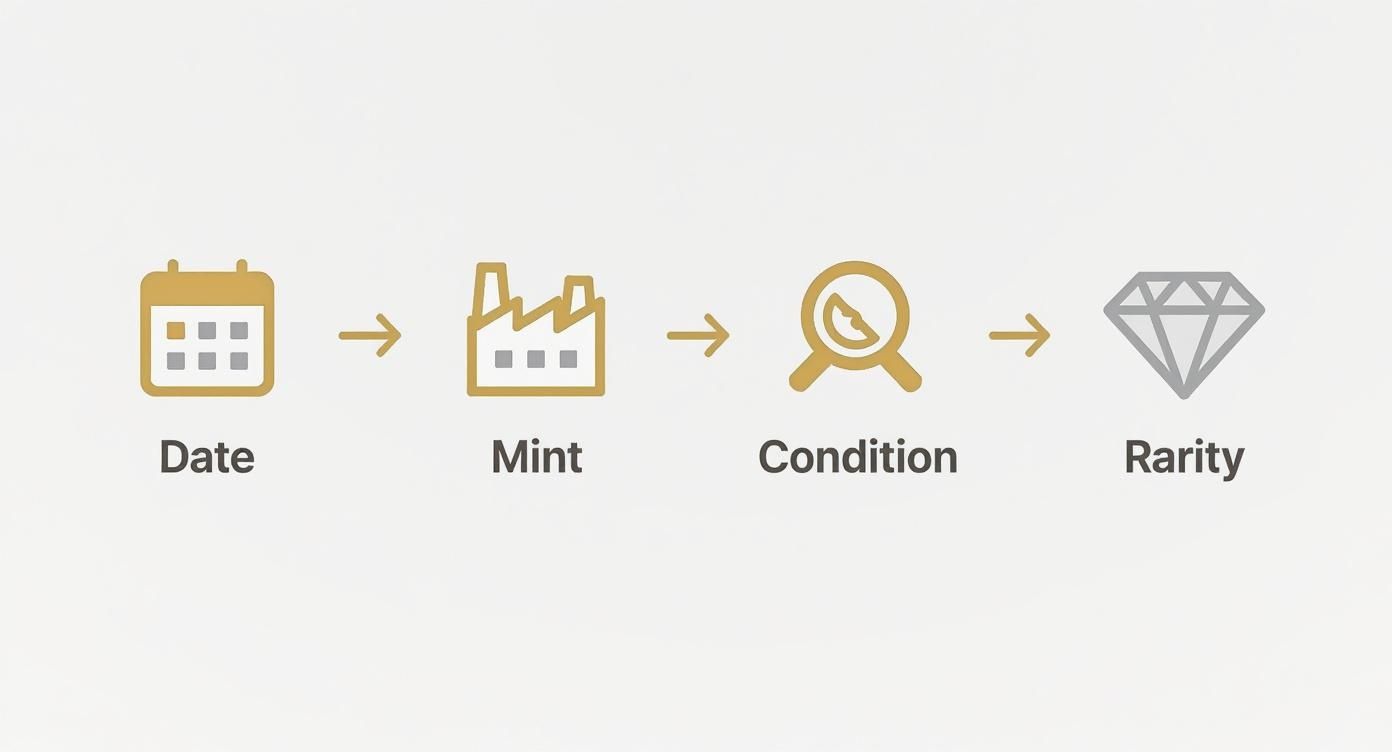
As you can see, condition sits right alongside date, mint, and rarity in building the complete picture of your shilling coin value.
Translating Grades Into Visual Checks
Official grading has its own language, but you can easily translate the terms into simple things to look for. Here’s a quick guide to help you place your coin on a basic scale.
- Good (G): The main design is there, but most of the finer details have worn away. You should be able to read the lettering and date, but they'll look quite flat and worn down.
- Fine (F): Most of the major details are still visible. You might be able to make out a few strands of hair on the portrait, but the very highest points are smooth.
- Very Fine (VF): The details are mostly sharp, with just a little bit of wear on the highest points. The coin has definitely been used but was looked after.
- Uncirculated (UNC): This coin looks like it just left the mint. There are absolutely no signs of wear, it still has its original shine (lustre), and every tiny detail is perfect.
A coin in Uncirculated condition can be worth 10 to 100 times more than the exact same coin in Good condition. This massive jump in value is precisely why getting the grade right is so important for any collector.
Shilling Coin Grading Quick Reference Guide
To make it even simpler, here's a quick reference table. Use it to compare your shilling against the descriptions and get a ballpark idea of its grade.
| Grade | Key Visual Cues | Typical Appearance |
|---|---|---|
| Good (G) | Main design is flat; lettering and date are readable but worn. | The coin looks heavily used and tired. |
| Fine (F) | Some detail in protected areas (like hair strands) remains. | A clearly circulated coin, but not completely worn out. |
| Very Fine (VF) | Light wear only on the highest points (e.g., cheek, crown). | Looks sharp at a glance, with wear visible on close inspection. |
| Uncirculated (UNC) | No wear at all; retains original mint lustre. | Looks brand new, as if it was made yesterday. |
This table is a great starting point for assessing your collection and understanding what to look for.
While checking at home is a fantastic first step, if you think you have a particularly valuable coin, getting it professionally assessed is always a good move. To see what that involves, you can learn more about how to get coins graded. For a broader look at how condition affects value across different hobbies, it's worth exploring the general principles of collectible grading.
Rare Shilling Dates and Varieties to Look For
While any old shilling is a fascinating piece of history, some dates and designs truly stand out. They can turn a simple coin into a highly sought-after prize. Spotting one of these in a collection is the numismatic equivalent of finding a needle in a haystack—and it’s just as rewarding.
The key is knowing what to look for and understanding why a particular coin is so desirable.
Often, a coin’s rarity is tied directly to a specific moment in history. Events like wars, economic turmoil, or short monarchical reigns frequently resulted in low mintage numbers, creating instant collectibles. These are the coins that command attention and drive up the shilling coin value at auction.
Key Dates from the 20th Century
You don't always need a centuries-old coin to find something special. The 20th century produced several shillings that are surprisingly scarce and valuable, mostly because so few were made in the first place.
- 1950 English Shilling: With a mintage of just over 2 million, this coin is significantly scarcer than those from surrounding years, which were often produced in the tens of millions.
- 1954 Scottish Shilling: This is another low-mintage issue and a key date for collectors focusing on the post-war period. Finding one in top-notch condition is particularly challenging.
- 1948 Shillings: The story behind the value of the 1948 shilling is especially interesting and worth a closer look for any aspiring collector.
These examples clearly show how mintage figures directly impact scarcity. A coin from a year with low production is simply harder to find, making it a target for serious collectors.
Victorian and Earlier Treasures
Going further back, the Victorian era and before offer a real treasure trove of rare varieties. During this time, minting processes were far less standardised, leading to fascinating errors and variations that are highly prized by collectors today.
For instance, a rare 1850 shilling featuring an overdate variety recently sold at auction for an impressive £2,750. It’s a testament to how scarce and well-preserved specimens can fetch a high premium.
Keep an eye out for "Gothic" shillings from Queen Victoria's reign or any shillings from short-reigning monarchs like Edward VII. These often have lower survival rates in good condition, making them exceptionally valuable to the right buyer.
Ultimately, the thrill of the hunt is a huge part of the appeal. By learning to recognise these rare dates and subtle varieties, you can transform a casual look through an old coin jar into an exciting treasure hunt with the potential for a remarkable discovery.
How Decimalisation Changed the Shilling Forever
The year 1971 marks a massive turning point in the story of British money. When the decimal system arrived, centuries of tradition built on pounds, shillings, and pence came to a sudden halt. This moment completely changed the game for collectors and shifted the shilling's identity for good.
Before this change, the system was a bit of a headache; one shilling was worth twelve old pence, and it took twenty shillings to make up a pound. The switch to decimal currency re-pegged the shilling at five new pence (£0.05), a move that made calculations much simpler across the country.
A New Role for an Old Coin
As it happens, shillings minted from 1953 onwards were a perfect match for the new 5p coin in both size and weight. Because of this, they were allowed to circulate side-by-side, with old shillings effectively being used as 5p pieces.
This double life carried on until 1990. That's when a smaller 5p coin was rolled out, making all the old shillings obsolete and officially pulling them from circulation.
This is the pivotal moment that draws so many collectors to post-war shillings. The last coins struck for circulation, like those from the late 1960s, truly represent the end of an era. Special proof sets from this period are also highly sought-after.
For numismatists, this dividing line is crucial. It's the point where a shilling coin's value stopped being about its use in day-to-day shopping and became all about its historical weight and collectability. To get a better feel for the timeline, have a look at our article on the brief history of British coins.
Your Shilling Coin Questions Answered
As you dive into the fascinating world of shillings, a few common questions always seem to surface. Let's tackle them head-on, giving you the clear, straightforward answers you need to feel more confident about your collection and the true shilling coin value.
Are All Old Shillings Valuable?
Not necessarily. It’s a common assumption that age equals value, but when it comes to coins, rarity and condition are often the true kingmakers.
Many shillings from the 20th century, for example, were churned out by the tens of millions. This makes them incredibly common, even today. An older, heavily worn shilling could easily be worth less than a much newer, low-mintage coin that looks like it just left the mint. It’s the unique mix of all four factors—date, mint, condition, and rarity—that tells the real story.
What Is the Difference Between English and Scottish Shillings?
This is a great question, and one that often trips up new collectors. After the Act of Union in 1707, shillings were minted for Great Britain as a whole. But things got interesting from 1937 onwards, when two distinct designs were released each year: one featuring an English shield and another with a Scottish one.
While they were often produced in similar numbers, tiny variations in mintage can sometimes make one type a bit scarcer for a particular year. That small difference can be enough to make it more sought-after by collectors aiming to complete a full set of both designs.
How Can I Get My Shilling Professionally Valued?
If you think you might be sitting on a rare shilling or one in exceptional condition, getting a professional opinion is your best move. Don't leave it to guesswork.
The smartest course of action is to consult a reputable coin dealer or a numismatic specialist at an auction house. They have the hands-on experience to give you an accurate appraisal based on the coin's specific features and what the market is doing right now. For a potentially high-value piece, you should seriously consider getting it graded and encapsulated by a third-party service for official certification.
At Cavalier Coins Ltd, we live and breathe numismatics. Whether you're looking to track down rare pieces to build your collection or just need some friendly advice on what to do next, we're here to help. Explore our extensive selection of world coins and banknotes at https://www.cavaliercoins.com.