
Believe it or not, some of the very best UK coins to collect are the modern ones you can find right in your pocket money. We’re talking about those rare 50p, £1, and £2 coins that pop up in your change from time to time. The undisputed champion is the 2009 Kew Gardens 50p, a coin famous for its tiny production run that makes it a holy grail for beginners and seasoned collectors alike.
Starting Your UK Coin Collecting Journey
So, you’re thinking about getting into the fascinating world of UK coin collecting? Welcome! This isn't a hobby that starts in a stuffy auction house; it begins with the change rattling around in your pocket or that old jam jar full of pennies. Think of it as a modern-day treasure hunt, where you learn to spot the tiny clues that turn a simple piece of metal into a piece of history.
What makes it so compelling is that absolutely anyone can start. It's as simple as checking your change for an unusual design or a particular date. We'll walk you through the core ideas that give a coin its value and turn a simple find into a prized possession.
What Creates Value in UK Coins
The first step on your journey is learning what makes one coin worth hanging onto while another is just... well, change. It’s like learning the language of numismatics (the official term for coin collecting). A few key factors come together to determine a coin's real worth:
- Low Mintage: This is simply the number of coins minted for a specific design in a given year. The rule is straightforward: the lower the mintage, the rarer the coin, and the more desirable it becomes. A coin with a mintage of 210,000 is a world away from one with 20 million in circulation.
- Unique Designs: The Royal Mint loves to release special commemorative coins for national events, famous Brits, or even beloved characters. These special editions are essentially miniature works of art, and their unique designs make them instant hits with collectors.
- Historical Importance: Coins are little time capsules. A coin minted during a monarch’s final year, or one created to mark a major anniversary, tells a story. That connection to a moment in time gives it an appeal that goes far beyond its face value.
A coin is more than just currency; it's a piece of history you can hold in your hand. Each design tells a story about the era it was minted, from royal successions to cultural milestones, making every find a direct connection to the UK's rich heritage.
This guide will cover everything you need to know, from the absolute basics of valuing a coin to identifying specific 50p, £1, and £2 pieces that are worth a closer look. If you're completely new to this, this easy beginner's guide to coin collecting is a fantastic starting point. We also have our own detailed guide on how to start collecting coins that builds on these concepts.
Now, let's start uncovering the stories hiding in your spare change.
What Makes a UK Coin Rare and Valuable
Before you can spot a treasure in your change, you need to understand what makes it a treasure in the first place. Working out a coin’s value is the first step to building a worthwhile collection of UK coins to collect, and it’s a lot more straightforward than you might think. It really boils down to a few key factors that turn a simple piece of metal into a collector's prize.
Learning to spot these clues is like getting your numismatic toolkit in order. It’s all about training your eye to see beyond the face value and start recognising the subtle signs of rarity and desirability.
The Power of Low Mintage
The biggest, most important factor in a coin’s rarity is its mintage – that’s simply the total number of coins that were made for a specific design in a specific year. The logic here is pure supply and demand. The fewer coins that exist, the more collectors want them, and the higher the price goes.
Think of it like a limited-edition art print versus a poster from a high-street shop. They might both have the same picture, but the print with only 100 copies made will always be more sought-after than the one with a million copies. Coins are no different.
A perfect example is the famous 2009 Kew Gardens 50p, which had a mintage of just 210,000. When you compare that to a standard 50p, which can have tens of millions minted, you see why the Kew Gardens coin is the undisputed star of modern UK collecting.
Condition Is Absolutely Key
So, you’ve found a low-mintage coin. What's next? Its physical condition is the next hurdle. A coin that looks like it just rolled off the production line at The Royal Mint will always be worth more than one that's been jangling around in pockets and cash registers for years. This is where grading comes in.
- Uncirculated (UNC): These are pristine coins that have never been used for shopping. They have no signs of wear and still have their original shine, or "mint lustre".
- Circulated: These are the coins you find every day. Their condition can range from having very light wear to being so worn down that the details are almost smooth.
Even a very common coin can be worth more than its face value if it’s in perfect, uncirculated condition. For the really rare ones, the difference in value between a worn example and a pristine one can be hundreds, if not thousands, of pounds.
The grade of a coin is its biography. An uncirculated coin tells a story of preservation, while a circulated coin carries the marks of its journey through countless hands, each scratch and ding a part of its unique history.
The Allure of Minting Errors
Sometimes, things go wrong during the minting process. These little mistakes can create incredibly rare and valuable coins. These aren't just damaged coins; they're unique varieties that slipped past quality control with a flaw, making them a huge prize for collectors who love hunting for oddities.
One of the most famous UK errors is the "dateless" 20p from 2008. A mix-up with the dies (the metal stamps that create the design) meant a batch of 20p coins was struck using the new reverse design but the old obverse. The result? A coin with no date on it at all. These can be worth a pretty penny.
Other errors to keep an eye out for include:
- Mule Coins: This happens when a coin is struck with an obverse die and a reverse die that weren't meant to be paired together.
- Off-Centre Strikes: The design isn't perfectly centred on the coin blank.
- Rotated Dies: The Queen's (or King's) head and the reverse design aren't lined up correctly.
Historical and Thematic Significance
Finally, a coin’s story really matters. Coins that are linked to a big historical event, a change of monarch, or a popular cultural moment often carry a premium. These pieces do more than just serve as currency; they capture a moment in time. For a deeper dive into specific valuations, our guide on rare UK coin values provides detailed insights.
Think about the coins released for the London 2012 Olympics or the charming Beatrix Potter series. Their connection to a much-loved event or character set makes them instantly collectable. In the same way, the first coins featuring King Charles III or the final coins of Queen Elizabeth II mark a massive moment in British history, giving them a special significance right out of the gate.
The Most Sought-After 50p Coins in Circulation
When you're talking about modern UK coins to collect, the seven-sided 50p is the undisputed star of the show. It's become a miniature canvas, celebrating everything from British sporting triumphs to our most beloved children's book characters. This unique role has turned it into a phenomenon, sparking a nationwide treasure hunt with every handful of change.
For many, the 50p is the gateway into the rewarding world of coin collecting. The varied and often beautiful designs make them instantly appealing, but it’s the thrill of finding a genuinely scarce one that really gets you hooked. Learning to spot these special issues is your first step towards building a collection with real character and potential value.
The Kew Gardens 50p: The Legend
You simply can't discuss collectable 50p coins without starting with the legend itself: the 2009 Kew Gardens 50p. This coin is the holy grail for modern collectors, and its story perfectly shows the power of low mintage figures. It’s the benchmark against which all other modern rare coins are measured.
Issued to celebrate the 250th anniversary of the Royal Botanic Gardens, its standout feature is the Chinese Pagoda design. But what truly makes it special is its scarcity. The Royal Mint only ever released 210,000 into circulation, an incredibly small number. This rarity has seen its value soar, with good examples often selling for over £150.
This infographic breaks down the key factors that influence a coin's value, from its mintage to its physical condition.
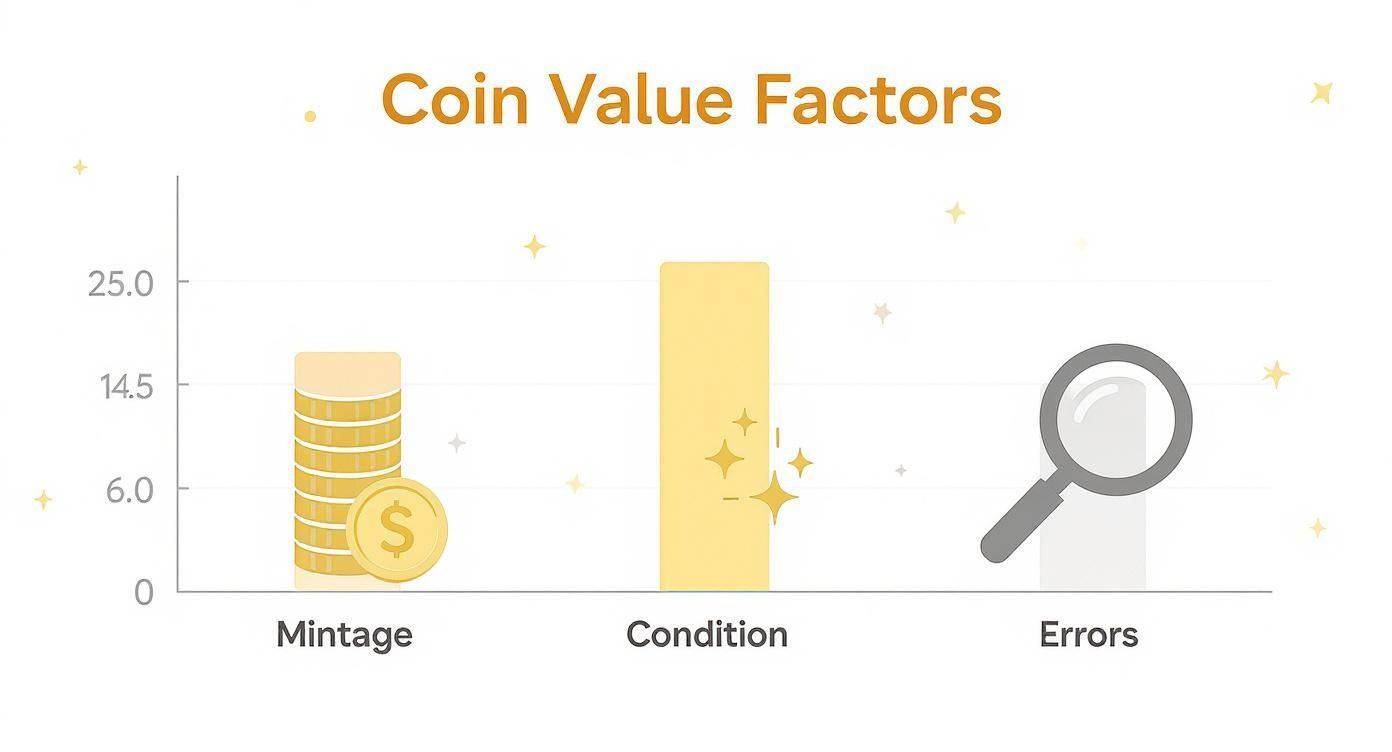
As you can see, a low mintage figure is the biggest driver of a coin's initial rarity and desirability among collectors. It’s the simple rule of supply and demand.
To help you spot the most valuable 50p coins, we've put together a quick reference table.
Top 5 Collectable UK 50p Coins
| Coin Name | Year of Issue | Mintage Figure | Key Design Feature |
|---|---|---|---|
| Kew Gardens | 2009 | 210,000 | The Great Pagoda at Kew Gardens |
| Olympic Football | 2011 | 1,125,500 | Diagram explaining the offside rule |
| Olympic Judo | 2011 | 1,161,500 | Two judoka engaged in a throw |
| Olympic Triathlon | 2011 | 1,163,500 | Silhouettes of swimming, cycling, and running |
| Peter Rabbit | 2018 | 1,400,000 | Peter Rabbit munching on a carrot |
This table highlights just a few of the top coins to keep an eye out for. Remember, condition is just as important as rarity, so always handle your finds with care!
The London 2012 Olympics Series
Before the Kew Gardens craze really took hold, it was the London 2012 Olympics series that lit the fuse for modern 50p collecting. To celebrate the games, The Royal Mint released an incredible 29 different designs, each representing a different Olympic or Paralympic sport.
This ambitious collection was a brilliant way to get the whole nation involved. Suddenly, everyone was checking their change, hoping to complete a full set. While many of the designs have fairly high mintage figures, a few are much harder to track down.
The Football 50p, famous for its quirky diagram explaining the offside rule, is one of the scarcest, with a mintage of just 1,125,500. Other tough-to-find designs from this series include Judo, Wrestling, and Triathlon, all with mintages below 1.2 million. Finding a complete set, especially in good condition, is a fantastic achievement for any collector.
The Charming Beatrix Potter Collection
Another phenomenally popular series features the delightful characters of Beatrix Potter. First released in 2016 to mark the 150th anniversary of her birth, these coins were an instant hit, combining British literary heritage with beautifully crafted designs. The initial wave featured icons like Peter Rabbit, Jemima Puddle-Duck, and Mrs. Tiggy-Winkle.
Because they were so popular, The Royal Mint kept releasing new designs in the following years, which means there are now many different Beatrix Potter coins to look for.
The scarcest of the bunch tend to be the earliest releases, as fewer people were actively saving them at the time. The 2018 Peter Rabbit and Flopsy Bunny 50p coins are particularly sought after, each with a mintage of just 1,400,000. These charming pieces prove how a strong theme can create a dedicated collector base. For a deeper dive into these and other valuable coins, you can explore our guide on which 50p coins are worth money.
Valuable £1 and £2 Coins Hiding in Your Change
The iconic 50p often steals the limelight in the world of modern coin collecting, but don't let that fool you. The heavier £1 and £2 coins jangling in your pocket or piggy bank can be just as exciting, each with its own tale of rarity and unique design.
From the old ‘round pound’ to the hefty bi-metallic £2 commemoratives, these coins have celebrated everything from the four corners of the UK to major scientific breakthroughs and historic anniversaries. Once you know what to look for, checking your change becomes a treasure hunt.
The Classic Round Pound Legacy
Before the 12-sided wonder arrived in 2017, the classic round £1 coin was a staple in British life for over thirty years. During its long service, The Royal Mint released a massive variety of reverse designs, most of them celebrating the capital cities and floral emblems of the UK's home nations. While the majority are extremely common, a few were struck in surprisingly small numbers.
These scarcer coins are now hot property for collectors scrambling to complete their sets of this now-defunct series. They represent a finished chapter in British coinage, making them a well-defined and satisfying collecting goal.
The undisputed king of the round pounds is the 2011 Edinburgh City coin. With a mintage of just 935,000, it's the only one that ever dipped below the one million mark, making it the rarest of them all. Keep an eye out for these others, too:
- 2011 Cardiff City: The second-rarest, with a mintage of 1,615,000.
- 2010 London City: Another key piece for any collection, with 2,635,000 minted.
- 2008 Royal Arms: The design is common, but this specific year had a much lower run of 3,910,000.
Unearthing any of these from an old coin jar is a brilliant find. It’s always worth a second glance at the date and design on any round pounds you stumble upon.
Modern 12-Sided £1 Coin Rarities
The launch of the 12-sided £1 coin in 2017 was a huge deal, a high-tech answer to the counterfeiters. That first year saw billions of them roll off the presses, but the mintages in subsequent years have been far, far lower. This is where the new rarities are emerging.
The key to spotting a future classic is to watch the annual mintage figures released by The Royal Mint. These newer coins are the ones to watch.
The changeover from one monarch to the next is a seismic event for coin collectors. The very last coins of a reign and the first of a new one immediately become historical artefacts, capturing a moment of profound national change.
This is especially true right now. The move from Queen Elizabeth II to King Charles III has created a fresh wave of collectable coins, and the 2022 £1 is a prime example. Only 7.735 million were released into circulation, a tiny number for this series. As the last £1 coin to feature the portrait of Queen Elizabeth II, it marks the end of an incredible era. If you want to dive deeper, you can read the full details on these modern rarities and see which pound coins are worth pulling from your change.
Hunting for Rare £2 Coins
First issued for circulation in 1998, the bi-metallic £2 coin has long been a canvas for some of the UK's most important commemorations. Its impressive size and two-tone composition make it the perfect medium for intricate, eye-catching designs—many of which are now highly prized by collectors.
The most famous of them all, the holy grail for many, is the 2002 Northern Ireland Commonwealth Games £2. The Mint produced four different coins for the XVII Commonwealth Games in Manchester, one for each home nation. For reasons lost to time, the Northern Ireland version was struck in far smaller quantities than the others.
With a mintage of just 485,500, it stands alone as the rarest £2 coin in circulation by a country mile. Its distinctive flag design is easy to spot, and finding one is a genuine red-letter day for any collector.
Other valuable £2 coins to keep an eye out for include:
- 2002 England Commonwealth Games: Mintage of 650,500.
- 2002 Wales Commonwealth Games: Mintage of 588,500.
- 2002 Scotland Commonwealth Games: Mintage of 771,750.
- 2008 Olympic Handover (Beijing): Mintage of 918,000.
- 2012 Olympic Handover (London): Mintage of 845,000.
Getting into the habit of checking the dates and designs on your £1 and £2 coins can seriously pay off. They might not grab the headlines like the 50p, but some of the biggest prizes in modern coin hunting are waiting to be found right there.
How to Protect and Organise Your Coin Collection
There’s a massive thrill in finding a rare coin, but the real work begins the moment it lands in your palm. Protecting that coin from damage is just as important as the hunt itself, because its condition and value are directly linked. A single careless fingerprint or an unfortunate scratch can slash the worth of a prized piece.
Becoming a great collector is really about building good habits from day one. It’s all about creating the perfect environment for your coins, making sure they stay in top-notch condition for many years to come.
The Golden Rules of Handling Coins
The first and most important rule is surprisingly simple: handle your coins as little as possible. When you absolutely must pick one up, always hold it by its edges between your thumb and forefinger. The natural oils and acids on your skin can eat into a coin’s surface and leave permanent marks, especially on shiny, uncirculated coins that still have their original mint lustre.
For your most valuable finds, it’s well worth investing in a pair of soft cotton or lint-free gloves. This tiny step provides a crucial barrier between your skin and the coin, preventing any accidental smudges. And whatever you do, never, ever clean your coins. You might think you're helping, but removing the natural patina can completely destroy their value.
Choosing the Right Storage Solution
Proper storage is your collection's best line of defence against the elements. What you choose will depend on your budget and the value of your coins, but there are fantastic options out there for every level of collector.
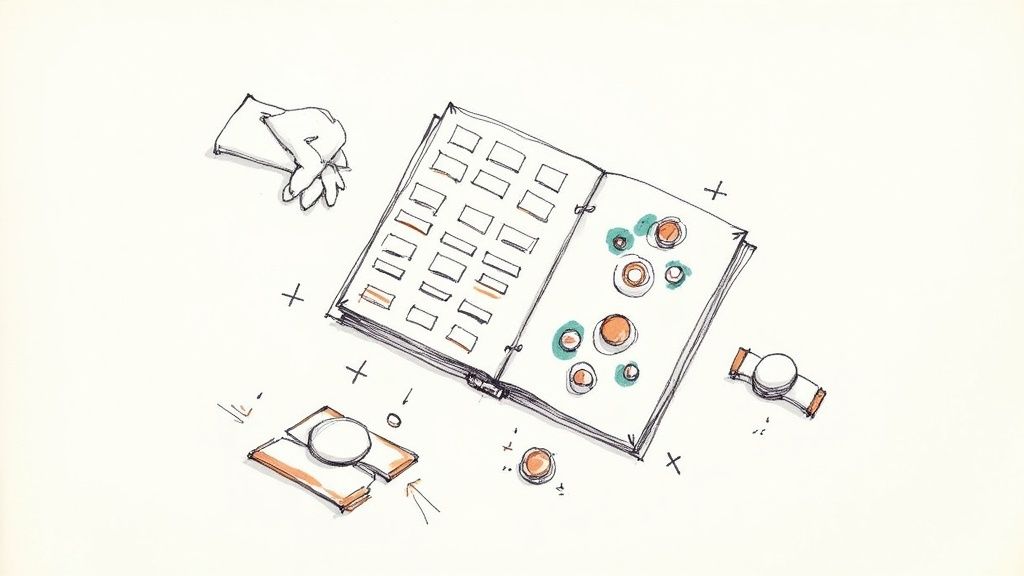
- Coin Albums and Folders: These are a brilliant starting point for beginners. They come with pre-labelled slots for specific coins, which makes it incredibly satisfying to fill the gaps in a series, like the famous London 2012 Olympics 50p set.
- 2x2 Cardboard Flips: These cheap and cheerful holders are just a cardboard square with a clear Mylar window. You pop the coin inside, fold it over, and staple it shut. They're perfect for organising and cataloguing individual coins without breaking the bank.
- Protective Capsules: For your absolute pride-and-joy finds, like a Kew Gardens 50p or a rare £2 coin, hard plastic capsules are the gold standard. These airtight cases offer the best possible protection against air, moisture, and any physical knocks.
A well-organised collection is a well-loved collection. It transforms a simple hobby into a curated library of miniature historical artefacts, where every piece is protected, accessible, and ready to be admired.
As your collection gets bigger, just keeping track of what you own becomes a job in itself. To ensure the long life and accessibility of your numismatic treasures, it’s worth exploring effective coin collection management strategies that can help you catalogue your finds properly.
Growing Your Collection Beyond Your Change
While sifting through your change is the heart and soul of the hobby, there are other safe and reliable ways to expand your collection of UK coins to collect. Reputable coin dealers, both online and in brick-and-mortar shops, are an excellent source for those specific coins you’re struggling to find.
You could also join online collector communities or a local coin club. These are fantastic places to trade duplicates with fellow enthusiasts and soak up knowledge from their years of experience. Just be sure to trade cautiously and stick with trusted members of the community – that’s how you’ll build a collection you can truly be proud of.
Got Questions About UK Coin Collecting? We’ve Got Answers.
Stepping into the world of numismatics always sparks a few questions, especially when you're just getting your bearings. To help you along, we’ve put together answers to some of the most common queries we hear from collectors of UK coins.
How Much Is My Coin Collection Worth?
Ah, the million-dollar question—or perhaps the 50p question! A coin's value really boils down to three key things: its rarity (how many were minted), its condition (its grade), and the demand from fellow collectors. You might be surprised to learn that a very rare coin in rough shape could be worth less than a more common one that looks like it just left the Mint.
To get a solid idea of what your coins are worth:
- Check recent sales: See what similar coins have actually sold for on auction sites or online marketplaces. That's real-world value right there.
- Consult the guides: Publications like the Spink "Coins of England" guide are the collector's bible, with regularly updated valuations.
- Ask a professional: If you think you've got something really special, it's always worth getting it appraised by a dealer you trust.
What's the Rarest UK Coin I Can Find in My Change?
That would be the one, the only, the 2009 Kew Gardens 50p. With a tiny mintage of just 210,000, its sheer scarcity has cemented its place as the holy grail for anyone checking their change.
For so many collectors, finding a Kew Gardens 50p in the wild is the ultimate thrill. It’s that perfect mix of beautiful design, a great story, and genuine rarity that makes this hobby so addictive.
Should I Clean My Coins?
In a word: no. It’s the single most important rule in coin collecting. Whatever you do, resist the urge to polish or scrub your coins. Cleaning strips away the coin’s natural patina—that subtle layer that builds up over decades—and leaves behind tiny, value-destroying scratches. A serious collector will always, always choose an original, untouched coin over a shiny, cleaned one.
Where Are the Best Places to Find Rare Coins?
The most exciting place is, and always will be, in your own pocket! But if you want to be a bit more strategic in tracking down specific UK coins to collect, you can also:
- Try asking for specific change at shops or your local bank.
- Get a few coin rolls from the Post Office and see what's inside.
- Hunt for treasures at car boot sales and flea markets.
- Join online collector groups to trade your duplicates for coins you need.
- Buy from reputable coin dealers who know their stuff.
Each approach offers its own kind of treasure hunt, which is what keeps this hobby so fresh and exciting as your collection grows.
At Cavalier Coins Ltd, we live and breathe coins. We have a huge selection of rare and collectable coins from the UK and beyond. Whether you're hunting for that one elusive piece or just starting out, come and explore our curated collections at https://www.cavaliercoins.com.