
The most common shortcut in coin collecting is to treat a low mintage as a price tag. It isn't. Legal-tender status, face value, mintage, condition and market demand describe different things, and confusing them can lead you to overpay for a coin or overlook a piece worth investigating.
A better approach is to identify what a coin is, check how it was made and issued, then compare its condition and recent sales. The examples below show how to do that with UK commemorative coins, without assuming that every special design is rare or valuable.
What Makes a UK Commemorative Coin Official
A UK commemorative coin is struck to mark a royal occasion, anniversary, person or national event, usually with a design that distinguishes it from standard coinage. “Commemorative” describes a coin's purpose and design, not its finish: a commemorative design can appear on a circulating, Brilliant Uncirculated or proof issue.
Official status and practical acceptance are separate questions. Under section 2 of the Coinage Act 1971, legal-tender limits depend on the coin's metal and denomination. The table summarises the limits set out in the Coinage Act's legal-tender provisions.
| Metal or composition | Denomination | Legal-tender limit |
|---|---|---|
| Gold | Any denomination | Any amount, subject to minimum weight requirements |
| Silver or cupro-nickel | Above 10p | Up to £10 |
| Silver or cupro-nickel | 10p or less | Up to £5 |
| Bronze | Any denomination | Up to 20p |
For example, a cupro-nickel 50p and a silver crown fall under the limit for coins above 10p, so each is legal tender up to £10. A bronze coin, by contrast, can settle only up to 20p of a debt. Gold coins are treated differently: their legal-tender status has no amount limit, but statutory or proclamation-defined minimum weight requirements apply.
Legal tender isn't a promise that shops will accept it
Think of legal-tender status as a passport. It establishes that a coin has a recognised legal status, but it doesn't guarantee that every shop, bank or vending machine will accept it in an everyday transaction. Commemorative coins are often made for collectors or gifts rather than for routine spending, and acceptance in practice can depend on the recipient.
A £5 commemorative's face value also doesn't tell you what it will sell for. A collector may pay more than face value for a desirable issue in sought-after condition, while another coin may be worth close to face value. A precious-metal coin's metal content can be another consideration, but it's still separate from its denomination and collector premium.
For a wider introduction to how commemorative design and purpose fit together, see what makes a coin commemorative.
Use this simple check when cataloguing a coin:
- Read the metal and denomination.
- Find the matching legal-tender limit.
- Record legal status separately from condition, metal content, scarcity and demand.
From the 1935 Jubilee Crown to the Modern Programme
The modern British commemorative-coin tradition is generally traced to 1935, when the Royal Mint issued a silver crown for King George V's Silver Jubilee. The Mint had made special-purpose coins earlier, but this issue established a recognisable model: using national coinage to mark a major royal or historical occasion. The Royal Mint's overview of coins and collecting places that crown at the foundation of the modern tradition.
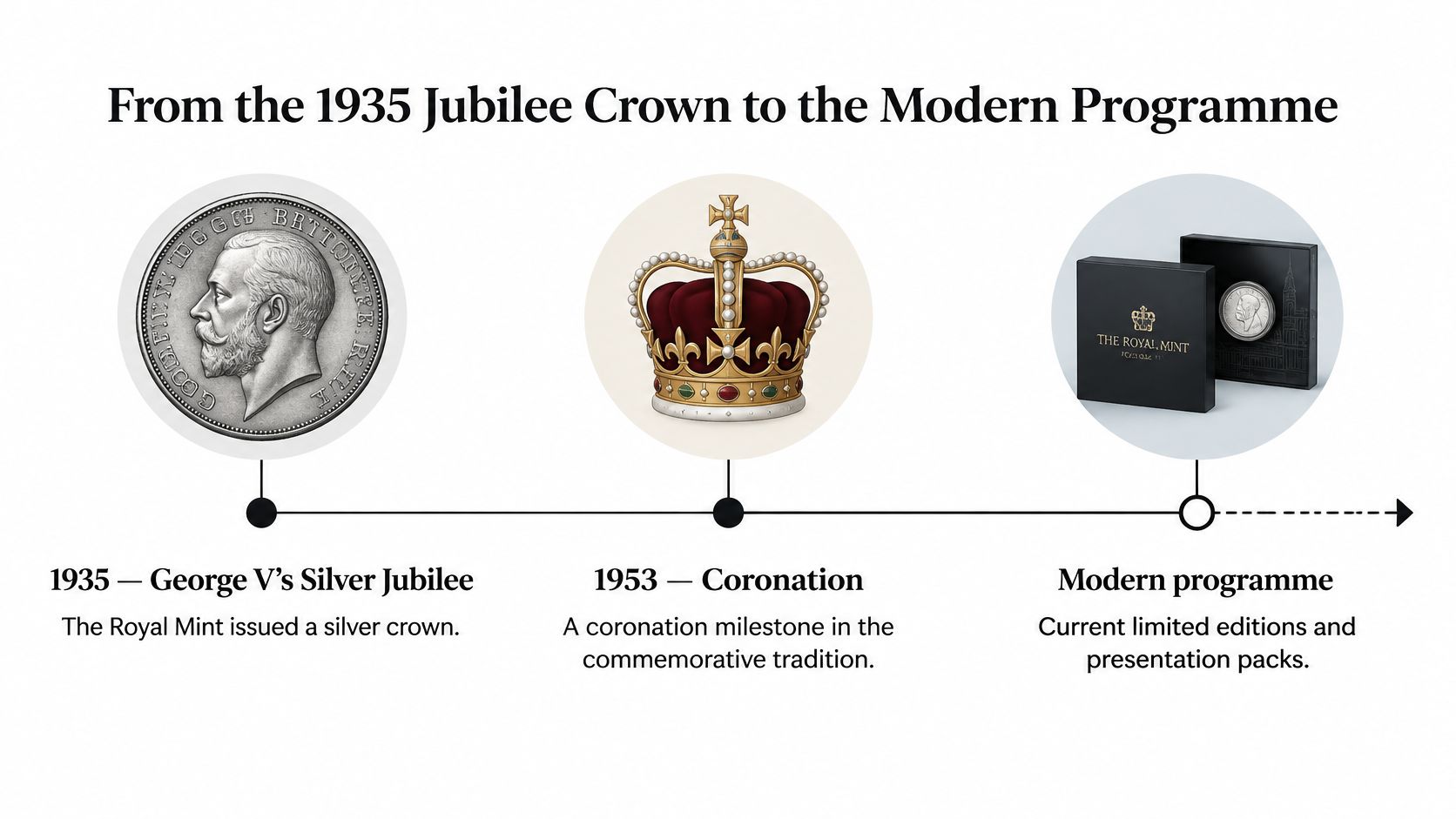
The next milestone came in 1953, when a commemorative crown marked Queen Elizabeth II's coronation. A crown commemorating Winston Churchill followed in 1965, extending the idea beyond royal occasions. The 1977 Silver Jubilee issue became one of the most widely recognised modern British commemorative coins, making it a familiar reference point for collectors comparing designs and generations of issues.
The crown's denomination changed to £5 in 1990. That change didn't end the crown's role as a commemorative format. Later £5 issues marked the millennium in 2000, the bicentenary of Horatio Nelson's death in 2005, and the bicentenary of the Battle of Waterloo in 2015. Together, these issues show how the programme expanded from occasional royal-jubilee coins to events spanning political, military, cultural and national history.
A family tree of designs
The 50p, introduced in 1969, and the bi-colour £2, first issued in 1997, brought commemorative designs into denominations familiar from everyday coinage. The result is a family tree, not a collection of unrelated one-offs. Each issue branches from a tradition that began with landmark occasions, while the themes and formats have broadened over time.
For a new collector, three dates help orient the timeline: 1935, as the foundational modern reference; 1977, for a particularly recognisable Jubilee issue; and 1990, when the crown denomination changed to £5. Knowing those anchors makes it easier to place later issues in context, rather than judging each design in isolation.
Spotting a Genuine Commemorative by Its Physical Features
Start by identifying the coin's finish. A circulating coin is made for everyday use and may show ordinary wear. Brilliant Uncirculated, or BU, coins retain full lustre from a standard strike, although handling marks can still be present. A proof coin is struck using polished dies and typically has mirror-like fields with frosted or contrasting design details; it's a specialist finish, not just a circulating coin in better condition.
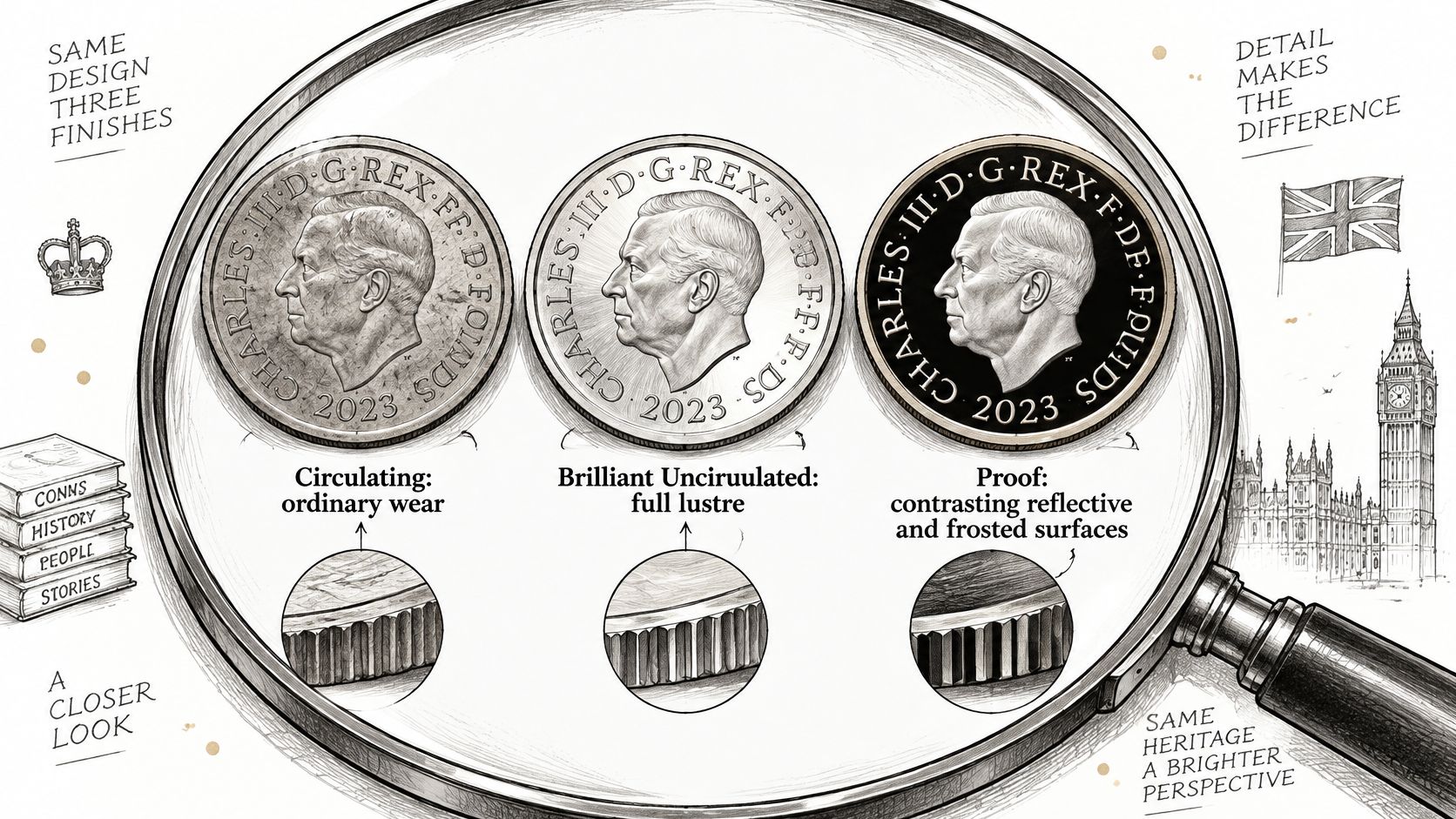
A useful reference is the 2022 Platinum Jubilee 50p. Its specified physical features provide a practical benchmark for checking an example, but compare like with like: a proof issue shouldn't be assessed as though it were a coin taken from circulation. The Royal Mint's commemorative coin product information distinguishes specialist proof production from circulating coinage.
| Attribute | Reference value | How to use it |
|---|---|---|
| Composition | Standard cupro-nickel | Compare colour and sound with a verified example |
| Mass | 8.00 g | Weigh on a scale that reads to 0.01 g |
| Diameter | 27.30 mm | Measure across the widest point with digital callipers |
| Thickness | 1.80 mm | Measure at the rim with callipers |
| Profile | Seven-sided | Count the sides; the outline should be rounded, not circular |
| Edge | Plain | Check for reeding or an inscription; a different edge may indicate another issue |
Use a scale that reads to 0.01 g, then measure diameter and thickness with digital callipers. Count the sides and inspect the edge under good light. The coin's circulating mintage was 2,300,000 pieces, so its commemorative status alone doesn't make it scarce; condition, packaging, variety, provenance and demand also matter.
A mismatch is a reason to investigate, not a verdict. Wear, damage or cleaning can affect a reading, so compare the coin with a trusted reference before deciding it's inauthentic.
Soft or blurred lettering and relief, or a finish that doesn't match a verified example, deserve extra scrutiny. Don't rely on one visual clue alone. Check both sides and the edge, and compare the coin's measurements and finish with an example of the same issue and quality.
At a coin fair or when reviewing a listing, keep this checklist handy:
- Identify the finish before judging condition.
- Check mass, diameter and thickness against a reliable reference.
- Inspect the profile and edge, not just the main design.
- Compare lettering and relief with a verified example.
- Ask for clear photographs if you can't inspect the coin in person.
Reading Mintage Figures Without Guesswork
Mintage figures help you compare how many coins were produced or released, but they don't predict a selling price by themselves. The Royal Mint's collector resources and mintage figures illustrate the range among circulating issues. The Kew Gardens 50p had a mintage of 210,000, while each of the 2020 British Diversity and UK withdrawal from the European Union 50p designs had 10 million coins released.
| Issue | Year | Mintage or limit | What it signals |
|---|---|---|---|
| Kew Gardens 50p | 2009 | 210,000 | Scarce among circulating 50ps |
| Olympic Wrestling 50p | 2011 | 1,129,500 | Below 2 million; relatively low among circulating issues |
| Olympic Triathlon 50p | 2011 | 1,161,500 | Below 2 million; relatively low among circulating issues |
| Platinum Jubilee 50p | 2022 | 2,300,000 | A substantial circulating issue |
| British Diversity and EU withdrawal 50ps, each design | 2020 | 10 million | Large releases; condition still matters |
| RNLI silver proof 50p | 2024 | 4,000 | Limited proof edition with capped production |
The Olympic examples show why it helps to read the actual figure, rather than relying on a label such as “rare”. The Wrestling 50p's mintage was 1,129,500, and the Triathlon 50p's was 1,161,500. Both were below two million, but that comparison says nothing on its own about the current price of a particular coin.
Issue type matters as much as the number. The RNLI silver proof had a limited edition of 4,000 pieces, but it belongs to a different collecting category from a circulating 50p. Comparing its limit directly with a circulation mintage is like comparing two different measuring scales: both figures describe production, but not the same kind of product.
The £2 programme offers another useful perspective. Since the first bi-colour £2 entered circulation in 1997, more than 400 million have been released across 39 commemorative designs. The 50p, introduced in 1969, has featured more than 100 designs and is described by the Royal Mint as the UK's most collected coin. Those figures explain the scale of the denominations, but they don't tell you how many examples of one particular design remain available or what a buyer will pay.
Treat mintage as a yardstick, not a price tag
A low mintage can support a case for relative scarcity, but it doesn't guarantee a high price. Buyers also respond to a design's appeal, the coin's condition, how it was distributed, whether it has original packaging, and what comparable examples sell for. A coin with a higher mintage may attract stronger demand than one with fewer examples.
Apply three rules when you see a scarcity claim:
- Check the finish. Make sure the figure relates to a circulating, BU or proof issue.
- Check where the figure comes from. Confirm that it refers to the same design and product type.
- Treat the number as context. Use completed sales and the coin's condition to assess value.
Valuing and Grading Commemorative Coins Like a Dealer
Before judging a coin's condition, identify its finish. A proof's reflective fields and contrasting devices are features of its production, while wear on a circulating coin shows how it has been used. Keep finish and grade separate: they answer different questions.
| Grade | What it looks like | Typical effect on value |
|---|---|---|
| Proof (PF) | Mirror-like fields with frosted or contrasting devices; no wear | Often commands a premium over circulating examples of the same limited issue |
| Brilliant Uncirculated (BU) | Full lustre from a standard strike; may show bag marks | Clean examples can command a premium |
| Uncirculated (UNC) | Full lustre; may show handling marks | Varies widely by issue |
| About Uncirculated (aUNC) | Light friction on the highest points | Usually below UNC for the same issue |
| Extremely Fine (EF) | Light wear on high points; most detail sharp | Usually below UNC for the same issue |
| Very Fine (VF) | Moderate wear; main design clear | Typically a substantial discount |
| Fine and below | Heavy wear; design partly worn | Often near metal or face value unless the issue is scarce |
Look closely at the high points, where raised details meet the most contact. Full lustre and sharp detail support a higher grade, while friction or worn relief can move the coin down the ladder. UK dealers commonly use terms such as Uncirculated and Extremely Fine; European listings may use XF, AU and MS. Ask the seller to explain the grading system if the terminology isn't clear. This UK coin grading guide provides further context for assessing condition.
Follow the quantities through the chain
A stated limit or mintage isn't always the same as the number of coins a collector can buy. Separate authorised mintage, coins struck, coins sold, coins released into circulation and surviving examples. These are different stages, and each can produce a different picture of practical availability.
Packaging and condition affect the comparison, too. A loose coin and the same issue in its original presentation packaging may appeal to different buyers. For current examples of the distinction between circulating and non-circulating releases, compare the product description with the applicable mintage information, rather than assuming one figure describes every version.
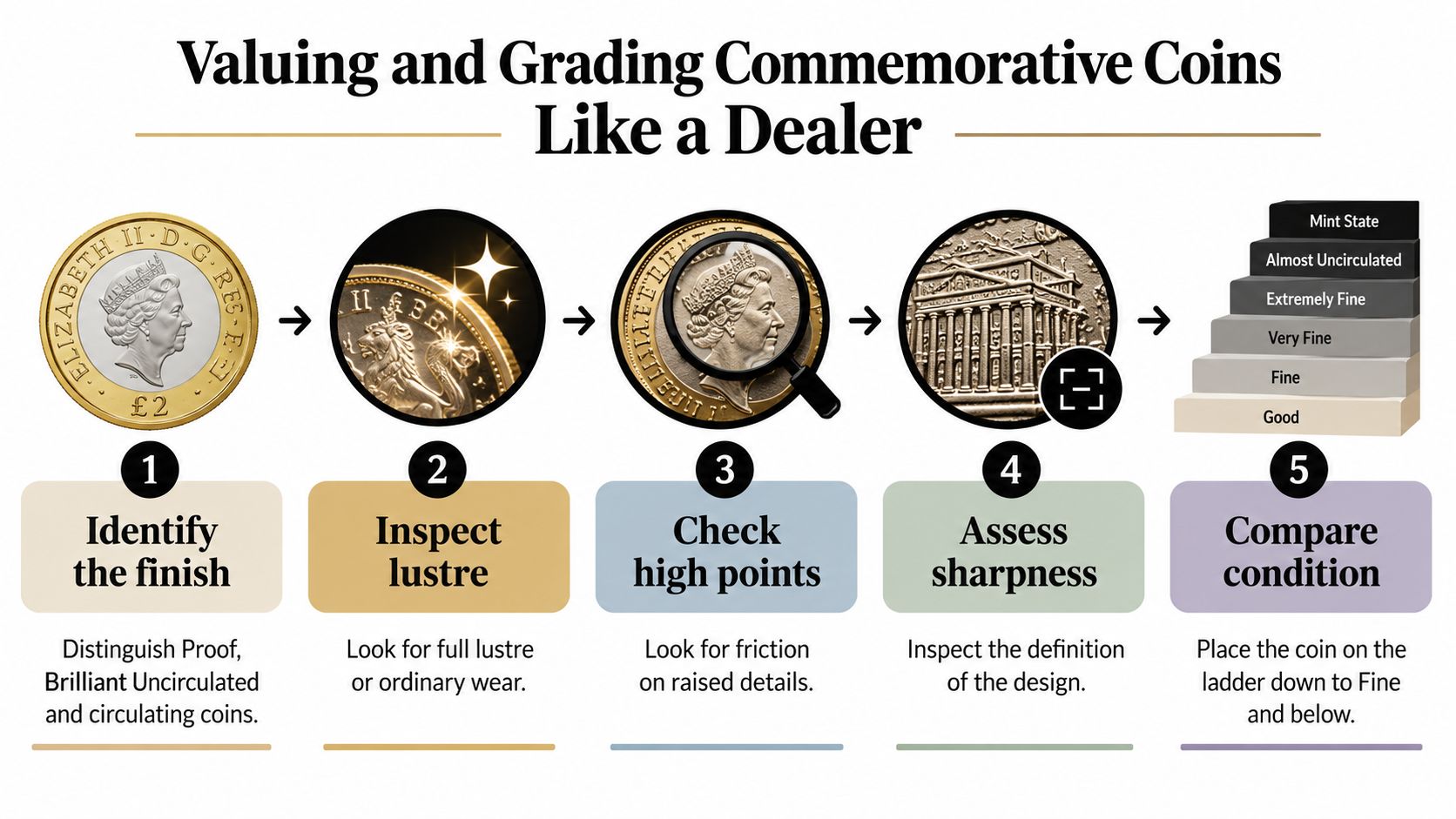
Use this sequence when you're preparing a valuation:
- Confirm the issue, year and finish. Small differences can mean you're comparing the wrong product.
- Establish which quantity the figure describes. A production limit isn't automatically the number released into circulation or surviving.
- Grade the coin objectively. Compare lustre, high-point friction and detail with the ladder, not with a cleaner example you hope it matches.
- Check the packaging and paperwork. Original boxes and certificates can affect buyer interest and should be described accurately.
- Compare asking prices with completed sales. Completed transactions offer stronger evidence of what buyers have paid than unsold listings do.
- Record separate kinds of value. Keep face value, legal-tender status, metal content and collector premium in distinct catalogue fields.
Where to Buy and Sell Without Overpaying
Different buying channels offer different safeguards and trade-offs. Compare the coin, the seller's terms and the full cost, rather than judging a listing by its headline price.
- The Royal Mint sells new issues directly and is a useful source for current limited editions and presentation packs. Check the exact product description so you know whether you're buying a circulating coin, a collector-quality issue or a proof.
- A coin dealer may let you inspect and handle a coin before buying. Ask about the returns window, and compare the coin's condition with the seller's description.
- An auction house offers competitive bidding, but the hammer price isn't the whole cost. Calculate the buyer's premium and other charges before placing a bid.
- An online marketplace can offer broad choice, but seller ratings and return rights matter. Look for clear photographs of both faces and the edge.
- Fixed-price listings make the asking amount clear; an auction can end above or below that amount. Neither format proves that the price reflects completed sales.
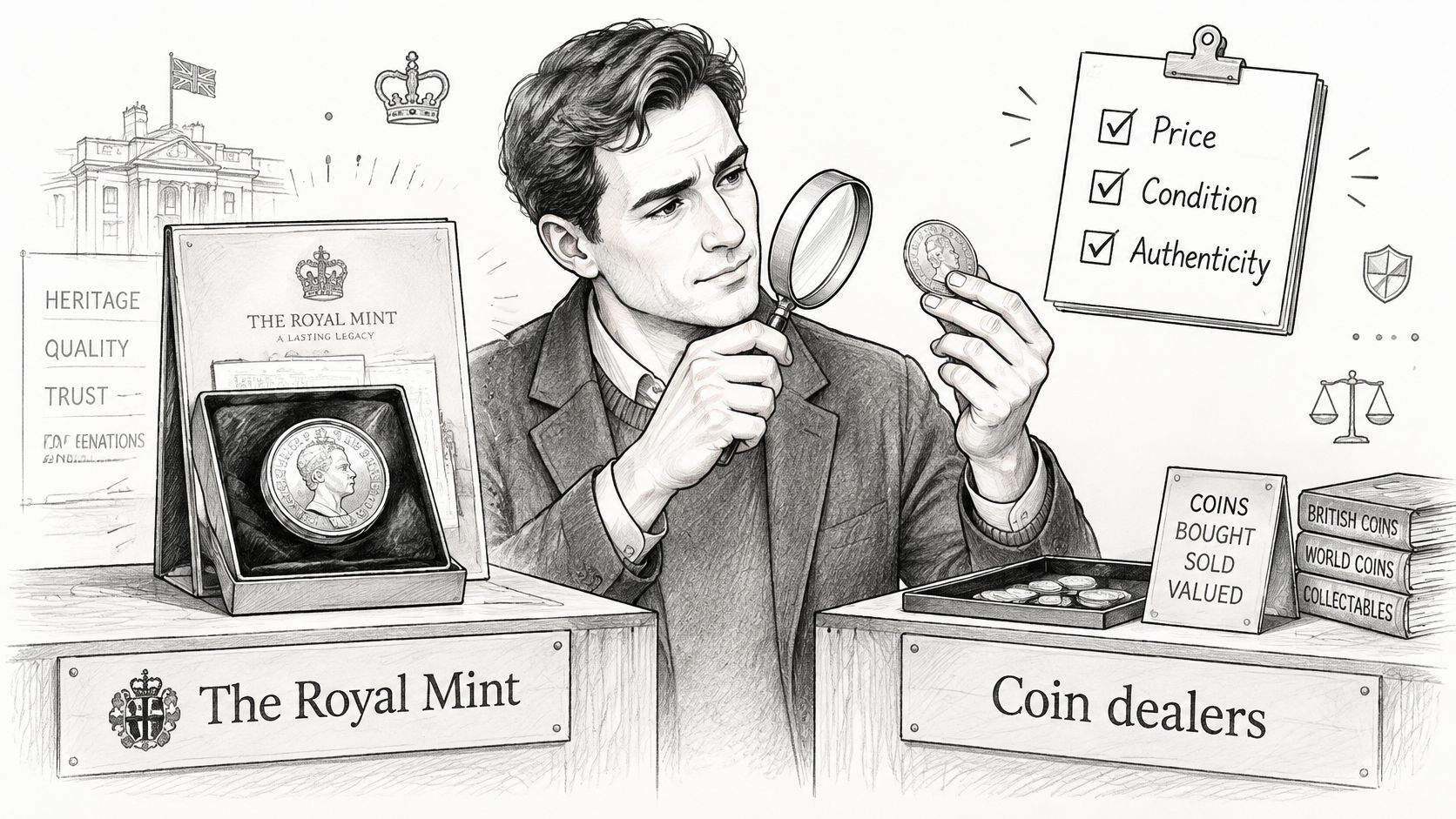
For an expensive or difficult-to-authenticate piece, consider whether a certified or graded holder would help you assess what's being offered. It's still important to confirm that the holder's description matches the coin and the finish you want.
Before you pay
- Get a written description of the issue, finish and packaging.
- Check the returns policy before committing.
- Work out the total cost, including postage, insurance and fees.
- Compare completed sales from several months, not just current asking prices.
If you're selling, ask more than one buyer for an offer. Describe the finish and packaging accurately, then compare the net amount you'd receive after fees with completed-sale prices. Cavalier Coins Ltd buys bulk coin collections from charities, and its guide to selling coins in the UK covers practical considerations for sellers.
Storing and Conserving Your Collection
A coin can leave the mint in excellent condition and lose that quality through careless handling or storage. Build a simple routine around protection, stable conditions and good records.
- Choose inert, PVC-free holders. Soft PVC can leave a green residue on a coin's surface.
- Handle coins by the edges. For proofs, cotton gloves can help avoid fingerprints and surface marks.
- Use a stable indoor space. Avoid damp areas and sunny windowsills, where conditions can fluctuate.
- Don't clean coins. Polishing and abrasives can strip lustre and lower the grade.
- Keep bronze and copper dry. Moisture can contribute to bronze disease, a green corrosion that may spread.
- Avoid adhesives and rubber bands. They can leave marks or residue.
- Keep original packaging and certificates. They help document how a coin was sold and presented.
- Photograph both sides and the edge. Clear images make it easier to identify and catalogue each piece.
A basic record should link each photograph to the coin's issue, finish, condition and storage location. That way, you can compare the coin over time without handling it unnecessarily.
If a valuable piece shows corrosion, don't try to treat it at home. Consult a qualified conservator before taking any action.
Choosing Your First Commemorative Set
A good collection starts with a subject you enjoy, not a list of coins someone else says you need. Royal occasions, naval history and sport are possible themes; a clear theme gives you a reason to choose one coin over another and helps keep spending purposeful.
A route for new collectors
- Choose one theme. Keep the focus narrow enough that you can explain why each coin belongs.
- Set a fixed monthly budget. Decide what you can comfortably spend before browsing listings.
- Buy a documented circulating example of each issue. Check its physical features against the relevant reference before adding it.
- Keep a simple catalogue. Record the year, finish, mintage figure, legal-tender status and condition as separate details.
- Review the set after six months. Remove anything that no longer fits your theme, and use what you've learned to refine the collection.
This approach makes the first purchase a learning tool, not just an object in a capsule. You'll practise checking details and comparing descriptions while building a set with a clear purpose.
A route for advanced collectors
Experienced collectors can narrow the focus to proof or limited editions, particular varieties, or original packaging. Compare completed sales with current asking prices, and assess condition before buying rather than hoping that grading will improve the coin later. If you're still learning to grade, practise on lower-cost pieces and compare each one against the grade ladder before moving on to more demanding issues.
Pick a theme, set your budget and buy your first coin this month. Add it to your catalogue with its finish, condition and legal-tender status clearly distinguished.
Cavalier Coins Ltd offers UK commemorative coins alongside other collectible coins and banknotes, with fixed-price listings and weekly auctions. To browse pieces for your collection, visit Cavalier Coins Ltd.