
Ever wondered if the change jangling in your pocket holds a secret? While most pound coins are worth exactly that—one pound—a select few are coveted by collectors and can sell for hundreds of pounds.
The trick is knowing what to look for. A coin's journey from simple currency to a collector's prize depends on a few key details. Spotting them can turn your everyday change into a surprisingly valuable find.
What Makes a Pound Coin Worth More Than a Pound?
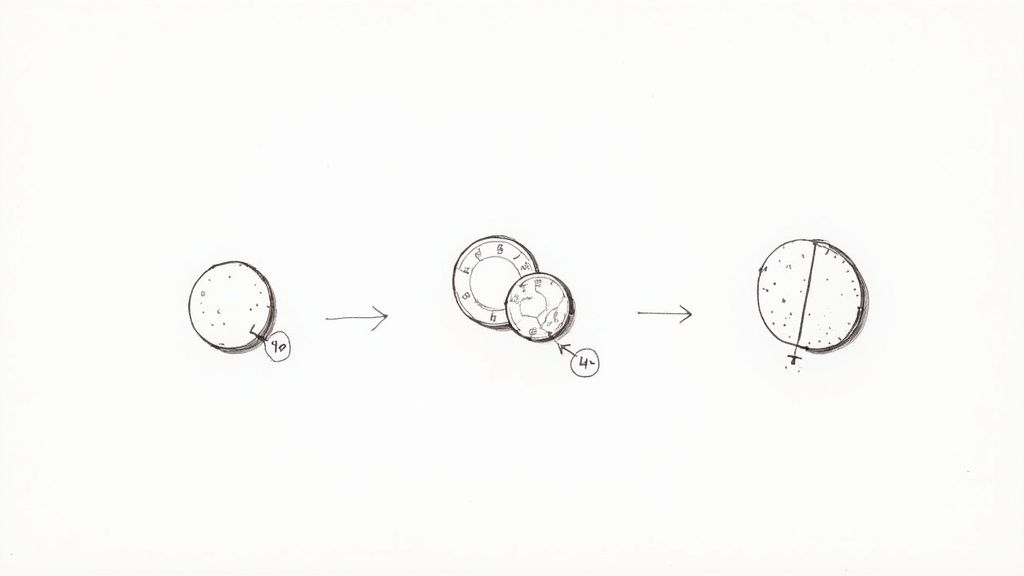
Think of it like this: a standard paperback book and a signed, limited first edition might tell the same story, but one is vastly more desirable. The same principle applies to coins. Scarcity and unique features transform them from mundane objects into something special.
Understanding what elevates a coin beyond its face value is the first, and most important, step for any budding collector. It all boils down to three core factors.
The Three Pillars of Coin Value
These three elements work together to determine a coin's true market worth. Get a handle on these, and you'll be well on your way to spotting the hidden gems in your own collection.
- Rarity: This is the big one. How many coins of a particular design and year were made? This figure, known as the "mintage," is the single biggest driver of value. A low mintage means fewer coins are out there, making them much harder to find and far more appealing to collectors.
- Condition: A coin’s physical state is absolutely crucial. A pristine, uncirculated coin that looks like it just left the Royal Mint—with sharp details and its original shine—will always command a higher price than one that's been scratched, worn, and dulled from years of use.
- Errors: Sometimes, mistakes happen. Errors made during the minting process can create fascinating and valuable oddities. Things like misaligned designs, incorrect lettering, or other strange flaws make a coin a unique one-off, and collectors love unique.
By learning to spot these key characteristics—low production numbers, excellent preservation, and unique manufacturing flaws—you can begin to separate common pocket change from genuine numismatic treasures.
In this guide, we'll dive deeper into each of these factors, giving you the knowledge you need to start assessing your own coins and exploring the fascinating world of numismatics.
Before we get into the nitty-gritty, here’s a quick summary of what we've covered. Think of this as your cheat sheet for spotting valuable coins.
Key Factors Determining a Pound Coin's Value
| Factor | How It Adds Value | What to Look For |
|---|---|---|
| Rarity | The fewer coins produced (low mintage), the higher the demand from collectors. | Check the official mintage figures for the coin's specific year and design. |
| Condition | Coins in pristine, uncirculated condition fetch the highest prices. | Look for sharp details, original lustre, and minimal scratches or wear. |
| Minting Errors | Unique mistakes make a coin a rare "variety," highly sought after by specialists. | Mismatched dates, incorrect text, or misaligned "die-struck" designs. |
Understanding these three pillars is your foundation. Now, let's build on that and look at some of the specific pound coins that have become modern classics.
The Journey of the Modern Pound Coin
To really get a feel for a pound coin's value, you have to understand its story. Every coin you hold is a tiny piece of history, and its journey from the mint to your pocket is what makes it—or doesn't make it—collectable. The modern £1 coin, for instance, didn't just appear out of thin air; it was created to solve a very real, very tatty problem.
Go back to the early 1980s, and you'd be paying for things with a paper £1 note. The trouble was, these notes had a ridiculously short lifespan. Most were worn, torn, and generally looking sorry for themselves after only nine months. It was clear a tougher, more durable alternative was needed, which set the stage for a major shift in British currency.
From Paper Note to Round Pound
The familiar "round pound" finally made its debut in 1983, designed as a hard-wearing replacement for the flimsy banknote. This was a massive logistical challenge for The Royal Mint. To get the entire country to swap from paper to metal, the first few mintages had to be absolutely enormous.
Millions upon millions of coins were pumped out in the first few years to make sure there were enough to go around. This bit of history is crucial for collectors because it explains why coins from 1983, 1984, and 1985 are incredibly common and usually only worth their face value. With so many made, they're anything but scarce.
The old £1 note was officially taken out of issue by the end of 1984 and fully withdrawn by 1988, closing one chapter and opening another for UK currency. You can dive deeper into the history of pound sterling coins on Wikipedia.
A coin's origin story is the key to its rarity. High initial production to meet a specific need, like replacing the £1 note, often means those early coins are the least scarce and, therefore, less valuable to collectors.
As the years went on, the round pound showcased a rotating series of designs celebrating the different countries of the UK. While most years saw huge production runs, a few designs and specific years had surprisingly low mintage figures. These are the "rare" coins that collectors are always on the lookout for today.
A New Shape for a New Era
After more than thirty years in our pockets, the round pound had a new enemy: counterfeiting. By the 2010s, it was estimated that a staggering 1 in 30 round pounds in circulation were fakes. This wasn't just a minor issue; it was a widespread problem that was seriously undermining public trust in the currency. Another big change was needed.
In March 2017, The Royal Mint rolled out the groundbreaking 12-sided, bimetallic £1 coin. It was packed with clever security features, including a latent image that switches from a '£' symbol to the number '1' when you tilt it. It was quickly hailed as the most secure circulating coin in the world.
This move didn't just put the counterfeiters out of business; it completely reset the stage for collectors and created a whole new area of interest for numismatists.
How Rarity and Mintage Figures Drive Value
When you get into coin collecting, you quickly learn that the game is all about supply and demand. The single biggest factor that decides the value of pound coins isn't how old they are or what picture is on them, but simply how many were ever made. This brings us to a key term you'll need to know: mintage.
Mintage is just the official count of how many coins of a particular design and year were struck by The Royal Mint. A high mintage figure means millions upon millions of coins flooded the country. But a low mintage figure? That's what creates scarcity and turns an ordinary coin into something special for collectors.
It's a bit like concert tickets. If a band is playing a huge stadium with 80,000 seats, tickets are easy to come by. But if they announce a surprise acoustic show at a tiny 200-seat pub, those tickets become gold dust, and their price on the resale market goes through the roof. The very same principle applies to pound coins.
Understanding High vs Low Mintage
A coin's mintage figure is the most direct indicator of its rarity. When The Royal Mint produces a design in huge numbers, it becomes the kind of change you find down the back of the sofa. But when the production run is small, finding one in your change becomes a real event, pushing its value far beyond the £1 stamped on it.
Take the 2011 Edinburgh City £1 coin, for example. It's well-known in collecting circles because only 935,000 were ever minted. Now, compare that to the most common round pound, the 1992 Royal Arms design, which had a mintage of over 320 million. The difference in scarcity is just enormous, and that's reflected in what people are willing to pay for them.
The infographic below shows the moment the game changed for modern £1 coins, creating a whole new world of collecting opportunities.
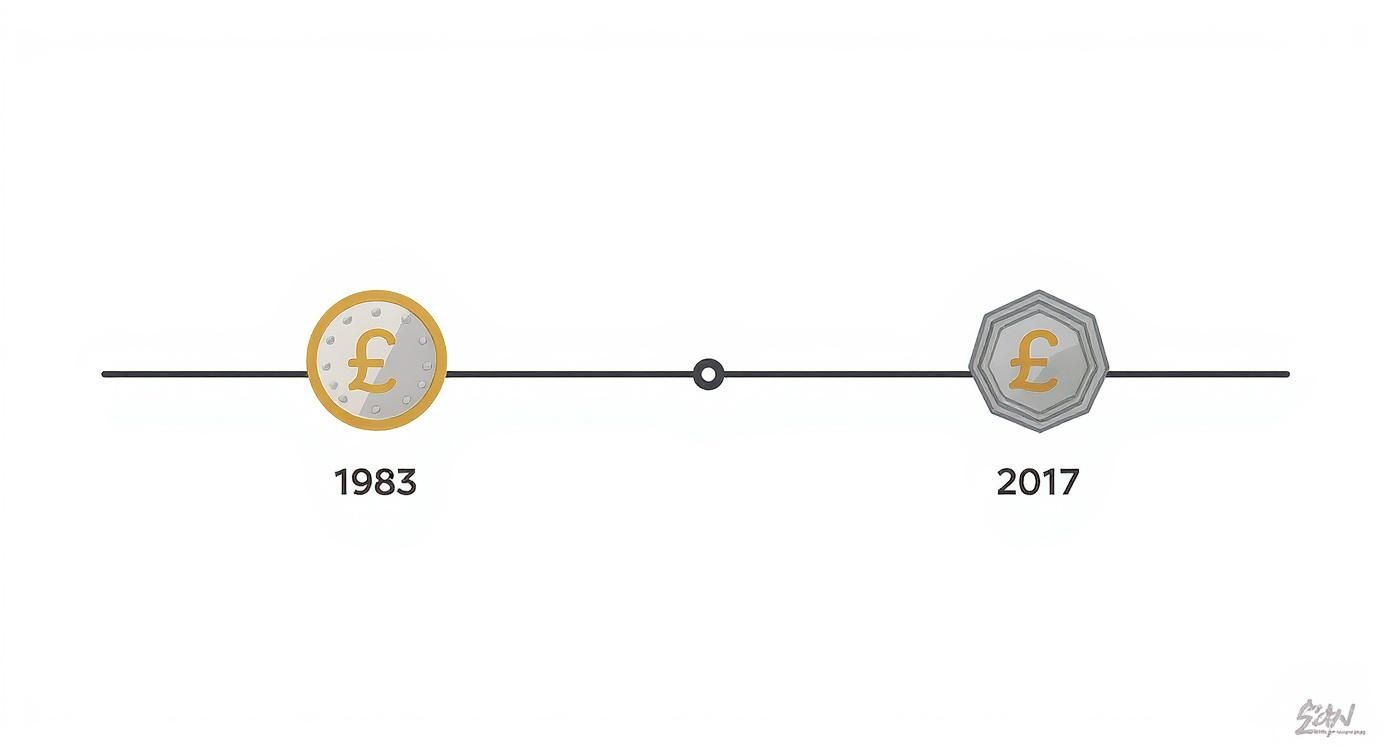
This switch from the familiar round pound to the super-secure 12-sided coin drew a line under one era of collecting and started a new one. It also had the knock-on effect of making certain round pound designs much more sought-after overnight.
Low vs High Mintage Pound Coins A Comparison
To really see the impact of production numbers, let's put a couple of well-known coins side-by-side. The table below shows just how vast the difference can be between a genuinely scarce coin and a common one.
| Coin Design | Year | Mintage Figure | Relative Scarcity |
|---|---|---|---|
| Edinburgh City £1 | 2011 | 935,000 | Extremely Rare |
| Belfast City £1 | 2010 | 6,205,000 | Scarce |
| Royal Arms £1 | 1992 | 323,373,911 | Very Common |
As you can see, finding an Edinburgh pound is statistically hundreds of times harder than finding a 1992 Royal Arms. This simple fact is the bedrock of their difference in value to a collector.
How to Find Mintage Figures
The best part is, you don't have to guess which coins are the rare ones. The Royal Mint publishes all this information, so a bit of research is all it takes to arm yourself with knowledge. By checking their official mintage figure tables, you can spot the scarcest designs and know precisely what to keep an eye out for.
Mintage is the foundation of a coin's collectable value. A low production number is the primary signal that a coin might be worth more than £1, transforming it from simple currency into a sought-after piece.
This data is what separates a casual spender from a savvy collector. Knowing that a 2009 Kew Gardens 50p had a mintage of just 210,000 explains why it's a collector's dream. Likewise, understanding that many commemorative coins are minted in the tens of millions helps you manage your expectations.
If you'd like to dig deeper into what makes some coins more desirable than others, our complete guide to understanding rare coin values covers this in much more detail. In the end, a coin's journey from currency to collectible almost always begins with its production numbers.
Why a Coin’s Condition Can Make or Break Its Value
Finding a rare, low-mintage coin is a genuinely thrilling moment for any collector, but it's only half the story. The physical state of that coin—its condition—is just as crucial in determining the final value of pound coins. A rare design that's been heavily scratched, worn, and dulled by years in circulation will always be worth significantly less than a more common design in flawless, mint condition.
Think of it like discovering two identical classic cars from the same year. One is a rust-bucket with faded paint and a wrecked interior, while the other looks like it just rolled off the showroom floor. Their values would be worlds apart, and this exact principle applies to the world of numismatics. Collectors always pay a premium for preservation.
From Poor to Perfect: A Simple Guide to Grading
Coin grading is simply the formal system we use to describe a coin’s condition. While it can get incredibly detailed, the basic concepts are pretty straightforward. At the very bottom of the scale, you have coins graded as 'Poor' or 'Fair'—these are so heavily worn that the design is barely visible.
At the very top, you have 'Brilliant Uncirculated' (BU), which is a perfect specimen showing no signs of wear and still holding its original mint lustre.
Most coins you’ll pull from your pocket will fall somewhere in the middle, typically in the 'Very Fine' (VF) or 'Extremely Fine' (EF) ranges. These coins show light wear on the highest points of the design but still retain most of their important details.
A coin's grade is its CV. A Brilliant Uncirculated coin tells a story of careful preservation from the moment it was minted, while a heavily circulated one shows a lifetime of use. For collectors, the former is far more desirable and, therefore, more valuable.
Getting your head around the fundamentals of grading is essential for any collector. To dig deeper into the specific criteria for each grade, you can explore an expert UK coin grading guide that breaks down all the terminology in detail.
What Collectors Really Look For
When assessing a coin's condition, collectors are hunting for a few key attributes that signal a high-quality piece. Developing an eye for these details will help you accurately gauge the potential worth of your own finds.
- Lustre: This refers to the original shine or "frost" the coin had when it was first struck. It’s a very delicate quality that quickly disappears once a coin enters circulation, making it a key indicator of an uncirculated piece.
- Sharpness of Strike: Take a close look at the fine details, like the Queen’s hair or the intricate patterns on the reverse. A well-struck coin will have crisp, clear details, whereas a worn coin will appear soft and flattened.
- Absence of Marks: Scratches, nicks, and rim bumps (often called 'bag marks' from when coins knock against each other in mint bags) all detract from a coin's grade and value. A clean, mark-free surface is what everyone is after.
Ultimately, proper handling is key to preserving value. You should always hold coins by their edges to avoid transferring oils from your skin, which can cause corrosion over time and ruin their condition.
Identifying Valuable Errors and Spotting Fakes
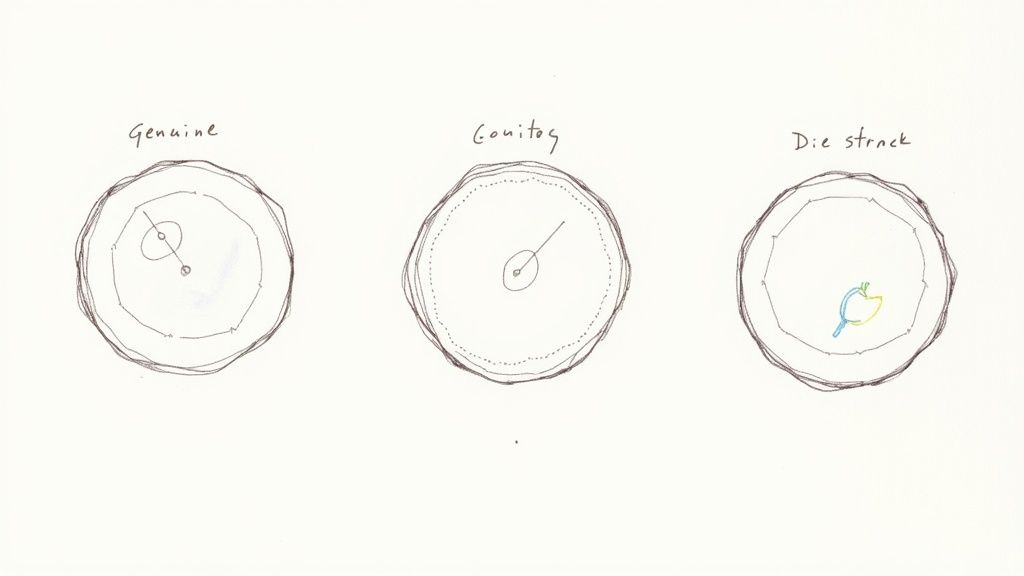
While rarity and condition are the bread and butter of coin valuation, there's another, often more thrilling, factor that can send a pound coin’s value skyrocketing: errors. In the world of coin collecting, a simple mistake made at The Royal Mint can turn an everyday coin into a prized treasure. These aren't just damaged coins; they're unique pieces with a story to tell.
These fascinating flaws happen during the minting process, creating unexpected rarities that collectors are always on the lookout for. Think of it like finding a limited-edition art print with a quirky mistake—that very imperfection is what makes it so special and valuable. Learning to spot these oddities opens up a whole new level of treasure hunting.
Common Types of Valuable Coin Errors
Not all imperfections are created equal, but a few specific types of errors are well-known for fetching high prices. Keeping an eye out for these can be incredibly rewarding. If you're keen to learn more, you can always discover valuable error coins and their hidden treasures.
- Mis-strikes: This happens when the coin isn't perfectly centred when struck, leaving the design noticeably off-kilter.
- Die Cracks: Tiny cracks in the die (the metal stamp used to create the design) leave behind raised, squiggly lines on the coin's surface.
- Rotated Dies: A real collector's favourite. This is where the Queen's head and the reverse design aren't correctly aligned when you flip the coin over.
- Mules: This is the ultimate prize for any error hunter. A mule is a coin struck with two mismatched dies—for instance, the obverse (heads) of one coin design and the reverse (tails) of another.
The Challenge of Counterfeits
On the other side of the coin, you have the fakes. Counterfeiting was a massive problem with the old round pound. Before it was withdrawn from circulation, it was estimated that as many as 1 in 30 pound coins were forgeries, posing a huge financial risk to the public and businesses alike.
This widespread issue was the main driver behind the introduction of the new 12-sided £1 coin in 2017. This modern coin was designed to be one of the most secure in the world, packed with clever features to outsmart the forgers.
The crucial skill for any collector is distinguishing between a valuable, legitimate error and a worthless fake. A genuine minting error is a rare prize, while a counterfeit is simply illegal and holds no collector value.
Thankfully, the new coin’s advanced security features make this distinction much easier. Its bimetallic design, the micro-lettering around the inner rim, and a latent image that changes from a '£' symbol to a '1' are all tell-tale signs of authenticity. By getting to know these features, you can confidently spot genuine coins and avoid the costly mistake of picking up a fake.
Common Questions About Valuing Pound Coins
Dipping your toes into the world of coin collecting always brings up a few questions, especially when trying to figure out what your pound coins are really worth. This section is here to give you straight, clear answers to the most common queries we hear.
Think of it as a quick-fire round to clear up any confusion. We'll cut through the noise and give you the confidence to sort the treasures from the everyday pocket change. By tackling these frequently asked questions, you'll get a much better handle on rarity, condition, and what's hot in the market for UK coins.
What Is the Rarest UK Pound Coin in Circulation?
The undisputed champion of rarity for the round £1 coins you might find in your change is the 2011 Edinburgh City from the "Cities" series. With only 935,000 ever minted for circulation, it's the one that sends collectors into a frenzy. Its scarcity alone makes it the top prize for anyone hunting through their loose change.
Of course, there are other trial pieces or non-circulating coins that are technically rarer, but for coins that were actually out there being used, the Edinburgh £1 is the one to watch. A good habit is to always double-check mintage figures with The Royal Mint, because at the end of the day, low numbers are what drive high prices.
Another heavy hitter from that same series is the 2011 Cardiff City £1. Its mintage of 1,615,000 makes it more common than its Edinburgh cousin, but it’s still a genuinely scarce find that commands a very respectable price among collectors.
How Do I Get My Pound Coin Collection Valued?
Getting a sense of your collection’s value is something you can absolutely start on your own. The first job is to identify each coin by its design and year, then look up its official mintage figure. That first step alone will tell you if you’re holding onto a common coin or something with a bit more potential.
Next, you need to be honest about its condition, or what collectors call its "grade." Does it look like it just left the mint, all shiny and sharp? Or is it dull and covered in scratches from years in circulation? A great way to get a quick, real-world valuation is to check recently sold listings on sites like eBay for coins in a similar state to yours. This gives you a live snapshot of what people are actually paying.
If you find a coin you suspect is exceptionally valuable—maybe it has a rare error or is in unbelievably perfect condition—it’s time to call in a professional. A reputable coin dealer or a certified numismatist can give you an appraisal you can trust.
Getting an expert eye on high-value pieces is critical. It ensures you know exactly what you have before you think about selling or getting your collection insured.
Are the Old Round Pound Coins Worth Anything?
This is probably one of the most common questions we get, and the answer is a classic "yes and no." While the old round pounds were taken out of circulation back in 2017, they didn't just become worthless overnight. Most major UK high street banks will still let you deposit them into your account for their face value of £1.
But for collectors, it’s a whole different ball game. The huge majority of designs with high mintages are still only worth £1. It’s the rare ones that change the story. Coins like the 2011 Edinburgh and Cardiff City designs we mentioned, or the 2010 Belfast City coin, are worth far more than their face value to a collector.
What Are the Best Coin Errors to Look For?
Finding a genuine minting error can feel like hitting the jackpot. The trick is to look for errors that are obvious, verifiable, and known in the collecting community. One of the most famous and sought-after flaws is a 'rotated die' error.
This happens when the Queen's head on one side and the design on the other aren't aligned properly. To check, hold the coin so the Queen's head is upright, then flip it over horizontally between your fingers. If the reverse design isn't also perfectly upright, you’ve got yourself a rotated die.
Other great errors to keep an eye out for include:
- Mis-strikes: Where the design has been stamped off-centre.
- Mules: An incredibly rare and valuable error where a coin is struck with two mismatched dies—for example, the 'heads' from one coin and the 'tails' from another.
- Missing Lettering: Check the edge of the coin. If the inscription is partly or completely missing, it can seriously boost its value.
At Cavalier Coins Ltd, we live and breathe coins. We're passionate about helping collectors, whether you're just starting out or have been at it for years. Explore our huge selection of rare coins and banknotes from across the globe. Visit https://www.cavaliercoins.com to find your next treasure.