
Trying to pin down the value of a sixpence is a fascinating puzzle. It’s not just one simple number. While a common, modern sixpence might only be worth a couple of pounds, a rare silver one from centuries ago could fetch hundreds, or even thousands.
The secret is understanding that its true worth is a blend of its history, the metal it’s made from, and its rarity to collectors.
Understanding the Three Types of Sixpence Value
To really get a grip on what your sixpence is worth, you need to look at it from three different angles. Think of it like a vintage car: it had its original sticker price, it has a scrap value for its raw parts, and then there’s the final price a passionate collector is willing to pay.
For a sixpence, these three pillars are its face value, its bullion value, and its numismatic value.
Getting your head around the difference between these is the first, and most important, step. It’s the journey the coin takes from being everyday money to becoming a piece of history and, in some cases, a tiny silver ingot.
The Three Pillars of Coin Value
- Face Value: This is simply the monetary worth stamped on the coin itself. Back when it was legal tender, this is what you could have bought with it. To dig deeper into the technical side, you can read our guide on what face value means.
- Bullion Value: This is the intrinsic worth of the precious metals inside the coin. For the sixpence, this only applies to coins minted before 1947, which contain either 92.5% or 50% silver.
- Numismatic Value: This is what collectors are really interested in. It’s the "collector value," driven by things like rarity, condition, historical importance, and sheer demand. This is what makes one sixpence worth £2 while another, seemingly similar one, is worth £200.
This flowchart helps to visualise how these different components come together to determine a sixpence's overall worth.
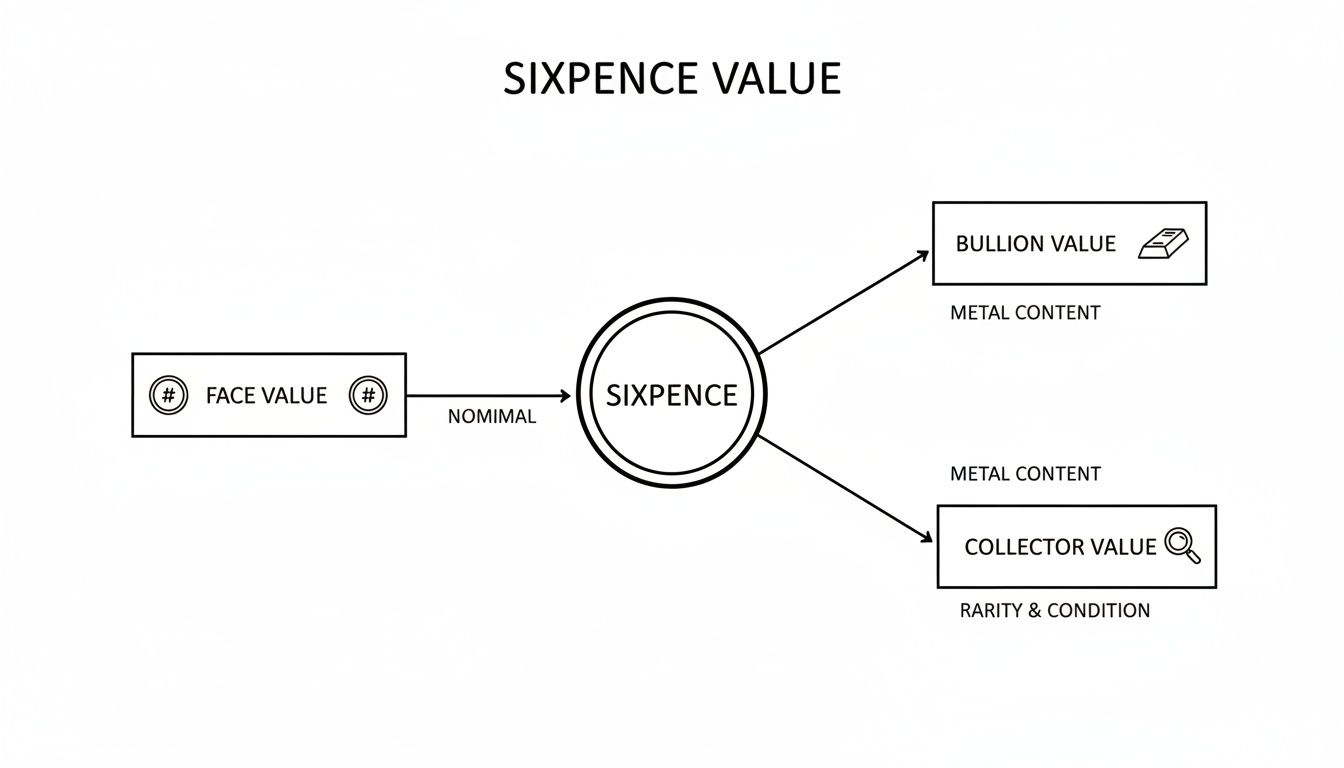
As you can see, these three distinct values combine to give you the complete picture of what your coin is worth on today's market.
Historically, in pre-decimal Britain, a sixpence was worth 1⁄40 of a pound. The real game-changer for its modern value, however, was its metal content. Before 1920, every sixpence was struck from sterling silver, giving a single coin a modern bullion value of over £3. In stark contrast, the cupronickel coins made after 1946 have no precious metal value at all.
Sixpence Value At a Glance: A Comparison by Era
This table gives you a quick summary of how the composition and potential value of a sixpence changed over its most common periods. It’s a great starting point for figuring out which category your own coins fall into.
| Era / Monarch | Years of Issue | Metal Composition | Approximate Bullion Value | Typical Collector Value (Common Date) |
|---|---|---|---|---|
| Early Modern | 1551-1919 | 92.5% Silver (Sterling) | £3 - £4 | £15 - £500+ |
| George V | 1920-1936 | 50% Silver | £1.50 - £2 | £3 - £25 |
| George VI | 1937-1946 | 50% Silver | £1.50 - £2 | £3 - £15 |
| George VI - Elizabeth II | 1947-1970 | Cupronickel (No Silver) | £0 | 50p - £5 |
Of course, these are just ballpark figures. A rare date or a coin in exceptional condition from any era can be worth significantly more, which is where the thrill of collecting really begins.
A coin's journey through time is etched onto its surface. While a shiny, new-looking coin is appealing, collectors often prize the natural patina that tells a story of its circulation, making condition a critical—and nuanced—part of its final value.
For a wider view on valuation principles that apply just as well to sixpences as they do to other historical items, this practical guide on how much is your antique worth is a great resource. It helps place the specific factors of coin collecting into a broader context.
The Story of the Sixpence in British History
To really get a feel for a sixpence's worth, you have to look past the metal and dive into its incredible story. Each coin is a tiny time capsule, a real piece of British history that has seen almost five centuries of change, from Tudor kings right through to the swinging sixties. Its journey perfectly mirrors the nation's own ups and downs.
The story kicks off in 1551, with the young King Edward VI on the throne. The kingdom’s finances were a mess, mostly because his father, Henry VIII, had drastically watered down the silver coinage. People had lost faith in the money, and something needed to be done. The solution was a brand-new, trustworthy coin: the sixpence, struck from high-quality sterling silver.
A Reflection of Britain's Fortunes
Right from the start, the sixpence was a symbol of reliability, containing 92.5% silver. For over 350 years, it was a dependable part of everyday life, worth half a shilling in the old £sd (pounds, shillings, and pence) system. Its consistency made it a cornerstone of daily life for generations. To get a wider perspective on these changes, you can explore our brief history of British coins.
But the immense financial strain of the First World War forced a huge change. In 1920, the silver content was slashed to just 50%. This was a direct result of soaring silver prices and the mountain of national debt from the war, and it marked a massive turning point for the coin.
The final chapter for its silver content came after the Second World War, another period of intense economic pressure.
A sixpence's metal content is like a historical barometer. The switch from sterling silver to cupronickel isn't just about changing materials; it tells a story of post-war austerity, economic necessity, and a nation having to adapt to a new reality.
From 1947 onwards, all new sixpences were made from cupronickel, an alloy of copper and nickel. For the first time in its long history, silver was gone from the coin completely. It was a practical decision, driven by the demands of the post-war economy.
Cultural Icon and the End of an Era
Even with all these changes, the British public's love for the "tanner" or "sixpenny bit" never really went away. It became a powerful cultural symbol, most famously tucked into a bride's shoe for good luck as part of the rhyme, "Something old, something new... and a silver sixpence in her shoe." Finding one in a Christmas pudding was also considered a sign of good fortune.
This affection was so strong that even after the massive switch to decimal currency on Decimal Day in 1971, it wasn't immediately withdrawn. While most old coins vanished, the sixpence—now revalued at 2.5 new pence—remained in use thanks to popular demand and a public campaign to "Save the Sixpence."
It was finally demonetised in 1980, but its unique legacy and cultural importance add massively to its appeal for collectors, directly influencing the value of a sixpence today.
How to Identify Your Sixpence Like a Pro
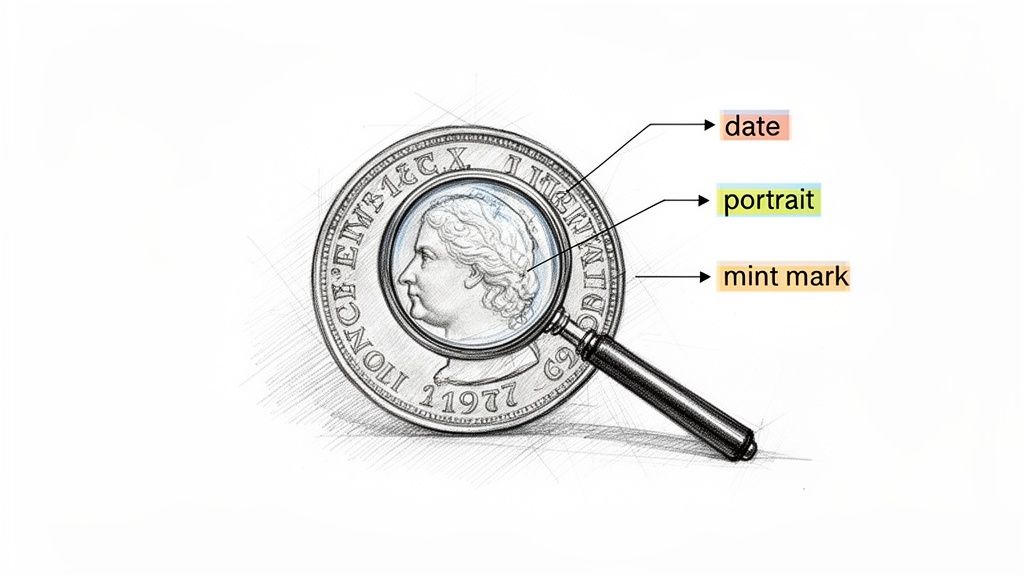
Figuring out the story behind a sixpence is a bit like playing detective. Every portrait, date, and tiny mark is a clue that helps you piece together its history and, ultimately, its value. You don't need to be a seasoned expert; with a little guidance and a keen eye, you can easily uncover the essential details of your coin.
There are three key features to examine on any sixpence: the date, the monarch’s portrait, and any mint marks. Together, these details give your coin a precise identity and form the foundation for understanding its rarity and worth.
Finding the Date and Its Significance
The most important piece of information on your sixpence is the year it was struck, which you'll almost always find on the reverse (the "tails" side). Finding the date is your first big breakthrough, as it immediately tells you what the coin is made of.
- 1946 or Earlier: Your coin contains silver.
- 1919 or Earlier: It’s made from 92.5% sterling silver.
- 1947 or Later: The coin is cupronickel and contains no silver.
Beyond the metal content, the date is a huge clue to its rarity. While millions of sixpences were minted in most years, some years had much lower production runs due to wars or economic issues, making them significantly harder to find today.
Examining the Monarch’s Portrait
The portrait on the obverse ("heads") side tells you which monarch was on the throne when the coin was made. Each ruler’s effigy has a distinct style, and for long-reigning monarchs like Queen Victoria, several different portraits were used over their reign.
A monarch's portrait on a coin is more than just a picture; it's a window into the era. The shift from Queen Victoria's youthful 'Young Head' to her solemn, veiled 'Old Head' reflects not just her own life but the changing mood and style of the entire British Empire.
Take Queen Victoria, for example. Her long reign is marked by three main portraits on the sixpence:
- Young Head (1838-1887): Shows a youthful Victoria with her hair tied in a bun.
- Jubilee Head (1887-1893): Features a more mature queen wearing a small crown.
- Old Head or Veiled Head (1893-1901): Depicts an older, veiled Victoria.
Learning to spot the correct portrait can help you narrow down the date range, even if the year itself is worn and hard to read. If you want to dive deeper into this skill, our guide on how to identify old coins offers some great expert tips.
Looking for Mint Marks
Mint marks are tiny letters that show where a coin was physically struck. Most British coins were made at the Royal Mint in London, which usually didn't use a mint mark. However, some were produced at branch mints across the Empire.
These marks are often small and cleverly hidden within the coin's design, typically on the reverse. For sixpences, mint marks are quite uncommon, but finding one can dramatically increase a coin’s value.
For instance, some Edward VII sixpences from 1902-1910 were struck at the Ottawa mint in Canada and carry a small "C" mint mark. Spotting that tiny letter can turn a common coin into a much more desirable find for collectors.
Grading Your Sixpence to Determine Its Condition
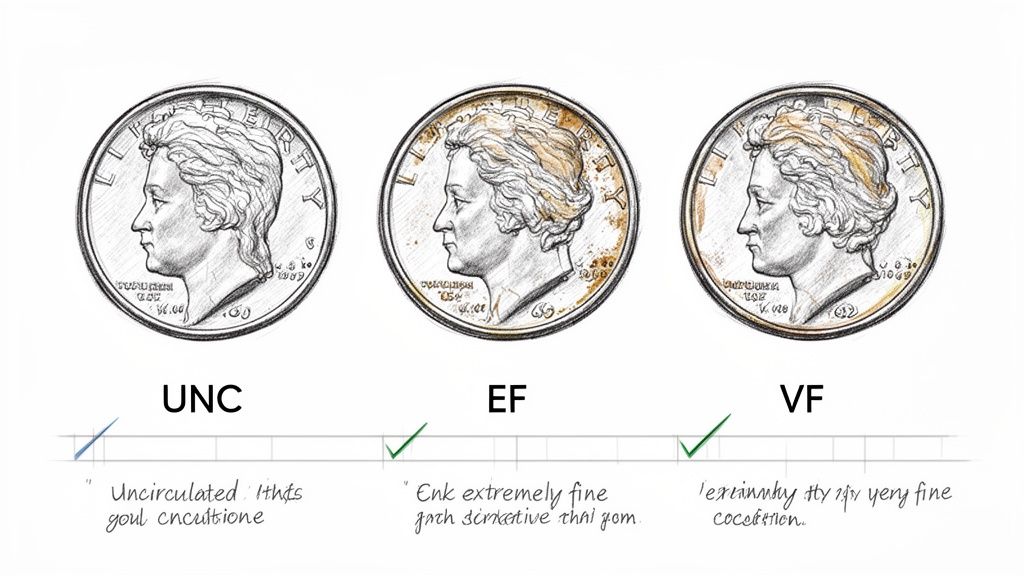
Ever wondered how two sixpences from the exact same year can have wildly different values? You might find one priced at £5 and another at £50. The secret almost always lies in its physical condition, or what collectors call its "grade."
Think of it like a first-edition book. A copy with a flawless dust jacket and crisp, unmarked pages is worlds apart from a well-read version with a battered spine and dog-eared corners. Coin grading follows the same logic – a coin that shows little evidence of its journey through pockets and purses will always be more sought-after.
This section will give you a practical guide to realistically assess your coin's condition. Getting a handle on these grades is the single most important step in estimating the true numismatic value of your sixpence.
Understanding the Key Grading Tiers
The world of coin grading can seem a bit intimidating at first, with a detailed scale running from "Poor" all the way up to a flawless "Mint State." But for most collectors, you only need to get familiar with a few key tiers that cover the vast majority of sixpences you'll come across.
Learning to spot the differences between these common grades will instantly sharpen your eye for value.
- Uncirculated (UNC): This is a perfect coin that looks like it just fell out of the press at the Royal Mint. It has its full, original mint lustre, with razor-sharp details and absolutely no signs of wear, even on the highest points of the design.
- Extremely Fine (EF): An EF coin has seen only the briefest moment of circulation. You'll spot the slightest touch of wear, but only on the very highest points, like the tips of the monarch's hair or the top of the shield on the reverse.
- Very Fine (VF): Here we see a coin with light to moderate wear, but all the main details are still clear. The lettering and portrait are distinct, though you'll notice the finer lines have started to soften.
- Fine (F): A coin in Fine condition has been around the block. It’s seen considerable circulation, and while the main design is visible, it's worn smooth, and much of the finer detail is long gone.
A coin's condition is its autobiography. Every scratch, every bit of wear, and every patch of patina tells the story of where it's been. Unlike most antiques, 'restoring' or cleaning a coin erases that story and, in doing so, destroys most of its collector value.
Putting Grading into Practice
Let's make this real. Imagine you're holding a George V sixpence from the 1920s.
If it were Uncirculated, you'd be able to count the individual strands of hair in the King’s portrait and beard. On an Extremely Fine example, the portrait would still look impressively sharp, but the very tips of the hair and beard might look a fraction flat.
For a coin in Very Fine condition, those high points would be noticeably more worn, and the intricate details within the crown would start to blur together. By the time it reaches Fine condition, the King's portrait is much flatter; the main outline is clear, but the complex details are gone.
This is why a common coin in Uncirculated condition can often be worth more than a much rarer date in poor condition. The grade is everything.
And whatever you do, remember the golden rule of numismatics: never clean your coins. The natural toning, or patina, that a coin develops over decades is part of its history and is highly prized by serious collectors. Cleaning it strips away that original surface, creates microscopic scratches, and will permanently tank its value.
Right, you've got the basics of identifying and grading your sixpence down. Now for the fun part: the treasure hunt. This is where we look past the common coins and start sniffing out the specific dates, quirky errors, and rare variations that can turn a simple coin into a serious collector's piece.
So, why are some years so much harder to find than others? It's usually a cocktail of history, economics, and sheer luck. A low mintage year, a design that was pulled from circulation almost as soon as it appeared, or a major event like a war could mean very few coins from that year ever made it into the hands of the public, let alone survived. Spotting these hidden gems is the real thrill of collecting. Think of this as your field guide to the most sought-after sixpences.
The Holy Grail: The 1952 George VI Sixpence
If there's one sixpence that sends a ripple of excitement through the collecting community, it has to be the 1952 issue. Its story is a classic example of how history creates incredible rarity. King George VI died in February 1952, which brought an immediate stop to the production of any coins featuring his portrait.
Here's the crucial bit: not a single 1952 sixpence was ever officially put into circulation in the UK. The only ones made were a minuscule batch intended for overseas territories, mainly British colonies like Jamaica. This unique twist of fate makes the coin phenomenally scarce. Finding one is the numismatic equivalent of striking gold, with values easily reaching into the hundreds, or even thousands, of pounds, all depending on its condition.
Victorian Sixpences: Key Dates to Watch For
Queen Victoria's long reign gives collectors a fantastic hunting ground. While many Victorian sixpences are pretty common, certain dates had tiny mintages, making them a real challenge to track down today. And with these older coins, condition is everything. A top-grade example of a scarce date is a genuine prize.
Here are a few notable dates from the Victorian era to keep an eye out for:
- 1862: This year had a particularly low mintage, making it a key date for anyone collecting the "Young Head" series.
- 1887 'Withdrawn' Design: The Jubilee Head sixpence of 1887 was released with a reverse design (a shield inside a garter) that looked suspiciously similar to the half-sovereign. Unsurprisingly, fraudsters started gold-plating them to pass them off as the more valuable coin. The design was quickly withdrawn and replaced that same year, making the original version a fascinating and highly collectible piece.
- 1893 'Veiled Head' with Engraver's Initials: When the new "Veiled Head" portrait was introduced, the very first issues had the engraver Thomas Brock's initials (T.B.) just below the bust. These were removed on later issues, making that initial "T.B." variety the one everyone wants.
A historic coin's value is often a balancing act between how many were originally made and how many survived in good shape. Millions of Victorian sixpences were minted, but very few made it through the hustle and bustle of daily life without getting worn down, creating real scarcity for high-grade examples.
Other Scarce Sixpences Across the Decades
The hunt for rarities doesn't stop in the Victorian era. There are plenty of other key dates and interesting varieties worth looking for as you sort through a collection. Each one has its own story that adds to its scarcity and, ultimately, its value.
For example, the value of a sixpence in today’s UK market can change dramatically based on the monarch, date, and condition. A standard Queen Elizabeth II sixpence (1953–1967), made from cupronickel, might sell for around £2 in decent collectible condition. But go back a bit further and things get more interesting. A typical George V issue could fetch around £5, while a popular Victorian Jubilee Head sixpence might sell for anywhere between £20–£75. To see just how high prices can go for top-tier rarities, detailed UK price guides show values stretching into the hundreds or even thousands. You can learn more about UK sixpence market values from Copes Coins.
This shows that even within a single monarch's reign, the specific date can make all the difference. Keep a sharp eye out for coins from the early 20th century, as several years had surprisingly low production runs. The 1926 sixpence, for instance, is known to be scarcer than its neighbours. In the same way, some sixpences from the reign of Edward VII are quite tough to find in good condition.
At the end of the day, a sixpence's value is a fascinating mix of its history, metal, condition, and rarity. While the chances of stumbling upon a 1952 are slim, there are countless other scarce dates and interesting varieties out there just waiting to be found. Always check your dates carefully—you never know when you might uncover a hidden gem.
Getting the Best Price for Your Sixpence Coins
So, you've figured out what your sixpence is worth and think it might be time to sell. Knowing where and how to sell can make a huge difference to the price you get, and it ensures your little piece of history finds a new home with someone who will genuinely appreciate it.
The right place to sell really depends on the coin you have. A common, everyday cupronickel sixpence and a rare, high-grade silver one are two completely different beasts.
Choosing Where to Sell
For the more common sixpences—think post-1946 cupronickel coins or well-worn silver ones—online marketplaces are a brilliant starting point. They give you direct access to a huge audience of casual collectors, history buffs, and even people searching for that traditional "lucky" sixpence for a wedding.
But what if you think you’ve got something genuinely special? A key date, perhaps, or a coin in truly exceptional condition? That calls for a more focused approach.
- Reputable Coin Dealers: A trusted dealer can give you a fair price on the spot. Of course, they need to make a profit, but it’s often the quickest and most hassle-free way to sell valuable coins.
- Specialist Auction Houses: For the real treasures, like the legendary 1952 sixpence, an auction house is the only way to go. They have the expertise to properly authenticate and market your coin to serious collectors who are ready to pay top-tier prices.
Presenting Your Coins Like a Pro
How you present your sixpence can dramatically affect how much interest you get and, ultimately, the final sale price. A great presentation shows you're a serious seller and lets the coin's quality shine through.
First off, photography is everything. You don’t need a fancy camera; a modern smartphone will do the job perfectly. Just place the coin on a plain, non-reflective background and use soft, natural light to avoid any harsh glare. Get crisp, clear photos of both the obverse (heads) and reverse (tails), and maybe a close-up of the date or any interesting features.
Next, write a description that's both clear and honest. Make sure you include the year, the monarch, and an accurate assessment of its condition, using the grading terms we covered earlier. Whatever you do, don't be tempted to say a coin is in better shape than it is—an experienced buyer will spot it a mile off.
Think of your coin's presentation as its first impression. Clear, well-lit photos and an honest, detailed description build trust with buyers and are absolutely key to getting the best possible price.
Packing and Shipping Securely
Once you’ve made a sale, getting the coin safely to its new owner is the final, crucial step. Proper packaging protects it during its journey and wraps up a smooth transaction for everyone.
- Secure the Coin: Pop the sixpence into a soft, non-PVC plastic flip or a simple cardboard coin holder. This stops it from getting scratched up in transit.
- Add Padding: Wrap the secured coin in a bit of bubble wrap and place it inside a sturdy, padded envelope or a small box. Give it a gentle shake to make sure it can’t rattle around.
- Use a Tracked Service: For any coin with a bit of value, always send it using a tracked and insured shipping service. This protects you if it gets lost or damaged and gives the buyer peace of mind.
Follow these steps, and you can confidently navigate the selling process, ensuring your historic sixpence achieves its full potential value.
Got Questions About Sixpence Coins?
As you dive into the fascinating world of the sixpence, a few common questions always seem to pop up. Whether you're just starting out or you’ve been collecting for years, these quick answers should clear up some of the key points.
Are All Silver Sixpences Valuable?
Not always. While any sixpence minted before 1947 contains silver and has an intrinsic metal value, that’s often just the starting line. A common, well-worn Victorian sixpence, for instance, might only be worth its weight in silver, which can change with the market.
The real collector value comes from a blend of rarity, the reigning monarch, and, crucially, the coin's condition. A scarce date can fetch a good price even in rough shape, but a pristine, uncirculated coin will always be worth significantly more than its more common, battered cousins.
How Can I Tell If My Sixpence Is Silver?
The date is your best friend here. It’s a straightforward rule that instantly tells you the metal content, no guesswork required.
- 1946 or Earlier: Your coin has silver in it.
- 1920 to 1946: The coin is made of 50% silver.
- 1919 or Earlier: It’s struck from 92.5% sterling silver.
If the date is 1947 or later, it’s made of cupronickel and has no precious metal value. While seasoned collectors can often tell the difference just by the lustre, checking the date is the foolproof method.
The cardinal rule for any coin collector is simple: never clean your coins. The natural surface, or patina, that builds up over the years is a vital part of its history. Cleaning permanently damages this surface, creating tiny scratches and stripping away its numismatic value.
Should I Clean My Sixpence Before Selling It?
Absolutely not. This is probably the most important piece of advice you’ll ever get in coin collecting. Polishes, chemicals, or even vigorous rubbing will strip away the coin's original surface and the unique character it has acquired over decades.
This damage is irreversible and can turn a valuable collector’s piece into something worth only its scrap metal value. Collectors prize coins with their original, untouched surfaces because that patina is proof of age and authenticity. An uncleaned coin tells a story, and that story is what makes it valuable.
Whether you are just starting your collection or looking for that one rare piece to complete a set, Cavalier Coins Ltd offers a vast selection of world coins and banknotes. Explore our curated collections and weekly auctions at https://www.cavaliercoins.com.