
Ever wonder if that handful of change rattling around in a drawer is worth more than you think? While most UK pound coins are just that—a pound—some are genuine collector's items hiding in plain sight.
It's a common mistake to assume only ancient or obviously old currency holds any real value. The truth is, modern coins, especially the familiar £1 coin, offer a fantastic and accessible way into the world of numismatics (the fancy term for coin collecting). This guide will show you exactly what to look for, helping you spot the hidden gems in your own pocket.
Unlocking the Value Hidden in Your Change
That jar of coins on your shelf or the loose change in your car could be a small treasure trove. We're not just guessing here; we'll walk you through the core principles that experts and serious collectors use to value their finds.
Understanding these key factors is your first step. It turns the mundane task of sorting through change into an exciting treasure hunt.
Why Some Pound Coins Are More Valuable Than Others
So, what transforms a standard coin from everyday money into a collector’s prize? It boils down to a few key things, each adding to a coin's scarcity and, therefore, its desirability. Getting to grips with these is crucial if you want to spot the potential value in your collection.
If you're short on time, this table gives a quick overview of what to look for.
| Key Factor | What It Means | Real-World Example |
|---|---|---|
| Low Mintage | The Royal Mint produced a very small number of this specific coin. | The 2011 Edinburgh City £1 coin is a classic. Only 935,000 were ever made, making it one of the rarest round pounds. |
| Minting Errors | A mistake was made during the coin's production. | 'Mules' are a famous example, where a coin is struck with mismatched obverse (heads) and reverse (tails) dies. |
| Popular Designs | Some designs are simply more popular with collectors. | The 'Cities' and 'Floral Emblems' series of round pounds are always in high demand. |
These are the main drivers, but the real art is in spotting them in the wild.
The Big Three: Mintage, Errors, and Design
Let's break these down a bit further.
-
Low Mintage Figures: This is the most common reason for a coin's high value. The Royal Mint releases official figures for how many of each coin they produce. When a design has a low mintage, it automatically becomes rarer and more sought-after by people trying to complete their collections.
-
Minting Errors: Mistakes happen, even at a place as precise as The Royal Mint. These errors can create exceptionally rare and valuable pieces. Look out for things like 'mules' (coins struck with mismatched designs), off-centre strikes, or even incorrect inscriptions. They're rare, but they are out there.
-
Specific Designs and Series: Just like with stamps or anything else, some series are simply more popular. Commemorative designs or themed sets, like the ones celebrating the capital cities of the UK, are highly prized by collectors. This demand alone can drive up prices far beyond face value.
Ultimately, a coin's value is a perfect storm of its rarity, its condition, and the story it tells. An uncirculated coin from a low-mintage year is often the jackpot, but don't discount a circulated coin with a rare error—it can still fetch a surprising price.
A Collector's History of the Pound Coin
To really get a feel for which coins are valuable, you need to know their story. A coin's history gives you the context, explaining why certain designs or years are much harder to find than others. The modern pound coin's journey is a great example—a tale of practicality, innovation, and a constant battle against crime.
Before 1983, the UK ran on £1 banknotes. They did the job, but they were flimsy and had a ridiculously short lifespan. The average note was worn out and needed replacing in just nine months, which was hugely inefficient. This practical headache was the catalyst for a major shift in British money.
On 21st April 1983, The Royal Mint rolled out the thick, nickel-brass round £1 coin. It was built to last, designed to withstand 40 years or more of use. This was a big change, creating a sturdy, tangible piece of currency that became a fixture in daily life for a whole generation.
The Original Round Pound Era
That very first round pound from 1983 featured the Royal Arms on its reverse. Around the milled edge was the inscription "DECUS ET TUTAMEN," which translates to "An ornament and a safeguard"—a nod to how the edge was first used to stop people from shaving bits off precious metal coins.
To get the entire country switched over from paper to metal, the Royal Mint went into overdrive. In its first year alone, an incredible 825,500,000 round £1 coins were minted. This is still the highest mintage figure ever for any £1 coin, making the 1983 Royal Arms design one of the most common you’ll ever come across. If you want to dive deeper, we have a detailed guide on the history of other British coins.
But the coin's success came with a major problem. Over the next thirty years, its simple, single-metal design made it a prime target for counterfeiters.
The Counterfeit Crisis and a New Beginning
The fake pound coin problem grew and grew, eventually hitting crisis point. By 2013, The Royal Mint estimated that a staggering 3.04% of all £1 coins in circulation were forgeries. Think about that—it means nearly one in every thirty pound coins you handled was a fake. This seriously dented public confidence and was a real threat to the UK economy, forcing a radical solution.
The answer arrived in March 2017: the twelve-sided, bimetallic £1 coin. It wasn't just a new look; it was a marvel of engineering, billed as "the most secure coin in the world."
What made it so tough to copy? It boiled down to a few key features:
- Twelve-Sided Shape: Instantly recognisable by sight and touch, making it much harder to fake than a standard round coin.
- Bimetallic Construction: The coin uses two different metals—a gold-coloured outer ring (nickel-brass) and a silver-coloured inner disc (nickel-plated alloy). This is a tricky and expensive process for counterfeiters to replicate.
- Latent Image: A clever hologram-like image that switches between a '£' symbol and the number '1' as you tilt the coin.
- Micro-Lettering: Look closely and you'll see tiny lettering inscribed on the lower inside rim on both sides.
- Hidden Security Feature: There's also a secret feature built right into the coin that allows for automated verification.
The image below shows just how big a leap this was, moving from the classic round pound to the modern, secure version.
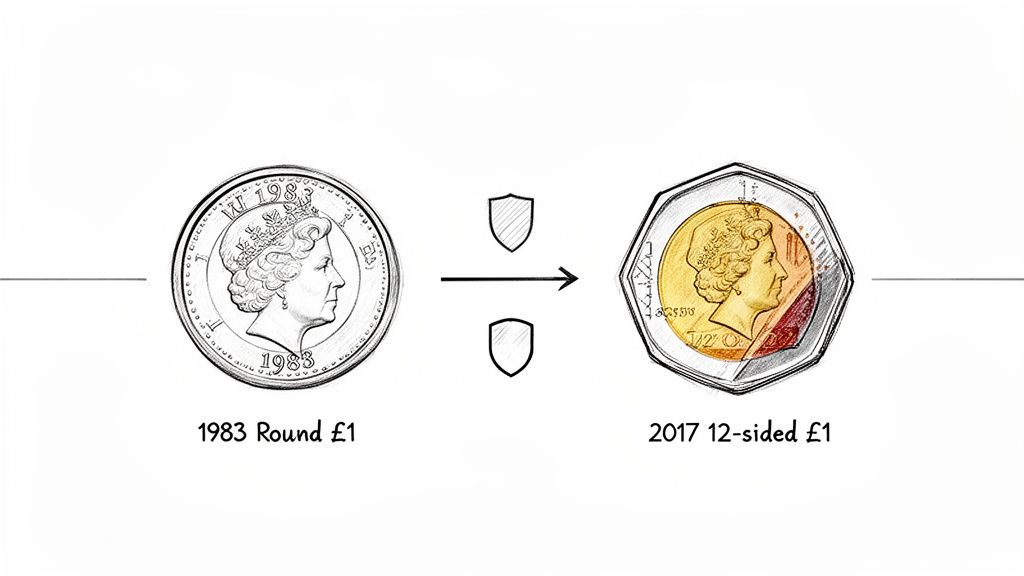
The visual contrast says it all. The introduction of the 12-sided coin was a massive success, and the number of fakes in circulation plummeted almost overnight.
Collector's Insight: This history is directly tied to the value of pound coins. The first-year issues for both the round pound (1983) and the bimetallic pound (2017) are historically important, but not especially rare. On the flip side, the very last round pound designs issued before it was withdrawn in 2016 are often sought after by collectors trying to complete their sets.
Understanding this timeline—from a practical need to replace banknotes to an urgent fight against fakes—is the key to spotting which coins are just loose change, and which are little pieces of history worth collecting. It's the story behind the metal that really creates the value.
How to Spot Rare and Collectible Designs
Alright, let’s get to the exciting part—how to sift through your loose change and actually find something valuable. This is where a bit of knowledge and a sharp eye can really pay off. For coin collectors, it's all about spotting specific, limited-run designs. And what makes them limited? It almost always boils down to one simple thing: low mintage figures.
When The Royal Mint doesn't produce many coins of a particular design, they become scarce. That scarcity is what pushes their value well beyond the £1 stamped on the front. We'll walk through some of the most sought-after series so you know exactly what you’re looking for.
The Iconic 'Cities' Series
If you’ve heard of rare round pounds, you’ve probably heard of the "Capital Cities" series. Issued between 2010 and 2011, these coins celebrate the four capital cities of the UK with beautiful, symbolic designs. They’re all popular with collectors, but their mintage numbers are wildly different, which creates a clear pecking order of rarity.
The series includes:
- London (2010): Features the city's coat of arms.
- Belfast (2010): Displays the Belfast City coat of arms.
- Cardiff (2011): Showcases the Cardiff City coat of arms.
- Edinburgh (2011): Represents the coat of arms for the City of Edinburgh.
The undisputed champion of this series is the 2011 Edinburgh City coin. Only 935,000 were ever minted for circulation, making it the rarest round £1 coin out there. Finding one of these is a huge win for any collector. Even a well-used one you find in your pocket can sell for £10 to £15. The Cardiff coin isn't far behind, with a mintage of 1,615,000, making it another fantastic piece to discover.
Floral Emblems and Bridges Series
Long before the cities, The Royal Mint was producing other series that have since become collector favourites. The "Floral Emblems" series (1984-1993) was a lovely tribute to the home nations' national plants, while the "Bridges" series (2004-2007) highlighted impressive feats of engineering from across the UK.
While many coins in these sets are quite common, a few stand out. The 1988 Crowned Shield round pound, for instance, had a fairly low mintage of 7,118,825, making it one of the harder-to-find designs from that period. In the Bridges series, the 2005 Menai Bridge coin is another one to keep an eye on. The key is to always check the mintage figures to get a sense of a coin’s potential.
A classic rookie mistake is thinking that old automatically means valuable. The 1983 Royal Arms is the very first round pound, but with over 443 million made, it's one of the most common. For modern coins, rarity beats age every time.
Modern Bimetallic Pound Coins to Watch
The switch to the 12-sided coin in 2017 opened up a whole new world for collectors. The game is still about spotting low mintage figures, but now we also have special commemorative designs and the possibility of minting errors that are unique to the two-metal format.
The first "Nations of the Crown" design from 2017 is incredibly common, but the numbers have dropped dramatically in recent years. This creates new collecting opportunities. After minting 130,560,000 in 2018 and a peak of 138,635,000 in 2019, production fell off a cliff to just 55,840,169 in 2020. It got even lower with 21,760,000 in 2021 and a tiny 7,735,000 in 2022, making these later years the ones to hunt for. You can explore the official data on the Wikipedia entry for the one pound coin.
Don't forget the special editions, either. The Royal Mint is now issuing commemorative £1 coins like the 2023 Bees design, which had a mintage of 10,030,000. These themed coins get snapped up fast, so finding one in circulation is a real bonus. For a deeper dive into other valuable designs, have a look at our complete guide on rare one pound coins.
To make things easier, here’s a quick-reference table to help you spot some of the big hitters.
Top 5 High-Value UK Pound Coin Designs
| Coin Design & Year | Mintage Figure | Estimated Circulated Value | What to Look For |
|---|---|---|---|
| Edinburgh City 2011 | 935,000 | £10 - £15 | The coat of arms of Edinburgh, often showing some wear. |
| Cardiff City 2011 | 1,615,000 | £8 - £12 | The coat of arms of Cardiff, featuring a prominent dragon. |
| London City 2010 | 2,635,000 | £6 - £10 | The shield from the City of London's coat of arms. |
| Kew Gardens 50p 2009 | 210,000 | £150+ | Not a £1, but the UK's most famous rare coin to find in change. |
| 2022 Nations of Crown £1 | 7,735,000 | £2 - £4 | The standard 12-sided design but from a very low-mintage year. |
As you can see, there’s a direct link between low mintage numbers and high market value. I’ve included the legendary Kew Gardens 50p as a benchmark—it’s the poster child for how scarcity can turn pocket change into a serious collectible. The principle for finding valuable pound coins is exactly the same: learn the designs, memorise the low-mintage years, and never stop checking your change.
Grading Condition and Identifying Valuable Errors
Finding a coin with a rare design or a low mintage year is a brilliant start, but it's really only half the story. The physical state of a coin—what collectors call its 'grade'—plays a massive part in its final value. A flawless, uncirculated coin can be worth many times more than an identical one that’s been rattling around in pockets and tills for years.
At the same time, the world of minting errors offers another thrilling path for collectors. These are simply mistakes made during the coin's production at The Royal Mint. A tiny flaw, an unusual mark, or a bizarre combination of designs can turn an everyday coin into a prized rarity, hugely increasing the value of pound coins you might otherwise overlook.
Understanding Coin Grades
In the world of coin collecting, condition is everything. Numismatists use a standardised grading scale to describe a coin's level of wear and tear. You don't need to be an expert on the entire scale, but knowing a few key terms will give you a huge advantage when looking at your own finds.
Think of it this way: every moment a coin is in circulation, it loses microscopic details. The sharpness of the Queen’s hair, the fine lines on a shield design, or the crispness of the edge lettering all start to soften. The less wear a coin shows, the higher its grade and, almost always, its value.
A few common grades you’ll come across are:
- Uncirculated (UNC): The coin looks brand new, as if it just left the mint. It has zero signs of wear and still has its original shine. These are usually found in special collector sets but can sometimes turn up in your change if you're very lucky.
- Extremely Fine (EF): This coin has only seen very light circulation. All the main design details are sharp and clear, with just a tiny bit of wear on the highest points of the design.
- Very Fine (VF): The coin shows some obvious signs of wear, but the main features are still distinct. You'll notice some flattening on the high points, but the overall design is still strong.
- Fine (F): There is moderate wear all over the coin. The major design elements are visible, but many of the finer details have been worn smooth.
A word of warning: you might be tempted to clean a dirty-looking coin, but please don't! Polishing or scrubbing a coin, no matter how gently, creates tiny scratches that ruin its original surface. This is known as 'harsh cleaning' and it can instantly wipe out most of a coin's collector value. A coin with its natural patina is always better than a shiny but damaged one.
Spotting Valuable Minting Errors
This is where coin hunting gets really exciting. Minting errors are production flaws that create unique and often valuable varieties. Quality control at The Royal Mint is exceptionally high, so when a mistake does slip through, the resulting coin can become a serious collectible.
Learning to spot these errors takes a keen eye. You’re essentially looking for anything that deviates from the standard, correct design. It’s a bit like being a detective, searching for clues that most people would miss entirely.
This chart shows the mintage figures for a few famously rare round pounds, giving you a clear idea of how scarcity drives value.
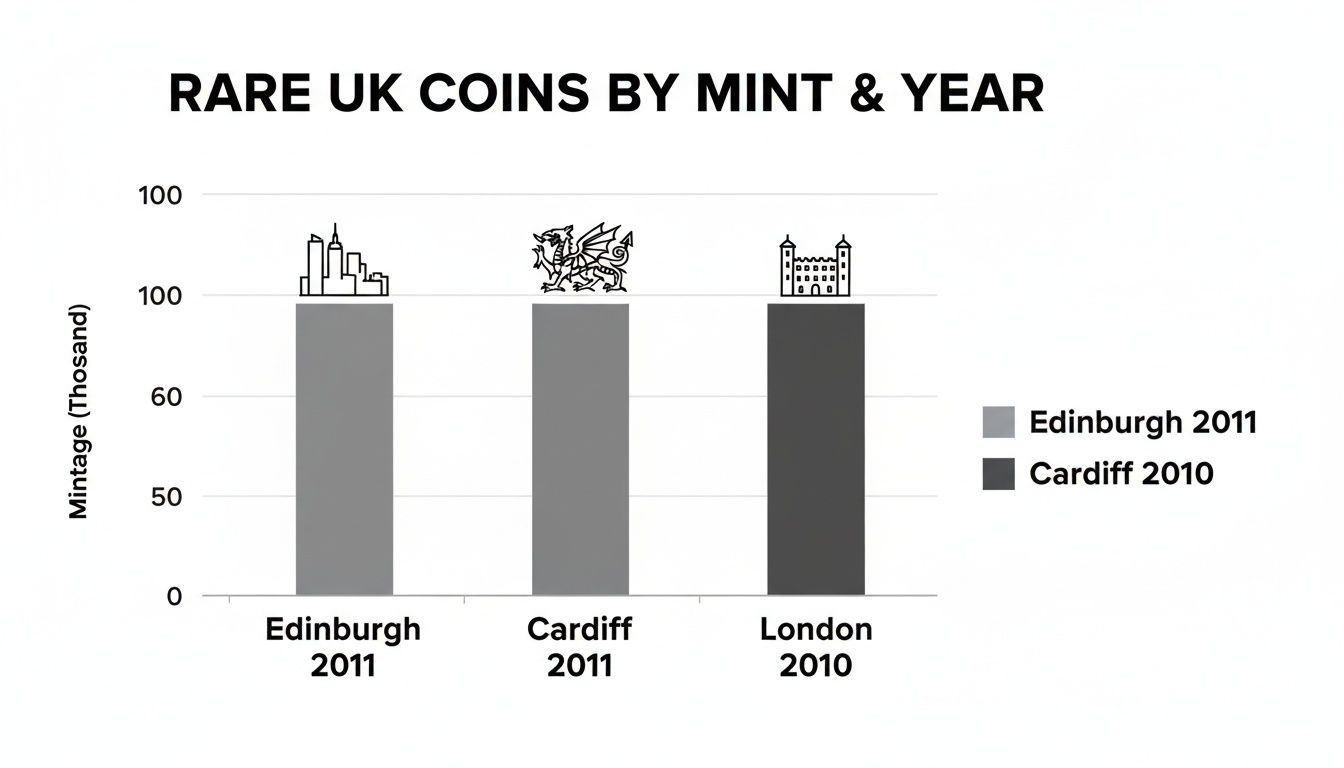
As you can see, the tiny mintage of the 2011 Edinburgh coin is exactly why it’s so sought-after compared to others in the 'Cities' series. That scarcity makes it a top target for collectors.
Common Types of Pound Coin Errors
Some errors are more common—and more valuable—than others. Here are a few key types to keep an eye out for as you inspect your change.
- Mule Coins: These are probably the most famous type of error. A 'mule' is a coin struck with mismatched dies—meaning the 'heads' side doesn't belong with the 'tails' side. For example, a mule might have the obverse from a 10p coin and a reverse from a £1 coin.
- Off-Centre Strikes: This happens when the coin blank isn't lined up properly with the striking dies. The result is a design that's off-centre, often with a crescent-shaped blank area on one side. The more dramatic the misalignment, the more valuable the coin tends to be.
- Die Cracks and Cuds: The dies used to strike coins can develop cracks over time, which then transfer to the coin’s surface as raised lines. A 'cud' is a more major error where a piece of the die actually breaks away, leaving a raised, featureless blob of metal on the coin.
- Rotation Errors: If you hold a coin by its top and bottom edges and flip it over, the Queen’s head should be perfectly upright. If it's tilted at an angle, you have a rotation error. Minor rotations are fairly common, but significant ones (over 90 degrees) can be quite valuable.
Identifying these takes patience and a good magnifying glass. For those keen to learn more, you can discover valuable error coins and their hidden treasures in our detailed article on the subject. By learning what to look for, you massively increase your chances of finding a truly special piece.
Your Next Steps: Selling or Securing Your Collection
There's a real thrill in finding a coin you know is worth more than face value. Whether it's a rare design you've been hunting for or a quirky minting error that just fell into your hands, the next question is always the same: what now?
Broadly speaking, you have two choices. You can sell it for a tidy profit, or you can secure it as the start (or newest addition) to a collection. The right path really just depends on your own goals. Let's walk through what to do, whether you're looking for a quick sale or to protect a long-term investment.
Deciding Where to Sell
If you're ready to sell, you've got a few different places to go. Each has its pros and cons, so it’s all about matching the platform to your coin’s value and how much effort you want to put in.
-
Online Marketplaces (like eBay): This is where most people start. You get access to a huge audience, but you have to work to get noticed. High-quality photos and a dead-honest description are non-negotiable. The big challenge here is the sheer number of listings, many with ridiculously optimistic prices that can confuse new buyers. Always filter by "Sold Items" to see what coins actually sold for, not what people are asking.
-
Specialist Coin Dealers: A reputable dealer offers expertise and a hassle-free sale. They can tell you what you have, its grade, and its authenticity almost instantly, then make you a fair offer based on the market. You might get a little less than you would in a private sale (they have a business to run, after all), but you get a secure, immediate payment without any of the faff of listing, packing, and posting.
-
Auction Houses: For the truly rare and valuable pound coins, a proper numismatic auction house is your best bet. These places are where the serious, deep-pocketed collectors hang out. The competitive bidding they can generate will almost always maximise what you get back. This is really for the top-tier stuff, where the potential sale price easily justifies the auctioneer's commission.
Insider Tip: Presentation is everything, especially online. Never, ever use stock photos. Pop your coin on a plain, neutral background—a sheet of white paper is perfect—and use soft, natural light to avoid any glare. Get sharp, in-focus pictures of both sides (the obverse and reverse) and a close-up of anything special like the date or a specific error.
Writing a Description That Sells
Think of your listing's title and description as your sales pitch. You need to be specific to attract the right kind of buyer. A title like "Rare Pound Coin" is useless. Instead, go with something like, "2011 Edinburgh City £1 Round Pound Coin - Circulated Condition."
Be completely honest in the description. Mention the year, the design, and its condition. If it has nicks and scratches from being in circulation, just say so. Being transparent builds trust and saves you from dealing with disputes down the line. It's this simple, honest approach that will make your listing stand out from all the noise.
Securing Your Growing Collection
If you're a keeper, looking after your coins properly is the only way to protect their condition and, by extension, their value. The biggest rookie mistake is handling valuable coins with your bare hands; the natural oils on your skin can cause corrosion over time. Always hold them by the edges or, even better, wear a pair of soft cotton gloves.
When it comes to storage, you've got a few solid options:
- 2x2 Cardboard Holders: Cheap, cheerful, and perfectly effective for individual coins. You just pop the coin inside and staple it shut.
- Coin Capsules: These are the hard plastic, airtight cases that offer fantastic protection from knocks, handling, and the environment.
- Collector's Albums: A brilliant way to organise and show off your collection, with dedicated slots for different series or designs.
Finally, as the value of your collection starts to climb, you need to think about insurance. Your standard home insurance policy probably offers very limited cover for collectibles—often just a few hundred pounds. Once your collection is worth more than that, it’s time to talk to your provider about adding it specifically to your policy or looking into a specialised collectibles insurance plan. It’s the only way to be sure you're fully protected against theft or loss.
Common Questions About Valuing Pound Coins
Even when you feel you've got the basics down, a few nagging questions always seem to pop up as you get more serious about hunting for valuable pound coins. It’s all part of the journey from being a casual change-checker to a proper collector. Getting solid answers is the best way to build your confidence and avoid any rookie mistakes.
Think of this as your go-to FAQ. We’ve pulled together the most common queries we hear to give you clear, straightforward answers and help you push past those initial uncertainties.
Are All the Old Round Pound Coins Valuable?
This is easily the most common misconception out there, and the short answer is no, not at all. A coin’s age is much less important than its mintage numbers and overall condition. Heaps of round pounds, particularly from massive production years like the very first 1983 Royal Arms or the 1991 Flax Plant, are incredibly common and will only ever be worth their face value.
What you're really looking for is scarcity. Designs like the 2011 Edinburgh City £1, with its tiny mintage of just 935,000, are the ones collectors are actively trying to find. These are the coins that can fetch much higher prices, even if they've been knocked about a bit in circulation. Always check the design and year against a reliable mintage list.
Here's the golden rule for modern coin collecting: scarcity always trumps age. A newer coin with a low production run will almost always be worth more than an older, more common one.
How Can I Get My Pound Coins Professionally Valued?
While online price guides and sold listings on auction sites are brilliant for getting a rough idea, they're no substitute for an expert eye. If you think you've found a genuinely high-value coin, your best bet is to talk to a reputable coin dealer or a numismatic expert.
A professional can accurately assess your coin's grade—its precise physical condition—which is a massive factor in its market value. They’re also trained to spot subtle errors or varieties that the rest of us might easily miss. A hands-on appraisal is the only way to go if you’re thinking of selling or need a valuation for insurance.
What Is the Rarest Pound Coin I Can Find in Circulation?
If we're talking about the old round pounds, the 2011 Edinburgh City £1 coin is the undisputed champion. Its low mintage figure makes it the top prize for anyone trying to complete their "Capital Cities" set, and that rarity keeps its value consistently high.
With the newer 12-sided coins, the landscape is a little different. No single design is quite as rare as the Edinburgh £1 just yet. However, collectors are starting to pay more attention to the lowest mintage years for the standard "Nations of the Crown" design, like the 2022 issue, realising just how few were produced compared to other years.
Can I Still Spend the Old Round Pound Coins?
No, you can't. The round pound coin was officially taken out of circulation on 15th October 2017. This means it's no longer legal tender, and shops have no obligation to accept it.
But that doesn't mean they're worthless. Most UK high-street banks and Post Office branches will still let you deposit them directly into your account. So while their spending days are over, they still hold their face value for deposits—on top of any potential collector's value, of course.
At Cavalier Coins Ltd, we are passionate about helping collectors at every stage of their journey, from spotting their first rare coin to curating a world-class collection. Explore our extensive selection of rare coins and banknotes from across the globe or contact our team for expert advice and valuations.