
Ever spotted a tiny letter tucked away near the date on a coin and wondered what it was for? That small symbol is what we in the coin world call a mint mark, and it’s a crucial piece of your coin’s story. Think of it as a postcode for your pocket change, telling you exactly which facility struck the coin.
Decoding the Small Symbols on Your Coins
That little mark is far more than just a random letter; it’s the signature of the mint that produced the coin. It works just like a car maker’s badge or an artist’s signature on a painting—it tells you who made it.
This wasn’t just for show. Historically, mint marks were a vital tool for quality control. If a batch of coins was underweight or poorly made, the mark made it easy to trace it back to the specific mint responsible. It held them accountable for the quality and accuracy of their work, which was incredibly important when multiple mints were operating across the country.
For collectors, these tiny symbols are fundamental. Understanding them is key to unlocking a coin's full story.
- Pinpointing a coin's origin: You can identify the exact location where it was created, whether it was the Royal Mint in London or a long-gone provincial mint.
- Establishing its rarity: Some mints produced far fewer coins than others. A coin with a mark from a low-mintage facility is often much scarcer and, therefore, more valuable.
- Revealing historical context: The presence of a certain mint mark can tell you about a country's economic or political situation at the time it was made.
A mint mark transforms a simple piece of currency into a historical artefact. It provides a direct link to the people and places involved in its creation, adding layers of context that collectors find fascinating.
Before we go further, it helps to understand how these marks are applied. The journey from a piece of raw metal to a finished coin is a fascinating process, and the mint mark is one of the final stamps of origin. If you’re curious about the mechanics, our guide on how coins are made gives you the full picture.
Knowing how they're made helps you appreciate why these tiny symbols are so significant. Ultimately, a mint mark is a key piece of the puzzle that tells a coin’s complete story.
The Purpose of Mint Marks at a Glance
To put it all into perspective, mint marks serve several critical functions that are important for both monetary authorities and collectors alike. This table breaks down their primary roles.
| Function | Description | Why It Matters |
|---|---|---|
| Identification | Clearly indicates which minting facility produced the coin. | Helps track production quantities and distribution across different regions. |
| Quality Control | Allows authorities to trace faulty or inconsistent coins back to their source. | Ensures accountability and maintains the integrity of the nation's currency. |
| Historical Record | Provides a tangible link to a specific time and place in history. | Offers insight into economic conditions, political changes, and minting technology. |
| Determining Rarity | Helps collectors identify coins from mints with lower production numbers. | A coin's mint mark can be the deciding factor in its scarcity and value. |
In short, these small symbols carry a lot of weight. They are the fingerprints of the minting world, each one telling a unique tale of origin, quality, and history.
A Journey Through UK Mint Mark History
Mint marks on UK coins are so much more than just tiny letters or symbols. Think of them as historical fingerprints, each one telling a story of economic shifts, civil unrest, and the slow march towards a centralised power. Their history is a journey through Britain's past, proving that every tiny mark is a clue to the era it came from.
The idea of marking a coin to show where it was made is an ancient one, with roots stretching all the way back to Roman and Anglo-Saxon Britain. In those early days, mints were scattered across the land, each serving its local region. Stamping their coins with a unique symbol was a simple, effective way to ensure accountability and maintain quality.
The Rise of Regional Mints
This decentralised system worked for centuries. By the medieval period, cities like London, Oxford, and Bristol had become major minting hubs. The marks they used were crucial for telling the difference between coins of the same value that were struck in different places. This was especially important for fighting counterfeiting and keeping public trust in the currency, particularly during turbulent times with frequent changes in rulers.
The London Mint, for example, reopened around 650 AD, while the Oxford Mint was active from 871-1066, and the Bristol Mint opened its doors around 1016. Each had its own identifiable marks. While production started to centralise at the Tower of London by 1279, these regional mint marks remained vital for keeping track of the coinage.
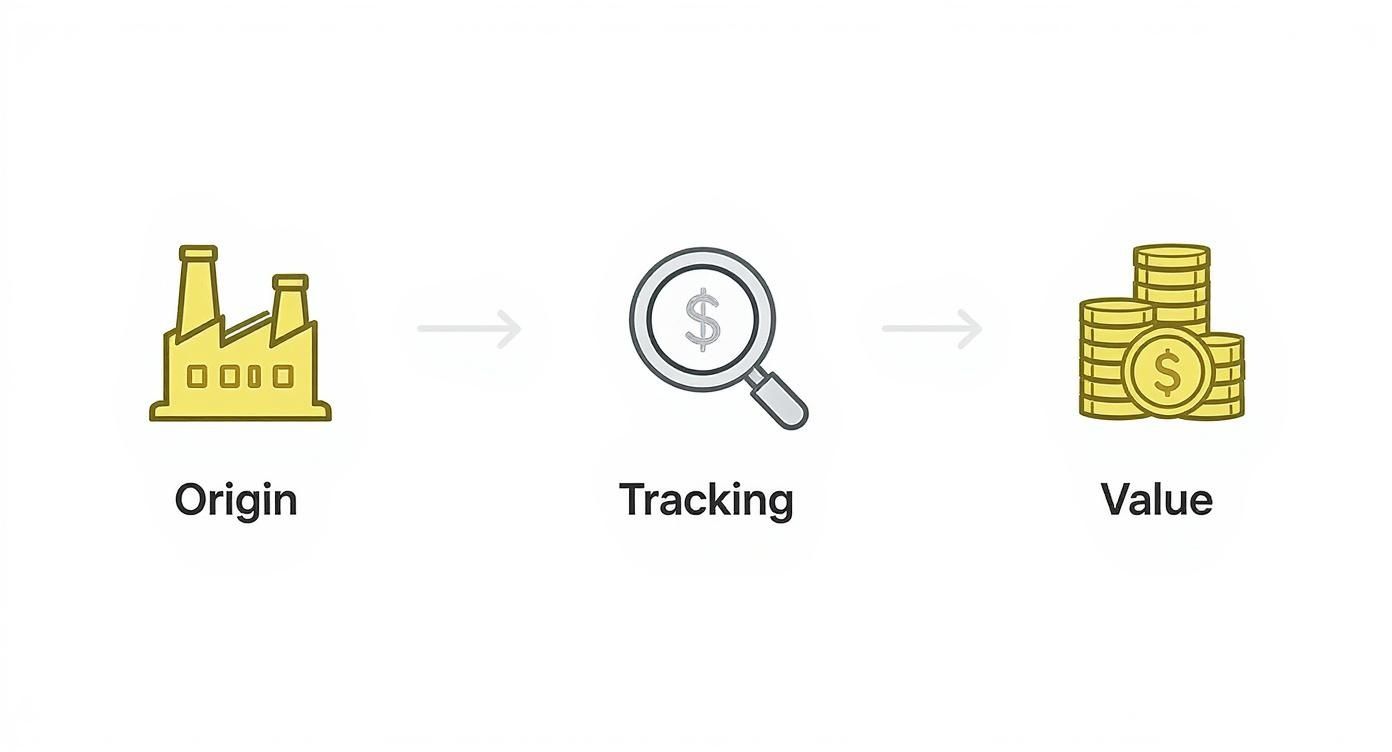
As you can see, a coin's journey starts with its origin, which the mint mark helps to track, ultimately influencing its value to collectors down the line.
Centralisation and the Modern Royal Mint
The move towards a single, unified minting authority was a long and gradual process. One of the most critical moments came during the English Civil War (1642–1651). Both Royalist and Parliamentarian forces set up their own mints, each with its own distinct marks. Today, these coins are fascinating historical artefacts that tell a vivid story of a nation torn in two.
The mint marks from this period aren't just numismatic details; they are symbols of allegiance. A coin marked with a plume, for instance, tells you it was struck at a Royalist mint using silver sourced from Wales.
After the monarchy was restored, it became clear that a single, technologically advanced mint was needed. The Royal Mint, which was officially established way back in 886 AD, eventually took over all minting operations. Now located in Llantrisant, Wales, it carries on the ancient tradition of using marks, particularly on commemorative and bullion coins. This practice beautifully connects our modern currency to a rich and complex past.
To see just how these changes shaped the money we use today, you can explore a brief history of British coins and follow the full story.
How to Find and Identify Common UK Mint Marks
Ready to do a bit of detective work? Finding these tiny symbols is actually much easier than you might think, once you get your eye in. They’re often tucked away in quite discreet spots, but with a bit of practice and a decent magnifying glass, you can start uncovering the hidden history stamped right into your coin collection.
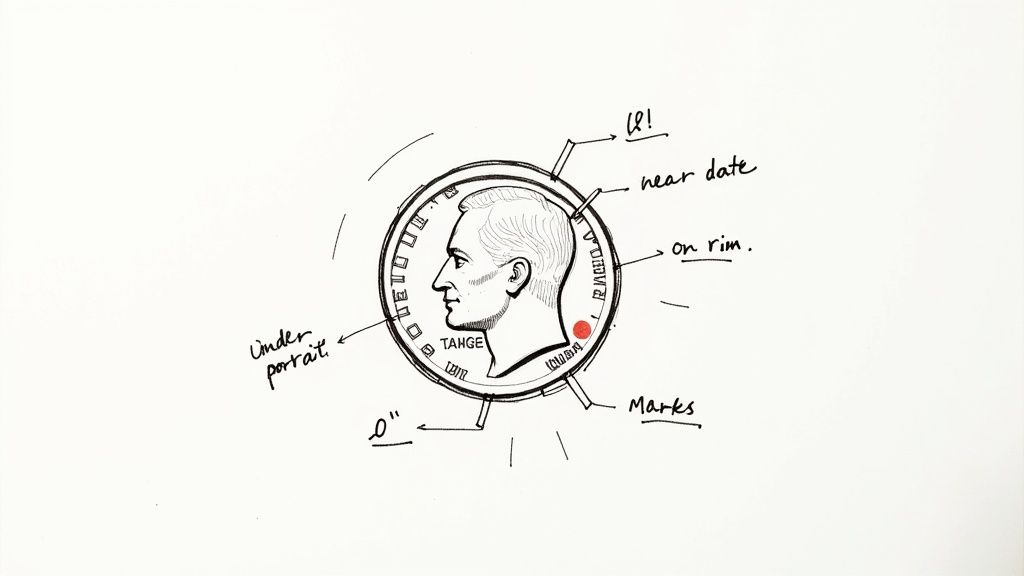
The first step is simply knowing the usual hiding places. While the exact location can change depending on the coin's denomination and when it was made, mint marks on British coins tend to show up in a few key areas. You'll want to pay close attention to the space near the date, just below the monarch's portrait, or sometimes cleverly worked into the design on the reverse (the "tails" side).
Key Locations to Check
Before you start hunting, grab a coin and get your bearings. The obverse is the "heads" side, which features the monarch's portrait, while the reverse is the "tails" side with the main design.
Here are the most common places you’ll spot a mint mark:
- Below the Monarch's Bust: This is a classic spot, especially on older coins. Look for a tiny letter or symbol just underneath the portrait.
- Near the Date: Check the area immediately surrounding the year of issue. The mark could be sitting just above, below, or to the side of the numbers.
- Within the Reverse Design: Sometimes, the mint mark is sneakily integrated into the patterns or imagery on the tails side of the coin.
It's worth remembering that not all British coins have mint marks. Many modern circulating coins from the Royal Mint at Llantrisant don't carry a mark, simply because it's the only facility producing them. These marks are far more common on older coins or special commemorative issues.
A Quick Reference Guide
To give you a head start, it helps to know the symbols used by some of Britain's most important mints. While the Royal Mint is the main show today, historically, several other mints were crucial in striking the nation's currency, often brought in as private contractors to meet high demand.
The table below is a handy reference for some of the key players and their identifying marks. It’s a great starting point for your search.
Common British Mint Marks and Their Locations
This quick guide covers some of the key British mints, their marks, and where you'll most likely find them on a coin.
| Mint Mark | Mint Name | Common Location on Coin |
|---|---|---|
| No Mark | Royal Mint (London/Llantrisant) | Often absent on standard circulating coins post-centralisation. |
| H | Heaton Mint (Birmingham) | Typically found below the monarch's bust or near the date. |
| KN | King's Norton Metal Co. (Birmingham) | Look for this mark on colonial coinage and some UK issues. |
| SOHO | Soho Mint (Birmingham) | Found on late 18th and early 19th-century copper coins. |
Getting familiar with these common marks and their typical locations will equip you to start piecing together the stories behind your coins. It’s this kind of knowledge that forms the foundation for understanding how a coin's origin can dramatically influence its rarity and, of course, its value.
How Mint Marks Affect a Coin's Rarity and Value
This is where your knowledge of mint marks really starts to pay dividends. A coin's mint mark isn't just some historical footnote; it’s one of the single biggest factors in determining how rare it is and, in turn, how much it’s worth. Think of it as a classic case of supply and demand. The mint mark tells you exactly how big the "supply" side of the equation is.
Imagine you have two identical pennies from the same year. One was struck at a mint that churned out millions of them. The other came from a smaller branch that only minted a few thousand. The coin from the low-production mint is instantly scarcer, making it far more desirable to collectors hunting for something truly rare. The mint mark is the tiny detail that unlocks this crucial piece of information.
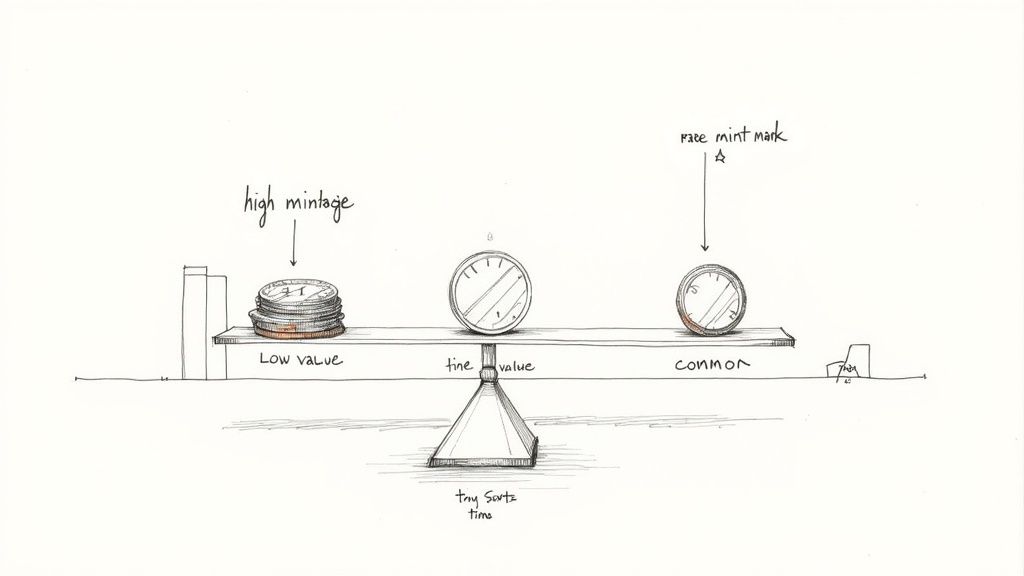
This simple principle explains why some coins are worth just their face value while others can fetch thousands of pounds at auction. A common date from a high-output mint is easy to come by, keeping its value grounded. But find a coin with a rare mint mark from a year with low mintage figures, and you’re holding a sought-after prize.
The Power of Low Mintage Numbers
The total number of coins a specific mint produces in a year is called its mintage. As a rule of thumb, lower mintage numbers almost always mean higher value. The Royal Mint, for example, produces coins on a colossal scale—there are roughly 27 billion coins circulating in the UK right now. Historic mints, like the Birmingham Mint, which hit a staggering production peak of 13 million coins per week back in 1979, also contributed to this huge pool.
With such mind-boggling numbers out there, a coin's specific origin becomes the key to spotting true scarcity. A fantastic example of a mint mark dictating extreme value is the legendary 1933 George V penny. While millions of pennies were struck in other years, only seven of the 1933 issue were ever officially made, each bearing special marks to identify them. Today, one of these pennies is valued at over £86,000, transforming a humble copper coin into a numismatic treasure purely because of its rarity.
The mint mark is the ultimate tiebreaker in coin valuation. When two coins of the same type and year exist, the one from the mint with the lower production run will almost invariably be the more valuable piece.
Condition Combined with Rarity
Of course, rarity is only one part of the story. A coin’s physical condition, or grade, plays an equally critical role in its value. A rare mint mark on a heavily worn coin is still valuable, but that same mark on a coin in pristine, uncirculated condition can be exponentially more so. For collectors, the combination of a scarce mint mark and a high grade is the holy grail.
Determining a coin's condition takes a trained eye, as even the smallest amounts of wear can drastically reduce its worth. If you're looking to sharpen your skills in this area, our expert guide to British numismatic value offers a detailed breakdown of the entire grading process. This knowledge helps you properly assess the potential of any coin you find, ensuring you can spot a true gem when you see one.
Reading History Through a Coin's Mint Mark
Mint marks are more than just a simple letter telling you where a coin was born; they're historical fingerprints. Learning to read these tiny clues opens up a surprisingly deep view into the economic and political turmoil of a particular era. Think of each mark not as a simple stamp, but as a key piece of a puzzle.
The very existence of multiple, active mints at the same time is often a dead giveaway for a period of significant change or upheaval. Take the English Civil War, for example. The explosion of provincial mint marks from this time gives us tangible proof of a fractured, decentralised nation. Each side fired up its own mints to pay its armies, and the coins they struck were, in effect, tiny declarations of their legitimacy.
A Window into Economic Policy
Mint marks also give us invaluable insight into evolving monetary policies and the march of technology. The 17th-century shift from rough, hammered coins to precisely milled ones is a perfect illustration. Mint marks from this period helped separate the new, higher-quality milled coins from 1662 onwards, which were brought in to tackle rampant counterfeiting and "clipping"—the illegal practice of shaving a bit of precious metal off a coin's edge. This wasn't just a cosmetic upgrade; it was a major leap forward in securing the nation's currency. You can find out more about these crucial moments in the evolution of the UK’s currency system over on Chards.
A mint mark is more than an administrative detail; it is a direct link to the economic pressures and technological innovations of its time. It tells a story of stability or chaos, progress or tradition, all within a tiny symbol.
Modern Marks and Commemorative Traditions
This tradition of using marks to tell a story is still alive and well, even with most production now centralised at the Royal Mint. While your average circulating coin won't carry a traditional mint mark, you'll often find special marks on commemorative and bullion coins. These can include privy marks—small, unique symbols added to a coin's design to celebrate an anniversary or a special event.
For instance, a special privy mark might be added to a Sovereign to honour a royal jubilee. These modern marks do the same job as their historical ancestors, adding a layer of context and creating a unique identity for a particular issue. They turn a standard coin into a specific historical artefact, continuing that long-held practice of embedding history right into our money. In that sense, mint marks are still a powerful lens for viewing and understanding our past.
Next Steps for Building Your Collection
Now that you have a solid grasp of mint marks, you’re ready to put that knowledge into practice. This is where the real fun begins—turning information into a tangible, rewarding hobby. Building a collection is a journey of discovery, and you don’t need a complicated setup to get started.
The single most essential tool for any coin collector, beginner or seasoned pro, is a good magnifying glass. Many mint marks are incredibly small, often just a tiny letter tucked away in a design. A quality jeweller’s loupe, with at least 5x magnification, will reveal these hidden details that are completely invisible to the naked eye. It’s a small investment that pays huge dividends in identifying marks and assessing a coin's overall condition.
Handle Your Coins with Care
This is non-negotiable. Proper handling is absolutely critical to preserving a coin's condition and, therefore, its value. The natural oils and dirt from your fingertips can cause permanent corrosion and damage over time, especially to older copper and silver pieces.
- Always hold coins by their edges: Make it a habit to never, ever touch the obverse (heads) or reverse (tails) surfaces.
- Use cotton gloves: For particularly valuable or pristine uncirculated coins, a pair of soft cotton gloves provides an extra, crucial layer of protection.
- Invest in proper storage: Don't just toss them in a drawer. Use acid-free holders, individual flips, or specially designed albums to shield your collection from scratches and environmental damage.
Remember, a coin's condition is just as important as its rarity. A single fingerprint or an errant scratch can dramatically slash the value of an otherwise prized coin. Mastering careful handling is one of the most fundamental skills you'll develop as a collector.
Frequently Asked Questions About Mint Marks
Even when you've got a handle on the basics, a few questions about mint marks seem to come up again and again. Let's tackle some of the most common ones to clear up any confusion and help you collect with more confidence.
Do All Modern UK Coins Have Mint Marks?
No, they don't, and this is a frequent source of confusion for new collectors. The vast majority of standard-issue, circulating coins made by the Royal Mint today do not have a mint mark.
Since the Royal Mint at Llantrisant is the only facility producing the UK’s circulating currency, there's simply no practical need to distinguish its coins from any others. You're much more likely to spot special marks on commemorative coins, proof sets, or bullion issues like the Sovereign. These are typically privy marks, added to celebrate an occasion rather than signal a place of origin.
Can a Mint Mark Be Faked?
Unfortunately, yes. Wherever there's high value, the risk of forgery is never far behind. An unscrupulous person might try to add a fake mint mark to a common coin, hoping to pass it off as a rare, high-value variant.
A classic example is adding a 'D' mint mark to a common 1916 US Mercury dime to make it look like the incredibly rare and valuable 1916-D version. This is precisely why getting high-value coins authenticated by a reputable coin dealer or a third-party grading service is so important. An expert can spot the tell-tale signs of tampering, like tooling marks around the letter or a font style that doesn't match the mint and year.
How Do I Know if a Mint Mark Makes My Coin Rare?
A mint mark on its own doesn't automatically mean a coin is rare. Its real significance comes down to the mintage figures for that specific coin. To figure out if your coin is a keeper, you need to research how many coins were struck by that particular mint in that specific year.
The key is to compare mintage numbers. A coin from a mint that produced 500,000 examples in one year will be significantly rarer and more valuable than a coin from a different mint that struck 50 million of the exact same coin in the same year.
What Is the Difference Between a Mint Mark and a Privy Mark?
This is a great question because the two are often mixed up. They can look similar, but they serve two very different purposes.
- A mint mark has one job: to identify the location of production. It simply tells you where the coin was made.
- A privy mark is a special, smaller symbol added to a coin’s design to commemorate an event, anniversary, or special theme. It tells you why that particular version of the coin exists.
Think of it this way: the mint mark is the factory address, while the privy mark is like a special "limited edition" sticker. Both add a unique chapter to a coin's story.
At Cavalier Coins Ltd, we provide a trusted source for authenticated and accurately described coins from around the world. Whether you're hunting for a specific mint mark or building a new collection, explore our extensive inventory to find your next treasure. https://www.cavaliercoins.com