
When you hear the word 'bullion', what comes to mind? For many, it conjures images of gleaming gold bars stacked in a vault. And that’s not far off.
At its heart, bullion is simply precious metal—gold, silver, platinum, you name it—that’s valued almost entirely for its weight and purity. It’s a physical, tangible asset, traded across the globe based purely on the raw metal it contains.
What Exactly is Bullion?
Think of it like this. When you go to a deli, a standard block of cheddar is priced by the kilogram. Its value comes from its weight and substance. An artisanal, cave-aged cheese, however, is priced for its unique character, its rarity, and the story behind it.
Bullion is the block of cheddar in this scenario. Its value is tied directly to the live commodity market, not its aesthetic appeal or a collector’s whim.
For centuries, 'bullion' has meant precious metals in their most basic, tradeable forms, like bars and ingots. In the UK, it has been a cornerstone of investment and trade for generations, representing a solid foundation of tangible wealth. For a deeper dive, you can explore its historical significance with UK gold market experts.
To put it simply: Bullion is valued for what it is, not who made it or how old it is.
To get a clearer picture, let's lay out what is—and what isn’t—bullion.
Bullion vs. Non-Bullion
A one-kilogram gold bar, stamped by a world-renowned refiner, is the perfect example of bullion. Its price is almost entirely dictated by the current spot price of gold, plus a small premium to cover the costs of making and selling it.
On the flip side, you have items made from precious metals that are definitely not bullion:
- Antique Jewellery: Your great-grandmother's gold locket is certainly valuable, but its worth is tied up in its craftsmanship, design, and sentimental value, not just its gold content.
- A Rare Roman Coin: The value here comes from its incredible historical significance and scarcity. The price of the metal it's made from is a tiny fraction of its overall worth.
- Limited-Edition Commemorative Coins: Collectors might pay a hefty sum for a coin celebrating a royal wedding, but they're paying for its rarity and theme, not the raw value of the silver or gold.
Before we go any further, here is a quick table to help you distinguish between the two.
Bullion vs Non-Bullion At a Glance
The table below offers a quick comparison, showing the key features that separate investment-grade bullion from other precious metal items.
| Characteristic | Bullion (e.g., Gold Bar) | Non-Bullion (e.g., Collectible Coin or Jewellery) |
|---|---|---|
| Primary Value Driver | Intrinsic metal content (weight & purity) | Rarity, historical significance, artistry, or brand |
| Pricing | Based on spot price + small premium | Based on collector demand and market sentiment |
| Form | Standardised bars, ingots, or coins | Unique designs, historical artefacts, wearable items |
| Purpose | Investment, wealth preservation | Collecting, adornment, historical preservation |
| Liquidity | High; easily bought and sold globally | Lower; depends on finding a specific buyer/collector |
Grasping this fundamental difference is the first, most crucial step for any new investor. It’s the line that separates the straightforward world of commodity investing from the much more nuanced market of collectibles. This foundation is key to understanding why bullion is measured and priced the way it is, which we'll explore next.
Exploring the Different Forms of Bullion
Once you decide to buy bullion, you'll quickly realise it isn't a single, uniform product. Instead, it comes in several distinct forms, each with its own character and appeal. The three main categories you’ll run into are bars, coins, and rounds. Getting to grips with what makes them different is the key to picking the right option for your own goals.
The most iconic form of bullion is probably the bar, sometimes called an ingot. These are produced in a massive range of sizes, from tiny one-gram pieces all the way up to the hefty 400-ounce bars that central banks trade amongst themselves.
Bars are typically made in one of two ways:
- Cast Bars: These are created by pouring molten metal straight into a mould. The end result is a rugged, unique-looking bar with a slightly rougher finish. Because they are often cheaper to produce, they usually carry a lower premium over the spot price.
- Minted Bars: These are cut from a larger blank of metal and then stamped with a design, very much like a coin. They have a sleek, uniform look and a high-quality finish, which can mean their premiums are a touch higher than cast bars of the same weight.
Government Coins and Private Rounds
Next up are bullion coins, which are minted by sovereign governments. A key feature of these coins is that they have a legal tender face value—for instance, the £100 face value on a one-ounce Gold Britannia. This value is purely symbolic, of course; the coin’s real worth is tied directly to its precious metal content, which is vastly higher. Well-known examples include the UK’s Britannia, the Canadian Maple Leaf, and the American Eagle.
Finally, we have rounds. These look a lot like coins but are produced by private mints, not government bodies. Because of this, they have no face value and are not considered legal tender. They are simply round pieces of metal valued purely for their weight and purity, often featuring unique and interesting designs. Lacking government backing, they can sometimes be a more cost-effective way to acquire physical gold or silver. For those interested in this specific format, you can learn more about investing in a bullion silver coin and see how it might fit into a portfolio.
This infographic simplifies the core concept of what gives bullion its value.
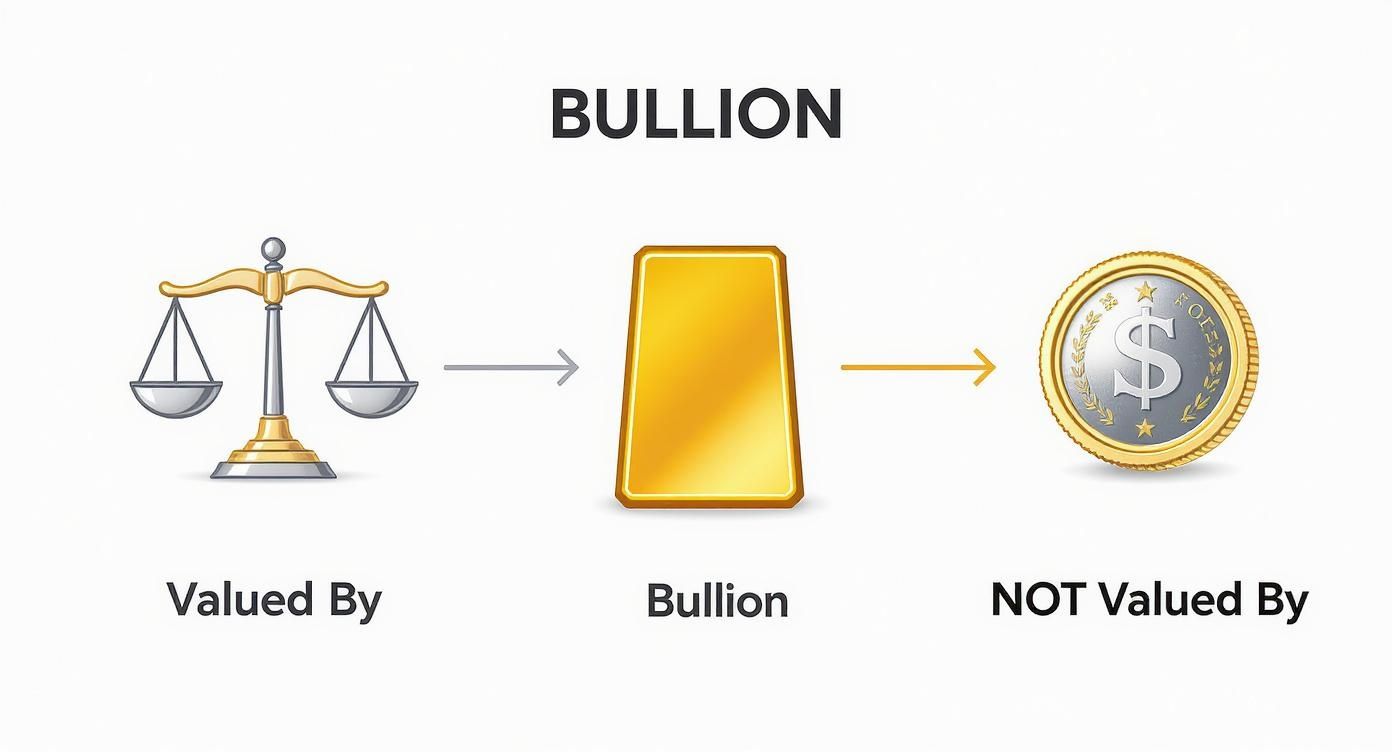
The crucial thing to remember here is that bullion’s identity is rooted in its substance—its weight and purity—not in any artistic flair or historical rarity.
Bullion's value is straightforward. Whether it's a sleek minted bar or a government-issued coin, its price is overwhelmingly dictated by the global market for the raw metal it contains.
Choosing between these forms really comes down to personal preference and your investment strategy. Bars are fantastic for efficient, low-cost bulk storage. Coins offer high liquidity and the assurance of a government backing their purity and weight. Rounds provide a flexible and often lower-premium alternative for stacking precious metals. At the end of the day, each serves the same fundamental purpose: to provide a tangible store of value.
Understanding Bullion Purity and Weight
So, now you can tell the difference between a chunk of investment bullion and a piece of jewellery from your grandmother's collection. The next step is to get under the bonnet and see what truly determines its value. Much like a master chef relies on exact measurements, the world of bullion is built on uncompromising standards of purity and weight. These details are precisely what make a gold bar in London worth the exact same as one in Tokyo.
The purity of any bullion product is described by its fineness. Think of it as a simple scale, measured in parts per thousand, that tells you exactly how much pure precious metal is in the item you're holding. For instance, a gold bar stamped with ‘999.9’ is 99.99% pure gold, a standard often referred to as ‘four nines fine’. This far more precise system has all but replaced the old karat scale for investment-grade metals.
A 24-karat gold ring might be considered 'pure' in the jewellery trade, but investment bullion plays by a much stricter set of rules. For serious investors, a fineness of 999 or higher is the real benchmark.
This obsession with precision guarantees that when you buy bullion, you're buying the metal itself, not some alloy of questionable worth. It’s a universal language of quality that everyone in the market understands.
The Troy Ounce and Hallmarks
When we talk about weight, the precious metals industry has its own special unit that you won't find on your kitchen scales. The unshakeable global standard is the troy ounce, which weighs in at approximately 31.1 grams. That’s a touch heavier than the standard ‘avoirdupois’ ounce (around 28.35 grams) we use for weighing everyday things like sugar or flour. It's a critical distinction; you should always assume bullion weights are given in troy ounces.
To guarantee both purity and weight, every reputable bullion product carries hallmarks or refiner marks. These are essentially stamps that identify the producer, the metal's exact weight, and its fineness. You can think of it as a certificate of authenticity that's stamped directly onto the metal itself.
Recognised marks from bodies like the London Bullion Market Association (LBMA) are a globally trusted seal of approval. London is a massive hub for this trade, and its vaults hold staggering quantities of gold. As of mid-2025, those vaults were home to around 8,776 tonnes of gold, with a value north of $927 billion. You can find more fascinating insights into UK gold demand and storage on goldbuyersafrica.com.
Getting to grips with these standards is what separates a casual buyer from an informed investor. They are the absolute bedrock of trust in the physical precious metals market, ensuring your investment can be easily valued and traded anywhere on the planet. This clarity is vital, especially when you start comparing investment-grade bullion against the very different world of collectable coins.
Bullion Coins vs Numismatic Coins
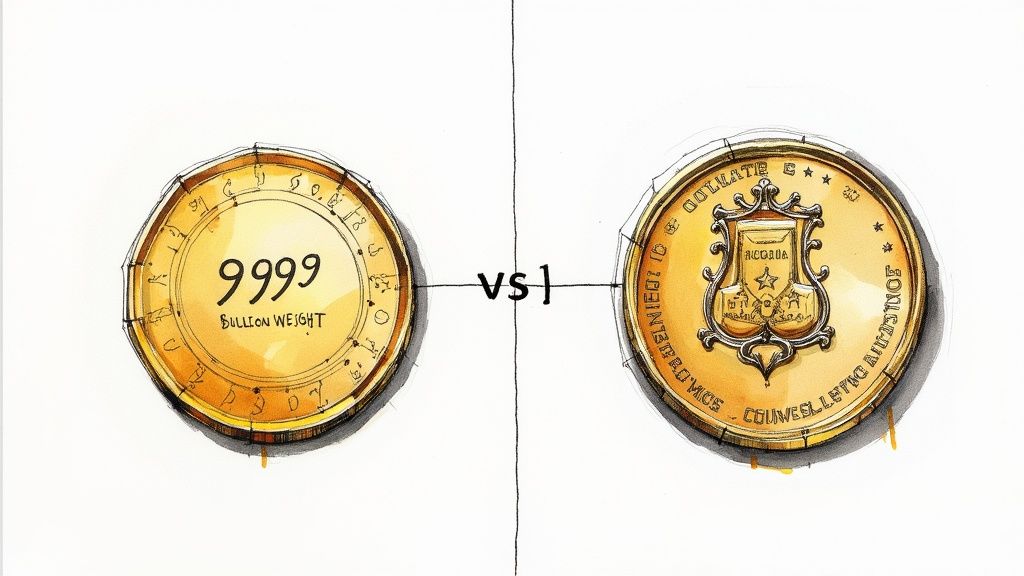
For anyone new to precious metals, learning to spot the difference between bullion and numismatic coins is probably the most important lesson. Getting this wrong can be a costly mistake. They might look similar at a glance, but where they get their value from is a world apart, and that defines two completely different approaches to investing.
Think of it this way: buying a bullion coin is like buying a physical share in the gold or silver market. Its value is almost entirely tied to the live, ever-changing spot price of the metal it contains. You’re investing in the raw commodity itself.
On the other hand, buying a numismatic coin is more like purchasing a rare piece of art or an antique. Its value comes from things that have nothing to do with its metal content. It’s an investment in history, scarcity, and beauty.
How Value Is Determined
With bullion coins, the maths is simple. Their price is just the current spot price of the metal, plus a small percentage on top called a 'premium'. This premium covers the costs of minting and distribution, along with the dealer’s margin.
Numismatic coins are a different beast entirely. Their value is driven by a unique set of factors:
- Rarity: How many were ever minted? More importantly, how many are thought to still be around today?
- Condition: Is the coin in pristine, uncirculated condition, or is it worn down from centuries of use? This is often professionally graded on a set scale.
- Historical Significance: Does the coin commemorate a major event? Was it found in a famous shipwreck or a hidden hoard?
- Collector Demand: Is there a strong, active community of people all trying to get their hands on this specific coin?
A worn Roman silver denarius, for instance, might only contain a few pounds' worth of actual silver. But because of its immense historical importance and rarity, it could sell for thousands. Its value is almost entirely numismatic.
In essence, a bullion coin’s worth is anchored to the global commodities market. A numismatic coin’s value is determined by the passion and budget of collectors.
Choosing Your Investment Path
Which one you choose really comes down to what you want to achieve. Bullion is a straightforward, liquid asset that’s great for preserving wealth and hedging against economic uncertainty. Its pricing is transparent, making it easy to buy and sell anywhere in the world. It's a pure investment in a tangible commodity.
Numismatics, however, is a specialised field that demands a lot of knowledge and expertise. It’s more of a hobby that can become a lucrative investment, but the risks are higher and the market is far less liquid. To do well, you need to understand grading, provenance, and market trends for specific coin series. You can learn more by researching Sovereign coin values to see just how much historical factors can influence price.
Ultimately, bullion fits a financial strategy, while numismatics aligns with a collector’s passion. Understanding this difference is key to choosing the path that fits your own goals, not someone else’s hobby.
How Bullion Pricing Actually Works
Ever looked at the price of a gold bar and wondered how dealers arrive at that specific number? It isn't just plucked out of thin air. The final price you pay for any piece of bullion is a simple, yet crucial, combination of two key ingredients: the spot price and the premium.
Getting your head around how these two parts work together is the key to knowing exactly what you're paying for and spotting a fair deal when you see one.
The Spot Price: The Raw Ingredient Cost
Think of the spot price as the live, raw material cost. It's the current market price for one troy ounce of a precious metal, like gold or silver, as it's being traded on global commodity exchanges.
This price is in constant flux, moving up and down throughout the day based on supply, demand, economic news, and global events. It’s the baseline value of the metal itself, before it’s been beautifully transformed into a bar or a coin.
The Premium: From Raw Metal to Finished Product
The second part of the equation is the premium. This is simply the amount added on top of the spot price to cover all the costs involved in turning that raw metal into a finished product and getting it safely into your hands.
Decoding the Premium
The premium isn't just pure dealer profit; it's a necessary charge that covers a number of real-world costs. This typically includes:
- Manufacturing and Minting: The cost to refine the metal to a high purity, melt it down, and strike it into a specific shape with a beautiful design.
- Assaying and Certification: The process of verifying the weight and purity of the product to make sure it meets strict international standards.
- Dealer Overhead: This covers everything from secure vault storage and insurance to shipping, staffing, and customer service.
The premium is essentially the cost of doing business. It’s why you can’t just buy a one-ounce gold coin for the exact one-ounce spot price of gold.
The size of the premium often depends on the product itself. A small one-gram gold bar, for instance, will have a much higher premium as a percentage of its value than a hefty one-kilogram bar. This makes sense when you think about it—the manufacturing costs are quite similar for both, but they make up a much larger slice of the smaller item's total price.
To see how this works in practice, let's break down the price of a typical one-ounce gold coin.
Example Bullion Price Calculation
| Price Component | Description | Example Value |
|---|---|---|
| Gold Spot Price | The live market price for 1 troy ounce of gold at the time of purchase. | £1,850.00 |
| Premium | Covers minting, shipping, insurance, and dealer costs (e.g., 5% of spot). | £92.50 |
| Final Retail Price | The total price the customer pays (Spot Price + Premium). | £1,942.50 |
As you can see, the final price is a straightforward sum of the metal's value and the costs to produce and sell it.
This pricing structure is the engine of the entire market. In the UK, the precious metals sector is a huge part of the economy, set to generate revenues of around USD 10.62 billion in 2024, with gold bullion accounting for over 61% of that figure. You can dig deeper into these numbers in the latest LBMA precious metals market report. It really highlights just how important it is for any investor or collector to understand these fundamental price mechanics.
Buying and Storing Bullion in the UK
Now that you have a grasp of how bullion is priced, let's get into the practical side of things: how to actually buy it and keep it safe. For anyone investing in the UK, this means finding reputable dealers, picking the right storage, and taking advantage of some brilliant tax rules that can make a real difference to your returns.
When you’re ready to buy, the first thing to sort out is your source. Always, always stick to established, reputable dealers with a long track record and clear, upfront pricing. The Royal Mint is the official home of UK coins and a great place to start. Beyond them, there are plenty of well-respected bullion dealers who are members of trade associations, which gives you an extra layer of confidence. As you get started, it's also helpful to see how buying physical metal fits into the wider investment world, like understanding the differences between advisory vs. brokerage accounts and where a direct bullion purchase fits in.
Be on the lookout for red flags. Prices that look too good to be true usually are. High-pressure sales tactics, no physical address, or a murky company history are all signs to walk away. A good dealer will be completely transparent about their premiums and how they operate.
Safe Storage for Your Physical Assets
Once that bullion is in your hands, you’ve got a big decision to make: where to keep it. Each option has its own mix of security, convenience, and cost.
- Home Storage: Keeping your bullion at home in a high-quality, professionally fitted safe gives you total control and immediate access. Just remember that this setup demands solid home security and a specialised insurance policy. Your standard home insurance often won't cover precious metals properly.
- Bank Safe Deposit Box: This is a classic choice, offering the high security of a bank vault. The main drawback is that you can only get to your holdings during banking hours. Crucially, the bank doesn't insure the contents – you'll still need to arrange your own separate cover.
- Third-Party Vaulting: Often called allocated storage, this is where you pay a specialist company to store your specific bars and coins for you. Your holdings are kept separate from everyone else's, are fully insured, and are regularly audited. It offers the highest level of security and complete peace of mind.
The UK Capital Gains Tax Advantage
This is where UK investors get a serious leg up. Certain legal tender coins struck by The Royal Mint are completely exempt from Capital Gains Tax (CGT). For your investment returns, this is an absolute game-changer.
Any profit you make from selling these specific coins is 100% tax-free. This special status applies to all British legal tender coins, but the most popular ones are:
- The Gold Britannia and Silver Britannia
- The Gold Sovereign and Half Sovereign
This CGT exemption doesn't apply to gold bars or any coins from other countries. By strategically focusing on UK legal tender coins, you can legally avoid a tax that could otherwise take a significant chunk out of your profits. To build a smart portfolio, it pays to explore the full range of gold coins in the UK to find the ones that best match your financial goals. It's this kind of insider knowledge that really helps you get the most from your assets.
Common Questions About Bullion Investing
To wrap things up, let's look at some of the most common questions that crop up when people first start thinking about what bullion could mean for their portfolio. Getting these queries answered should help clear up any lingering confusion and leave you feeling ready for the next step.
Is Bullion a Good Investment for Beginners?
Absolutely. Bullion is one of the most transparent and straightforward tangible assets you can own, making it a great place to start. Its value is tied directly to the price of the precious metal itself, so you don’t need any specialised knowledge of historical markets or art to get involved.
Unlike stocks or shares, it's an investment you can physically hold in your hand, which gives many people a real sense of security. It’s a brilliant entry point for anyone looking to add physical assets to their portfolio.
How Do I Know My Bullion Is Real?
This is a vital question, and one you're right to ask. The single best way to guarantee you’re buying the real deal is to purchase exclusively from reputable, well-established dealers. Think of places like The Royal Mint or members of recognised trade bodies.
Genuine bullion products always have official markings stamped on them, known as hallmarks. These clearly state the refiner, the weight, and the purity (or fineness) of the metal. Think of these stamps as a built-in certificate of authenticity. If you see a deal that seems too good to be true, it almost certainly is.
When you buy from a trusted source, you are buying peace of mind. Their reputation is built on the authenticity of the products they sell.
What Is the Easiest Way to Sell Bullion?
Selling is just as straightforward as buying. Most reputable dealers will almost always buy back the products they sell, typically offering you a price based on the live spot price at that moment.
Because bullion is standardised, it's what we call a highly liquid asset. This simply means you can sell it quickly and easily to dealers all over the world, not just the one you bought it from. Coins from well-known government mints, like the British Britannia, are particularly easy to move on because they are recognised and trusted everywhere.
At Cavalier Coins Ltd, we provide a wide range of authentic, high-quality coins for both new and experienced collectors. Explore our collection to find the perfect addition to your portfolio at https://www.cavaliercoins.com.