

You've probably heard the term "legal tender" thrown around, but what does it actually mean? It’s one of the most misunderstood concepts in the world of money.
The simple truth is this: legal tender is a very specific form of money that the government legally requires a creditor to accept when you're settling a debt. The key word there is debt. In the UK, this distinction is everything. It's not about what a shop has to take for a sandwich, but about officially wiping a formal debt clean.
So, What Is Legal Tender in Everyday Life?

Most people assume a shop is breaking the law if they refuse to take your cash. That's a myth. The real meaning of legal tender comes down to the difference between buying something on the spot and paying off money you already owe.
Think about buying a coffee or a newspaper. When you do that, you and the shop owner are basically entering into a new contract. The shop is completely free to set its own terms for that contract, and that includes which payment methods they're willing to accept. They can absolutely refuse your £50 note for a pack of gum or decide to be a "card-only" establishment. It's their call.
The Debt-Settling Superpower
The real power of legal tender only kicks in when a formal debt is already on the books.
Let’s say you owe a friend £20. If you hand them a crisp £20 Bank of England banknote to settle up, they can't then turn around and sue you for not paying. Why? Because you've offered to clear the debt using official legal tender. Their refusal doesn't make the debt vanish, but it does protect you from further legal action or any claims for interest.
The crucial takeaway is this: Legal tender provides a legally recognised way to extinguish a debt. A creditor’s refusal of a valid offer of legal tender can prevent them from later claiming interest on that debt.
This is what makes it fundamentally different from other ways we pay for things:
- Debit and Credit Cards: These are convenient, but they aren't legal tender. They're just tools for transferring money, all based on prior agreements between you, your bank, and the merchant.
- Cheques and Digital Transfers: Just like cards, these are payment methods accepted by agreement, not because of a legal mandate under the definition of legal tender.
At its heart, you can think of legal tender as the final, undeniable way to settle a financial obligation once it's been created. It’s the official last word in paying what you owe.
Navigating Legal Tender Rules Across the UK
You’d think that with a single currency like the pound sterling, the rules about what counts as legal tender would be the same everywhere in the United Kingdom. But it’s not that simple. The reality is surprisingly complicated and leads to a lot of confusion, especially when you try to spend a Scottish banknote in England.
Where you are in the UK completely changes the rules.
Different Rules for Different Nations
In England and Wales, things are pretty much as you'd expect. Both Royal Mint coins and Bank of England banknotes are recognised as legal tender for paying off debts. This is the classic definition most of us have in our heads.
But step over the border into Scotland or Northern Ireland, and the rulebook changes dramatically.
Here, only Royal Mint coins are officially legal tender. It’s a real head-scratcher for many, but the banknotes issued by their own national banks—like the Bank of Scotland or the Bank of Ireland—don't actually have legal tender status. Not even in their home countries.
This creates an interesting quirk: Scottish and Northern Irish banknotes are perfectly valid legal currency, but they are not legal tender. In simple terms, while they are accepted in almost every shop, a business can legally refuse to take them to settle a debt. You can read the official line on this at the Bank of England's explainer on legal tender.
This is exactly why a shopkeeper in London is well within their rights to politely decline a Scottish or Northern Irish banknote. They aren’t legally obliged to accept it. When they do, it’s purely out of convention, not a legal requirement.
To make this clearer, let's break down exactly what has legal tender status in each part of the United Kingdom.
Legal Tender Status Across the United Kingdom
The table below shows which types of currency a debtor must offer—and a creditor must accept—to settle a debt in each country.
| Currency Type | England & Wales | Scotland | Northern Ireland |
|---|---|---|---|
| Royal Mint Coins | Yes | Yes | Yes |
| Bank of England Notes | Yes | No | No |
| Scottish Banknotes | No | No | No |
| N. Ireland Banknotes | No | No | No |
As you can see, Royal Mint coins are the only currency that holds legal tender status across all four nations. Bank of England notes are only legal tender in England and Wales, while the notes printed in Scotland and Northern Ireland aren't legal tender anywhere.
Are There Limits on Using Coins?
Yes, absolutely. Even when coins are legal tender, you can’t just show up with a wheelbarrow full of pennies to pay off a big bill. The rules are there to keep things practical.
- 1p and 2p coins: Legal tender for any amount up to 20p.
- 5p and 10p coins: Legal tender for any amount up to £5.
- 20p and 50p coins: Legal tender for any amount up to £10.
- £1, £2, and £5 coins: Legal tender for any amount.
These limits make sure that settling a debt doesn't become a logistical nightmare. They uphold the spirit of the law while keeping payments sensible.
When Legal Tender Actually Matters
So, if the rules of legal tender don't really apply to your daily coffee run or weekly shop, when on earth do they matter? The concept's true power comes into play in one very specific situation: the formal settlement of a debt. It becomes absolutely vital in legal disputes, acting as the final, undeniable way to pay what you owe.
Imagine you owe a local business £100 for a service they provided. If you turn up and offer to pay them with £100 in Bank of England banknotes, you have officially made a valid offer of legal tender. This simple act gives you a surprisingly strong legal defence.
Settling Debts The Official Way
What happens if the business refuses your cash and then tries to sue you for non-payment? Well, their case just got a lot weaker. By offering the exact amount owed in the correct legal tender, you've fulfilled your end of the bargain.
The debt itself doesn't just vanish into thin air, but the person you owe money to (the creditor) loses the right to sue you for any further interest or claim you failed to pay. It’s a clean break.
This is a world away from tapping your debit card or sending a bank transfer. Those are just convenient payment methods agreed upon by both parties; they don't carry the same legal weight as a formal tender.
Legal tender is the government-backed method for definitively putting a debt to bed. Offering it correctly protects the debtor from further legal action for non-payment, effectively shifting the responsibility back to the creditor to accept it.
This infographic neatly breaks down the hierarchy of what counts as legal tender across the different parts of the UK.
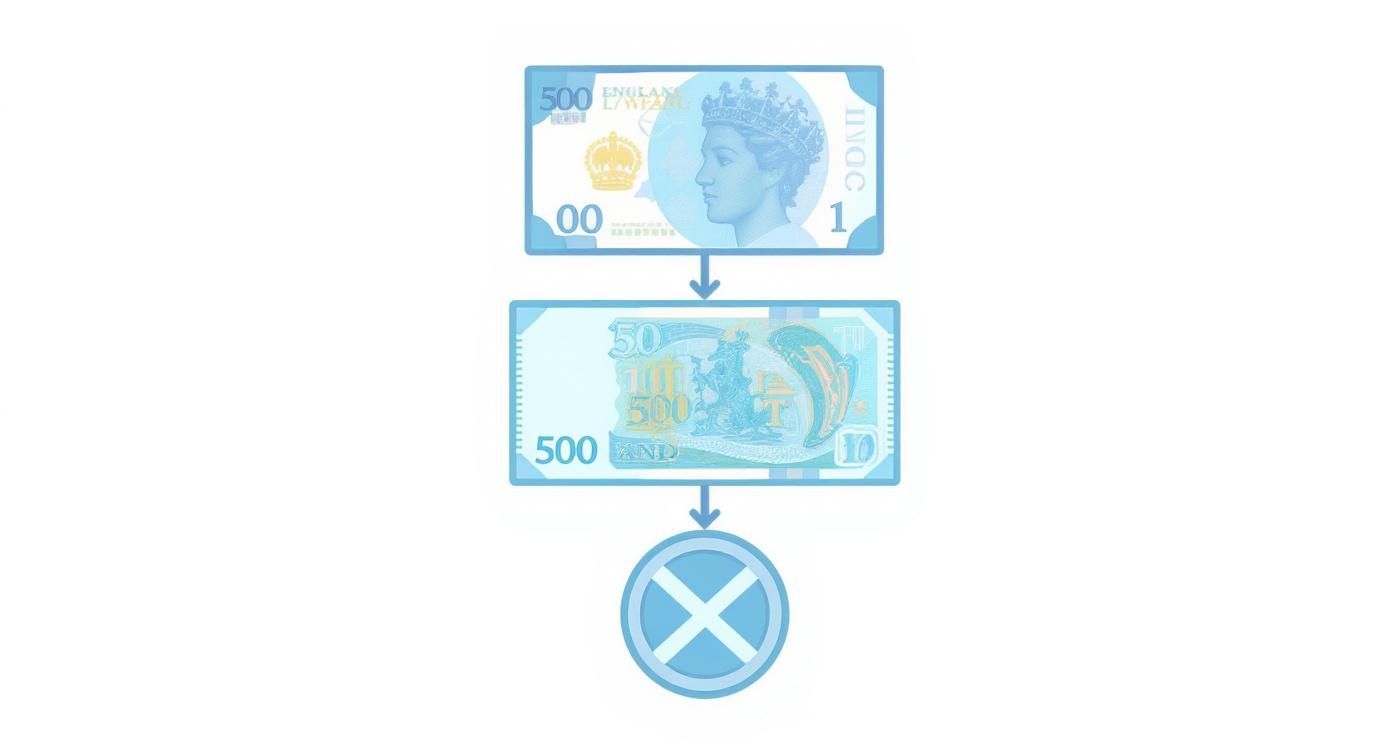
As you can see, while Royal Mint coins are considered legal tender everywhere, the status of banknotes is more geographically restricted. This really highlights just how specific the legal application of the term is.
The Story Behind British Legal Tender
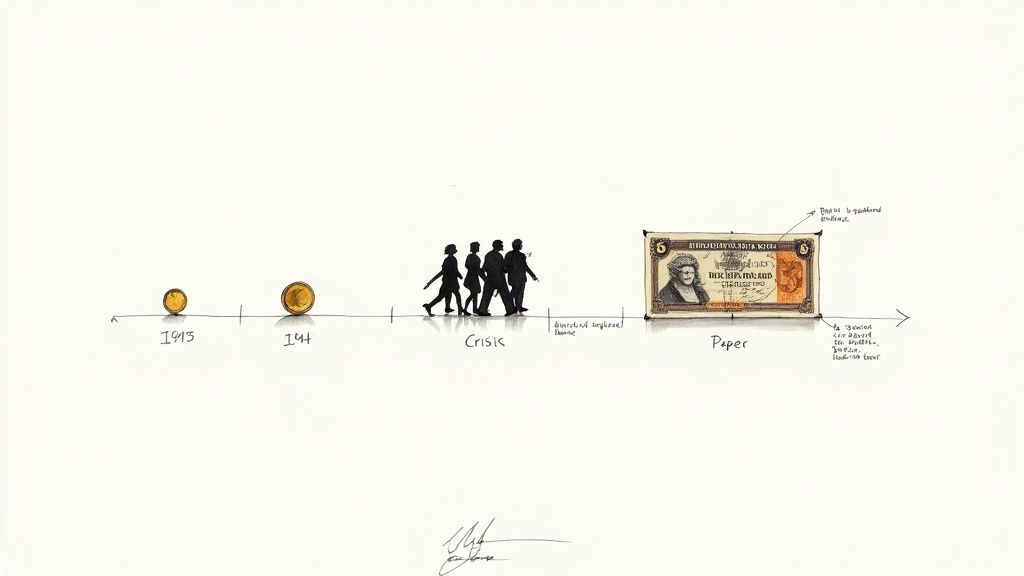
The concept of legal tender wasn’t dreamed up in some quiet boardroom meeting. It was forged in the heat of national crises. Its history here in Britain is a fascinating tale, tracking the move from trusted gold coins to the government-backed paper notes we carry today. It’s a story that shows just how powerful a tool legal tender can be for stabilising an economy.
This becomes crystal clear when you look back to the outbreak of the First World War in 1914. For centuries, gold sovereigns had been the very backbone of British money. You can find out more about the evolution of UK currency in our brief history of British coins. But as war clouds gathered, a wave of panic washed over the nation.
People started rushing to the banks, all trying to exchange their paper banknotes for the solid, tangible safety of gold.
A Crisis Forged in Gold
This public scramble triggered a classic bank run. The situation was getting desperate; between late July and early August 1914, the Bank of England paid out an incredible £12.3 million from its £26.5 million gold reserves in just six days as people clamoured for their money. The entire financial system was teetering on the brink of collapse, and the government had to act, and act fast.
This panic also shone a light on a strange quirk in the UK’s monetary system, especially when it came to Scottish banknotes. For over 200 years, Scottish banks had issued their own notes. While they were widely accepted as legal currency, they weren't actually legal tender. When the wartime panic hit, some merchants in England started refusing them.
To stop commerce from grinding to a halt, the British government took an extraordinary step. It temporarily granted legal tender status to Scottish banknotes, making sure they had to be accepted everywhere. This immediately helped to restore public confidence.
This little piece of history perfectly illustrates what legal tender means in practice. It’s not just some dusty old rule. It's a vital mechanism for keeping the economy stable and ensuring the public continues to trust its money, particularly when times get tough.
Modern Currency and the Bank of England
In a world filled with tapping cards and digital payments, it's easy to forget about the sheer amount of physical cash still floating around. The Bank of England is the institution at the very heart of this system, making sure the notes in our wallets are more than just pieces of polymer—they're a trusted form of legal tender.
The scale of it all is pretty staggering. As of 2024, there were over 4.7 billion Bank of England banknotes in circulation, adding up to a total value of about £86 billion. This huge circulation of £5, £10, £20, and £50 notes, all legal tender in England and Wales, shows just how fundamental physical cash still is. You can dig into the numbers yourself on the Bank of England's official statistics page.
Protecting Our Currency
To keep our trust in the currency rock-solid, every single banknote is a masterpiece of security design. The Bank of England is always updating its security features to stay one step ahead of counterfeiters, which is why fake notes are incredibly rare.
These security measures are what make legal tender work in practice. They include:
- Polymer Substrate: Modern notes are printed on a tough polymer material, which is far more difficult to fake than old paper notes.
- Holograms: These clever features change their image when you tilt the note, a trick that's very hard for forgers to copy accurately.
- See-Through Windows: You'll find large, clear windows built right into the note, often with intricate foil designs.
Because of these high-tech protections, the rate of counterfeit notes found in 2024 was less than 0.0019%. It’s a remarkable success that reinforces the integrity of our physical money. To get a better sense of currency production, you can explore our guide on how coins are made.
Even when a banknote design is withdrawn from circulation, the Bank of England guarantees its value forever. Old notes can always be exchanged for their face value, ensuring that legal tender never truly expires.
Why Legal Tender Status Is Key for Coin Collectors
For anyone serious about collecting coins, the term ‘legal tender’ is far more than a dry legal definition. It’s a critical piece of a coin's identity, one that helps shape its story, its appeal, and ultimately, its value. This official status is what separates a genuine piece of national currency from a privately minted medal or token.
Think about the special commemorative 50p or £2 coins that The Royal Mint releases. These aren't just novelties; they are genuine legal tender. While you could, in theory, pop down to the shops and spend a rare Kew Gardens 50p on a pint of milk, you'd be making a terrible mistake. Its value to a collector soars far beyond its 50p face value. That official government backing provides a layer of authenticity and pedigree that collectors absolutely cherish.
Bullion vs Circulating Coins
Now, let's look at bullion coins. Pieces like the iconic Sovereign or the stunning Britannia also have a nominal face value and are classed as legal tender, but they were never intended to jingle around in your pocket. Their true worth is directly tied to the day-to-day market price of the precious metal they're made from, whether that’s gold or silver.
This is a crucial distinction to grasp.
- Commemorative Coins: Their value is built on rarity, design quality, and condition. Legal tender status bolsters this, confirming their official origin.
- Bullion Coins: Their value comes almost entirely from their intrinsic metal content. The legal tender status is more of a secondary feature, a seal of quality.
A coin's legal tender status is the ultimate guarantee. It confirms it was issued under the authority of a government, providing an iron-clad assurance of its origin and specifications. For many collectors, this official stamp of approval is non-negotiable.
Of course, the story doesn't end there. Collectors also hunt for demonetised currency—coins that were once legal tender but have since been withdrawn from circulation. At that point, their value completely transforms. They cease to be money and instead become fascinating historical artefacts, their worth now defined purely by their significance and rarity.
For a closer look at some of the most sought-after coins, have a read of our collector's guide to the UK's finest proof coins.
Common Questions About Legal Tender
The idea of 'legal tender' can feel a bit abstract, so let's break it down with a few real-world examples that often trip people up.
Can a Shop in England Refuse a Scottish £20 Note?
Yes, they absolutely can. This is a classic real-world test of the difference between accepted payment and legal tender.
When you're buying something in a shop, you're starting a new transaction, not paying off a debt you already owe. Because of this, the shop owner can set their own rules. Since Scottish banknotes are not technically legal tender in England, a retailer is well within their rights to refuse one.
Are Commemorative 50p Coins Real Money?
They certainly are. Any commemorative coin struck by The Royal Mint, whether it's a colourful 50p or a special edition £2, is genuine UK currency and legal tender.
You could, in theory, pop down to the shops and use one to buy something. You're just limited by the usual rules – for 50p coins, you can only use them for payments up to £10. But let's be honest, the value to a collector is almost always far higher than its face value, so spending it would be a real shame.
The core difference is this: Legal currency is all the official money a country issues. Legal tender is a specific part of that currency with a legal status for settling a debt, and the rules about what counts can vary.
This is a really important distinction to grasp. It's why all UK banknotes are legal currency, but only Bank of England notes are legal tender in England. Understanding this simple difference clears up why a shopkeeper in London can refuse a Scottish note, while that special commemorative 50p in your pocket is still perfectly valid money.