
So, you're ready to sell your antique coins, but where's the best place to go? The right choice really comes down to what you've got and how quickly you need the cash.
For your truly high-value, rare coins, a top-tier auction house is often the best bet to reach a global audience of serious collectors. But if you have less rare but still valuable pieces, a local dealer can offer a much faster and more straightforward sale.
Navigating Your Antique Coin Selling Options
Deciding where to offload your collection can feel a bit daunting at first. It’s a classic balancing act between getting the best price, how quickly you want to sell, and how much effort you're willing to put in.
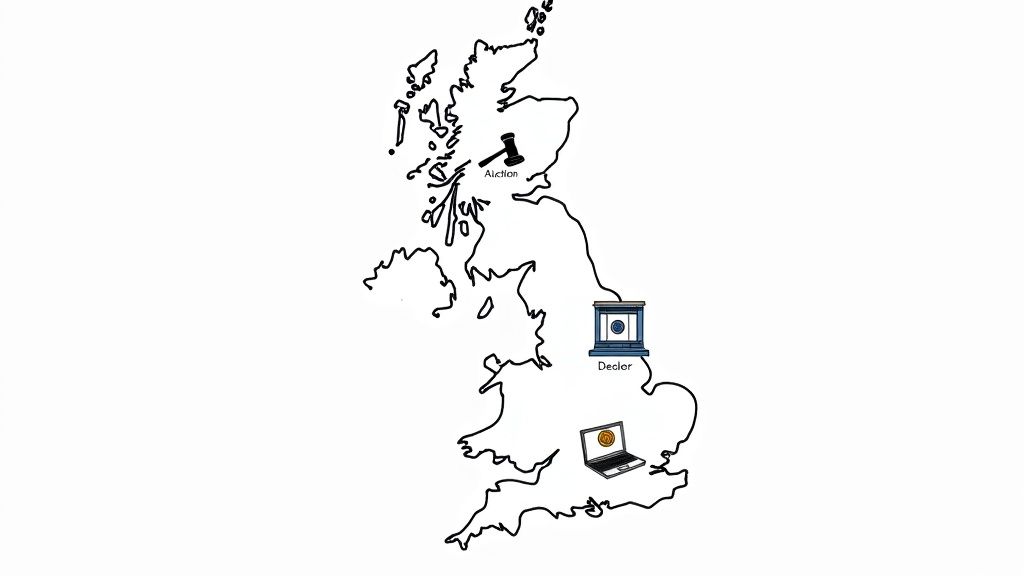
Essentially, you have three main routes to consider: specialist dealers, auction houses, and online marketplaces. Each one serves a very different purpose.
Getting your head around these differences right from the start can save you from common mistakes. You don’t want to undervalue a rare gem by selling it too hastily, nor do you want to pay hefty auction fees for a bag of common Victorian pennies. It's just about picking the right tool for the job.
The Main Sales Channels at a Glance
To make things simpler, let's take a quick look at the main options. This should help you figure out which path aligns best with your collection and your goals.
- Local Coin Dealers: This is your go-to for a quick, direct sale. It’s perfect for common to mid-range coins where you’d rather have immediate payment and a simple handshake deal over squeezing out every last penny.
- Auction Houses: They really come into their own when you're selling exceptionally rare or high-demand coins. The thrill of competitive bidding can push prices way beyond what you expected, but be prepared for a slower process and higher commission fees.
- Online Marketplaces: Platforms like eBay and specialist forums put you in direct contact with a massive pool of collectors. You get full control over the price, but you're also the one handling everything from photography and listings to shipping and dealing with queries.
To give you an even clearer picture, here’s a table breaking down the pros and cons.
Comparing Your Antique Coin Selling Options
| Selling Venue | Best For | Sale Speed | Potential Price | Fees |
|---|---|---|---|---|
| Local Coin Dealer | Common to mid-value coins, quick sales | Very fast (often same-day) | Moderate | None (price is net) |
| Auction House | High-value, rare, or certified coins | Slow (months) | Potentially very high | High (15-25%+) |
| Online Marketplace | All types, if you have the time & expertise | Varies (days to weeks) | Varies (up to you) | Moderate (10-15%) |
This table should help you quickly weigh up which avenue feels right. A dealer offers speed, an auction house offers top-tier prices for top-tier coins, and online gives you control.
The single most important decision you'll make is choosing the right venue. A reputable dealer offers certainty, an auction offers potential, and an online sale offers control. Your coin's rarity and your personal goals will dictate the best fit.
The whole game is about matching your coins to the right audience. A dealer specialising in Roman coins will likely pay a premium for a denarius but might not be as interested in a George V sovereign. Likewise, an auction catalogue focused on British milled coins will naturally attract the very people willing to pay top prices for that specific category. This guide is all about helping you make that choice wisely, so you don't just find a place to sell, but the best place for your specific coins.
Getting Your Coins Ready for a Successful Sale
Before you even start thinking about where you’ll sell your antique coins, a bit of careful preparation can make a massive difference to the final price you get. It’s all about setting the stage for a smooth, profitable sale and showing potential buyers you know what you’re doing.
The single most important rule is actually about what not to do: do not clean your coins. I can't stress this enough. It’s a classic mistake that can be incredibly costly.
Collectors and dealers genuinely prize the natural toning, or patina, that develops on a coin's surface over decades or even centuries. Getting rid of it, even with what seems like a gentle solution, can leave behind microscopic scratches and strip away its historical character. This can literally halve its value in an instant. For a deeper dive on this crucial point, our guide on the best way to clean old coins explains exactly why leaving them as they are is always the best move.
Instead of cleaning, just focus on safe handling. Always pick up coins by their edges to avoid getting oils from your fingers on their surfaces, which can cause corrosion over time.
Organise and Get to Know Your Collection
Once you're comfortable with handling them correctly, the next job is organisation. Start by grouping similar coins together—perhaps by country, monarch, or denomination. This simple step makes your collection much easier for a potential buyer to look through and assess.
While you're sorting, it's the perfect time to do a little research:
- Identify Key Features: Take note of the year, the monarch, and any mint marks you can see.
- Check a Catalogue: Use online resources or get your hands on a printed "Spink" catalogue (it's the standard reference for British coins) to get a rough idea of rarity and value.
- Document Their Story: If you know anything about a coin's history—who owned it before you, where it was found—write it all down. This history, known as provenance, can seriously boost a coin's appeal and its final price.
This initial research isn't about becoming an expert overnight. It's about getting a feel for what you've got. Knowing you have a low-mintage date or a sought-after variety means you can go into a negotiation with confidence.
A well-organised collection with a bit of documented history speaks volumes to a buyer. It signals that the items have been looked after and builds a level of trust that often leads to a better offer.
Should You Get Your Coins Graded?
Finally, it’s worth thinking about whether professional grading is a smart investment for your coins. For most common pieces, the cost of grading probably won’t be recovered in the sale.
However, if you have a coin that you suspect is rare or in exceptionally good condition, getting it authenticated and graded by a reputable third-party service like the Numismatic Guaranty Company (NGC) or Professional Coin Grading Service (PCGS) is a game-changer.
These services will encapsulate your coin in a protective, sealed holder (often called a "slab") with an official grade printed on the label. This removes any doubt about the coin's authenticity and condition, making it far easier to sell for its true market value, especially if you're aiming for an auction or a serious collector. Think of it as a strategic investment for your most valuable pieces.
Choosing Between Coin Dealers and Auction Houses
Once you’ve got your coins sorted, you're faced with a big question: where should you actually sell them? For most people, it boils down to two main avenues: a specialist coin dealer or an established auction house.
Both are solid choices, but they serve very different purposes. The best path for you really depends on what you're selling, its value, and how quickly you need the funds.
Selling directly to a dealer is, without a doubt, the fastest way to turn your coins into cash. A reputable dealer will look over your collection and give you an offer right there on the spot. It’s a route that offers certainty and speed, which is perfect for collections that are valuable but not necessarily packed with ultra-rare items. Think of a small batch of common date sovereigns or a binder full of Victorian pennies – a dealer offers a clean, straightforward transaction for these.
Auctions, however, are a completely different ball game. They bring in the element of competitive bidding, which can sometimes push prices well beyond what you might expect, especially for the right coins. If you suspect you're sitting on a real treasure, like a 1937 Edward VIII sovereign or a key-date coin in stunning condition, an auction house is almost certainly your best bet.
When to Choose a Coin Dealer
A coin dealer is the way to go when speed and convenience are what you value most. You skip the long consignment process you'd find at an auction and get paid immediately.
A dealer is probably the right call if:
- You need a quick sale: The whole process can often be wrapped up in a single visit.
- Your collection is quite broad: Dealers are often happy to buy entire collections, saving you the headache of selling off coins one by one.
- Your coins are in the mid-range: For items worth hundreds rather than tens of thousands, a dealer's direct offer is just more efficient.
This simple chart can help you visualise the first crucial decisions you'll need to make.
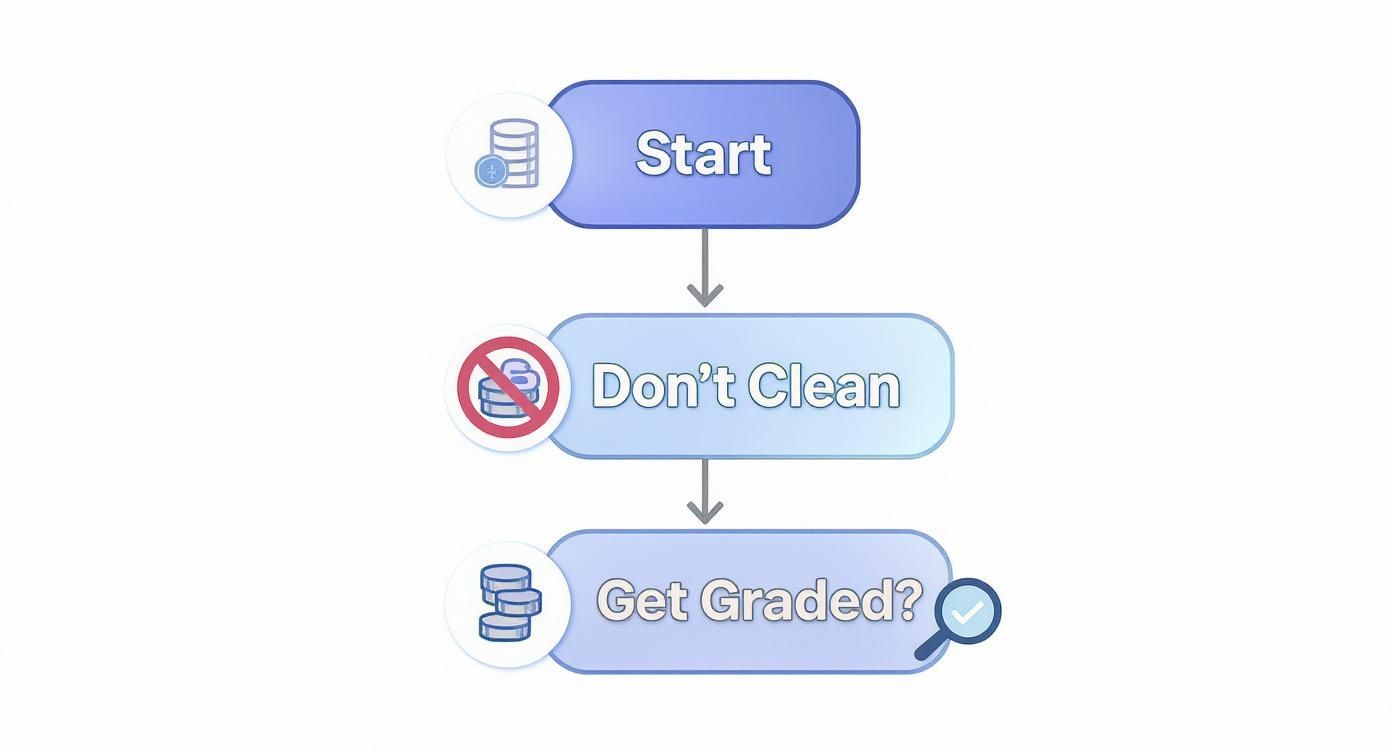
As you can see, a successful sale really starts with proper preservation – first, by not cleaning your coins, and then by deciding whether professional grading could add real value.
When an Auction House Makes Sense
An auction house is the ultimate stage for truly exceptional coins. The global reach and marketing muscle of the major auctioneers pull in serious collectors from all over the world, people who are prepared to pay top-tier prices for rarity and quality.
Be prepared, though – the process is much slower. It can often take several months from the time you consign your coin to when you actually receive payment. You'll also face significant fees, which are typically 15-25% of the final hammer price.
An auction is a strategic move, designed to squeeze every last drop of value out of a standout piece. The competitive atmosphere is engineered to find that one collector in the world who is willing to pay more than anyone else for your coin.
Both dealers and auction houses are vital parts of the UK's thriving numismatic trade. It's a significant market and a key player in the global coin collection industry, which was valued at around USD 4.71 billion and is forecast for steady growth.
Ultimately, the best choice really comes down to your unique situation. If you're leaning towards a sale by competitive bidding, have a look at our detailed guide on the best coin auction sites. It offers a much deeper dive into how these platforms operate and what you can expect.
Navigating Online Marketplaces and Coin Fairs
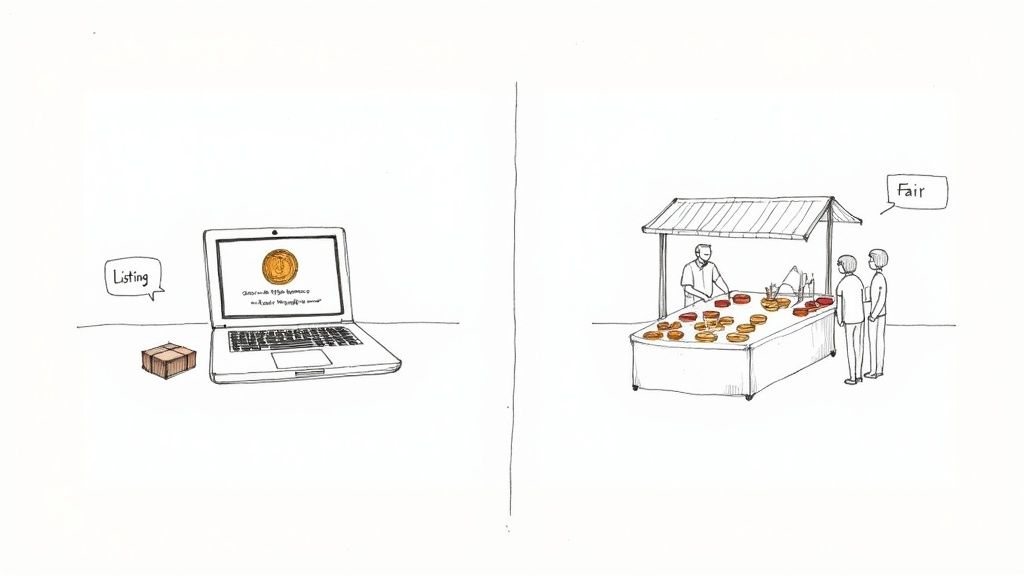
Beyond the traditional dealer and auction routes, you have the option of selling directly to other collectors. This is where online marketplaces and coin fairs really shine, putting you firmly in control. But be warned, this path requires a different set of skills to get the best price for your antique coins.
Places like eBay can get your coins in front of a huge global audience. Success here, though, really boils down to creating a listing that screams trustworthiness and grabs attention. High-quality, crystal-clear photographs are absolutely non-negotiable. You’ll need shots of the front (obverse), back (reverse), and the edge, all taken in good, natural light.
Then there's the description. It has to be detailed and, most importantly, completely honest. If there's a scratch or a knock on the edge, mention it. That kind of transparency is what builds buyer confidence and stops any disputes in their tracks later on.
Perfecting Your Online Listing
To really make your listing pop, you need to think like a seasoned collector. What information would they be looking for?
- Detailed Descriptions: Don't just say "old coin." Include its denomination, the monarch, the year, and any specific variety or mint mark you can identify. If you know the proper numismatic terms, use them.
- Quality Photography: A macro lens is your best friend here. Get sharp, close-up shots against a plain, neutral background. Absolutely no filters or edits that could misrepresent the coin's true colour or condition.
- Fair Pricing: This is where a bit of homework pays off. Hop onto the platform and search for what similar coins have actually sold for recently. This gives you a realistic benchmark. It's also a good idea to add a 'Best Offer' option to get more people interested and start a conversation.
And don't forget the hidden costs. Platform fees, insured postage, and proper packaging materials all nibble away at your profit. Factor these into your asking price from the start.
When you sell online, you're not just a seller; you're the photographer, the marketer, and the logistics manager all in one. A well-crafted, honest listing is your single most powerful tool for attracting serious collectors and securing a fair price.
The Buzz of a UK Coin Fair
If you prefer a more hands-on approach, nothing quite compares to the atmosphere of a UK coin fair. These events are fantastic, bustling hubs where hundreds of keen collectors and dealers gather, all actively looking to buy. It’s the perfect place for a quick sale and to get some invaluable feedback from people who live and breathe coins.
Before you pack your bags, do a little digging. Look for a reputable fair—organisations like the British Numismatic Trade Association (BNTA) are a good place to check for accredited events. Once you're there, be ready to negotiate. But remember, dealers need to make their own profit, so be realistic with your expectations. It’s an unbeatable way to shift multiple coins in one go.
Market analysis in the UK consistently shows a stable, year-round interest from a core group of dedicated collectors, even if demand for certain British coins can have its ups and downs. This steady enthusiasm is precisely why coin fairs and specialist shows are so crucial. They bring motivated buyers right to you, people who are often willing to pay a premium for quality pieces. If you want to get a better feel for the market, you can read more about these British coin market trends and see what's currently in demand.
Understanding What Makes Antique Coins Valuable
Ever wondered why one old coin might fetch millions at auction, while another, looking almost identical, is barely worth more than the metal it’s made from? The answer to that question is your first, and most important, step towards getting a fair price for your collection.
It’s not just about how old a coin is. True numismatic worth is a delicate balance of its rarity, its condition, and the story it carries.
Getting your head around these factors is your best tool. It gives you the confidence to talk to dealers on a level playing field, to make sense of an auctioneer’s valuation, and most importantly, to spot when you've got something genuinely special on your hands.
Rarity Is More Than Just Old
The most common mistake people make is thinking that an old coin must be a valuable coin. That’s rarely the case. In the world of coins, rarity is the real kingmaker. It's not just about the date stamped on the metal; it’s about how many were made in the first place and, crucially, how many are still around today in decent shape.
A coin's rarity really boils down to two things:
- Mintage: This is simply the number of coins of a certain type and date that the mint originally produced. A low mintage is always a good start.
- Survival Rate: This is the big one. How many of those original coins still exist? Over the centuries, countless coins were melted down, lost to the earth, or damaged beyond repair. A well-preserved survivor from a low-mintage batch can be incredibly scarce.
Think about it this way: a Roman coin might be nearly 2,000 years old, but if millions were struck and detectorists are digging them up every other day, it might not be worth a huge amount. On the other hand, a much more recent coin, perhaps with a famous minting error or from a tiny production run, could be worth a small fortune.
Condition and Grade Are Everything
Right after rarity, the condition of a coin is the next make-or-break factor. In the numismatic community, we formalise this through grading – a careful process of assessing a coin's state of preservation on a scale from "Poor" all the way up to a flawless "Mint State."
Even the tiniest bit of wear can knock thousands off a coin’s value. It's common to see two coins from the same year, with the same mint mark, have wildly different price tags simply because one is in slightly better condition. A coin that still has its original mint lustre, sharp, clear details, and no noticeable scratches or dinks will always be in a different league.
This is exactly why professional grading is so vital for high-value pieces; it gives you a standardised, expert judgement on the coin’s physical state. You can dive deeper into this fascinating process in our complete guide to UK coin grading and its impact on value.
Provenance and Historical Significance
Finally, a coin’s backstory – what we call its provenance – can add a whole other layer of value. If you can trace a coin's ownership back through time, especially if it was part of a famous collection or has a well-documented discovery story, it becomes far more desirable.
This documented history gives buyers confidence in its authenticity and adds a unique narrative that collectors absolutely love.
A coin's value is a three-legged stool supported by Rarity, Condition, and Provenance. If one leg is weak, the entire value can wobble. A rare coin in poor condition or a perfect coin with a questionable history will never reach its full potential.
The UK market has seen some staggering prices for rare coins. A famous example is the 1703 Queen Anne ‘Vigo’ Five-Guineas, valued at around £845,000, with only about 20 examples known to exist. It’s figures like these that really drive home why understanding a coin's true value is essential before you even think about selling.
If you’ve discovered antique coins, it's also wise to be aware of the potential Capital Gains Tax on found antique objects.
Your Antique Coin Selling Questions Answered
Even when you've pinpointed the best place to sell your antique coins, it’s completely normal to have a few last-minute questions. Getting solid answers now will give you the confidence to see the sale through without any nasty surprises.
Working through the finer points, from getting a coin authenticated to understanding the commission fees, is just as important as choosing where to sell. Here, we tackle the most common queries that pop up, giving you practical advice to finalise your sale smoothly.
How Can I Tell if My Coin Is Real or Fake?
Spotting a forgery from a genuine antique coin is a real skill, but there are a few initial checks you can do yourself. Start by comparing your coin's weight and diameter to the official stats, which you can usually dig up in numismatic catalogues or on The Royal Mint’s website.
Have a close look for classic signs of a fake. A tiny seam running along the edge can be a giveaway, as can a patina that looks a bit too perfect or almost painted on. That said, for any coin you suspect might be valuable, the only way to be sure is to get it professionally authenticated. This is a job for a third-party grading service like NGC or a trusted dealer who is a member of the British Numismatic Trade Association (BNTA).
Should I Sell Coins Individually or as a Collection?
This is a big strategic question, and the right answer really depends on what’s in your collection.
If you’re sitting on a few high-value, sought-after "key date" coins, selling them one by one will almost certainly get you the best price. These are the specific pieces that serious collectors are actively hunting for.
However, if your collection is mostly made up of more common, lower-value coins, it's often much more practical to sell them as a single lot. This approach is usually more appealing to dealers who need to top up their general stock. A good specialist can look over what you have and give you an honest opinion on the best way forward for your particular coins.
What Fees Should I Expect When Selling?
The fees you’ll run into are tied directly to how you choose to sell.
- Dealers: Selling directly to a dealer is usually straightforward—no fees. The price they offer is what you walk away with.
- Auctions: Auction houses take a "seller's commission," which typically falls somewhere between 10% and 25% of the final sale price. You might also see smaller charges for things like photography or insurance.
- Online Marketplaces: Platforms like eBay have a final value fee, which is often around 10-13%, and you'll have payment processing fees on top of that.
Always get a full, written breakdown of every single potential cost before you commit, especially with an auction house. It’s the only way to avoid any unwelcome shocks when you get your final payment.
And if you're thinking of using a storage facility for your antique coins while you weigh up your options, it's a good idea to get familiar with UK storage unit contents insurance to make sure your investment is properly protected.
At Cavalier Coins Ltd, we provide expert advice and fair appraisals to help you understand the true value of your collection. Whether you're a seasoned collector or have just inherited a few pieces, our team is here to guide you through a secure and transparent selling process. Explore our services and see how we can help you today at https://www.cavaliercoins.com.