
A coin commemorating a war can be easier to encounter than the money people spent during it. The 2014 UK First World War Kitchener £2 coin had a circulation mintage of 5,720,000, according to Westminster Collection's collector guide. That makes it a useful starting point for a distinction every beginner needs: a war-themed coin isn't necessarily a wartime coin, and neither description establishes rarity.
World War I coins tell separate stories about money and collecting. Governments needed currency that worked under extraordinary pressure. Collectors need to establish what survives, in what condition, and why a particular example deserves a premium. Keeping those questions separate makes the subject much easier to understand.
Which WWI Coins Were Struck and Where
From 1914 to 1918, Britain, Germany, Austria-Hungary, France, Canada and the United States continued issuing circulating coins, but their wartime changes differed. A coin's date and denomination can explain its role in the monetary system; they do not establish its rarity or value. Mintage, later withdrawal and survival determine how many collectible examples remain.
In Britain, circulating denominations included the farthing, halfpenny, penny, threepence, sixpence, shilling, florin and half crown. Bronze and silver coins continued, while the gold sovereign's role changed: the Royal Mint's account of the First World War records that sovereigns had largely disappeared from London circulation by June 1915, even as overseas branch mints continued striking them. Paper money took on a greater role at home. A sovereign's wartime date alone, then, does not tell you whether it circulated locally or where it was minted.
Major WWI coin issuers and their wartime changes
The table gives collectors a concrete starting point. Metals and denominations varied by country and issue, so treat broad descriptions as a guide to identification, not as proof that every coin changed composition during the war.
| Country | What was struck during the war | Collector focus |
|---|---|---|
| United Kingdom | Bronze farthings, halfpennies and pennies; silver threepences, sixpences, shillings, florins and half crowns; gold sovereigns continued, with London circulation falling as overseas production carried on | Compare the date and denomination with the metal, design and mint mark where present |
| Germany | Pfennigs in copper and nickel, alongside wartime iron issues, including 1-, 2- and 5-pfennig denominations | Iron issues are a tangible example of base metal entering wartime coinage; identify the denomination and year |
| Austria-Hungary | Heller coins included copper and nickel issues, with iron 10- and 20-heller coins issued during the war | Check the denomination and date against the coin's metal and design |
| France | Bronze 1-, 2- and 5-centime coins continued in circulation; aluminium-bronze 5-, 10- and 25-centime coins belong to later issues, not the wartime emergency coinage | Don't assign a wartime date or emergency role to a coin based only on its metal |
| Canada | Ottawa continued issuing cents in bronze during the war; the cent was the main Canadian circulating denomination struck there | Check the year and composition before attributing a coin to a wartime change |
| United States | Cents were struck in bronze, while silver coinage included half dimes, dimes, quarters and half dollars; wartime dates do not by themselves indicate a composition change | Identify the denomination, mint and issue year before drawing conclusions about metal |
Use the country and denomination to narrow down what an object is, then compare its date, composition and mint details with records for that specific issue. This is like identifying a book by both its title and edition: one detail alone can point you in the wrong direction.
A British coin is a manageable starting point because you can compare related denominations within one system. Collectors interested in iron or other substitute-metal issues need country-specific references, since similar-looking coins can represent different monetary decisions.
Practical rule: Identify the issue before interpreting its history. A plausible wartime story cannot correct a mistaken attribution.
Choose whether to focus on one country, denomination or monetary change. That boundary guides your research and keeps a wartime date from becoming a substitute for evidence of collectability.
Silver Shortage and the Metal Shift
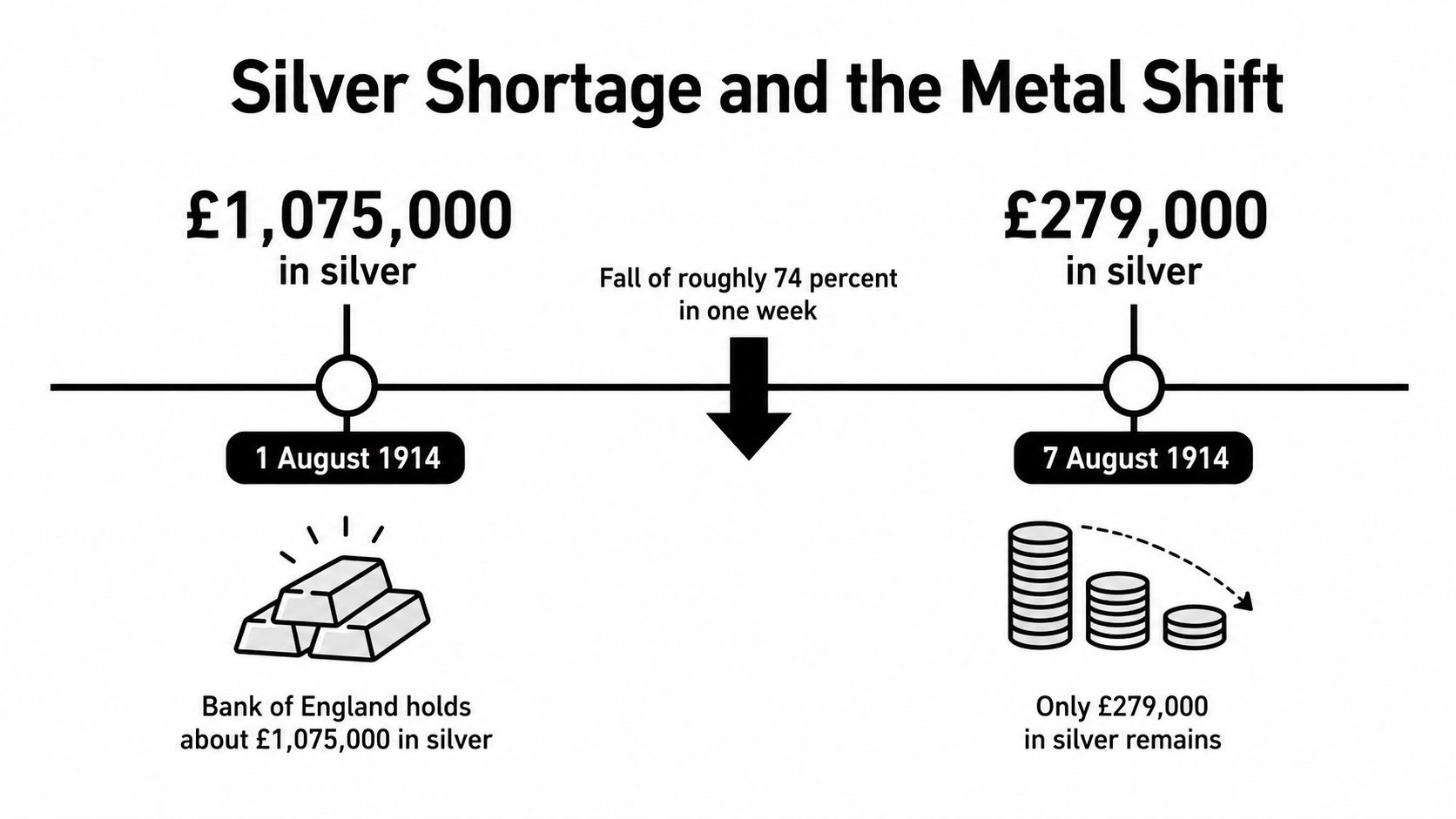
In the opening days of the war, the Bank of England's recorded silver holdings fell sharply. Its wartime history reports approximately £1,075,000 on 1 August 1914 and £279,000 on 7 August. The same account records that the Royal Mint delivered £5,350,019 in silver coin, representing 76,833,540 pieces, by the end of 1914. These figures describe distinct measures: the Bank's holdings and the Mint's coin deliveries, not the number of coins available to collectors. The Bank of England's wartime history of coinage and currency documents these figures and the pressures on wartime currency.
Military needs, payments to soldiers' families, and everyday commerce all placed demands on the monetary system. A shortage of silver held by the Bank did not mean that every denomination vanished from circulation. It meant that authorities had to keep payments working while people still needed usable coins and other forms of money.
Why more money didn't automatically mean enough change
A shop can have enough money in its till overall and still lack the smaller coins needed to give change. National currency works similarly: the total value in circulation and the denominations people can readily spend are separate issues.
The Bank of England's account records the issue of more than 25 million Postal Orders between 7 August 1914 and 3 February 1915. Postal Orders offered another way to make payments as the supply of coinage came under pressure. Their use helps explain how a payment system could adapt without making the need for convenient denominations disappear.
The Royal Mint's recorded deliveries also show why a wartime date alone does not prove that an issue was scarce. A crisis could lead to more coin production, not less. The monetary emergency explains the demand for coins; it does not establish how many examples of a particular issue were struck or survive today.
A wartime date and denomination tell a money story. Mintage, withdrawal and survival determine what collectors can find.
Gold withdrawal and the post-war silver standard
Gold and silver followed different timelines. In August 1914, the government introduced £1 and 10-shilling Treasury notes and encouraged the public to surrender gold. London half-sovereign production had ceased by 1915; London sovereign production stopped in 1917 and resumed in 1925. These dates concern gold coin production, not a change to the silver standard.
Silver fineness after the war
George V's silver coinage later changed from .925 sterling, or 92.5% silver, to .500, or 50% silver. The Royal Mint Museum's history of George V coinage describes this shift. It belongs to the later transition, so collectors should not assume every wartime-dated silver coin had the lower fineness.
The change is easier to understand by treating a coin's date and metal specification as separate clues. Two similar-looking coins from adjacent periods may use different standards. The guide to British silver coins can help when comparing those specifications.
National output and coin types
Royal Mint Museum material also reports that imperial coin output rose from 188 million pieces in 1914 to 267 million by the war's end, an increase of approximately 42%. This is a total across imperial coin output, not a count of silver coins alone. It cannot show that every silver denomination increased by the same amount.
| Coin or measure | Before the war | Wartime or later change | Collector note |
|---|---|---|---|
| Silver coinage | Sterling silver standard | Lower fineness came in the post-war transition | Check the coin's actual date and specification |
| Gold sovereign | Used within the monetary system | London production stopped; overseas branches continued | Identify the mint before interpreting an issue |
| Half-sovereign | Gold used as money | London production ceased | Consider withdrawal separately from original output |
| Imperial coin output | 188 million pieces in 1914 | 267 million by the war's end | The total does not give an individual coin's mintage |
| Bronze pennies and halfpennies | Everyday circulating denominations | Continued to be struck during the war | Assess the specific issue and specimen |
Keep the measures distinct. The Bank's recorded silver holdings are not the same as the Mint's coin deliveries, and aggregate imperial output is not an individual denomination's mintage. Likewise, a sovereign's metal value concerns its gold content, while its collector value depends on evidence about the specific coin. A wartime emergency explains the monetary context, but not a coin's market price.
Condition and Scarcity Set the Price
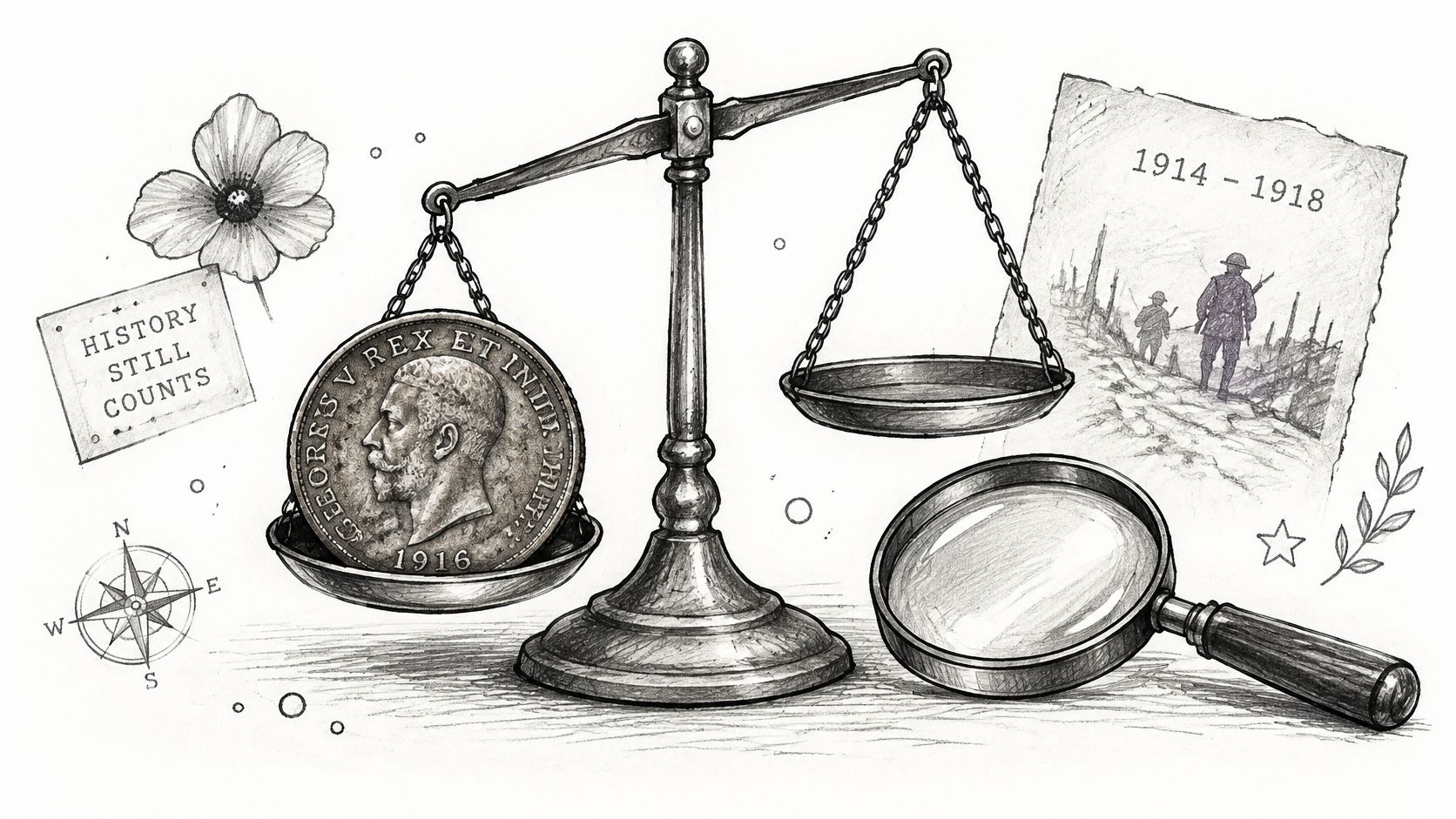
Scarcity can arise through low original mintage, withdrawal, export or limited survival. These aren't interchangeable explanations. A coin might have been produced extensively yet become difficult to find in a particular condition, while another might have a modest original issue without attracting strong demand.
For buying purposes, ask the seller to identify the relevant cause rather than accepting “wartime rarity” as a complete description. Without issue-specific evidence, a wartime date establishes a period, not a premium.
Condition grades and how they affect price
Use these descriptions as a comparison aid, not a substitute for denomination-specific grading standards. Surface damage, cleaning and other problems need separate attention.
| Grade | What it looks like | Price pattern |
|---|---|---|
| Good (G) | Heavy wear; basic outlines and identifying details remain | Compare with similarly worn examples |
| Fine (F) | Obvious wear, with more design detail visible | Assess whether the added detail supports the premium |
| Very Fine (VF) | Moderate wear; substantial detail remains | Compare high points carefully with the seller's description |
| Extremely Fine (EF) | Light wear, with much fine detail preserved | Small differences in surfaces become more important |
| About Uncirculated (AU) | Slight wear or friction on the highest points | Check that lighting isn't hiding wear |
| Uncirculated (UNC) | No circulation wear; marks or impaired lustre may still exist | Don't assume all unworn examples are equivalent |
The guide to coin grades can help you build a consistent vocabulary. Before assigning a grade, compare high-resolution photographs of the obverse and reverse, preferably taken in natural light, with the relevant descriptions.
Compare transactions, not optimistic labels
For a valuation, I'd prioritise recent sold examples of the same issue and comparable grade. Auction archives and dealer price lists can provide context, but an asking price shows what someone hopes to receive, not necessarily what another buyer has paid.
Keep sale proceeds separate from replacement cost. A dealer's purchase offer and retail listing serve different purposes, so ask which kind of valuation you're receiving.
Before paying a premium: Can you explain the coin's scarcity, and do its photographs support the stated grade?
No defensible price bands follow from the historical figures alone. If comparable sales are unavailable, acknowledge that uncertainty rather than filling the gap with a confident-looking estimate.
Key Collectible Types Worth Knowing
A wartime date and denomination explain a coin's place in the money system, not its value to collectors. For that, mintage, withdrawal and survival matter too. A coin used in ordinary commerce can be historically informative, while a later commemorative can recall the war without having circulated during it.
Sovereigns, florins and half crowns
A branch-mint sovereign is a gold coin identified by its date and mint mark. During the war years, sovereigns were struck at branch mints including Melbourne, Perth, Sydney, Ottawa and Bombay. Look for the mint mark on the coin, usually in the area around the date or below the reverse design, and check that it matches the claimed issue. The mark helps identify where the coin was struck; it does not prove where it circulated.
A George V florin is a silver two-shilling coin, while a half crown is worth two shillings and sixpence. Both belong to the period's circulating British silver currency. Their denomination and silver content connect them to wartime money, but wear and surviving detail vary from coin to coin. Check the date and design against a reliable identification reference before buying.
Pennies, halfpennies and remembrance
Pennies and halfpennies show the smaller-value bronze money people handled in daily transactions. George V's portrait identifies the reign, while the date places an example within the war years. On the reverse, the penny carries Britannia; the halfpenny also features Britannia, on a smaller coin. These details help distinguish the denominations and period more clearly than a general label such as “WWI coin.” Look for a readable date and compare the design with a recognised example.
The Kitchener commemorative is different: it remembers the conflict but was not a circulating coin of the war years. Its documented circulation mintage provides context, not a price for a particular piece. A commemorative belongs in a collection about wartime remembrance, while a sovereign, florin, half crown, penny or halfpenny represents contemporary money.
Let the collecting question guide you
Each type offers a different way into the subject. A branch-mint sovereign makes mint attribution central. Silver denominations show the coinage used during the period, and bronze pennies and halfpennies bring everyday money into focus. The Kitchener piece represents later commemoration.
Before choosing, ask whether the object was made during the war or recalls it afterward, and what its date, denomination or mint mark can establish. Then separate that historical evidence from collectability. A wartime date alone cannot tell you how many examples survive or what buyers will pay. A clear identification is a better starting point than a dramatic sales story.
Challenge Coins and Other Wartime Myths
A wartime date, a military emblem and a vivid story can make an object feel authentic. Each detail needs a different test. A date may place a coin in the period, while the design, production method and issue records help establish what the object actually is.
One familiar challenge-coin story says that a pilot's coin saved him from being mistaken for an enemy during the First World War. A repeated anecdote does not prove that a surviving coin belonged to that pilot or was made during the war. To support that link, look for a traceable history connecting the specific object to its owner and unit, alongside physical features consistent with its claimed age. Without those, the story remains an attribution, not authentication.
Objects that need a different identification
A token described as “trench-made” raises a separate claim. Handwork alone cannot show where or when it was made. Examine its construction and materials, and check whether its design or documented ownership connects it to the claimed wartime setting. If that evidence is absent, “trench art” may describe the style rather than a proven place or date of manufacture.
Other military-themed objects also need careful classification:
- Memorial plaques: These commemorate a person or event; they are not circulating money. A named recipient calls for evidence linking the plaque to that person.
- Fantasy pieces and restrikes: Find out whether the seller means an original issue, a later authorised striking or a design that was never an official issue.
- Replicas and altered pieces: Compare their details with a recognised issue. Added dates or marks can imitate an official feature.
The guide to military coins in the UK can help distinguish these collecting categories. A missing mint mark does not prove an object false, and a convincing mark does not prove it genuine. The design, issuing authority, physical features and issue record need to agree.
An object can be meaningful military memorabilia without being wartime currency.
A wartime money emergency and a collectible's value are separate questions. The date and denomination tell part of the monetary story; mintage, withdrawal and survival affect scarcity. For tokens and memorabilia, the strength of the object-specific evidence determines how confidently its history can be described.
How to Handle and Store WWI Coins Safely
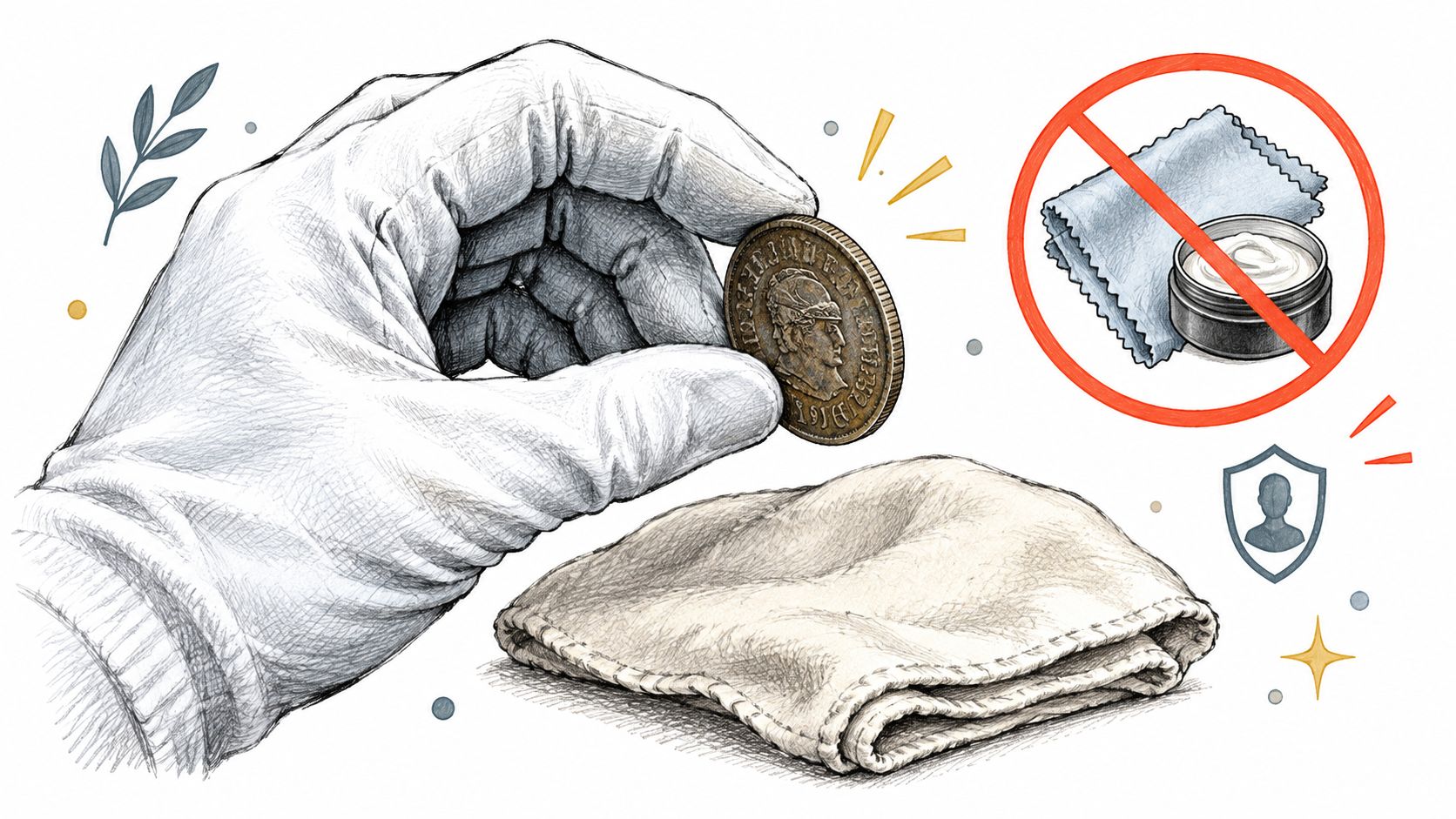
Don't clean a coin to make it easier to sell or grade. As a conservative collecting practice, leave polishing, dipping and abrasive treatment out of your routine. If a surface worries you, seek advice before doing anything irreversible.
Your aim is to preserve the object as received and create a record that lets you recognise later changes. Good photographs and suitable storage are more useful than attempts to make an old coin look new.
A conservative handling routine
- Hold the edges over a clear, soft surface. Avoid touching the fields and designs. If you use gloves, choose a pair that allows a secure grip rather than making the coin harder to control.
- Photograph both faces before rehousing it. Use natural light where practical and keep the original image files. Record the date, denomination, visible mint identification and any weight measurement you've taken.
- Keep the paperwork with the record. Save the listing, receipt and provenance separately from the coin. Distinguish documented information from a seller's unverified suggestion.
- Choose a holder made for coin storage. Prefer an inert capsule or a clearly identified archival-quality, PVC-free holder. Don't assume a soft plastic pocket or an “acid-free” label answers every question about the material.
- Choose a dry, stable storage location. Avoid bathrooms, kitchens and places prone to condensation. Keep rubber bands, loose adhesives and household packaging away from the coins.
- Inspect without unnecessary handling. Compare the coin with its earlier photographs and look for new spotting, deposits or colour changes. Separate anything concerning and ask a knowledgeable conservator or dealer before attempting treatment.
Preserve the evidence as well as the surface
Don't remove a coin from a sound holder merely to repeat an inspection you can perform through it. When photography requires removal, prepare the workspace first so the coin spends less time exposed to accidental contact.
A useful collection record also includes what remains uncertain. An unreadable mint detail, disputed grade or incomplete ownership history should stay visible in your notes. Careful storage preserves the specimen; careful recording preserves the honesty of its description.
Choose Your First WWI Coin to Buy
Start with one clearly identified denomination in a grade you can assess from good photographs. For a learning purchase, I'd choose a straightforward George V circulating coin before an expensive piece whose appeal depends on specialist attribution.
Ask the seller these questions before paying:
- Identity: Which country and denomination is this, and what supports the attribution?
- Date and mint: What can be read directly from the coin, and what has been inferred?
- Condition: What grade is being offered, and are cleaning, damage or other surface problems disclosed?
A focused gold purchase may suit someone interested in mint history. A small group of everyday denominations offers a different learning exercise: comparing wear, descriptions and photographs. Choose the project that matches your knowledge and budget rather than buying an assortment just because it carries a wartime label.
Buy an attribution you can defend
This guide is published by Cavalier Coins Ltd, an online seller of rare and unusual world coins. Weigh its advice as you would any retailer's guidance, and compare individual listings with independent references and other sellers.
Ask for the dating, stated grade and any claimed provenance in writing. If the seller can't substantiate a wartime connection, either price the uncertainty into your decision or leave the purchase.
Pick one denomination, set a firm budget and buy one example whose identity and condition you can explain. That's a stronger beginning than a supposedly rare coin you can't yet verify.
For world coins, banknotes and themed collecting sets, visit Cavalier Coins Ltd. Compare available pieces with your chosen WWI collecting focus, and ask the team to clarify any listing's date, attribution or condition before you buy.