
If you've found a 2010 Girlguiding 50p in circulation, it usually sits near face value because 7,410,090 were issued, while the collectible tiers are the 2010 proof with a mintage of 5,271 and the 2019 re-issue with a listed mintage of 88,186. There isn't one fixed price for any of them, because date, finish, packaging, and condition decide what buyers will pay.
That's the part most quick value pages blur together. A worn pocket-find, a boxed proof, and a later re-issue may carry the same basic design story, but they don't behave like the same coin in the market. If you're holding one now, the first useful question isn't “What's it worth?” It's “Which one is it, exactly?”
The 50p You Found in Your Pocket
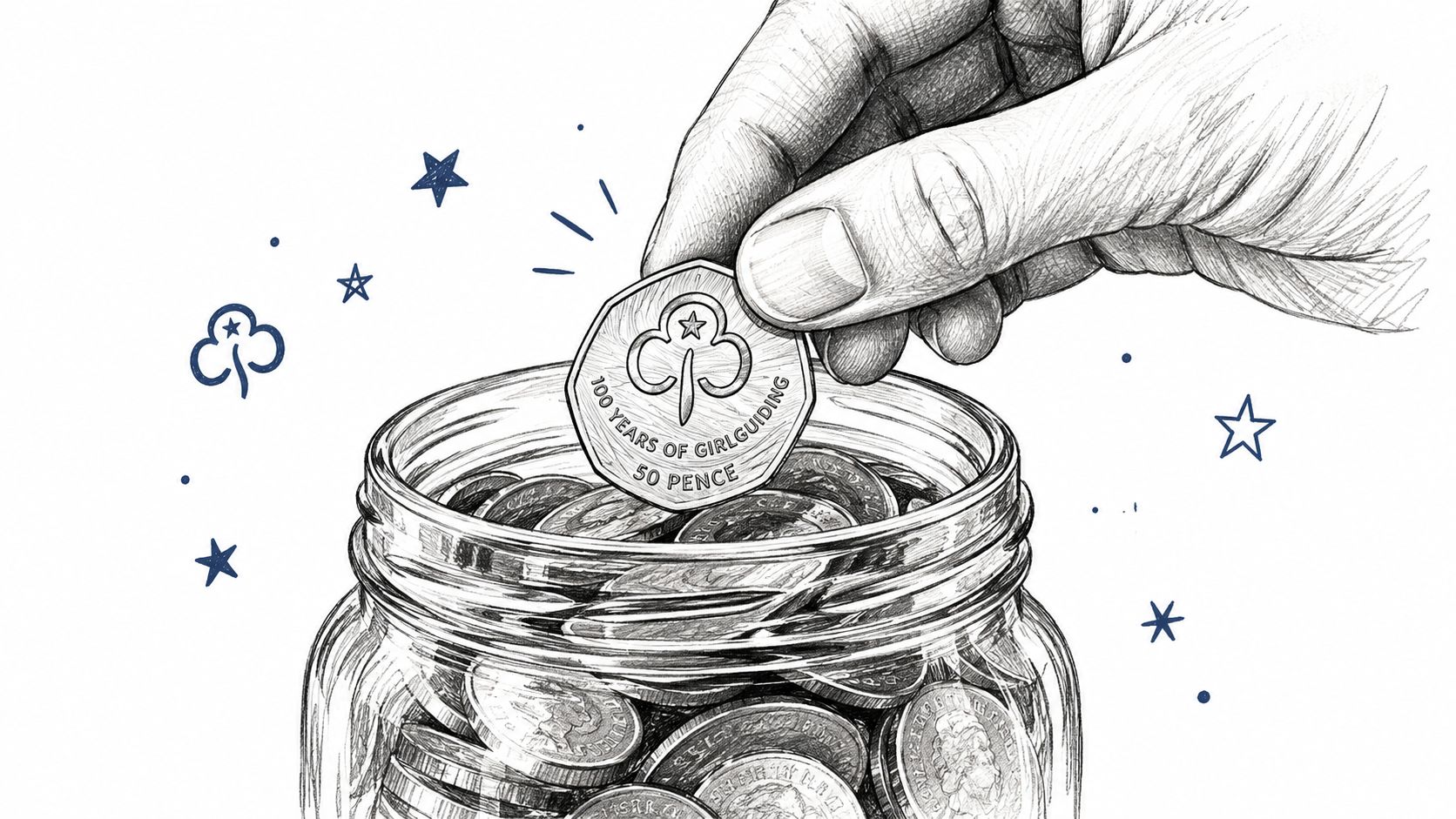
A lot of collectors meet the 100 Years of Girlguiding 50p the same way. It turns up in a jam jar, in supermarket change, or in the bottom of a handbag that hasn't been emptied properly in months. The design catches the eye, you notice the Girlguiding theme, and for a moment it feels like you may have found something scarce.
Usually, that first instinct needs tempering. The circulating 2010 coin is collectable, yes, but it was made to circulate widely, not to stay pristine in a presentation case. That means two coins with the same date can live in completely different value brackets once wear enters the conversation.
What collectors notice first
A dealer doesn't start with excitement. A dealer starts with triage.
- The date matters first: A 2010 coin found loose in change usually points to the standard circulating issue.
- The surface tells a story: Hairlines, dulling, knocks on the high points, and rim bruises all push a coin towards ordinary collector value rather than premium territory.
- The find context matters: If it came in original packaging rather than from a till, you should stop treating it like pocket change straight away.
Practical rule: If a commemorative 50p came out of circulation, assume common until the date, finish, and packaging prove otherwise.
What makes this issue appealing is that it sits in that sweet spot collectors know well. It isn't rare in the dramatic sense, but it has a proper event behind it, a recognisable design, and enough public interest to keep people searching for better examples. That's why the coin keeps turning up in conversations long after its year of issue.
The mistake is thinking all interest means all versions are equal. They aren't. With the 100 Years of Girlguiding 50p, ordinary circulation and serious collectability part company very quickly.
Why the Royal Mint Chose Girlguiding
The 2010 Girlguiding 50p wasn't a random commemorative. The Royal Mint issued it to mark the centenary of Girlguiding, and the reverse carries the inscription “CELEBRATING ONE HUNDRED YEARS OF GIRLGUIDING UK” with design credit to Jonathan Evans and Donna Hainan, as listed by The Royal Mint's fifty pence coin designs reference. That same Royal Mint listing records the circulation mintage at 7,410,090 and the proof mintage at 5,271.
That context matters more than many collectors first realise. Some 50ps are chased because they complete a denomination run. Others get their appeal from the story attached to them. This one leans strongly into social history. Collectors who specialise in youth movements, British institutions, or anniversary issues often want it for reasons that go well beyond face value denomination collecting.
A centenary with a natural coin theme
Girlguiding gave the Mint a clean, coherent commemorative brief. A hundred-year anniversary is easy for the public to understand, strong enough for a national issue, and broad enough to attract interest outside the core coin trade.
That's often when commemorative design works best. The subject already has public recognition, and the coin acts as a compact piece of national memory rather than just a collecting product.
Why the design still lands with collectors
The reverse inscription does a lot of the heavy lifting. It anchors the piece firmly to the centenary instead of leaving the theme vague or overly symbolic. The named designers matter too, because many experienced collectors catalogue modern British commemoratives by both event and designer.
This is one of those 50ps where the historical reason for issue is part of the value conversation, even when the circulating version itself isn't scarce.
There's also a practical dividing line in collector behaviour. Royal-event issues often pull in buyers who collect monarchy material first and denomination second. A coin like this tends to draw people from a wider net: decimal collectors, social-history collectors, former Guides, and families building themed albums. That broader emotional appeal helps explain why the coin remains easy to recognise, even among people who don't follow every Royal Mint release.
Design Details and Technical Specifications
Collectors talk about design, but they verify with specifications. That's how you separate a normal circulating example from something misdescribed, damaged, or not right at all.
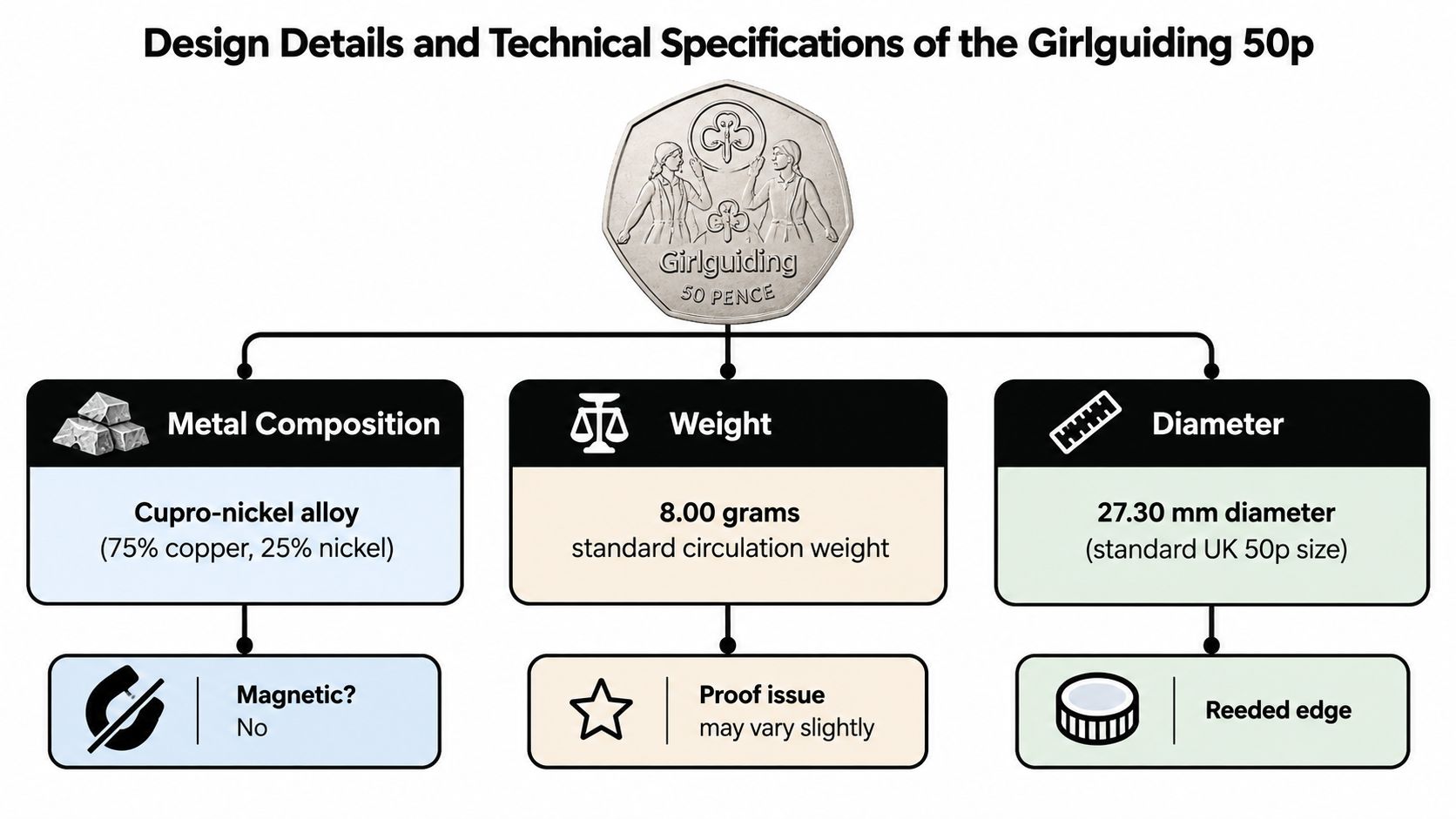
The 2010 circulating Girlguiding 50p was struck to the standard decimal 50p specification in cupro-nickel, with a weight of 8.00 g and a diameter of 27.30 mm, and it was made for general circulation according to The Royal Mint's 2010 Girlguiding 50p listing. That matters because a circulation coin is expected to pick up knocks, friction, and staining in normal use.
The specs that matter in hand
When a coin comes across a dealer's table, these are the checks worth making first:
- Metal and feel: Cupro-nickel has the familiar look and handling of standard UK circulating 50ps.
- Weight: At 8.00 g, a genuine normal example should feel right in hand and check out sensibly on a scale.
- Diameter: 27.30 mm helps confirm you're looking at the proper denomination and format, not a novelty piece or an altered item.
Collectors who like the manufacturing side of the hobby often enjoy reading more broadly about how coins are made, because striking method and intended finish explain a lot about why proofs and circulation pieces age so differently.
What wear usually looks like on this issue
Because the coin entered general use, clean survivors are a separate challenge from original mintage. You're not just competing against how many were struck. You're competing against years of tills, pockets, vending machines, and careless storage.
A well-kept circulating example should still show crisp detail and an even surface. A tired one often shows:
- Flattening on the high points
- Bag marks across the fields
- Small rim knocks from repeated handling
- General dullness from circulation friction
A common coin in excellent condition can be harder to replace than people expect. That's especially true when most surviving examples have already had a rough life.
The design itself helps here. The bold centenary inscription and central motif make weak detail easier to spot than on some busier commemoratives. If the lettering looks tired and the surfaces are heavily grazed, you're looking at a collector filler, not a premium piece.
2010 Versus 2019 Versions That Collectors Often Mix Up
Many buyers and sellers lose money. They see the Girlguiding design, search the phrase, and assume every result refers to the same coin. It doesn't.
The 2010 circulation issue sits in what many collectors would call the common-but-collectible bracket. Chancery Collection notes the circulation mintage of 7,410,090 and places it outside the low-mintage scarcity tier, with condition and theme demand carrying more weight than raw rarity in valuation, as outlined in its Girl Guide 50p overview.
The often-missed wrinkle is the later re-use of the design. The Girl Guides reverse appeared again in the 2019 Celebrating 50 Years of the 50p British Culture set, with the related 2019 issue listed at 88,186 total mintage by Online Coin Club's 2019 Girl Guiding entry. That puts it in a very different supply and packaging conversation from the 2010 circulation piece.
The comparison that actually helps
| Version | Mintage | Format | Market Position |
|---|---|---|---|
| 2010 circulation | 7,410,090 | General circulation | Common but collectible |
| 2010 proof | 5,271 | Proof collector issue | Specialist collector tier |
| 2019 re-issue | 88,186 | Set and collector format | Distinct later collector issue |
Why people confuse them
The reverse theme is the trap. If you focus on the design alone, the coins look connected enough that lazy listings and quick value pages merge them into one bucket.
That's bad practice. In real dealing, date and packaging format come first. A 2019 example belongs to a later commemorative context. A 2010 proof belongs to a low-mintage collector issue. A 2010 loose coin belongs to the circulation market unless something about its grade lifts it.
What the market actually rewards
Here's the plain version:
- 2010 circulation pieces reward strong grade.
- 2010 proofs reward completeness, careful storage, and original presentation.
- 2019 re-issues reward correct identification and proper attribution to the British Culture set context.
If you describe a 2019 re-issue as just a “Girlguiding 50p”, you leave money and trust on the table.
This is why generic value pages so often miss the point. They treat one design as one market. Dealers don't. Collectors shouldn't either.
How to Identify Your Girlguiding 50p Correctly
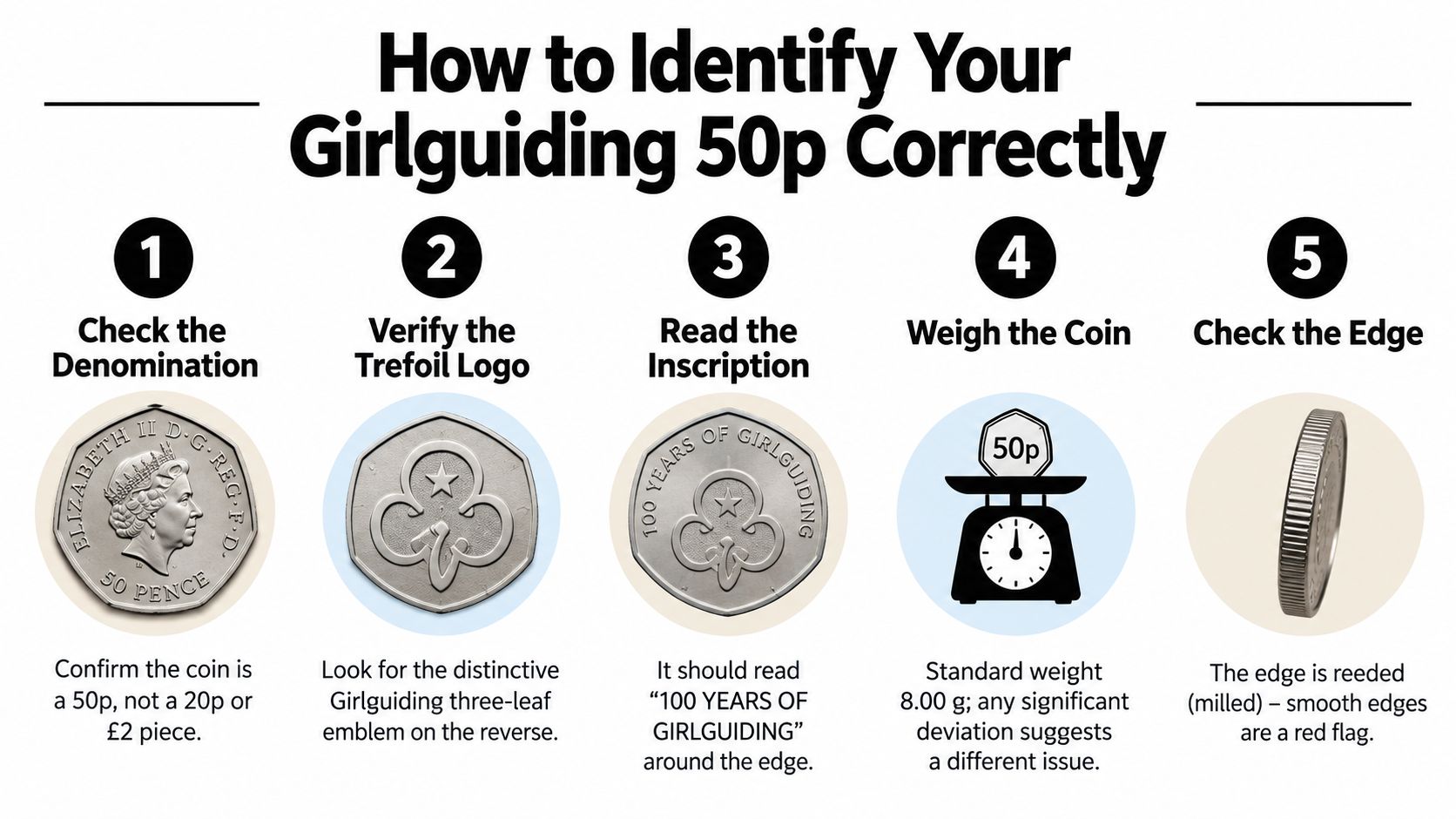
Most identification mistakes happen because the owner looks for a price before looking at the coin properly. Slow down and work in order. With the 100 Years of Girlguiding 50p, three checks usually settle the matter quickly.
Start with the date and finish
Look at the date first. That single detail tells you whether you should be thinking about the original circulating issue or the later re-issue.
Then look at the surfaces under decent light.
- A circulated look usually means a standard 2010 piece that has done the rounds.
- A polished, mirrored appearance points towards a proof or a collector-strike presentation coin.
- An oddly bright but scratched coin may have been cleaned, which collectors usually dislike.
If you want a wider sense of which UK fifty pences collectors tend to pull aside, a 50p coin checker guide can help place the coin in the broader commemorative series.
Packaging is not an afterthought
Collectors new to modern Royal Mint material often underestimate packaging. They shouldn't.
- Loose coin only: Fine for circulation finds, but it limits how confidently you can place a coin in the collector market.
- Capsule, card, or presentation case: Strong clue that you're dealing with a non-circulating collector format.
- Original complete presentation: That's what many buyers want, especially for proofs and later set issues.
Packaging doesn't magically rescue a poor coin, but for modern commemoratives it often changes buyer confidence immediately.
Use measurements as a sanity check
If something feels wrong, verify the basics. The known circulating specification gives you a practical benchmark.
- Weight check: A genuine standard example should align with the stated 8.00 g specification already covered earlier.
- Diameter check: The expected 27.30 mm helps rule out obvious mismatches.
- General appearance: If the piece has the wrong proportions, odd edge work, or a toy-like finish, treat it cautiously.
Good identification beats optimistic pricing every time. Buyers forgive an ordinary coin. They rarely forgive a wrongly described one.
When you contact a dealer, send the date, clear photographs of both sides, and details of any packaging. That's far more useful than asking for a value based on the design name alone.
Current Market Values and What Actually Moves Price
Here's the honest trade answer. There is no single price for the 100 Years of Girlguiding 50p, and anyone offering one flat figure without asking which version you have is simplifying too much.
The circulating 2010 coin generally lives in the near-face-value end of the market unless the grade is notably strong. The 2010 proof sits in a different tier because buyers in that lane care about preservation, original issue status, and whether the coin still presents as a proper collector piece. The 2019 re-issue has its own demand pattern because buyers often seek it as part of a later set story rather than as a pocket-find commemorative.
What actually pushes value up
Mintage matters, but it doesn't work alone. For this coin, these factors usually do more to move the needle in practice:
- Grade: Sharp, fresh-looking examples stand apart quickly from washed-out circulated pieces.
- Format: Proof and set-issued material attracts a different buyer from a loose circulation coin.
- Packaging: Original cases, cards, or presentation material help establish what the coin is.
- Description quality: Correctly identifying 2010 circulation, 2010 proof, or 2019 re-issue makes a real difference when selling.
That's why broad mintage lists are useful as reference points rather than price sheets. If you track commemorative context through resources such as 50p coin mintage figures, you'll be better placed to understand why one Girlguiding coin feels ordinary and another feels targeted to collectors.
What doesn't work when selling
Some habits consistently disappoint sellers:
- Calling every example rare
- Ignoring the date in the listing title
- Photographing proofs loose on a table without showing packaging
- Cleaning the coin to make it look brighter
- Assuming mintage alone decides value
One practical route is to compare sold listings, speak to a dealer who handles modern British commemoratives, or use a specialist retailer as one option among several. Cavalier Coins Ltd, for example, sells coins and banknotes to collectors and also handles bulk material, which is useful if your Girlguiding 50p is part of a wider group rather than a single-coin enquiry.
The market pays for precision. Correct version, honest condition, complete packaging. That combination beats hype every time.
If you're buying rather than selling, the same rule applies in reverse. Pay for the coin that's correctly identified, not the coin with the loudest claim attached to it.
If you're sorting a Girlguiding 50p and want a reliable place to compare collectible material, Cavalier Coins Ltd offers world coins, banknotes, themed collector pieces, and regular auction stock that suits both specialists and newer buyers. It's also a practical contact point if your coin sits inside a larger collection and you want straightforward help with selling, trading, or building out a focused commemorative run.