
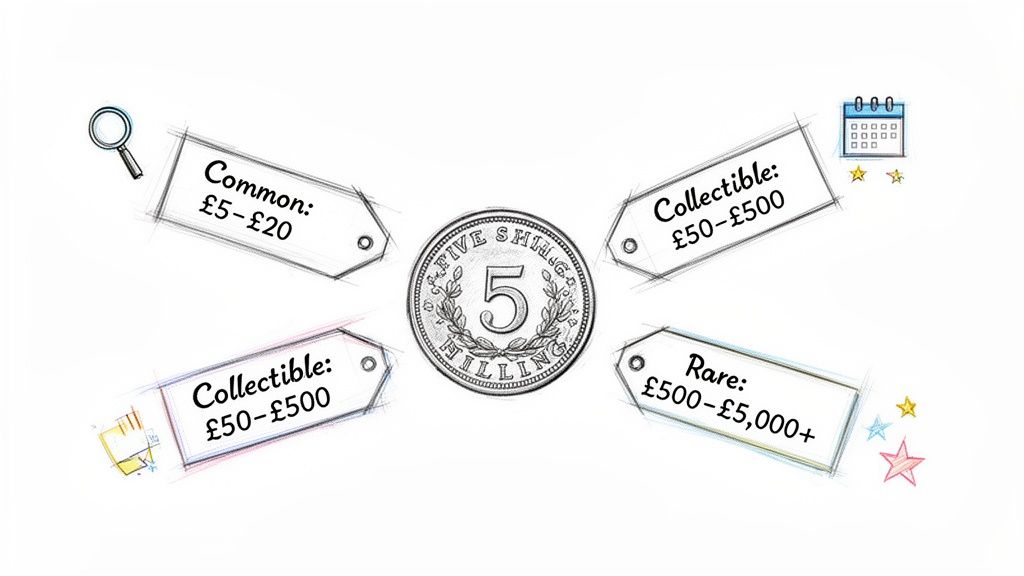
So, you've got a five shilling coin and you're wondering what it's worth. The answer isn't a simple one – it could be anything from a few pounds for a common cupro-nickel piece to potentially thousands for a rare silver example in top-notch condition.
The value really hinges on its age, what it's made of, and how well it's been looked after.
Unpacking the Value of a Five Shilling Coin
Many people know the five shilling coin by its more famous name: the Crown. It's a big, impressive coin with centuries of British history behind it, which is what makes it such a fascinating piece for collectors. To understand its value, you have to look beyond the face value and get to grips with the key factors that can turn a simple lump of metal into a prized collectible.
Think of it like appraising a vintage car. A rusty, high-mileage model is worth far less than a pristine one with a rare engine, even if they're from the same year. The same principle applies here.
Key Factors Influencing Price
The journey to figuring out a five shilling coin's value starts with three core elements. These are the first things any expert or seasoned collector will look for:
- Condition: This is everything. Scratches, dinks, and general wear from being in circulation can drastically reduce a coin's value. A coin that looks like it just left the mint ('Uncirculated' condition) will always fetch a much higher price.
- Year of Mintage: Just like with any collectible, some years are harder to find than others. Certain years had very low production numbers, making those coins inherently rarer and more desirable to collectors hunting for them.
- Metal Content: This is a big one. Crowns minted before 1920 are made of 92.5% silver, which gives them a base value tied directly to the precious metal market. From 1947 onwards, they contain no silver at all.
To give you a quick reference point, the table below offers a snapshot of what you might expect for different types of Crowns. This should help you quickly gauge where your coin might fall on the value spectrum before we dive deeper into specific dates and grading.
Estimated Value Range of Common Five Shilling Coins (Crowns)
This table is a quick reference guide to the typical market values for five shilling coins from different eras, showing just how much condition matters.
| Coin Era or Type | Typical Circulated Value | Typical Uncirculated Value |
|---|---|---|
| Pre-1920 Sterling Silver | £20 – £100+ | £150 – £1,000+ |
| 1920-1946 50% Silver | £10 – £40 | £50 – £200+ |
| Post-1947 Cupro-Nickel | £1 – £5 | £5 – £25 |
| 1965 Churchill Crown | £1 – £2 | £5 – £15 |
As you can see, a silver Crown that's been passed around in pockets and tills is worth a fraction of one that was put away and preserved from the day it was minted.
The Story Behind the British Crown
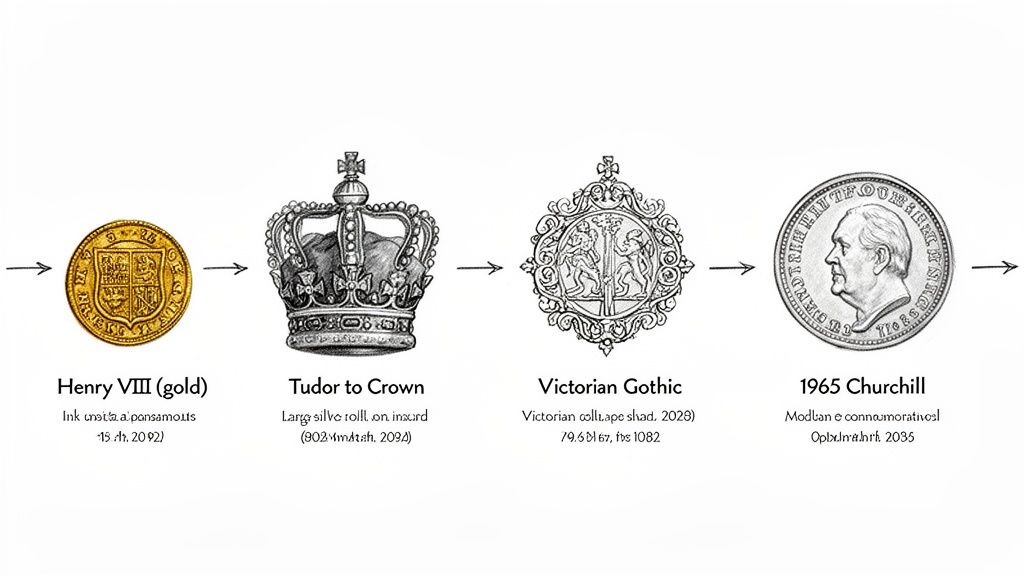
To really get a feel for a five shilling coin's value, you have to look past the metal it's made of and dig into its incredible story. The coin we know as the Crown wasn't always a hefty silver piece. Its journey began in Tudor England, first popping up as a gold coin under Henry VIII way back in 1526.
This original gold Crown was soon joined by a silver counterpart during the reign of his son, Edward VI, setting up a dual-metal standard that would last for centuries. Over time, it grew into the large, impressive silver coin that became a canvas for some of Britain’s most stunning numismatic art. Its history is truly woven into the fabric of the nation itself.
From Silver Standard to Modern Memorabilia
For hundreds of years, the Crown was a heavyweight in British currency, minted from 92.5% sterling silver. This high silver content means any Crown struck before 1920 has a significant built-in value from its metal alone. But after the First World War, things changed dramatically.
The government, grappling with economic strain, slashed the silver content to just 50% in 1920. This standard held until after the Second World War, when in 1947, silver was removed from all circulating coins. The Crown then made the switch to a cupro-nickel alloy. For collectors, this is a crucial dividing line, separating the coins with precious metal value from those valued purely for their history and rarity. The evolution of British coins offers a fantastic window into the country's economic past.
The Crown became a symbol of national pride, often reserved for commemorating major royal and historical events. Its large size provided the perfect medium for detailed, celebratory designs that captured pivotal moments in British history.
The five shilling coin's story is particularly rich during Queen Elizabeth II's reign. Minted from 1953 to 1966, these were the last pre-decimal five shilling pieces issued before the UK went decimal. A classic example is the 1953 Coronation Crown, struck to celebrate the Queen's coronation. With nearly six million circulated coins made, plus another 40,000 in proof condition, it's an iconic yet accessible piece for any collection.
The Final Chapter of a Historic Coin
By the 20th century, the Crown's days as a coin for everyday transactions were numbered, cementing its new role as a purely commemorative piece. The most famous of these is undoubtedly the 1965 Winston Churchill Crown, issued to honour the great statesman after his death.
This coin was a real game-changer, being the first time a non-royal had ever featured on a British coin. Millions were minted, so they aren't rare, but their historical significance is off the charts. This final act in the Crown’s long story—from Tudor gold to a modern tribute—is the perfect example of why a coin’s narrative is so vital to understanding its true worth.
How to Decode Your Coin's True Value
Figuring out what a five shilling coin is really worth is a bit like playing detective. It’s not just about what the coin is, but about piecing together all the little clues that tell its unique story. There are five key factors that separate a common crown from a real collector's treasure, and once you understand them, you can start to see your coin through a numismatist's eyes.
Condition, Condition, Condition
The first and most obvious thing that affects a coin's value is its condition, or 'grade'. Think of it like a classic car: one that's been driven daily for 50 years is going to look very different from one that's been tucked away in a garage. Every scratch, ding, or bit of wear from its time in circulation takes away from its appeal to collectors, who are always searching for the best-preserved examples.
A coin that has never been used for payment is called Uncirculated (UNC) and will still have its original shine, known as mint lustre. The moment a coin shows even the slightest sign of wear, it gets downgraded to categories like Very Fine (VF) or Fine (F). The drop in value between these grades can be staggering – a tiny, almost invisible scratch can genuinely be the difference between a £10 coin and a £1,000 prize.
Rarity and Key Dates
Beyond its physical state, the rarity of a coin is a massive driver of its value. This is simple supply and demand. If millions of a coin were minted, like the common 1965 Churchill Crown, they're easy for anyone to find and therefore aren't worth much. But if a coin had a very low mintage, its scarcity alone pushes the five shilling coin value way up.
Serious collectors are always on the hunt for what they call 'key dates' – these are the years when very few coins were made. Take the 1934 crown, for instance. Only 932 of them were ever struck, making it one of the rarest and most sought-after crowns out there.
Likewise, keep an eye out for varieties and errors. These are little mistakes that happened during the minting process, like a slightly different design or a missing detail. These imperfections are often much rarer than the standard coin, creating a little collecting niche of their own and sometimes multiplying the coin's value overnight.
What's It Made Of? Metal Content and Provenance
The actual metal your coin is made from gives it a base-level, or intrinsic, value. This is particularly important for the older crowns.
- Pre-1920 Crowns: These are made from 92.5% sterling silver. This gives them a built-in value based on the day's silver price. They can never be worth less than their weight in precious metal.
- 1920-1946 Crowns: The silver content was dropped to 50%, but this still provides a solid intrinsic value.
- Post-1947 Crowns: These are made from cupro-nickel and have no silver content at all. Their value comes purely from how collectible they are.
Think of the metal content as a safety net for older coins. While their numismatic value might go up and down with market demand, the silver provides a solid price floor that will always be there.
Finally, while it’s less common for most coins, provenance can add a huge premium. This is all about the coin's ownership history. If you can prove your five shilling piece was once part of a famous collection or owned by a historical figure, its story adds a unique and often priceless layer of value that collectors will happily pay extra for.
Real-World Examples of Five Shilling Coin Values
Theory is one thing, but seeing how these factors play out in the real world is where the fun begins. The value of a five shilling coin isn't some abstract number; it’s a living market with clear winners and losers. By looking at a few specific coins, we can see exactly how history, rarity, and condition create a huge spectrum of prices.
A perfect starting point is the common 1965 Winston Churchill commemorative crown. Billions were minted, making it a familiar sight in household drawers across the country. In its typical circulated state, it’s usually worth just a few pounds. Its value comes more from its historical significance as the first UK coin to feature a non-royal than from any rarity.
In a similar vein, the 1953 Coronation crown, struck to celebrate Queen Elizabeth II’s ascension, is another very accessible piece. With nearly six million made for circulation, a standard example might fetch £5-£10 if it's in excellent condition. It's a fantastic entry point for new collectors, but those high mintage numbers keep its value modest.
From Common Crowns to Coveted Classics
This is where the story really gets interesting. As soon as we shift our focus to older, rarer, or better-preserved crowns, the value skyrockets. A Victorian ‘Young Head’ crown from the early part of her reign, for example, is in a completely different league. These are sterling silver and much, much scarcer, often commanding hundreds of pounds even with a bit of wear.
The following infographic neatly sums up the three pillars—condition, rarity, and metal content—that separate a common coin from a rare treasure.
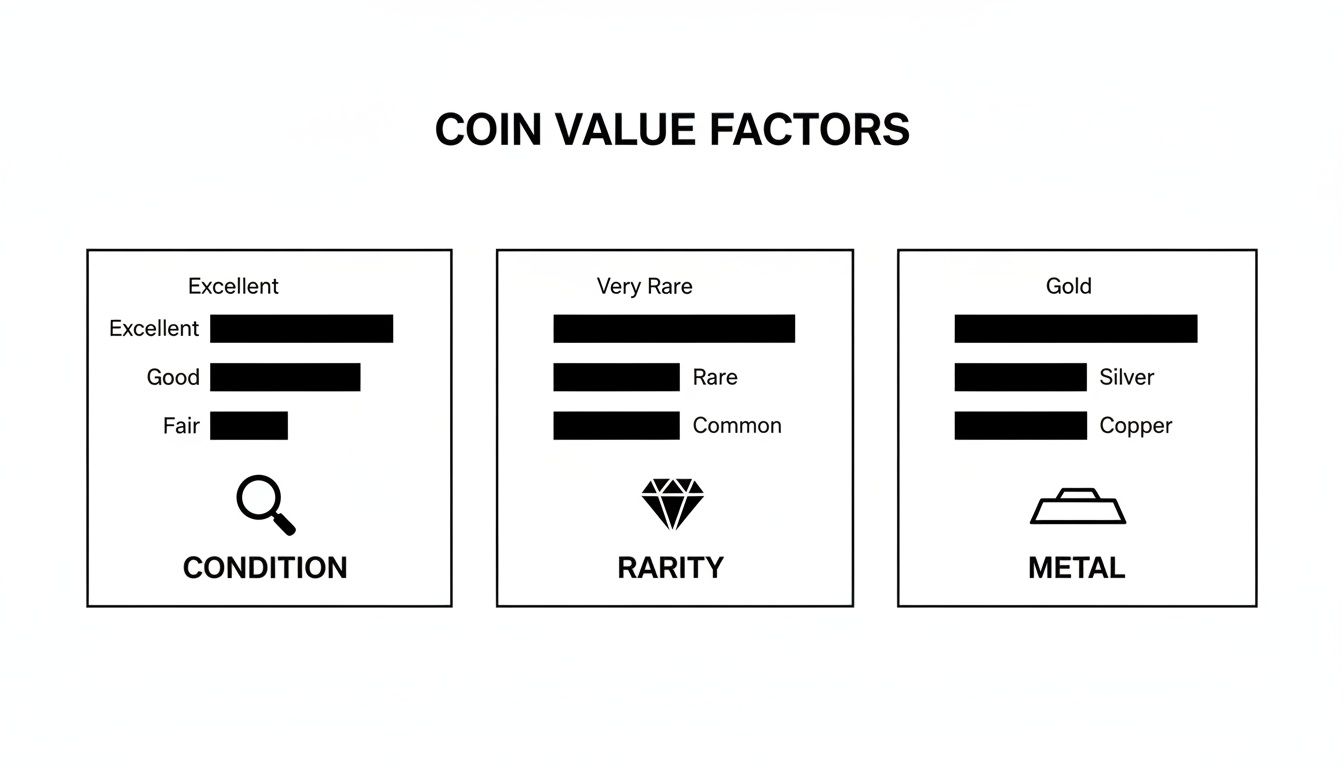
Ultimately, a coin's final valuation comes down to a careful balance of these three critical elements.
Then you have the true aristocrats of the five shilling world. The 1847 Victorian ‘Gothic’ crown is widely hailed as one of the most beautiful coins ever minted. Its stunningly intricate design and relative scarcity make it a numismatic icon. An example in top-notch condition can easily sell for thousands.
The leap in value from a 1965 Churchill crown to an 1847 Gothic crown perfectly illustrates the market's priorities. One is a piece of modern history; the other is a rare work of art made from precious metal.
Mintage and Value Comparison for Key Date Crowns
The number of coins originally minted has a direct and dramatic impact on what they’re worth today. This table highlights a few key examples, showing just how much low production numbers can drive up prices for collectors.
| Coin (Year and Type) | Mintage Figure (Circulated) | Estimated Uncirculated Value |
|---|---|---|
| 1965 Churchill Crown | 19,640,000 | £5 - £15 |
| 1953 Coronation Crown | 5,962,600 | £10 - £25 |
| 1934 'Wreath' Crown | 932 | £4,000 - £6,000 |
| 1847 'Gothic' Crown | 8,000 | £3,500 - £7,500+ |
As you can see, finding a 1934 'Wreath' Crown is a world away from finding a Churchill commemorative. It’s this thrill of the hunt for rare, low-mintage pieces that fuels much of the passion in coin collecting. For those looking to dive deeper, you can discover more insights about key date coins online.
How to Grade Your Coins at Home
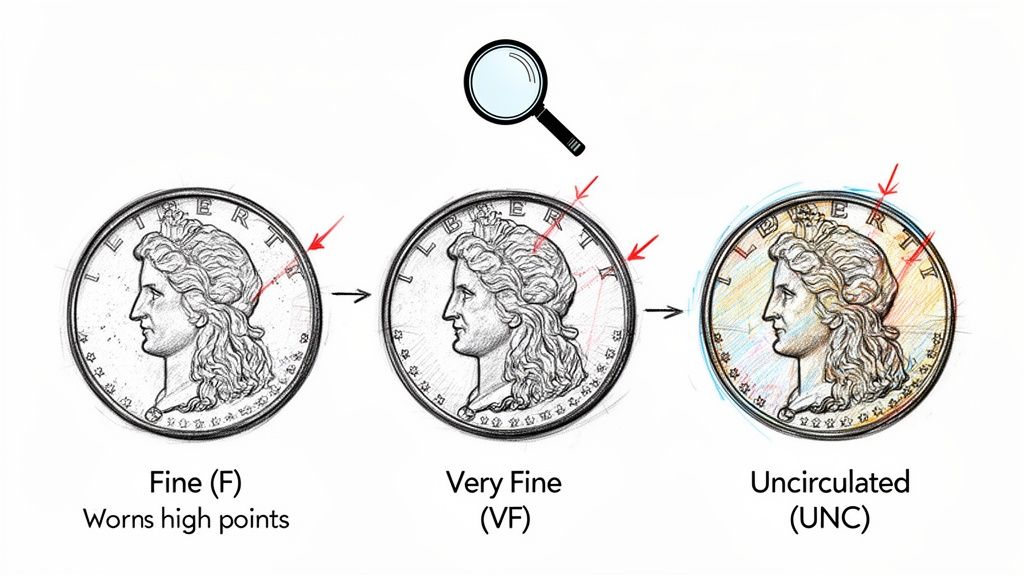
While sending a coin off for professional grading gives you the final, official word, learning to assess your own five shilling pieces is one of the most important skills you can develop as a collector. It helps you understand what you've got, what it might be worth, and how to spot a good deal when you see one.
At its heart, grading is simply the art of observing how much wear and tear a coin has picked up over its lifetime.
Think about a coin fresh from The Royal Mint. It's got that beautiful, cartwheeling shine known as mint lustre, and every single line and detail is razor-sharp. This is the gold standard, what we call an Uncirculated (UNC) coin. It’s the highest grade possible. The second that coin is spent, it starts its long journey of losing that perfect finish.
Spotting the Signs of Wear
The real trick to grading is knowing exactly where to look. Wear isn't spread evenly across a coin; it always starts on the highest points of the design. For a five shilling coin, or crown, these are the spots that need your closest attention.
When looking at the monarch’s portrait on the front (the obverse), check for any flatness on:
- The very top of the hair, particularly the strands just above the ear.
- The monarch’s cheekbone and eyebrow.
- The fine details within the crown or laurel wreath.
On the back (the reverse), using the classic St George and the Dragon design as an example, you’ll want to inspect:
- The dragon’s head, claws, and wing tips.
- St George’s helmet, the hilt of his sword, and the definition on the horse's muscles.
A coin that grades as Very Fine (VF) will show just a little bit of wear on these high points, but the majority of the design will still be crisp and clear. Drop down to a Fine (F) grade, and you’ll see those same areas are now noticeably flattened, with many of the smaller details having worn away completely. For a deeper dive, you can learn more about the specific grades of coins to really sharpen your eye.
Grading is all about observation. Imagine running your finger over the coin's surface (though you should never actually do this!). The areas that feel the smoothest and flattest are where time and handling have erased the most valuable details.
Quick Tips for Identifying Fakes
Sadly, wherever there’s value, you’ll find fakes. When you’re looking at any five shilling coin, especially the older silver ones, it pays to be a bit sceptical. A few simple checks can help you weed out the most obvious forgeries.
First, weigh it. A genuine silver crown should tip the scales at around 28.28 grams. Fakes made from cheaper base metals are almost always underweight. Next, take a close look at the edge—the lettering or reeding should be sharp and evenly spaced.
Finally, just look at the overall quality. Real coins have a crisp, well-defined strike. Many fakes look soft, blurry, or almost 'soapy', as if the details are melting into the background. These quick checks won't catch everything, but they'll protect you from the most common counterfeits out there.
Getting a Professional Valuation or Selling Your Coins
So, you've had a go at identifying and grading your five shilling coin at home. What's next? You might be thinking it’s time for an expert opinion, or maybe you're ready to sell. Knowing where to turn is key to getting a fair price and steering clear of the usual traps.
The right path really depends on your coin's potential value and what you hope to achieve.
For the more common crowns, like the 1965 Churchill issue, your local coin dealer is a brilliant first stop. They can often give you an immediate offer, making it a convenient way to handle a quick transaction. Online marketplaces are another option, opening you up to a huge audience, but be prepared to manage the listing, shipping, and any questions from buyers yourself.
When to Seek Expert Help
But what if you think you've got something special? If your gut tells you the coin is a rare variety or in truly exceptional condition, a more formal approach is definitely the way to go. A high-value piece, like a stunning 1847 Gothic crown, will benefit hugely from professional services.
Here’s where you should be looking:
- Auction Houses: For premium coins, a reputable auction house is ideal. They have a global network of serious collectors who are prepared to pay top prices for scarce and desirable items.
- Professional Grading: If your coin could be worth hundreds or even thousands of pounds, getting it professionally graded is a smart move. Services like NGC or PCGS will authenticate your coin and assign it an official grade. This removes any guesswork about its condition and often boosts its final sale price significantly.
Think of professional grading like getting a certified appraisal for a valuable antique. It's an unbiased, universally recognised assessment that gives buyers the confidence to pay a premium for guaranteed quality and authenticity.
Ultimately, understanding these different avenues is what it's all about. Taking the time to properly explore where you can get coins valued can make a massive difference to your final return. A bit of research now will help you make a confident and informed decision, potentially turning a fun hobby into a rewarding result.
Got Questions About Five Shilling Coins? We’ve Got Answers.
When you're digging into the world of five shilling coins, a few questions always seem to pop up. Let's tackle some of the most common ones that we hear from both new and seasoned collectors.
Are All Five Shilling Coins Made of Silver?
This is a big one, and it's a trap many new collectors fall into. The short answer is no.
The metal composition is entirely down to the date. British crowns struck before 1920 are the ones you're looking for if you want high-purity silver – they contain 92.5% sterling silver, which gives them a solid base value from the metal alone.
From 1920 to 1946, that silver content was slashed to 50%. Then, after 1947, all circulating five shilling coins were switched to cupro-nickel, meaning they contain no silver at all. Always, always check the date; it's the most critical clue to a coin's intrinsic worth.
What Is the Rarest British Five Shilling Coin?
Now that's a question that sparks debate! While a few crowns are incredibly hard to find, the legendary 1934 crown is often at the top of the list. With a minuscule mintage of just 932 pieces, it's a massive key date for any serious collector and can fetch thousands of pounds, even if it's not in perfect condition.
Of course, rarity comes in many forms. You also have certain proof versions and truly iconic historical pieces like the stunning 1847 'Gothic' crown. That particular coin is as famous for its breathtaking design as it is for its scarcity.
Is a 25 New Pence Coin the Same as a Crown?
In a collector's eyes, yes, they are essentially the same. When the UK's currency went decimal in 1971, the old five shilling crown was replaced by the 25 new pence commemorative coin. They were made to the same large size and weight, carrying on the tradition.
These 25p coins continued to mark major royal and national events, and they're considered the modern continuation of the crown series. To keep up with inflation, their face value was officially re-tariffed to £5 in 1990, cementing their role as special commemorative issues.
If you dive into the mintage numbers, you see a fascinating story. Mintage of George VI's shillings, for instance, soared after WWII. Later, the Elizabeth II era saw huge fluctuations, culminating in the 1965 Churchill crown – the last of its kind before the switch to the 25p commemoratives. You can discover more insights about these commemorative coins on BullionByPost.
Whether you are just starting your collection or hunting for that one elusive piece, Cavalier Coins Ltd offers an extensive selection of world coins and banknotes. Explore our curated collections and weekly auctions today at https://www.cavaliercoins.com.