
Ever glanced at the change in your pocket and wondered if that shiny £1 coin is a hidden gem? Most of the time, it's worth exactly one pound. But every now and then, you might just be holding a genuine collector's item.
Figuring out what makes these coins special is the first step to spotting treasure in your everyday change. It’s a fascinating process, and once you know the basics, you'll never look at a coin the same way again. A regular coin is just a tool for a transaction; a rare one tells a story.
What Determines Your Pound Coins Value
The journey from everyday currency to a valuable collectible boils down to a handful of key factors. The principles are surprisingly straightforward once you know what to look for.
The Three Pillars of Coin Value
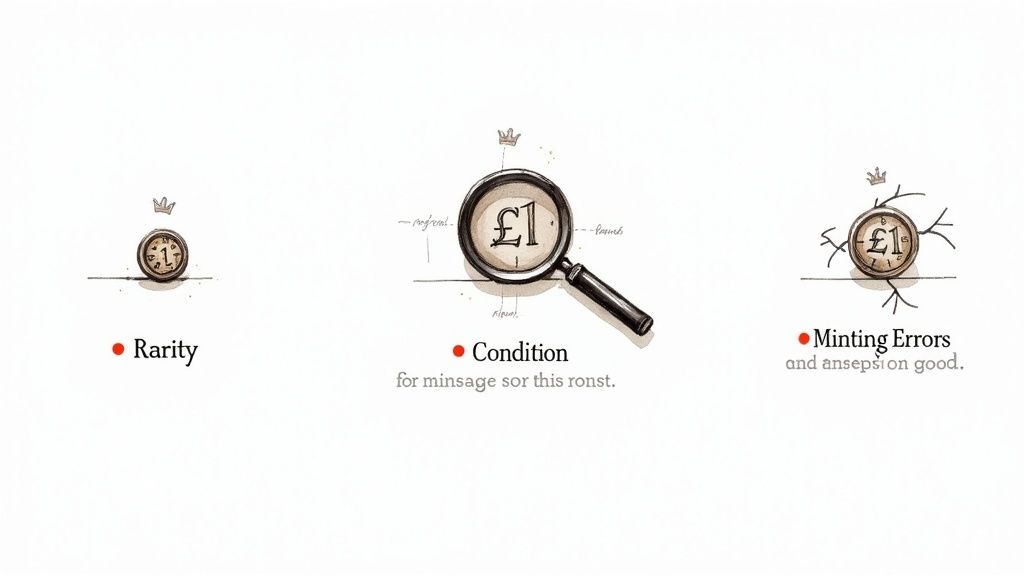
To get a real sense of what a pound coin might be worth, you need to look at it from three different angles. Each one plays a crucial role in deciding its final market price.
-
Rarity (Mintage): This is the big one. Mintage is simply the total number of coins of a specific design and year that The Royal Mint produced. A low mintage figure means fewer of that coin are out there, making them much harder to find and, naturally, more desirable to collectors.
-
Condition (Grade): Just like any collectible, a coin's physical state is critical. A coin that looks like it just left the Mint, with sharp details and no scratches, is far more valuable than an identical one that's worn, scuffed, or dirty. Collectors will always pay a premium for preservation.
-
Minting Errors: Sometimes, things go wrong during production. These little mistakes—a misaligned strike, a wrong date, or an incorrect metal—can create exceptionally rare and sought-after variations. A small flaw can sometimes translate into a very big price tag.
Getting your head around these core ideas is essential before you start hunting. As you dig deeper into the world of coin collecting, you'll realise these three pillars—rarity, condition, and error—are used to determine the value of all kinds of currency, a topic you can learn more about in guides on rare coin values.
By keeping these elements in mind, you can turn a simple habit of checking your change into a calculated treasure hunt. Every coin you come across becomes a small puzzle, with its date, design, and condition offering clues to its hidden worth.
The Story of the Modern Pound Coin
To really get a feel for a pound coin's value, you first need to know its story. Every coin you hold is a tiny piece of history, and the reasons behind its creation are often the very same reasons some are much harder to find than others. The modern pound coin's journey is a fascinating tale of innovation, practicality, and a constant cat-and-mouse game with counterfeiters.
It all started on 21st April 1983. On that day, a chunky, golden-coloured coin thumped into circulation, finally replacing the familiar but flimsy £1 banknote. The old paper notes had an average lifespan of just nine months, so bringing in a durable coin was a much smarter, more economical choice for the country. This new pound quickly became a staple in pockets, purses, and piggy banks across the UK.
The Rise of the Round Pound
The era of the 'round pound', which ran from 1983 to 2016, was defined by its ever-changing reverse designs. These designs were a celebration of the four nations of the United Kingdom, featuring emblems like the English Oak, the Scottish Thistle, the Welsh Leek, and the Northern Irish Flax Plant.
This regular cycle of new designs was a brilliant way to showcase national pride, but it created an interesting side-effect for collectors. It naturally produced scarcity for certain designs and years, laying the foundation for what makes some round pounds quite valuable today. If a coin was minted in a year with a low production run, it automatically became a tougher find.
But the round pound had a fatal flaw. Its simple, single-metal design made it a ridiculously easy target for fakes. By the 2010s, it was estimated that an incredible 1 in 30 round pound coins out there were counterfeit. This widespread fraud was seriously undermining public trust, and it was clear something drastic had to be done.
A New Era: The 12-Sided Coin
In March 2017, The Royal Mint rolled out a game-changing successor: the 12-sided, bi-metallic pound coin. It was immediately hailed as 'the most secure coin in the world,' packed with clever features designed to stop counterfeiters in their tracks.
These security features are pretty impressive:
- A 12-sided shape: This unique design makes it instantly recognisable, even just by touch.
- Bi-metallic construction: It has a gold-coloured outer ring (nickel-brass) and a silver-coloured inner circle (nickel-plated alloy).
- A latent image: A bit like a hologram, this feature shows a '£' symbol that cleverly changes to a '1' when you tilt the coin.
- Micro-lettering: You'll find incredibly small lettering on the lower inside rim on both sides.
- Milled edges: The edges have a pattern of alternating milled (grooved) and smooth sections.
This switch from the round to the 12-sided coin was a huge moment. All the old round pounds were demonetised, meaning they stopped being legal tender after October 2017. You can't spend them anymore, but they instantly became collectors' items, with their value now based purely on rarity and demand from people like us.
The change to the 12-sided coin wasn't just a simple currency update; it drew a clear line in the sand for collectors. It closed the book on one collecting era and kicked off an entirely new one, with fresh designs, dates, and potential rarities to hunt for.
On top of all this, we're living through another historic change: the move from coins featuring the effigy of Queen Elizabeth II to those of King Charles III. This handover naturally creates limited runs of coins with each monarch in the same year, making them instant targets for collectors. Understanding this timeline is the first step to thinking like a pro, as it shows you exactly when and why scarcity—and value—are born.
Decoding Rarity: Mintage, Errors, and More
So, what separates a pound coin that’s worth just a quid from one that could fetch a pretty penny? It all comes down to the secret language collectors use to determine a coin’s true value, and the most important word in that language is mintage.
Think of the mintage figure as a coin's official birth record from The Royal Mint. It tells you exactly how many coins of a specific design were made in a particular year. In the world of coin collecting, the golden rule is simple: the lower the number, the higher the potential value. It’s all about supply and demand.
When millions of a particular coin are put into circulation, they're easy to come by, so their value rarely climbs above £1. But when the Mint only produces a few hundred thousand, they suddenly become much harder to track down. This scarcity is what gets collectors excited and drives up the pound coins value.
The Power of Low Mintage Figures
A low mintage figure is the clearest sign that a coin might be rare. It's the difference between finding a common garden snail and spotting a rare, exotic butterfly. Both are interesting, but one is far more sought-after simply because there are so few of them around.
The legendary Kew Gardens 50p is the perfect example of this. With a mintage of just 210,000, it’s the coin that sends a ripple of excitement through the collecting community. The very same principle applies to pound coins. Certain designs and years were produced in much smaller batches, making them the top targets for anyone checking their change.
We saw this play out with the 2025 Bee £1 coin. Initially, an incredibly low mintage of 170,000 was announced, which would have made it even rarer than the Kew Gardens 50p. The Royal Mint later released another 8.84 million, bringing the total to 9,010,000. While that diluted its extreme rarity, it showed just how much mintage figures can excite the market. You can read more about this fascinating release over at the Westminster Collection's coverage.
This timeline shows how the pound coin has evolved, largely driven by the need to stay one step ahead of counterfeiters.
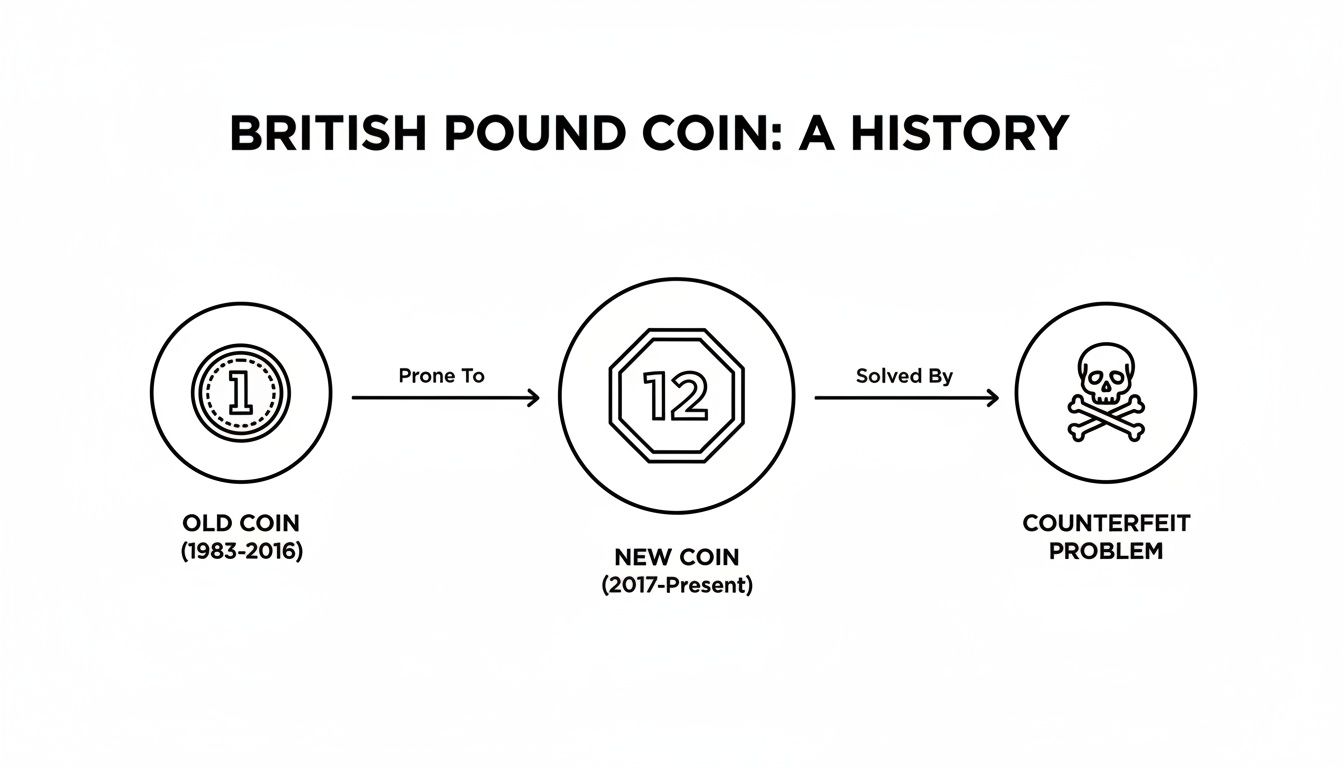
As you can see, the switch from the old round pound to the ultra-secure 12-sided coin was a direct response to the massive number of fakes in circulation.
When Mistakes Create Treasure
While low mintage is a deliberate act of scarcity, sometimes real value is created completely by accident. The Royal Mint is an incredibly precise operation, producing billions of coins flawlessly. But every now and then, a mistake slips through. These little imperfections, far from being worthless, can turn an ordinary coin into a collector’s prize.
A minting error isn't just damage like a scratch or a dent someone made after the coin left the Mint. It's a genuine flaw that happened during the production process itself.
It's like finding a postage stamp with the aeroplane printed upside down. The error is part of its story, a rare glitch in a mass-produced system, and that's exactly what makes it special.
Common Types of Minting Errors
You’ll need a keen eye to spot these. Some errors are glaringly obvious, while others are incredibly subtle. Here are a few key types to look for on your pound coins:
- Mule Coins: This is one of the most famous and sought-after errors. A 'mule' is a hybrid coin struck with the heads (obverse) die of one coin and the tails (reverse) die of another.
- Off-Centre Strikes: This happens when the blank coin isn't sitting perfectly in place during striking. The result is a design that’s pushed to one side, often leaving a blank, crescent-shaped area.
- Die Cracks and Clashes: The dies used to stamp coins wear out over time and can develop tiny cracks, which show up as raised, jagged lines on the coin. A 'die clash' is when the two dies strike each other without a coin between them, leaving a faint ghost of one design on the other side.
- Rotation Errors: Flip a coin over from top to bottom, and the design on the back should be perfectly upright. If it's rotated at an angle, you've found a rotated die error.
Finding a genuine minting error is a real thrill. It’s a direct connection to the fascinating process of how our money is made, and it means you’re holding something that is truly one-of-a-kind.
A Checklist of Valuable Pound Coins to Find
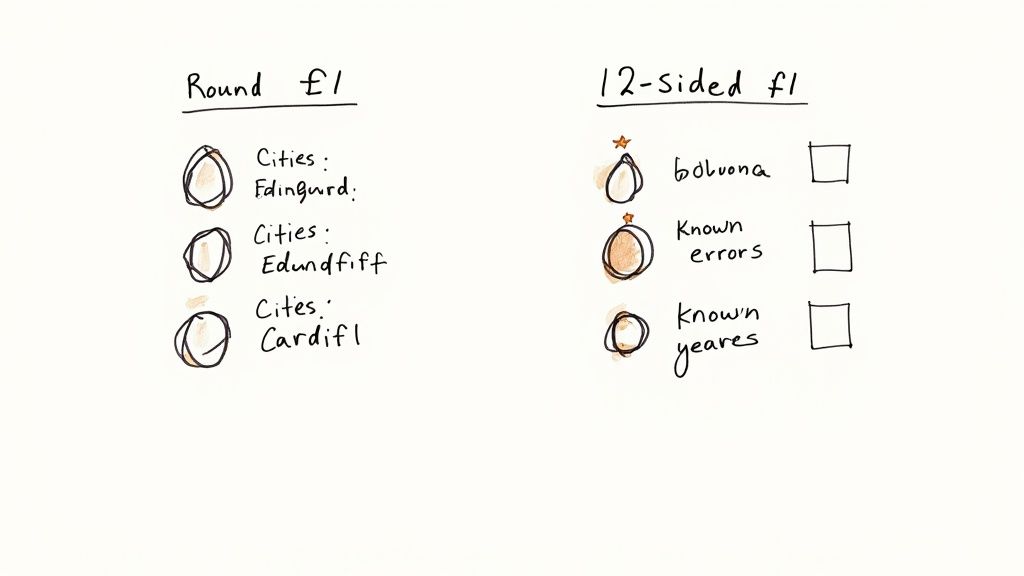
Now that you have a feel for what makes a coin rare, it’s time to put that theory into practice. Think of this checklist as your treasure map for sifting through your change, organised by the two main eras of the modern pound coin: the classic round pound and the newer 12-sided version.
Every coin listed here is sought-after for a reason, which nearly always comes down to a low mintage figure. Remember, while a coin's condition will always affect its final price, just finding any of these in your change is a genuinely exciting moment.
Rare Round Pound Coins
The original round pounds were taken out of circulation back in 2017, which means you can no longer spend them in shops. For collectors, however, their value has only grown, especially for those designs with smaller production runs. The 'Cities' series, in particular, contains some of the rarest and most desirable finds.
-
2011 Edinburgh City: This one sits right at the top of the list for rare round pounds. With a mintage of just 935,000, it’s the only circulating round £1 coin to dip below the one million mark, making it a key target for any serious collector. A good circulated example can fetch between £5 and £10.
-
2011 Cardiff City: The partner to the Edinburgh coin, the Cardiff City design also boasts a low mintage of 1,615,000. Its relative scarcity means it often sells for £4 to £8, a healthy return on its original face value.
-
2010 London City: As part of the same series, the London coin is another one to keep an eye out for. It had a slightly higher mintage of 2,635,000, but it’s still a desirable piece for anyone trying to complete the capital cities set. Expect to see values in the £3 to £5 range.
These 'Cities' coins are the perfect illustration of how mintage directly creates value. They weren't released as special editions; they were simply made in smaller numbers to meet that year's circulation demand, accidentally creating the collectibles we hunt for today.
Valuable 12-Sided Pound Coins
The arrival of the 12-sided pound in 2017 kicked off a whole new chapter for collectors. While most of these coins have sky-high mintage figures, a few specific years—and some fascinating errors—have already started to stand out from the crowd.
The key to spotting valuable 12-sided coins is to pay incredibly close attention to the date. Some years had significantly lower production numbers than others, creating instant scarcity right from the get-go.
Top 12-Sided Coins to Look For
Here are the key dates and errors that have really captured the attention of the numismatic community since the new design was launched.
-
2017 'Dual-Dated' Error: This is one of the most interesting errors to emerge. A small number of the very first 2017 coins were struck with a die that had a microscopic '2016' date visible in the micro-lettering. This 'trial piece' error is incredibly rare and can command prices of several hundred pounds.
-
2022 Nations of the Crown: As it stands, this is the rarest circulating 12-sided pound coin. The Royal Mint produced a surprisingly low 7,735,000 of them, making it the one to watch from recent years. Its low mintage means collectors are happy to pay a premium, often in the region of £3 to £6.
-
Known Striking Errors: Always keep an eye out for imperfections on any 12-sided coin. So-called 'fried egg' errors, where the inner silver-coloured circle is misaligned with the outer ring, are more common than you might think. While minor misalignments may not add much value, really dramatic examples are certainly collectible.
This list gives you a fantastic starting point for your coin-hunting adventures. By focusing on these specific coins, you’ll start to train your eye for what makes a pound coin valuable, turning the simple act of checking your change into a rewarding and potentially profitable hobby.
Top 10 Valuable Pound Coins to Find
To give you a clearer picture, we've pulled together a table of the most sought-after UK pound coins. This combines some of the coins mentioned above with other notable rarities, giving you a quick reference guide for their mintage figures and what collectors are currently paying for them in good condition.
| Coin Name and Year | Type (Round/12-Sided) | Mintage Figure | Key Identifying Features | Average Collector Value |
|---|---|---|---|---|
| 2011 Edinburgh City | Round | 935,000 | Coat of Arms of Edinburgh | £5 - £10 |
| 2011 Cardiff City | Round | 1,615,000 | Coat of Arms of Cardiff | £4 - £8 |
| 2010 London City | Round | 2,635,000 | Coat of Arms of London | £3 - £5 |
| 2008 Royal Arms | Round | 3,910,000 | The 'denticle' version of the Royal Arms design | £3 - £6 |
| 2014 Thistle & Bluebell | Round | 5,185,000 | Representing Scotland in the Floral series | £2 - £4 |
| 2014 Flax & Shamrock | Round | 5,780,000 | Representing Northern Ireland in the Floral series | £2 - £4 |
| 2022 Nations of the Crown | 12-Sided | 7,735,000 | The standard 12-sided design with the 2022 date | £3 - £6 |
| 2009 Royal Arms | Round | 10,050,000 | Earlier version of the standard Royal Arms design | £2 - £3 |
| 1988 Crowned Shield | Round | 7,118,825 | The second portrait of Queen Elizabeth II | £3 - £5 |
| 2017 'Dual-Dated' Error | 12-Sided | Unknown | Microscopic '2016' date on a 2017 coin | £100 - £300+ |
This isn't an exhaustive list, but it covers the heavy hitters you're most likely to encounter. Happy hunting
How to Judge Your Coin's Condition
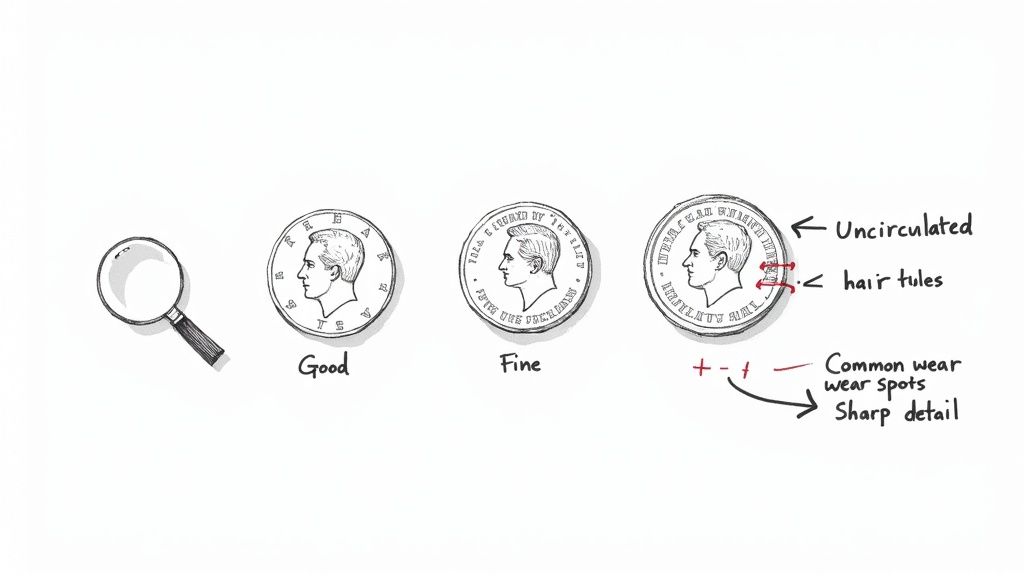
Finding a rare, low-mintage pound coin is a brilliant start, but its physical state is just as vital for figuring out its true worth. In the world of coin collecting—or numismatics, as it’s properly known—this evaluation process is called grading.
Think of it like buying a classic car. A model with low mileage and immaculate paintwork will always fetch a higher price than the exact same one covered in dings and scrapes, even if both are rare. The same principle applies directly to the pound coins value you’re looking at.
From a distance, two coins might seem identical. But get up close, and a whole world of difference can emerge. The amount of wear, the sharpness of the design, and any nicks or marks all play a part in a coin’s grade, and this can make its value swing wildly.
Understanding the Grading Scale
Coin grading uses a descriptive scale that ranges from heavily worn to absolutely perfect. The official systems can be incredibly granular, but for most purposes, we can boil it down to a few key categories that are easy to get your head around.
-
Poor/Good (G): The coin is very worn down. Key features of the design are flat and hard to make out, and the date might be barely readable. These have little collector value unless they’re exceptionally rare.
-
Fine (F): Most of the main design elements are visible, but they show quite a bit of wear. On the Queen’s portrait, for instance, the finer strands of hair will have blended into a single flat area.
-
Very Fine (VF): The details are much clearer. You can see individual strands in the hair and sharper lines on the reverse design, but the highest points of the coin will still be smooth from being in circulation.
-
Extremely Fine (EF): This coin shows only light wear on its very highest points. Nearly all the original detail is there, giving it a sharp and attractive look.
-
Uncirculated (UNC): This coin looks like it just came from The Royal Mint. It has zero signs of wear and still has its original mint lustre—that lovely, cartwheeling shine you only see on brand new coins.
It's a classic rookie mistake to confuse 'shiny' with 'Uncirculated'. A heavily worn coin can be polished to a mirror finish, but doing so actually damages its surface and wipes out its collector value. An Uncirculated coin is valuable because it’s pristine and untouched.
Where to Look for Wear
To properly assess a coin’s condition, you have to know where to look. Wear and tear always hits the highest points of the design first, since these are the areas that get the most contact.
For UK pound coins, pay close attention to these spots:
-
The Monarch's Portrait: The highest points are usually the Queen's or King's cheekbone, the hair just above the ear, and the very top of the crown. On a worn coin, these areas will look flat and smooth.
-
The Reverse Design: Check the highest points of the emblem. On a Royal Arms design, look closely at the lion and the unicorn. For a floral emblem, check the tips of the leaves and petals.
Learning to spot these subtle differences is a key skill for any collector. If you want to dive deeper, you can find more technical breakdowns of the grades of coins in specialised guides. This knowledge will help you protect your finds and understand why a perfect example of a common coin can sometimes be worth more than a battered version of a rare one.
How to Sell Your Coins for the Best Price
Finding a coin worth more than its face value is a genuinely brilliant feeling. But what comes next? The real trick is turning that potential value into actual cash in your pocket. The market can feel a bit like the Wild West at first, but understanding your options is the secret to getting a great price for your discovery.
Your two main routes are online marketplaces and specialist coin dealers. Each has its own set of pros and cons, and the best choice really boils down to the coin's value and how much legwork you’re prepared to do.
Online Marketplaces Versus Specialist Dealers
Platforms like eBay throw open the doors to a massive global audience of collectors. For a well-known rare coin, this can spark a bidding war that pushes the final price right up. You’re in the driver’s seat, controlling everything from the starting price to the description.
Of course, with great power comes great responsibility. You'll need to take crystal-clear, high-quality photos that show the coin's condition honestly. You'll also be writing the description, sorting out the packaging and postage, and dealing with platform fees, which can take a decent chunk out of your final sale price.
It's vital to watch out for wildly misleading listings on these sites. You’ll often see sellers listing common coins for thousands of pounds, creating a totally false impression of their value. Always, always check the sold prices for coins like yours to see what people are actually paying, not just what sellers are asking for.
On the flip side, selling to a specialist coin dealer is a much more straightforward and quicker affair. A reputable dealer has the expertise to give your coin an accurate valuation on the spot and will make you a direct offer. There are no fees to worry about, and the sale is secure and immediate.
The trade-off is that a dealer’s offer will be below the coin’s full retail value – after all, they need to make a profit when they sell it on. This is often the best path if you value a quick, hassle-free sale or if you're looking to sell a larger collection all in one go. For a much deeper look into the selling process, our full guide on how to sell coins in the UK lays out detailed strategies for success.
Presenting Your Coin for Sale
No matter which path you take, presentation is absolutely everything. First impressions really do count, and a coin that’s poorly presented will never fetch the price it could have.
- Photography is Key: Get your coin in natural light against a plain background. Take sharp, focused shots of both the front (obverse) and back (reverse), and don't forget the edge. If there are any unique features or errors, make sure you capture them clearly.
- Describe it Accurately: Just be honest about the coin's condition. Point out any visible wear, scratches, or marks. Honesty builds trust with buyers and stops any headaches or disputes down the line.
- Do Not Clean Your Coin: This is the golden rule, and it’s non-negotiable. Cleaning a coin, no matter how gently you think you're being, will create microscopic scratches and strip away its natural patina. This single act can destroy its collectible value. A dirty, original coin is always worth more than a brightly polished but damaged one.
Your Top Pound Coin Questions Answered
As you get deeper into collecting, you’re bound to have questions. It happens to everyone! To help you along, I’ve put together some of the most common queries I hear from new collectors, with straightforward answers to keep you on the right track.
Are the Old Round Pound Coins Worth Anything?
Absolutely. While they were withdrawn from circulation and you can't spend them in shops anymore, the old round pounds are far from worthless. For a start, most high-street banks will still let you deposit them straight into your account.
But more importantly for us, many of them have a collector's value that goes well beyond their old £1 face value. The really sought-after designs, like the 2011 Edinburgh City coin, are now valued entirely on what collectors are willing to pay, not on their old legal tender status.
How Do I Spot an Error on a 12 Sided Pound Coin?
Spotting an error coin takes a sharp eye and knowing what looks ‘off’ compared to a normal one. It's a real thrill when you find one.
- Look for a misaligned inner 'plug', sometimes called a 'fried egg' error where the silver-coloured centre isn't perfectly positioned.
- Check for a visible die clash. This is where a faint, ghostly impression of the Queen's head might appear on the reverse side (or vice versa) from when the dies smashed together without a coin in between.
- Flip the coin over from top to bottom. If the design on the other side isn't perfectly upright, you've found a rotated die error.
These little production hiccups are exactly what hunters are looking for, and they can turn a regular quid into something much more valuable.
Crucial Tip: Whatever you do, never clean your coins! It’s tempting, I know, but cleaning leaves tiny scratches and strips away the natural patina that develops over time. This absolutely tanks a coin's grade and value. Collectors want originality above all else, making a dirty, untouched coin far more desirable than a shiny but damaged one.
What Is the Best Way to Start a Pound Coin Collection?
Honestly, the easiest and most enjoyable way to get started is by 'change checking'. Just have a good sort through the coins you already have in your pocket, purse, or piggy bank. It costs nothing and it’s a brilliant way to find your first few interesting pieces.
When you're ready to look a bit wider, you can pop into your local bank and ask to swap a banknote for a bag of £1 coins. This gives you a much bigger batch to sift through and really gets the hunt going.
The world of pound coins is a fascinating little corner of Britain's wider monetary system. As of June 2025, the total value of all notes and coins in circulation was nudging £100 billion, and our humble £1 coins are a huge part of that. The Royal Mint has a tricky balancing act: they need to release enough for day-to-day use—over 30 million new £1 coins in 2025—while also creating the scarcity that collectors love. It's why understanding pound coins value beyond what's stamped on them is so rewarding. You can read more about the Royal Mint's 2025 coin releases on Business in Wales.
Ready to expand your collection or track down that one special piece you've been looking for? At Cavalier Coins Ltd, we stock a huge range of rare and fascinating coins and banknotes from across the globe. Explore our collections today at https://www.cavaliercoins.com.