
Most pound coins are, of course, only worth £1. But some can be worth a small fortune, with the rarest examples fetching thousands of pounds from eager collectors. So, what separates a standard quid from a valuable rarity? It usually comes down to three things: low mintage numbers, special commemorative designs, and quirky minting errors.
Unlocking the Hidden Value in Your Pocket Change
Ever glanced at the change in your hand and wondered if it might be worth more than it says? It’s a common thought, but most of us just dismiss it. The truth is, that jar of coins sitting on your shelf could be a genuine treasure chest.
This guide is here to take you beyond just face value. We’ll show you exactly what to look for, revealing how tiny details can turn an ordinary pound coin into a collector’s dream. Knowing what to spot is the real key to finding valuable coins hiding in plain sight.
From Old to New: A Collector’s Starting Point
The story of our modern pound coin is a tale of two halves. The original round pound coin, first minted back in 1983, was a familiar sight for over 30 years. That all changed in 2017 when The Royal Mint rolled out the current 12-sided bimetallic coin, a high-tech wonder designed to be the most secure coin in the world.
This switch from the old "round pound" to the new 12-sided version instantly created a before-and-after moment for collectors. As the old coins were pulled from circulation, certain designs suddenly became much harder to find.
Think of it like this: The withdrawal of the old round pound was a game-changer. It instantly turned a circulating currency into a finite set of historical artefacts, with some designs becoming much more sought-after overnight.
Understanding this change is the first step. It's the backdrop to the whole story, explaining why some coins are incredibly common while others are genuine rarities.
What You Will Learn in This Guide
Think of this guide as your starting block for confidently figuring out what your pound coins are really worth. We'll walk through the essentials that every budding coin enthusiast—or numismatist, to use the proper term—needs to know.
We’ll cover:
- Key Identification Factors: You'll learn how to quickly identify a coin's date, its specific design, and any potential (and valuable!) minting errors.
- The Importance of Mintage: We'll explain why the number of coins ever made is often the single biggest clue to its rarity and value.
- Condition and Grading: It’s not just about what coin you have, but what state it’s in. We’ll break down how simple wear and tear can drastically affect a coin’s market price.
The Story Behind the Pound Coin
To really get to grips with the value of a pound coin, we need to take a quick step back in time. Before the chunky, golden-coloured coin we know today, the humble one-pound note was the workhorse of British currency. But it had a big problem that was getting worse over time.
Put simply, the paper one-pound note wasn't built to last. It creased, tore, and generally wore out at an incredible rate. For the government and The Royal Mint, this meant a constant, costly cycle of printing, distributing, and replacing millions of notes every single year. It was a hugely inefficient and expensive process.
The Shift from Paper to Metal
The solution was clear: a much more durable alternative was needed. The decision to introduce a coin was driven by pure economics and practicality. Research at the time showed that the average one-pound note had a surprisingly short lifespan of only nine months in circulation. In stark contrast, a new pound coin was expected to last for 40 years or more, making it a far more sustainable and sensible choice.
This historic change happened on 21 April 1983, when the very first round pound coin rolled into circulation. It featured the Royal Arms on its reverse and the famous Arnold Machin portrait of Queen Elizabeth II on the obverse, marking the start of a brand new era for our change.
The introduction of the pound coin wasn't just a currency update; it was a fundamental shift in strategy. It prioritised long-term durability over the short-term convenience of paper, forever changing the feel of the change in our pockets.
Why This History Matters to Collectors
Understanding this origin story is crucial for anyone interested in the value of pound coins. The 1983 coin wasn't some limited edition release; it was a mass-produced replacement for an entire form of currency. This is why the early round pounds are generally very common and, unless they are in perfect, uncirculated condition, typically only hold their face value.
The real excitement for collectors often starts with the designs that came later. As The Royal Mint began introducing new designs each year to represent the home nations—England, Scotland, Wales, and Northern Ireland—the whole idea of collectability was born. This history is just one part of a much bigger story, and you can explore the rich tapestry of UK currency by reading our brief history of British coins.
Each new design created a new chance for rarity. Some years saw far fewer coins minted than others, and special commemorative editions were released to mark major national events. This evolution from a single, practical design to a diverse and ever-changing series is what makes hunting for pound coins so fascinating today. It's the story behind the coin that so often creates its value.
How to Determine the Value of Your Pound Coins
So, you’ve got a handful of pound coins and a nagging feeling that one of them might be a hidden gem. Where do you even begin? Figuring out what your coins are worth isn’t about guesswork; it’s a process, a bit like being a detective.
Every coin tells a story, and your job is to look for the clues that separate everyday pocket change from a genuine collector's piece. We'll start with the most obvious details on the coin's surface and work our way up to the finer points that can make all the difference.
Start with the Basics: Date and Design
The first two clues are staring you right in the face: the year the coin was made and its design. The date is usually on the "obverse" (the 'heads' side with the Queen or King’s portrait) or sometimes the "reverse" ('tails' side). This tells you when it was minted.
Next, flip it over and look at the reverse design. Is it the familiar Royal Arms shield, or something more unusual, like a national flower for Scotland or a design marking a special event? Pinning down both the date and the design is your crucial first step. It’s the key that unlocks everything else, especially the mintage figure.
Mintage Figures: The Golden Rule of Coin Value
If you learn one thing today, make it mintage. It’s simply the total number of coins with a specific design and date that The Royal Mint ever produced. It's the fundamental rule of supply and demand—a low mintage almost always means a rarer coin, and therefore, a more valuable one.
Think about it. As of late 2025, reports suggested there were around 27 billion individual coins floating around the UK. That’s a staggering number, and it puts into perspective just how common most of the coins in our pockets really are. For collectors, knowing these massive circulation numbers helps them zero in on what's genuinely scarce. You can dig deeper into these currency statistics to see just how many of each coin is out there.
As a rule of thumb: A coin with a mintage in the tens of millions is just common pocket change. If the mintage is below two million, it’s starting to get scarce. Anything under one million is officially rare and what serious collectors are hunting for.
Hunting for Errors and Varieties
This is where the real treasure hunt begins. Beyond the standard date and mintage, the most exciting finds are often coins with minting errors—basically, happy accidents that happened during production. The Royal Mint has incredibly high standards, so genuine mistakes are few and far between, which makes them highly prized.
Keep your eyes peeled for these kinds of slip-ups:
- Mule Coins: This is the big one. It’s when a coin is accidentally struck with the front (obverse) of one design and the back (reverse) of another. The 2014 Royal Arms / Flowers of the UK mule £1 is a classic example of this rare mix-up.
- Off-Centre Strikes: The design isn't stamped squarely in the middle of the coin blank, leaving a smooth, unmarked crescent on one side.
- Rotated Dies: When you hold the coin by its top and bottom edge and flip it over, the design on the other side should be perfectly upright. If it’s off-kilter or completely upside down (a 180-degree rotation), you’ve found a desirable error.
- Edge Inscription Errors: Many of the old round pounds had lettering on their edges. Sometimes this lettering was stamped upside down or, even better, was the wrong inscription entirely for that year’s coin.
Beyond outright mistakes, you should also look for varieties. These aren't errors, but small, deliberate tweaks made to a coin's design within the same year of issue. For instance, the 1997 round pound was issued with two slightly different portraits of the Queen. Spotting these subtle differences can have a surprisingly big impact on a coin’s value.
Understanding How Condition Impacts Value
Ever wondered why two pound coins from the exact same year, with the same design, can have wildly different values? One might be worth just a quid, while the other fetches a serious price. The answer almost always boils down to one simple thing: its condition.
In the world of coin collecting, condition is king. It's the story of a coin's life, a measure of the wear and tear it's picked up since the day it was struck by The Royal Mint. Think of it like this: you can have two copies of the same book, but one is a dog-eared paperback that's been read a hundred times, and the other is a crisp, mint-condition hardback. Same story, but worlds apart in value.
It's precisely the same with the value of your pound coins. A coin that's been jangling in pockets, dropped in tills, and passed between countless hands will inevitably show scratches, dulled surfaces, and softened details. We call this a circulated coin. On the other hand, an uncirculated coin is one that’s been kept safe from the rigours of daily life, preserving its original shine and sharp details.
A Simple Guide to Coin Grades
You don't need to be a seasoned numismatist to get a feel for a coin's condition. While professional grading is a fine art, you can learn to spot the key differences just by looking closely. The trick is to focus on the high points of the design—the Queen’s hair, the top of the shield—as these are the first areas to show wear.
Here’s a quick look at the main grades you'll come across, which can help you start estimating the condition of your own coins.
Simplified UK Coin Grading Guide
This table is a great starting point for assessing your pound coins, moving from heavily worn to practically perfect.
| Grade | Abbreviation | Description of Key Features |
|---|---|---|
| Fine | F | Significant wear across the entire coin. The main design is clear, but finer details are smoothed over and mostly gone. |
| Very Fine | VF | Still shows obvious wear, but much more of the original design is visible. You'll see some detail in the high points. |
| Extremely Fine | EF | Only light wear is visible on the highest points of the design. The coin looks sharp and may still have some of its original shine. |
| Uncirculated | UNC | Appears as if it just left the mint. No signs of wear at all, with full original lustre. May have tiny nicks from being in a bag with other new coins. |
Learning to tell these grades apart is a fundamental skill for any collector. If you want to get into the nitty-gritty, our complete guide to the grading of coins takes a much deeper dive into the subject.
This visual path helps show how a collector might think—first checking the design and rarity, then looking for errors, with condition influencing the final value every step of the way.
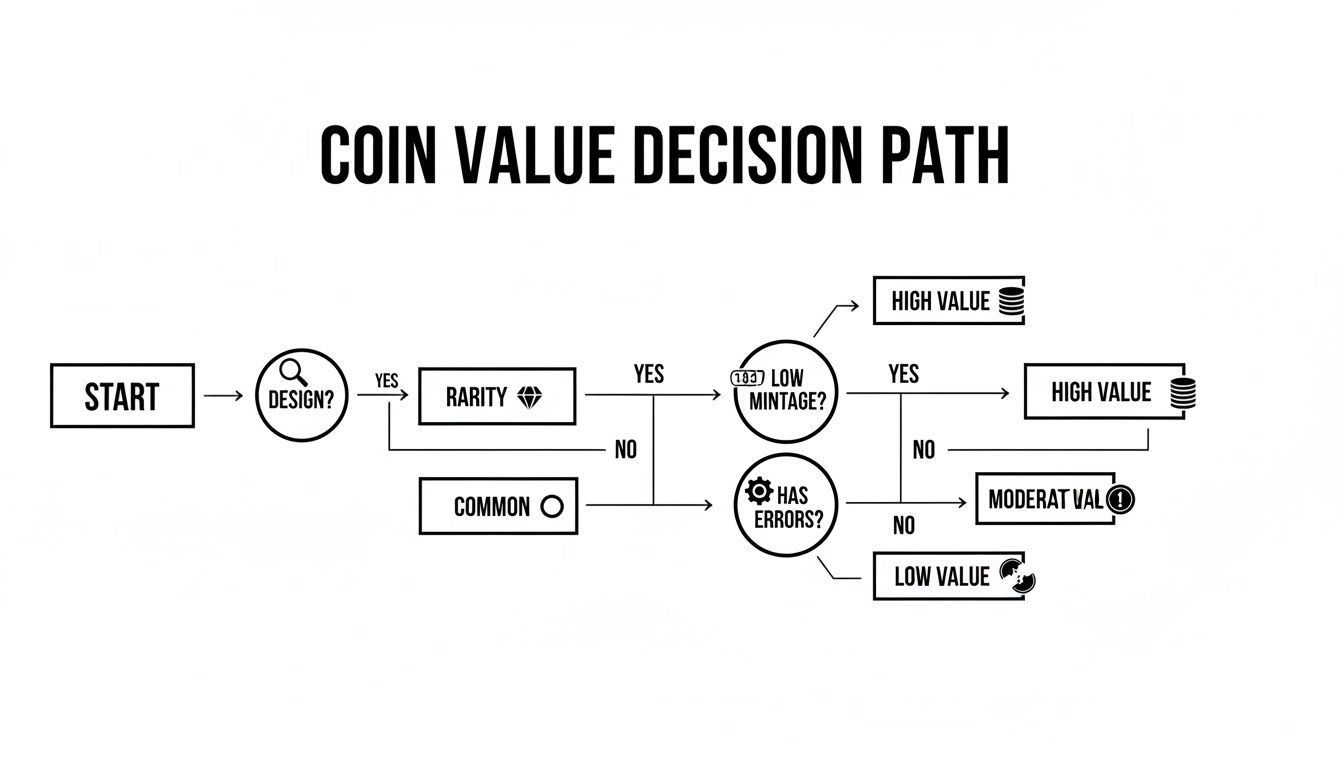
As you can see, condition is a massive multiplier. A rare coin is great, but a rare coin in fantastic condition? That's where the real value lies.
How Scratches and Dings Affect Price
Even the smallest imperfections can have a huge impact on what a coin is worth. For a common, everyday coin, the difference between a circulated and an uncirculated version might only be a couple of pounds. But when you're talking about a genuinely rare coin, the gap can be enormous.
A rare coin in circulated condition might sell for £50. That very same coin, in perfect uncirculated condition, could easily command £500 or more. Rarity creates the potential for value, but condition is what truly realises it.
Why the huge jump? Simple. Serious collectors are always on the hunt for the "best of the best" to add to their collections. While there might be plenty of worn examples of a rare coin floating around, finding one in pristine, untouched condition is another story entirely. It’s this scarcity of quality that sends prices soaring.
So, the next time you get a particularly shiny, new-looking coin in your change, take a second. Popping it into a protective holder instead of letting it rattle around with your other keys and coins could be one of the smartest collecting moves you ever make.
Rare and Collectable Pound Coins to Look For
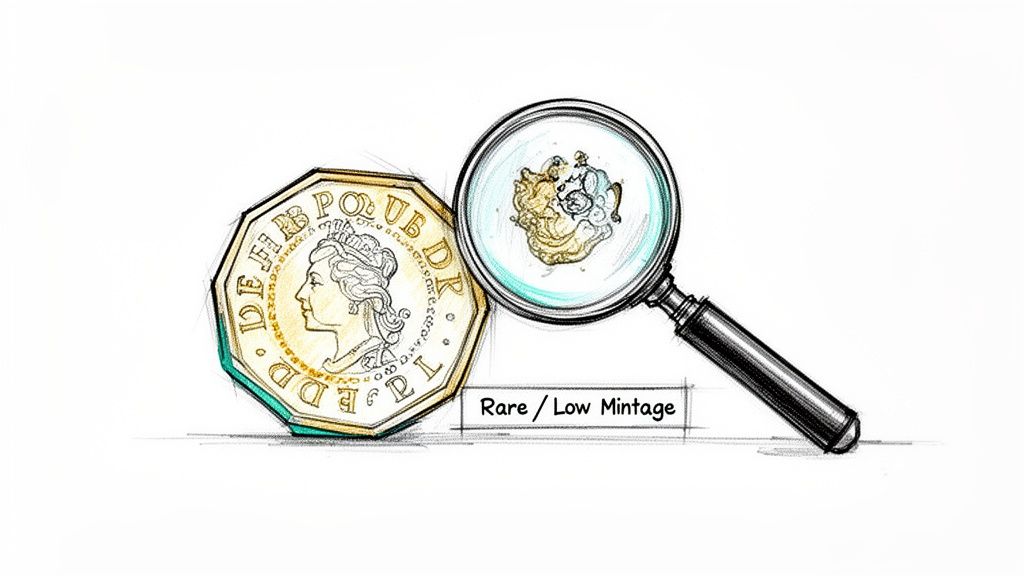
Now that you've got the essentials of mintage and condition down, we can get to the fun part—the treasure hunt. This is where we put the theory into practice and start looking for specific pound coins that are genuinely worth finding. Knowing which ones to pull out of your change can be the difference between a pound and a nice little windfall.
Some coins are valuable simply because so few were ever made, making them scarce from the moment they left the mint. Others get their value from being special one-off commemorative designs or, even more excitingly, from having a documented mistake from the production line. Let's dig into some of the most sought-after examples you might just find.
The Holy Grail of Round Pounds
When you talk about valuable round pounds with collectors, one coin always seems to come up: the 2011 Edinburgh City £1 coin. It was part of the Capital Cities series, but what makes it stand out is its incredibly low mintage. Only 935,000 of these were ever struck for circulation.
That tiny number makes it the rarest non-Olympic round pound out there. To give you some context, the very first Royal Arms Shield £1 from 1983 had a mintage of over 443 million. The scarcity of the Edinburgh coin has sealed its reputation as a must-have for any serious collector, and finding one is a genuinely great feeling.
The Edinburgh City £1 coin is a perfect example of how mintage directly translates to value. Its sub-one-million production run makes it a modern classic, consistently sought after in the collecting community.
Its sister coin from the same year, the 2011 Cardiff City £1, is also one to watch out for. With a mintage of just 1.6 million, it's not quite as rare as the Edinburgh design, but it's still a fantastic find.
Minting Errors That Create Immense Value
While a low mintage figure is a solid sign of rarity, nothing gets a collector's heart racing like a genuine minting error. These are mistakes made during production, and because The Royal Mint has such strict quality control, very few ever make it out into the wild. This makes them exceptionally valuable.
One of the most talked-about errors involves the lettering around the edge of the old round pounds. Many designs had an inscription like "DECUS ET TUTAMEN" (An ornament and a safeguard). Sometimes, things didn't go to plan.
- Upside-Down Lettering: A lot of people think upside-down edge lettering is a rare mistake. In reality, the orientation of the inscription was completely random, so this doesn't add any value.
- Wrong Inscription: The real prize is finding a coin with the wrong edge inscription for its design and year. This is a confirmed error and can significantly boost the value of a pound coin.
- Mule Coins: As we touched on earlier, a "mule" is a coin struck with mismatched dies. The 2014 Royal Arms £1 coin, which was accidentally struck with the Flowers of the UK reverse design, is a brilliant example of a modern, valuable mule.
A Quick Guide to Sought-After Pound Coins
Knowing exactly what you're looking for is half the battle. This table breaks down some of the most famous and collectable UK pound coins, explaining why they're so desirable and what they might be worth. Remember, these values are just estimates and can shift based on market demand and, most importantly, the coin's condition.
Examples of Sought-After UK Pound Coins and Estimated Values
This table highlights some of the most collectable UK pound coins, their mintage figures, and typical value ranges based on condition.
| Coin Name / Design | Year | Reason for Rarity | Estimated Value Range (Circulated to Uncirculated) |
|---|---|---|---|
| Edinburgh City | 2011 | Mintage of only 935,000 | £10 - £25 |
| Cardiff City | 2011 | Mintage of 1,615,000 | £8 - £18 |
| London City | 2010 | Mintage of 2,635,000 | £5 - £12 |
| The Royal Arms | 2008 | Mintage of 3,910,000 | £4 - £10 |
| Kew Gardens 50p | 2009 | The rare modern coin (mintage 210k), included for comparison | £150 - £250+ |
You'll notice the Kew Gardens 50p isn't a pound coin, but we've included it as it's the gold standard for modern coin rarity. It shows just how high values can climb when mintage numbers are exceptionally low, making it a great reference point. At the end of the day, the value of these pound coins comes down to simple supply and demand—and for these coins, the supply is very, very low.
How to Sell Your Coins and Avoid Common Pitfalls
Once you've found a pound coin that seems a bit special, the real fun begins: figuring out how to turn that piece of metal into cash. For newcomers, the coin market can feel like a maze, but don't worry. With a little know-how, you can find the right buyer and make sure you get a fair price for your find.
It all comes down to picking the right place to sell and making your coin look its best.
There are really three main routes you can take, and each has its own quirks. Knowing the difference will help you choose the best path for your specific coins.
- Online Marketplaces (like eBay): This route gives you a massive audience but means you're in charge of everything, from taking good photos to packing and posting.
- Specialised Coin Dealers: A dealer is your quick and easy option. They offer an expert opinion and an instant sale, but you'll trade a bit of the top-end price for that convenience.
- Auction Houses: If you’ve stumbled upon something truly rare and valuable, an auction house is the way to go. They can achieve incredible prices, but it's a slower process and they take a cut.
Choosing Your Selling Platform
For most people dipping their toes into selling, online marketplaces like eBay are the first port of call. You get direct access to a huge number of collectors, but there's a big catch. The site is absolutely flooded with listings for bog-standard coins priced at silly amounts, which creates a lot of confusion for everyone.
Here's a pro tip for cutting through the noise on eBay: always filter your search by 'Sold Items'. This shows you what people have actually paid for a coin, not the fantasy prices sellers are hoping for. It’s a simple click that gives you a much more realistic idea of your pound coin's value.
On the other hand, going to a professional coin dealer is a much more straightforward experience. You'll get an immediate, expert appraisal and often a cash offer right there and then. It's the fastest way to sell, especially if you have a handful of coins or a whole collection. You might not get the absolute peak market price, but you're paying for a hassle-free, expert service. Our guide on how to sell a coin digs deeper into the process of working with dealers.
Presenting Your Coins to Attract Buyers
It doesn’t matter where you sell – presentation is everything. Good, clear photos are an absolute must. You need to take pictures of both the front (obverse) and the back (reverse) in bright, natural light. If your coin has a unique feature, like an error or a cool edge inscription, get a separate close-up shot of that too.
Your description needs to be honest and give all the key details. Mention the year, the design, and be upfront about its condition. If there are scratches, dinks, or anything unusual, say so. Being honest builds trust and saves you from potential headaches with buyers down the line.
Avoiding Scams and Common Pitfalls
Sadly, where there's money, there are potential pitfalls. The biggest one to keep an eye out for is fakes. If someone is offering you a price that seems way too good to be true for a "rare" coin, it probably is. Be very wary of any private offers that try to pressure you into a quick decision.
Another common mistake is confusing post-mint damage with a valuable error. A coin that’s been scratched, dented, or otherwise damaged after it left The Royal Mint is not a rare error coin; it's just a damaged coin. Genuine minting errors are very specific and well-documented. Always do your homework before you list something as a "rare error"—it protects your reputation and ensures you don't mislead potential buyers.
Your Pound Coin Questions Answered
Diving into the world of coin collecting always sparks a few questions, especially when you're trying to figure out what your coins are actually worth. Let's tackle some of the most common queries we get, helping you make sense of your collection with confidence.
Are Old Round Pound Coins Still Worth Anything?
They certainly are, but it really depends on which one you're holding. Although they were taken out of circulation and you can't spend them in shops anymore, they haven't lost their face value. Most high street banks will still let you deposit them for £1.
The real excitement, though, is in the rare designs. Certain coins, like the highly sought-after 2011 Edinburgh City £1, are worth a great deal more to collectors.
What Is the Rarest Pound Coin?
For the classic round pounds, the undisputed champion of rarity is the 2011 Edinburgh City £1, with a tiny mintage of just 935,000. It’s the one every collector is looking for.
When it comes to the newer 12-sided coins, the real rarities are the trial pieces from 2015. These were never meant for circulation, which makes them incredibly desirable. As a general rule of thumb, any coin with a mintage under one million is one to watch.
Do Minting Errors Always Make a Coin Valuable?
Not always. The value of an error all comes down to how rare and obvious it is.
- Valuable Errors: Think big, dramatic mistakes. "Mule" coins, where the wrong obverse and reverse dies are paired, or coins struck on the wrong type of metal are exceptionally rare. These can fetch hundreds, sometimes even thousands, of pounds.
- Common Variations: On the other hand, you have minor quirks. A slightly off-centre strike or the "fried egg" look on some bimetallic coins are quite common and don't add much, if any, value.
The key is learning to spot the difference between a genuine, valuable error and a simple production hiccup.
Why Do I See Common Coins Listed for Thousands on eBay?
It's a common trap for new collectors. You'll often spot listings for perfectly ordinary pound coins with eye-watering price tags. These are almost never a reflection of the coin's true value.
Some sellers are just hoping an inexperienced buyer will take the bait. Others might be using a clever tactic to make their other overpriced coins look like a bargain by comparison.
The single best trick for finding a coin's real market price is to use the "Sold Items" filter on eBay. This cuts through the noise and shows you what people have actually paid for a coin, not the fantasy prices sellers are asking for. It gives you a much truer picture of a pound coin's value.
At Cavalier Coins Ltd, we provide fair, expert valuations based on real market data. Whether you're looking to sell a single rare coin or an entire collection, explore our extensive selection and professional services at https://www.cavaliercoins.com.