
Trying to figure out the price for a silver coin can feel like a bit of a mystery. On one hand, a common one-ounce modern silver coin might fetch around £25-£30, a price that sticks closely to the day-to-day silver market. On the other, a rare historical coin could be worth thousands. It’s a huge range, but this guide is here to clear up the confusion and show you how to understand a coin's real worth.
Decoding the True Value of Your Silver Coins
Welcome to our definitive guide on getting to grips with the price of silver coins. Whether you're a seasoned collector, just starting out, or even handling a charitable donation, knowing what a silver coin is really worth is absolutely essential. We’ll break down all the moving parts that determine its value, from the raw silver content (its bullion value) to its desirability as a collector's item (its numismatic value).
We're going to translate industry jargon like 'spot price' and 'dealer premiums' into plain English. Getting your head around these concepts is the first, and most important, step to making smart decisions in the UK coin market.
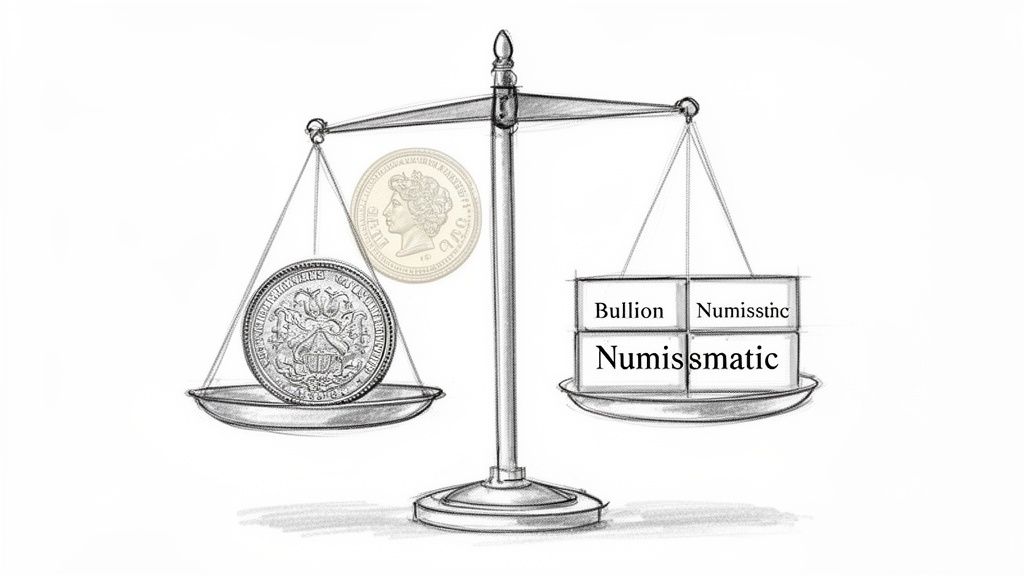
Bullion vs Numismatic Value
At its core, every silver coin has two potential sources of value. It's really important to understand this difference, as it’s the foundation for how any coin is priced.
- Bullion Value: Think of this as the coin's raw, intrinsic worth. It's determined purely by the weight and purity of the silver inside it—essentially, its 'melt value' which moves up and down with the global commodity markets.
- Numismatic Value: This is the extra value a coin has to collectors. This 'collector's premium' is driven by things like how rare it is, its history, its condition, and how much other people want it.
A coin’s final price is almost always a blend of the two. For instance, a modern British Silver Britannia is valued almost entirely on its bullion content. In stark contrast, a rare Victorian Crown's value is overwhelmingly numismatic; the silver it contains is just a small part of its story. You can dive deeper into this with our guide on the silver content of various coins to learn how to spot their metal worth.
By the time you finish this guide, you’ll have a solid framework for assessing any silver coin. It will help you buy wisely, sell with confidence, and truly appreciate the dual nature of these fascinating and valuable assets.
The Foundation of Value: Spot Price and Melt Value
Every silver coin, whether it's a centuries-old relic or a freshly minted bullion piece, has a rock-bottom price based on the metal it’s made from. We call this its melt value. This fundamental worth is tied directly to the global spot price of silver—the live, constantly changing wholesale price for one troy ounce of the metal on the commodity markets.
Think of the spot price as the cost of flour for a baker. It's the price of the raw ingredient before any skill, labour, or other costs are factored in to create the final loaf of bread. In the same way, a coin's melt value is its baseline price before any collector appeal, minting costs, or dealer profits are added on top.
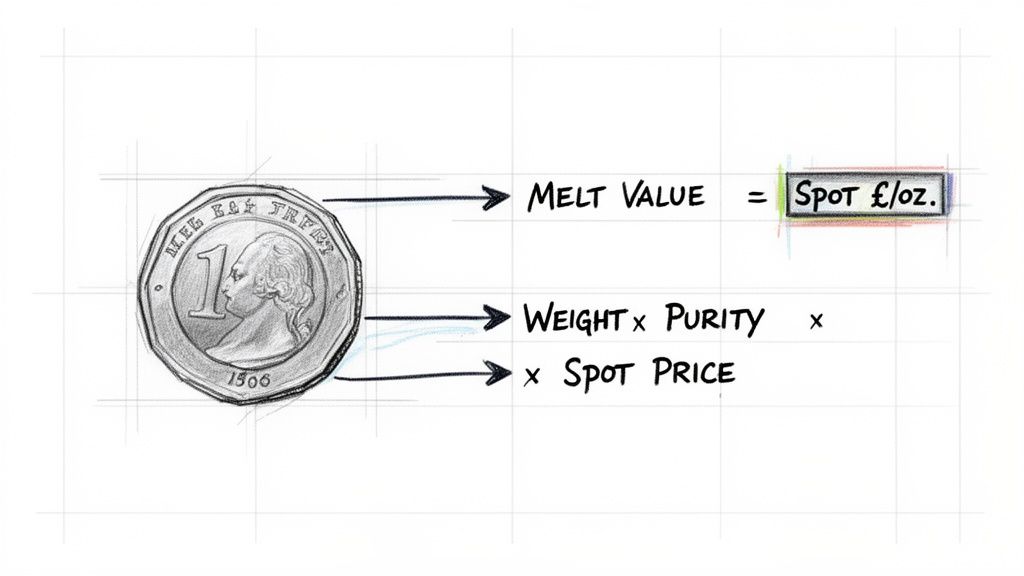
This spot price shifts throughout the day, nudged up and down by global supply, demand, and economic news. You can easily find the current UK spot price in pounds sterling (£) on the websites of reputable bullion dealers and financial news outlets. Getting your head around this concept is the crucial first step to understanding what any silver coin is truly worth.
How to Calculate a Coin's Melt Value
Once you've got the spot price, working out the melt value is refreshingly simple. You just need two other bits of information: the coin's weight and its silver purity (often called 'fineness').
The formula is straightforward:
Silver Weight in Troy Ounces x Purity x Current Spot Price = Melt Value
Let’s run through a couple of real-world examples to see it in action.
-
Example 1: A Pre-1947 British Shilling
- These older coins contain 50% silver and weigh about 0.1818 troy ounces. If we say the spot price is £24 per troy ounce, the sum looks like this: 0.0909 (the actual silver weight) x £24 = £2.18. That's the coin's intrinsic silver worth.
-
Example 2: A Modern 1oz Silver Britannia
- Minted since 2013, these popular coins are 99.9% pure silver (.999 fineness) and weigh exactly one troy ounce. Using that same £24 spot price, the melt value is: 1 oz x 0.999 x £24 = £23.98.
This simple calculation instantly reveals the minimum value you should ever expect for your coin. If you're offered less, you're essentially selling the silver for below its market rate. It sets a non-negotiable baseline for every valuation.
The difference between the two examples really brings home why purity matters so much. The Britannia's value is almost entirely its silver content, while the old shilling's worth is far more modest. If you're looking at modern investment-grade pieces, you can explore the nuances between different bullion silver coins and their pricing in our detailed article.
Understanding this foundation is vital. It stops you from overpaying when you buy and from being short-changed when you sell. It’s the bedrock upon which all other pricing factors are built.
Beyond Melt Value: Understanding Premiums and Numismatics
Ever wondered why a one-ounce silver coin almost always costs more than the spot price of an ounce of silver? The answer isn't just about the metal. It comes down to two crucial concepts that build on a coin's basic melt value: premiums and numismatic value. Getting your head around these is the key to figuring out the real price of silver coins.
A premium is simply the amount tacked on top of the silver spot price. You can think of it as the coin’s ‘making and handling’ fee. This extra cost covers everything from the complex process of minting the coin to getting it into your hands, including distribution, dealer overheads, and a small profit margin.
Take a brand-new Silver Britannia from The Royal Mint, for example. It will carry a noticeable premium. You're not just buying silver; you're paying for the mint's reputation, the coin's advanced security features, and its recognised quality. On the other hand, a generic one-ounce silver 'round' from a private mint will usually have a much lower premium because its production costs and brand recognition are lower.
The Power of Numismatic Value
While premiums explain why a standard bullion coin costs more than its weight in silver, numismatics is where pricing can get really interesting—and often, much higher.
Numismatic value is all about what a coin is worth to a collector. This value can completely overshadow its silver content. It’s the story, the rarity, and the artistry of the coin that collectors are chasing.
This value is driven by a few critical factors:
- Rarity: How many were actually made? A coin from a limited-edition proof set is naturally going to be scarcer and more desirable than a coin produced by the millions.
- Condition (Grade): Has the coin been knocked about in circulation, or does it look like it just left the mint yesterday? A coin in pristine, uncirculated condition will always fetch a much higher price than a heavily worn one.
- Historical Significance: Does the coin mark a major event or represent a unique moment in history? A coin from the short reign of a monarch, for instance, carries a historical weight that adds massively to its appeal.
- Collector Demand: At the end of the day, a coin is only worth what someone is willing to pay. Popular designs, beautiful artwork, or coins needed to complete a specific collection can create fierce demand, driving prices sky-high.
Imagine you have two silver shillings from the exact same year. One is worn smooth from a century of changing hands, while the other was tucked away in a drawer, preserving its original shine. Even though their silver melt value is identical, their numismatic value—and their final price tag—will be worlds apart.
From Pence to Pounds: A Real-World Example
Let's look at a 1932 George V silver florin.
Based on its silver content alone, its melt value might only be a few pounds. However, this particular year had an incredibly low mintage of just 154,000 coins, making it what's known as a 'key date' for collectors. Find one in great condition, and you could see it sell for over £200 at auction.
This is a perfect illustration of numismatics in action. The coin's real value isn't in its 11.3 grams of 50% silver; it's in its rarity and the intense demand from collectors desperate to complete their George V series. Its unique story transforms it from a simple piece of silver into a prized historical artefact, showing just how much collector interest can inflate the price of a coin.
How Market Volatility Shapes Silver Coin Prices
The price of silver isn’t set in stone. It’s a living, breathing figure that moves with the rhythm of global economic and political events. Market sentiment, speculation, and worldwide crises can cause dramatic price swings, turning a modest bullion coin into a far more valuable asset almost overnight. Understanding these volatile moments is crucial for any collector or seller.
Silver is often seen as a ‘safe haven’ asset. When traditional investments like stocks and shares feel uncertain, investors tend to flock to precious metals. This surge in demand naturally drives up the price. This isn't just theory; history gives us some powerful examples of just how quickly the market can react.
The Hunt Brothers and the 1980 Peak
One of the most legendary episodes in silver's history happened back in 1980. Two wealthy American businessmen, the Hunt brothers, attempted to corner the global silver market by buying up enormous physical quantities and futures contracts. Their actions created an artificial squeeze on the world's supply.
This aggressive speculation caused an absolute frenzy, pushing silver prices to heights no one had ever seen. For a brief, chaotic period, the price for silver coins with high bullion content shot up dramatically, reaching a nominal peak of around £29 per ounce in the UK. The bubble eventually burst, but it remains a stark lesson in how concentrated buying pressure can distort the market.
The 2011 European Debt Crisis
For a more recent example of how economic fears influence silver, let's fast-forward to 2011. The European debt crisis rattled markets from Athens to Westminster, and investors once again looked for safety. This fuelled another feverish peak, with silver prices in the UK hitting a nominal high near £73.09 per ounce.
That price was a huge jump from the post-2008 lows of around £10, with some metrics showing a massive 43.09% monthly surge. It was a clear echo of global uncertainty, as Eurozone troubles pushed investors straight into precious metals. You can explore more of silver's historic price movements at The Gold Bullion Company.
These historical peaks serve as a powerful reminder: the underlying bullion market is a massive force. While numismatics add value, major global events can profoundly and rapidly change the fundamental price for all silver coins, affecting buyers, sellers, and collectors alike.
A Practical Guide to Valuing Your Silver Coins
Right, with the basics of spot price and premiums under our belts, it's time to roll up our sleeves and get practical. Figuring out what your silver coins are actually worth isn't guesswork; it's a methodical process. Let's walk through the steps together, so you can find a realistic and fair price for any coin you hold.
The journey always begins with identification. You simply have to know what you're looking at. Grab a magnifying glass and note down the country it came from, the date on the coin, its denomination (like a shilling or a crown), and any little mint marks you can spot. These details are your starting clues.
Once you know what the coin is, a quick search online will tell you its original specifications, including its weight and silver purity. Websites like Numista are fantastic for this, as is the official Royal Mint site for British coins. With that information, you can calculate the baseline melt value we talked about earlier.
Researching the Current Market Value
Calculating the melt value gives you a floor price—the absolute minimum it's worth. The real detective work, however, is in uncovering its numismatic value. This is where you investigate what collectors are actually paying for a coin like yours.
The easiest place to start is by checking the 'sold' listings on platforms like eBay. It's absolutely crucial to look at what items have already sold for, not the wishful thinking prices on current listings. Sold prices show you the genuine market demand for a coin in a similar condition to the one in your hand.
This simple, repeatable process is the core of valuing any silver coin you come across.
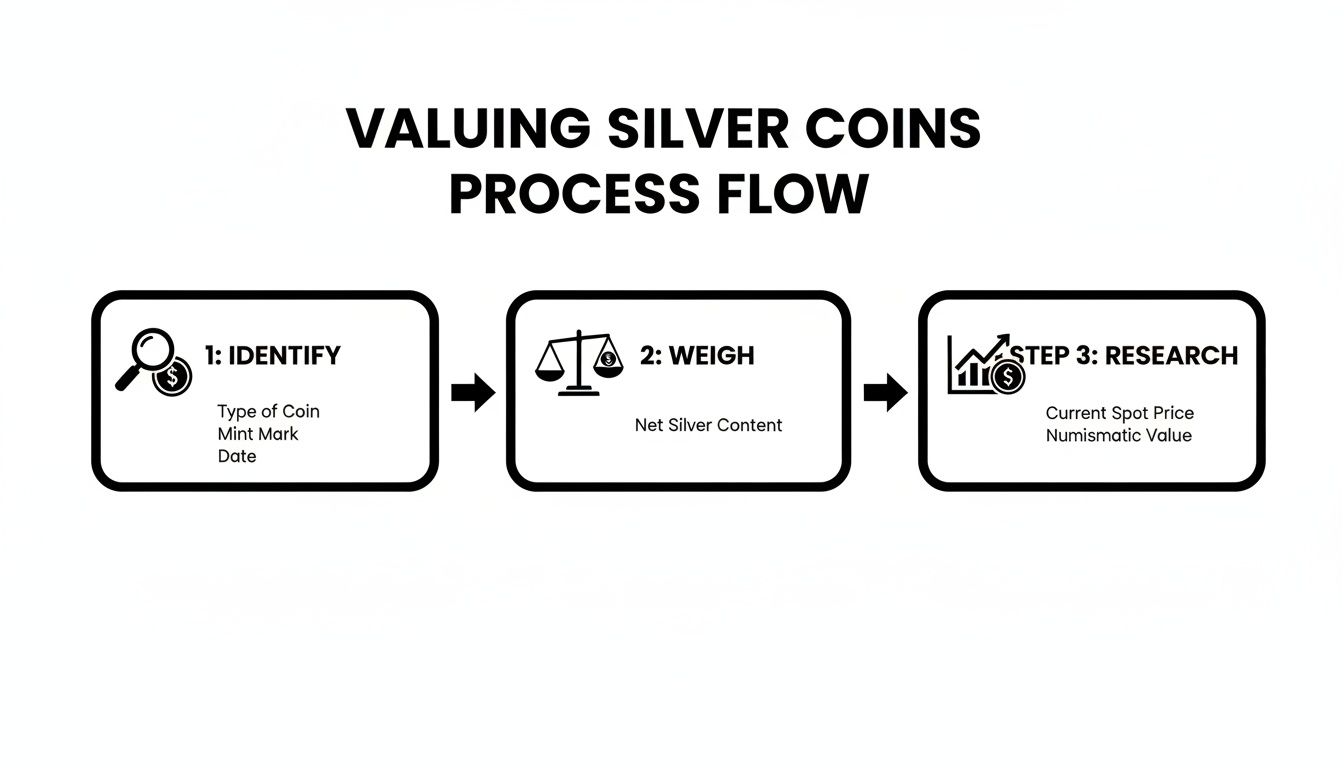
This three-step loop—Identify, Weigh, and Research—is a reliable framework for assessing any coin, from a common bullion piece to a potential hidden gem.
To give you a clearer picture, here’s a quick comparison of the common valuation methods.
Valuation Methods At a Glance
| Method | Best For | Pros | Cons |
|---|---|---|---|
| Melt Value Calculation | Common bullion or heavily worn "junk silver" | Quick, easy, and provides a solid price floor. | Ignores all numismatic value; you could miss out on significant profit. |
| Sold Listings Research | Most collectible coins, from common to semi-rare. | Gives a real-time snapshot of what the market is willing to pay. | Can be time-consuming; requires comparing coins of similar condition. |
| Printed Price Guides | Getting a standardised benchmark for graded coins. | Provides established, expert-researched price ranges. | Can be outdated; market prices often move faster than print schedules. |
| Professional Appraisal | High-value rare coins or large, complex collections. | The most accurate assessment from an expert with deep market knowledge. | Costs money; not practical for low-value individual coins. |
Each method has its place, and the best approach often involves using a combination of them to build a complete picture of your coin's worth.
Printed Guides and Professional Appraisals
Don't forget the old-school approach. A printed price guide, like the annual "Coins of England & the United Kingdom" by Spink, can be an invaluable tool. These catalogues give you estimated values based on a coin's specific grade, offering a standardised reference point. Just remember they are guides, and the live market can, and does, fluctuate.
For particularly rare coins or if you've inherited an entire collection, getting a professional appraisal is the wisest path forward. A reputable dealer can accurately grade your coins and give you a valuation rooted in genuine market expertise. While silver coins have their unique factors, the core principles are universal; you can learn more about how to determine product price across different sectors.
Ultimately, a coin's final price is a combination of its intrinsic metal worth and what the collector market is willing to pay at that moment. By blending melt value calculations with solid market research, you can arrive at a confident and accurate valuation.
Smart Strategies for Buyers, Sellers, and Charities
Your game plan for the silver market really depends on what you're trying to achieve. The best approach for a buyer is worlds away from that of a charity trying to turn a donation into cash. Whether you're buying, selling, or handling a large collection, you need a strategy that fits your specific situation.
Knowing where you stand helps you get the best possible price for your silver coins, sidestep common traps, and make the most of your assets. Let's break down the different tactics for each group.
Advice for Buyers
If you're buying, knowledge is your best friend. Getting a fair price starts with a bit of homework. Always, and I mean always, check the current spot price before you even think about buying. You should also have a good feel for what a reasonable premium is for the type of coin you're looking at. A modern bullion coin, for example, will carry a much smaller premium than a rare, graded numismatic coin.
Keep an eye out for red flags that can tank a coin's value. One of the biggest offenders is improper cleaning. A coin that’s been polished or scrubbed might look shiny to the untrained eye, but an expert will spot the tiny scratches and lack of original patina from a mile away. This kind of "help" can absolutely destroy its value to a serious collector.
Always ask about a coin's history, or its 'provenance'. A trustworthy seller will be open about a coin's condition and background, which helps you make a smart decision and avoid a very expensive mistake.
Maximising Returns for Sellers
For sellers, it’s all about timing and tactics. To get the best return, you want to sell when the market is on your side. While nobody has a crystal ball, selling when the silver spot price is high gives you a much better starting position, especially if your collection is mostly bullion.
Think back to 1980, when the Hunt Brothers tried to corner the silver market. The price shot up to a nominal high of around £29.29 per troy ounce here in the UK. It was a wild ride, but it shows how market spikes can create golden (or silver) opportunities for sellers. You can see these historical movements for yourself by checking the silver price history at Chards Coin and Bullion Dealer.
You also have a big decision to make: sell to a dealer or go to auction? A dealer offers a quick, straightforward sale with immediate payment. An auction, on the other hand, might take longer but could bring in a higher price for particularly rare or sought-after coins by putting them in front of a room full of competing collectors. Our guide on how to sell silver coins can help you figure out which path is right for you.
Solutions for Charities and Bulk Collections
Charities often get landed with large, mixed collections of donated coins. The sheer task of sorting, identifying, and valuing hundreds or even thousands of individual pieces can be completely overwhelming without specialised expertise.
In these cases, the most practical solution is to work with a dealer who has experience buying entire collections. It's what we do. We offer a service designed to take that entire process off your hands, providing a simple way for charities to convert donated coins into much-needed funds without the logistical nightmare. This lets organisations get back to what they do best, knowing they've received a fair and honest price for the whole lot.
Where Do You Go From Here?
You’ve now got a solid grasp of how a silver coin gets its price tag, from the ever-shifting global spot price to the more subtle art of numismatic value. If there's one key takeaway, it's this: a coin's final worth is always a blend of its raw material and its unique story.
This knowledge gives you the confidence to calculate melt value, investigate collector demand, and see how the bigger market picture affects your own holdings. Whether you're looking to build a personal collection, sell an inherited estate, or simply manage a portfolio, you have the essential tools to make a smart move.
Putting Knowledge into Practice
The best way to truly understand all this is to get your hands dirty. Start small. Pick out a few coins from your own collection and walk through the process we've outlined.
First, identify the coin. Then, find its purity and calculate its melt value. Finally, hop online and check sold listings to see what similar pieces are actually selling for in today's market. There’s no substitute for this kind of hands-on experience; it’s the quickest way to build real confidence in your own valuation skills.
The true value of a silver coin isn’t just a number. It’s a story told through its metal, its history, and the hands it has passed through. Your ability to read that story is your greatest asset in this field.
Your Journey Is Just Beginning
The world of silver coins is incredibly rich, rewarding, and steeped in fascinating history. There is always more to discover, whether it's a rare mint mark you've never seen before or an obscure historical issue that suddenly grabs the market's attention.
Think of this guide as your foundation. Keep an eye on the silver market, stay curious, and never stop learning. Your journey into the rewarding world of silver coins is just getting started, and this solid groundwork will help you navigate every step of the way, successfully and profitably.
Whether you're looking to buy your first piece, sell a collection, or simply learn more, Cavalier Coins Ltd is here to help. Explore our extensive collection of rare and interesting coins and banknotes from around the world at https://www.cavaliercoins.com.