
When we talk about a "silver content coin," we're referring to any coin that isn't just symbolic but is made from an alloy with a measurable amount of pure silver. This is important because its value is often directly linked to its actual silver weight, making it a solid, tangible asset for both collectors and investors.
Decoding Silver Content in Your Coins
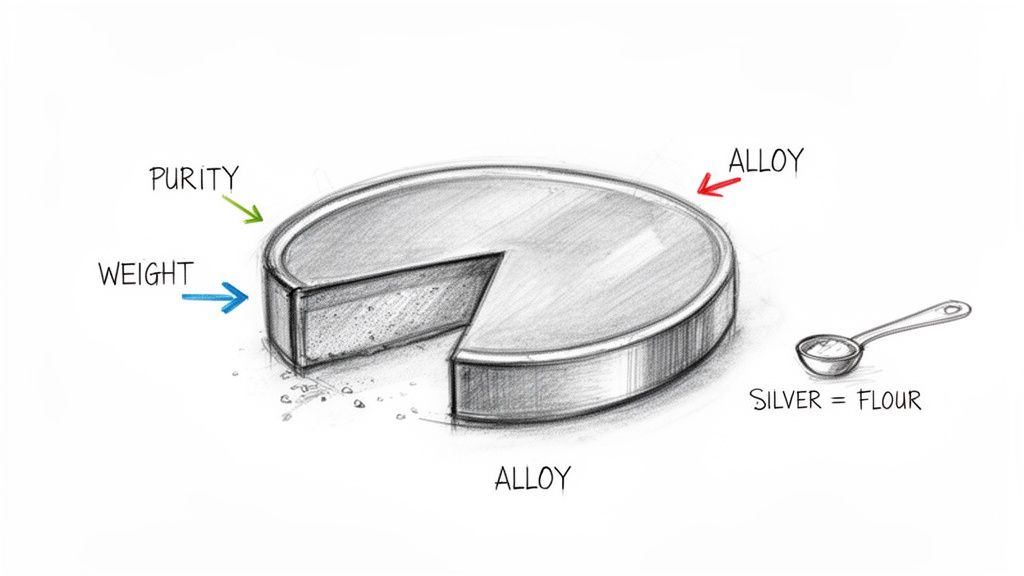
Ever picked up an old coin and wondered what it's really worth? The secret is understanding that it has two different values. First, there’s its bullion value—the raw market price of the precious metal inside. Then, there's its numismatic value, which is what a collector might pay based on its rarity, condition, and story.
The foundation of any silver coin’s bullion value is, you guessed it, its silver content. I like to think of it like baking a cake where silver is the flour. The total weight of the cake isn't just flour; you’ve got eggs, sugar, and other bits. It's the same with coins. Most silver coins aren't pure silver; they're alloys, meaning silver is mixed with other metals like copper to make them tougher and more durable.
Understanding Fineness and Purity
So, to figure out how much "flour" is in your coin "cake," you need to get to grips with its fineness. Fineness is simply a measure of purity, usually written as parts per thousand. For instance, a coin stamped with ".925" is 92.5% pure silver. This particular purity is famously known as sterling silver, a standard that’s been used in British coinage for centuries.
Key Takeaway: A coin's total weight and its silver weight are two different things. The purity percentage, or fineness, is the magic number you need to work out how much actual silver you're holding.
As you explore coins from around the world, you'll come across all sorts of purities. Here are a few common ones to get you started:
- Sterling Silver (.925): This is 925 parts silver for every 1,000 parts, with the other 75 parts usually being copper. You’ll find this in many historic British coins.
- 50% Silver (.500): Just as it sounds, these coins are half silver and half base metal. This was a common recipe during times of economic strain, like in UK coinage between 1920 and 1946.
- Fine Silver (.999): Modern bullion coins, such as the Canadian Maple Leaf or the American Silver Eagle, are often made of .999 or even .9999 fine silver. They’re about as pure as it gets.
Really getting to know what coins are made of is the most fundamental skill for any valuation. Pinpointing the exact silver content is the first real step to unlocking a coin's true worth, separating it from those made of more common metals. This knowledge lets you look right past the face value and see the real asset in your hands.
How to Calculate a Coin's Silver Value
Right, let's get to the practical bit. Knowing what a coin is made of is one thing, but turning that into a real-world monetary value is where the fun starts. This is how you figure out a coin's rock-bottom worth, what we call its "melt value" or "intrinsic value."
Don't worry, you won't need a degree in mathematics. The formula is refreshingly simple and just needs three key bits of information.
The Silver Value Formula: Total Coin Weight (in grams) x Silver Purity (%) x Current Silver Price (per gram) = Intrinsic Silver Value
Let's walk through each part of that equation. By the end, you'll be able to work this out for any silver coin that comes your way.
Step 1: Find the Coin's Total Weight
First up, you need the coin's total weight. For the best accuracy, a digital scale that measures in grams to at least one decimal place is your friend here. A kitchen scale might do the job if you're in a pinch, but a proper jeweller's scale is what the pros use.
Remember, this total weight is just our starting point. Think back to our cake analogy – this is the weight of the entire cake, not just the silver "flour" inside it.
Step 2: Determine the Silver Purity
Next, you need to know the coin's fineness, or purity. This is simply the percentage of actual silver within the coin's metal mix. A quick search online for the coin's type and year will usually give you the answer.
You'll come across a few common purities time and again:
- .999 (99.9%): Pure silver. You'll find this in modern bullion like the Canadian Maple Leaf.
- .925 (92.5%): The classic sterling silver standard, used in all British coins before 1920.
- .900 (90.0%): A common standard for older US silver, like the iconic Morgan and Peace Dollars.
- .500 (50.0%): Used for UK coinage in the period from 1920 right up to 1946.
Getting this number right is the key to separating the value of the silver from the other metals in your calculation.
Step 3: Use the Current Silver Spot Price
The last piece of the puzzle is the spot price of silver. This is the live market price for one troy ounce of silver, and it moves up and down all day long. You can find it easily on any financial news site or the websites of precious metal dealers.
Now, this is the crucial part. The spot price is almost always quoted per troy ounce, which is 31.1 grams. Since you weighed your coin in grams, you need to get the price per gram. It’s easy – just divide the spot price by 31.1.
Worked Examples: Putting It All Together
Let's run through the formula with a couple of real-world coins.
Example 1: A Pre-1920 British Shilling
- Weight: A standard sterling silver shilling from this era weighs 5.66 grams.
- Purity: It's sterling silver, so we know the purity is .925 (or 92.5%).
- Silver Price: Let's say the spot price is £24.00 per troy ounce. Our price per gram is £24.00 / 31.1 = £0.77 per gram.
Calculation: 5.66 g x 0.925 x £0.77/g = £4.03
Just like that, the intrinsic silver value of that old shilling is about £4.03.
Example 2: A Modern .999 Fine Silver Bullion Coin A modern pure silver coin is a great example for collectors and investors. You can see from this deeper look at the bullion silver coin market how their value is almost entirely tied to this simple calculation.
- Weight: This coin weighs exactly one troy ounce, which is 31.1 grams.
- Purity: It's fine silver, meaning the purity is .999 (99.9%).
- Silver Price: Using the same spot price, our per-gram value is £0.77.
Calculation: 31.1 g x 0.999 x £0.77/g = £23.97
As you’d expect, the melt value is almost identical to the spot price. That's because it’s a pure, investment-grade piece. With these simple steps, you're now fully equipped to find the true silver worth of any coin you handle.
A Quick Reference Guide to Common Silver Coins
Right, so you've got the hang of calculating a coin's melt value. The next logical step is knowing the specs for the coins you're most likely to find in a collection. Let's be honest, sorting through a mixed bag of old currency can feel like a real chore, but having a simple guide to hand transforms that chaos into an organised, efficient process.
Think of this section as your go-to resource for quickly spotting the silver content of common coins from the UK, the US, and Canada. Instead of getting lost down a rabbit hole searching for data on every single piece, you can use the table below to find exactly what you need for your calculations.
This flowchart neatly sums up the three-step process we just covered for figuring out the intrinsic value of any silver coin.
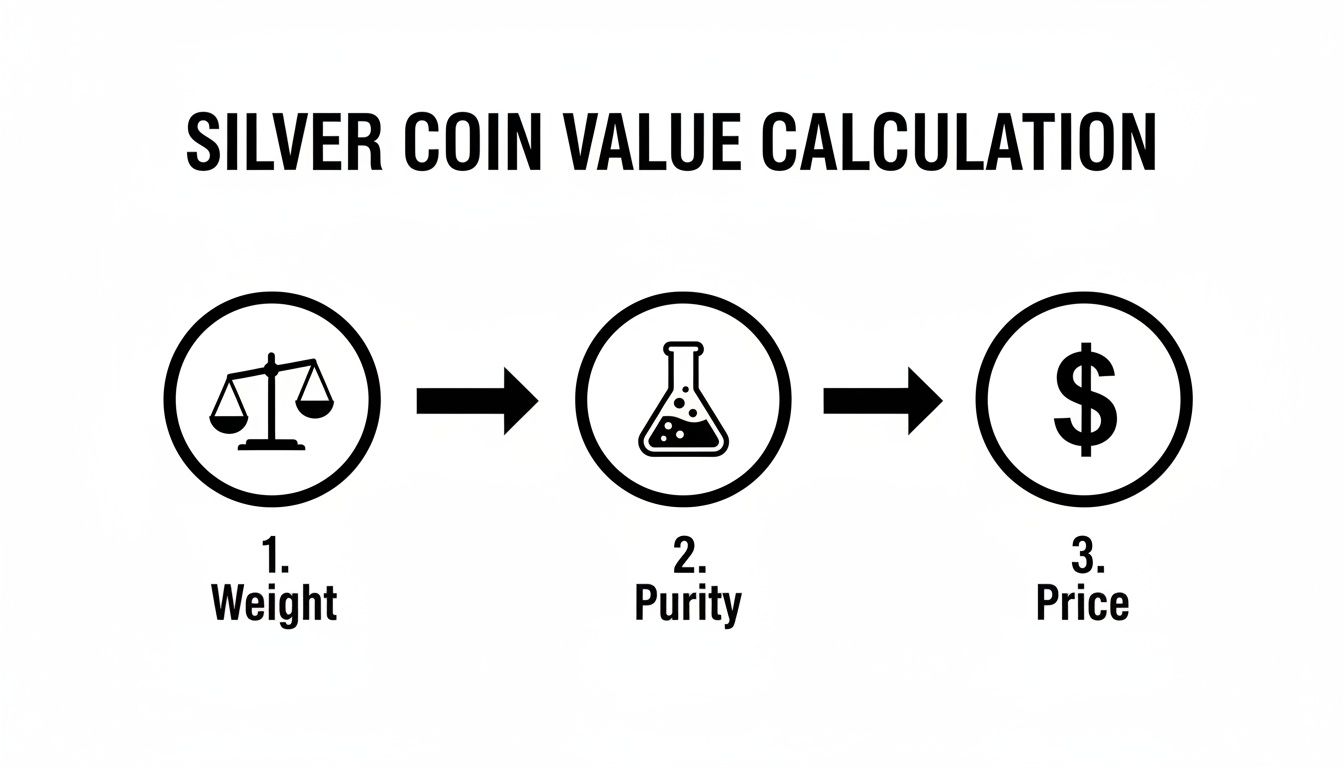
It’s a great visual reminder that finding the value is just a straightforward sequence: weigh the coin, identify its purity, and multiply by the current spot price of silver.
British Silver Coinage: A Storied History
British coins offer a fantastic glimpse into the history of silver purity. For centuries, the UK set the global standard with its sterling silver. That standard, 92.5% purity, wasn't just a number pulled out of a hat; it was a clever choice to balance real value with everyday durability.
The sterling standard, a blend of 925 parts silver with 75 parts copper, was officially established as early as 1158. This alloy made coins tough enough to survive the rough and tumble of daily trade, a serious problem that plagued the softer, purer silver coins of that era.
This remarkable consistency held for hundreds of years. You can dive deeper into the fascinating history of British silver coins over at chards.co.uk, which is a brilliant resource.
However, the economic pressures of the 20th century forced some big changes:
- Pre-1920: All silver coins were struck in classic .925 sterling silver.
- 1920–1946: The silver content was slashed to 50% (.500 fine).
- Post-1946: Aside from a few special commemorative issues, silver was completely removed from circulating British coins.
This clear-cut timeline makes sorting UK coins by date an incredibly effective first step when you're valuing a collection.
North American Silver Coins
Over on the other side of the pond, the United States and Canada were busy producing their own iconic silver coins, each with its own standards and timelines. Getting to grips with their specifications is an absolute must for anyone sorting through North American collections.
American silver coins, especially those minted before 1965, are famous for their 90% silver content (.900 fine). This includes legendary coins like the Morgan and Peace Dollars, but also the smaller dimes, quarters, and half dollars. After 1964, the US removed silver from most of its circulating coins, giving collectors a very definite cut-off point.
Canada went down a similar path, but with different numbers. From 1858 to 1919, Canadian silver coins matched the British sterling .925 standard. This was then knocked down to 80% silver from 1920 right up to the mid-1960s. After a short transition where some coins had 50% silver, the metal was removed from general circulation coins in 1968.
Silver Content of Popular World Coins
To make identifying coins as painless as possible, I’ve put together a detailed table covering some of the most popular silver coins you'll come across. Use this as your quick-reference sheet when you're sorting through any collection. For each coin, you'll find its country, key silver mintage years, total weight, purity, and the crucial Actual Silver Weight (ASW).
| Coin Name | Country | Silver Mintage Years | Total Weight (g) | Silver Purity (%) | Actual Silver Weight (g / ozt) |
|---|---|---|---|---|---|
| Crown | UK | Pre-1920 | 28.28 g | 92.5% | 26.16 g / 0.841 ozt |
| Shilling | UK | Pre-1920 | 5.66 g | 92.5% | 5.23 g / 0.168 ozt |
| Shilling | UK | 1920-1946 | 5.66 g | 50.0% | 2.83 g / 0.091 ozt |
| Morgan Dollar | USA | 1878-1921 | 26.73 g | 90.0% | 24.06 g / 0.773 ozt |
| Peace Dollar | USA | 1921-1935 | 26.73 g | 90.0% | 24.06 g / 0.773 ozt |
| Quarter | USA | Pre-1965 | 6.25 g | 90.0% | 5.62 g / 0.181 ozt |
| Silver Dollar | Canada | 1935-1967 | 23.33 g | 80.0% | 18.66 g / 0.600 ozt |
| 50 Cents | Canada | 1920-1967 | 11.66 g | 80.0% | 9.33 g / 0.300 ozt |
| Britannia | UK | Modern | 31.21 g | 99.9% | 31.18 g / 1.002 ozt |
| Maple Leaf | Canada | Modern | 31.10 g | 99.99% | 31.10 g / 1.000 ozt |
| American Eagle | USA | Modern | 31.10 g | 99.9% | 31.07 g / 0.999 ozt |
Basically, this table is your cheat sheet. By checking a coin's design and date against this data, you can instantly pull the key figures you need to calculate its melt value. It turns what was once pure guesswork into a precise and repeatable process.
Spotting the Difference Between Bullion and Collector Value
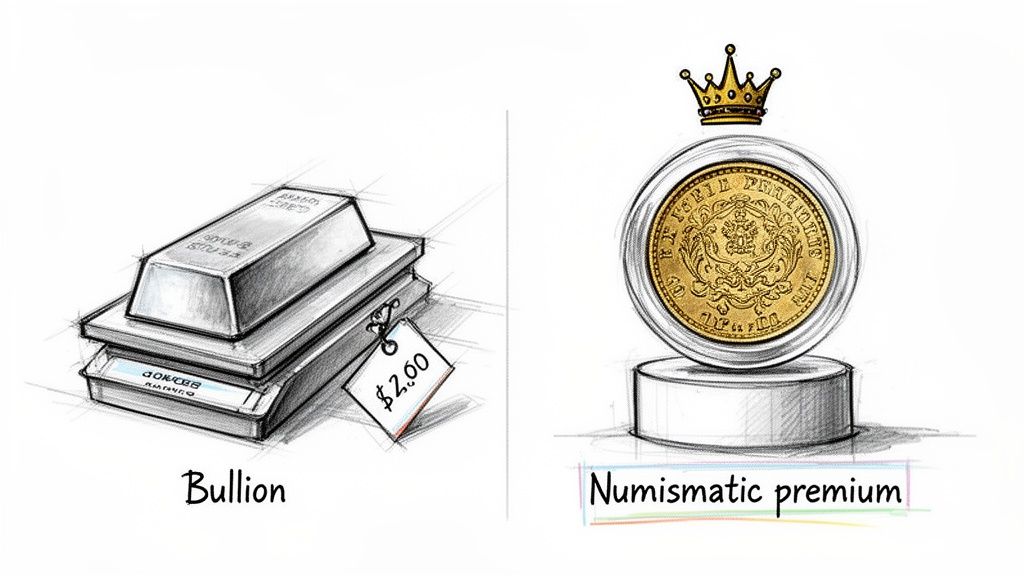
Why is one silver coin worth just a bit more than its weight in metal, while another could fetch the price of a small car? The answer comes down to the huge difference between its bullion value and its numismatic value. Getting your head around this is probably the single most important skill for anyone handling old coins.
Think of it like this. You could have a simple block of high-quality wood, or you could have an antique, hand-carved chair. Both are made of wood, but the block’s value is tied purely to the raw material. The chair's value comes from its history, its craftsmanship, its rarity, and the sheer demand from people who appreciate it. It’s the exact same principle with silver coins.
The Foundation: Bullion Value
As we’ve already touched on, every silver coin has a base value, which we call its bullion, melt, or intrinsic value. This is simply the going rate for the actual silver inside it, worked out from its weight and purity. For loads of common, heavily circulated coins, especially those in rough shape, this bullion value is all they’re really worth.
Beyond just the calculation, a deeper appreciation of the concept of intrinsic value shows why this figure is the absolute price floor. A coin will almost never be worth less than the silver it contains because, at the very worst, it can be melted down. This is your safety net, the rock-bottom value of the asset in your hand.
The Power of the Collector Premium
Now, this is where things get interesting. A coin’s value can shoot up when it develops a numismatic premium. This is the extra cash a collector is willing to pay over and above the coin’s silver value. This premium has nothing to do with the metal and everything to do with a collection of factors that make the coin desirable.
Key Takeaway: The numismatic premium is the invisible value that transforms a simple piece of silver into a sought-after collectible. Recognising this premium is what separates a savvy valuer from someone who might accidentally sell a treasure for scrap.
Several key factors work together to create this collector premium. A coin doesn't just need one of these to be valuable; it's often a combination of them that drives the price sky-high.
What Creates Numismatic Value?
So, what are these magic ingredients? The main things that drive a coin's collector appeal can be broken down into a few core areas.
- Rarity and Mintage: This is the big one. How many were ever made? Coins with low mintage figures are naturally harder to find. Maybe a specific year had a tiny production run, or an error during minting created a handful of unique variations that are now fiercely hunted.
- Condition or Grade: A coin’s state of preservation is absolutely critical. A pristine, uncirculated piece with razor-sharp details and its original mint lustre will be worth massively more than the exact same coin that’s worn smooth from decades in circulation. Professional grading services assign a score to formalise this.
- Historical Significance: Does the coin have a story to tell? Coins struck during the reign of a famous monarch, a major war, or a pivotal moment in history often carry a premium. They are real, tangible links to the past that people are desperate to own.
- Collector Demand: At the end of the day, a coin is only worth what someone is prepared to pay for it. Wildly popular series, like the American Morgan Dollar, have millions of dedicated collectors. This creates a buzzing, competitive market that keeps prices strong for the best examples.
Actionable Tips for Buying and Selling Silver Coins
Once you understand how to figure out a coin's silver value, you're ready to jump into the market. But whether you're a new collector making your first purchase or a reseller sorting through a family inheritance, you need a plan. This section lays out some proven strategies to help you buy smart and sell for the best possible price.
Making good decisions right from the start saves you from costly mistakes and makes the whole experience far more enjoyable. We'll cover everything from simple authentication tricks you can do at home to the best ways to keep your collection safe, giving you the confidence to act at every step.
Starting Your Collection Wisely
You don't need a huge budget to start a coin collection. The trick is to begin with a clear focus, which usually means going after common but historically important coins. Pre-1947 British silver coins, for instance, are a fantastic way to own a piece of history and are often available for prices very close to their actual silver value.
This approach lets you build up a decent collection without having to pay those steep collector premiums. You get to learn how to spot different dates, grades, and mint marks on lower-value coins before you even think about chasing the rarer, more expensive ones.
Pro Tip: When you're just starting out, try to focus on one specific series, like British shillings or pre-1965 US quarters. This helps you get a really deep understanding of that particular coin, making it much easier to spot a good deal or an undervalued piece when you see one.
Simple Home Authentication Techniques
Before you buy or sell any coin, it's absolutely vital to run a few basic checks to make sure it's genuine. While you'll need professional authentication for the really high-value items, you can weed out a surprising number of fakes right at your kitchen table with a few simple tools.
These quick tests can save you from buying a dud or give you peace of mind when you're listing a coin for sale.
- The Magnet Test: This is the easiest one of all. Silver isn't magnetic. If a coin snaps onto a strong magnet (a neodymium one works best), it's almost certainly a fake made from something cheap like steel or nickel.
- The Weight Test: Fakes are very often the wrong weight. Get yourself a digital scale that's accurate to at least 0.1 grams and check the coin's weight against the official specs in our reference table. If it's off by a noticeable amount, that's a huge red flag.
- The "Ring" Test: Gently balance the coin on the tip of your finger and tap its edge with another coin. A real silver coin makes a beautiful, high-pitched ringing sound that lasts for a second or two. A fake will usually just make a dull, short thud.
Think of these simple methods as your first line of defence against the most common fakes out there.
Storing Your Coins to Preserve Value
How you store your coins is every bit as important as how you buy them. The wrong kind of storage can cause permanent damage like scratches, corrosion, or that awful green gunk from PVC plastic, completely wiping out a coin's numismatic value.
The goal is simple: protect your coins from the environment and from physical knocks. Always use materials made specifically for long-term archival storage.
- Coin Flips: For single coins, make sure you use flips made from Mylar, not the soft, floppy PVC ones.
- Tubes: If you're stacking up bulk "junk" silver or modern bullion coins, plastic tubes are a great, secure way to store them neatly.
- Capsules: For your best high-grade or valuable coins, hard plastic airtight capsules offer the ultimate protection, shielding them from both air and scratches.
And always, always handle your valuable coins by their edges. The oils from your skin can leave fingerprints that cause irreversible damage over time.
Maximising Your Returns When Selling
When it's time to sell, you've got a few different options, and each has its pros and cons. The best path really depends on what you're selling and how much time and effort you're willing to put in. Taking a moment to research the different avenues for selling silver coins will help you make a choice that fits your goals.
- Direct to a Dealer: This is the quickest way to get cash. A reputable dealer will assess your coins and make you an offer on the spot. It's convenient, but just know that you'll be offered a price a bit below the full retail value—they have to make a profit, after all.
- Online Auctions: Sites like eBay can get your coins in front of a huge global audience of collectors, which can lead to a bidding war that drives the price up. The downside is that you need to take great photos, write detailed descriptions, and remember to account for platform fees and shipping costs.
- Consignment: For exceptionally rare or high-value pieces, selling through a specialised auction house might get you the best result. They handle all the marketing and logistics, but they will take a hefty commission from the final sale price.
For bulk silver coins that don't have much collector value, selling straight to a dealer is often the most sensible choice. For individual rare coins, an auction could bring in a much bigger return.
A Few Final Questions on Silver Coin Valuation
Now that we’ve walked through the essentials of purity, weight calculations, and the all-important collector premium, a few common questions usually surface. This last section is here to tackle those lingering queries, giving you quick and clear answers to round out your knowledge.
Think of this as a handy reference for those final details that can make all the difference, whether you're sorting through a family inheritance or getting ready to make your first purchase.
How Can I Tell If My Old UK Coin Contains Silver?
The easiest and most reliable way is to check the date. British coins minted before 1920 are made from 92.5% sterling silver. From 1920 to 1946, that content dropped to 50% silver. Apart from a few special proof sets, any regular UK coin you find dated after 1946 will have no silver content at all.
You can also use a couple of old-school tricks. A silver coin has a distinct, high-pitched ring when you gently tap its edge, unlike the dull thud of a modern cupro-nickel coin. Another dead giveaway is rust – silver will tarnish and turn dark over time, but it won't ever rust. If you see any reddish-brown spots, it's definitely a base metal.
Should I Clean My Silver Coins Before Selling Them?
In a single word: no. Please don't. This is without a doubt the biggest and most costly mistake that newcomers to the hobby make. Cleaning a coin, whether it's with a polish, a chemical dip, or even just a bit of rubbing, can completely obliterate its numismatic value.
A collector prizes a coin's original surface and the natural toning, or patina, that it develops over many decades. This historical 'skin' is proof of its age and authenticity. Aggressive cleaning leaves behind tiny scratches and strips away all that character, effectively turning a valuable collectible into a simple piece of scrap silver.
It's always best to present coins in their "as-found" condition when you get them appraised. Let an expert be the one to decide if any professional conservation work is necessary.
What Is the Difference Between a Troy Ounce and a Regular Ounce?
This is a crucial distinction that can really throw your calculations off if you're not careful. The standard ounce (known as an avoirdupois ounce) that we use for weighing things like food is about 28.35 grams. But the entire precious metals market runs on the troy ounce, which is noticeably heavier at roughly 31.1 grams.
Every spot price you see for silver and gold is quoted per troy ounce. To get an accurate melt value for your coin, you must either convert its gram weight to troy ounces or, much more simply, use the price of silver per gram. It’s a common slip-up that will always lead you to undervalue your holdings.
Why Is a Coin's Face Value Lower Than Its Silver Value?
Modern bullion coins, like a Silver Britannia stamped with a £2 face value, were never actually meant to be spent in shops. That face value is mostly symbolic. It gives the coin official legal tender status, backed by the government that issued it, which adds a layer of authenticity and trust.
The coin's real worth, however, comes from the precious metal it's made of. These are investment products, plain and simple. Their market price is based on the live spot price of silver, plus a small premium to cover the costs of minting and distribution—not the nominal value printed on it. You should never, ever spend a bullion coin for its face value.
Here at Cavalier Coins Ltd, we're passionate about helping collectors and resellers navigate the fascinating world of coins. Whether you're trying to identify a single piece or value an entire collection, our expertise is always at your disposal.
Why not explore our extensive selection of world coins and banknotes today? You might just find the next centrepiece for your collection at https://www.cavaliercoins.com.