
Most jars of coppers contain exactly what they look like, a lot of small change that has done its job for years. That's not bad news. It means you can sort quickly if you know which Rare 1p Coins UK collectors chase, which dates are only interesting in a sealed set, and which odd looking pieces are damaged rather than rare.
Why Most UK 1p Coins Are Not Rare
Start with the scale of the problem. In 2024, reporting on the Treasury position confirmed the Treasury had ordered no new UK 1p coins because sufficient quantities were already in circulation, and a Treasury estimate put the total number of UK coins in circulation at approximately 27 billion. If the country doesn't need more pennies, your jar isn't holding a shortage.
Imagine tipping that jar onto a kitchen table on a Sunday afternoon. You find brown coins, dull coins, one that looks silvery at the edge, and a bright piece you swear you've never seen before. Your first instinct is to search the oldest date. That's where the common mistake happens.
Age Isn't the Test
A 1p becomes interesting for only a few reasons. Few were released in the first place, few survived outside institutions or sealed sets, or the coin was never meant for everyday change at all. If none of those applies, age adds history but not scarcity.
A bus ticket still sitting in millions of coat pockets. An old ticket from a route that printed millions is still an old ticket. A ticket from a short closed print run, kept flat in its original wallet, is the one a collector might want.
Don't price a coin by how different it looks in your hand. Price the idea only after the date, metal, and issue channel match something genuinely scarce.
That gives you a simple order of work. Match the coin against a shortlist of dates first. Then understand why those dates matter. Then run hands on checks for colour, metal, and damage before you think about grade or a selling price.
Ignore a silvery shine for now. Shine is the most misleading clue on a copper coloured coin, and you'll test it properly later. If the date is common and the coin's circulated, you've already got your answer, however unusual it looks under a kitchen light.
Rare 1p Dates and Varieties Worth a Second Look
A date can make a coin worth checking, but it cannot establish authenticity or value on its own. Use this shortlist to decide which pennies deserve closer attention. A chart entry is a starting point, not a price for a damaged, cleaned or poorly identified coin.
| Variety | Why it is discussed | How it was issued | What to look for | Value expectation |
|---|---|---|---|---|
| 1933 penny | A very small number were struck for foundations and collections, not ordinary change | Institutional and foundation sets | Pre-decimal penny; a loose example needs expert authentication | Auction rarity, not a pocket find |
| 1971 1 new penny | First decimal 1p | General circulation in large numbers | Bronze, non-magnetic, NEW PENCE | Common; any premium depends on exceptional condition |
| 1982 1p | NEW removed from the reverse | General circulation | Reverse reads ONE PENNY | A type coin, not scarce |
| 1992 bronze 1p | Last bronze composition | Circulation before the steel change | Non-magnetic | Modest interest as a transitional piece |
| 1992 copper-plated steel 1p | Mild-steel core under copper | Circulation from September 1992 | Magnetic | Common once identified |
| 2018 and 2019 1p | None issued for general circulation | Brilliant Uncirculated annual sets | Set packaging and provenance | Any premium is tied to the set and the coin's condition |
| 2023 Charles III hazel dormouse 1p | Mintage of 600,000 | Collector sets, not initially for circulation | Charles III, dormouse reverse, documented issue | Requires verified issue and high grade |
The 1933 Penny Sets the Standard for Rare
The famous 1933 penny is a pre-decimal penny, not a decimal 1p. It is still a useful comparison because it shows why a small production run must be understood alongside the way coins were distributed. According to the Royal Mint account of rare 1p and 2p coins, only six examples are recorded in the Royal Mint's principal account. Three were placed beneath the foundation stones of buildings, and three were allocated to national collections. Other Royal Mint records suggest at least one additional example may have been produced and possibly entered circulation, so the exact surviving total remains uncertain.
These pennies were not needed for ordinary circulation that year. Their small production was associated with foundation stone sets and museum or institutional records. That makes their distribution part of the rarity story, alongside the number struck.
Their known history also shows how few could realistically turn up in private hands. One of the three foundation stone sets was stolen in 1970, another was removed and sold, and the third is believed to remain in place. If a coin described as a 1933 penny appears loose in a biscuit tin, treat the claim cautiously. Its appearance is not proof. Specialist authentication must come before any discussion of value.
A low mintage alone does not explain scarcity. You also need to know where the coins went and how many could realistically survive outside collections.
Decimal Dates That Are Common but Useful
The 1971 1 new penny is important as the first decimal 1p, but it was issued in large numbers for general circulation. NEW on the reverse is correct for the period. A worn coin is ordinary small change; a sharp example with original surfaces may interest a type collector. Any premium in that case comes from condition, not from the date being rare.
The 1982 1p is a useful type coin because its reverse reads ONE PENNY, marking the removal of NEW. That design change helps collectors tell the types apart. It does not make an ordinary circulated example scarce.
The 1992 split is easier to check in hand. Bronze pennies are non-magnetic, while copper-plated steel pennies issued from September 1992 are magnetic. A magnet separates the two. The bronze issue can attract modest interest as the final coin of its composition; the steel issue is common once identified. A transitional date is not automatically a rare coin.
Set-Only Years Change Where You Look
The 2018 and 2019 issues are different because no 1p coins were issued for general circulation in those years. The Royal Mint account of rare 1p and 2p coins states that limited numbers were struck to Brilliant Uncirculated standard for annual definitive sets. Look first to those sets when checking these dates. A loose coin without packaging or provenance is harder to attribute to the intended issue.
The 2023 King Charles III hazel dormouse 1p is another set-focused issue. The Royal Mint 1p mintage figures give its mintage as only 600,000, substantially below the approximately 28 billion 1p coins released since decimalisation, and describe it as one of the first definitive designs of the new reign. The Mint states that it was struck for Brilliant Uncirculated annual definitive sets and was not initially intended for general circulation unless demand required it.
The important distinction is between a low mintage and a coin that is difficult to find in the form collectors want. If many examples remain preserved in sets, set packaging and provenance help explain their route to market. Record the date, monarch, reverse type, packaging provenance, and grade separately. A circulated example should not be treated as equivalent to a sealed or certified one. Original surfaces, correct attribution and a clear issue history matter more than dramatic appearance. A bright or unusual-looking coin could be plated or damaged, while a genuine premium belongs to a correctly identified piece in original condition.
For the modern shortlist, describe the target precisely: 2023 Charles III hazel dormouse, verified issue, high grade, documented provenance. Without those details, the date alone does not establish what the coin is worth.
Keep expectations grounded across the chart. Worn common coins remain spendable. A well-preserved bronze type coin may attract a small premium, while set-only dates need to be considered with their packaging. The 1933 penny belongs in a discussion of auction rarity, but authentication comes before price.
What Makes One UK 1p Scarcer Than Another
Scarcity is a stack of filters, not a birth year. A coin passes through each filter, date, metal, purpose, survival, and condition, and only a few pieces come out the other side as hard to find.
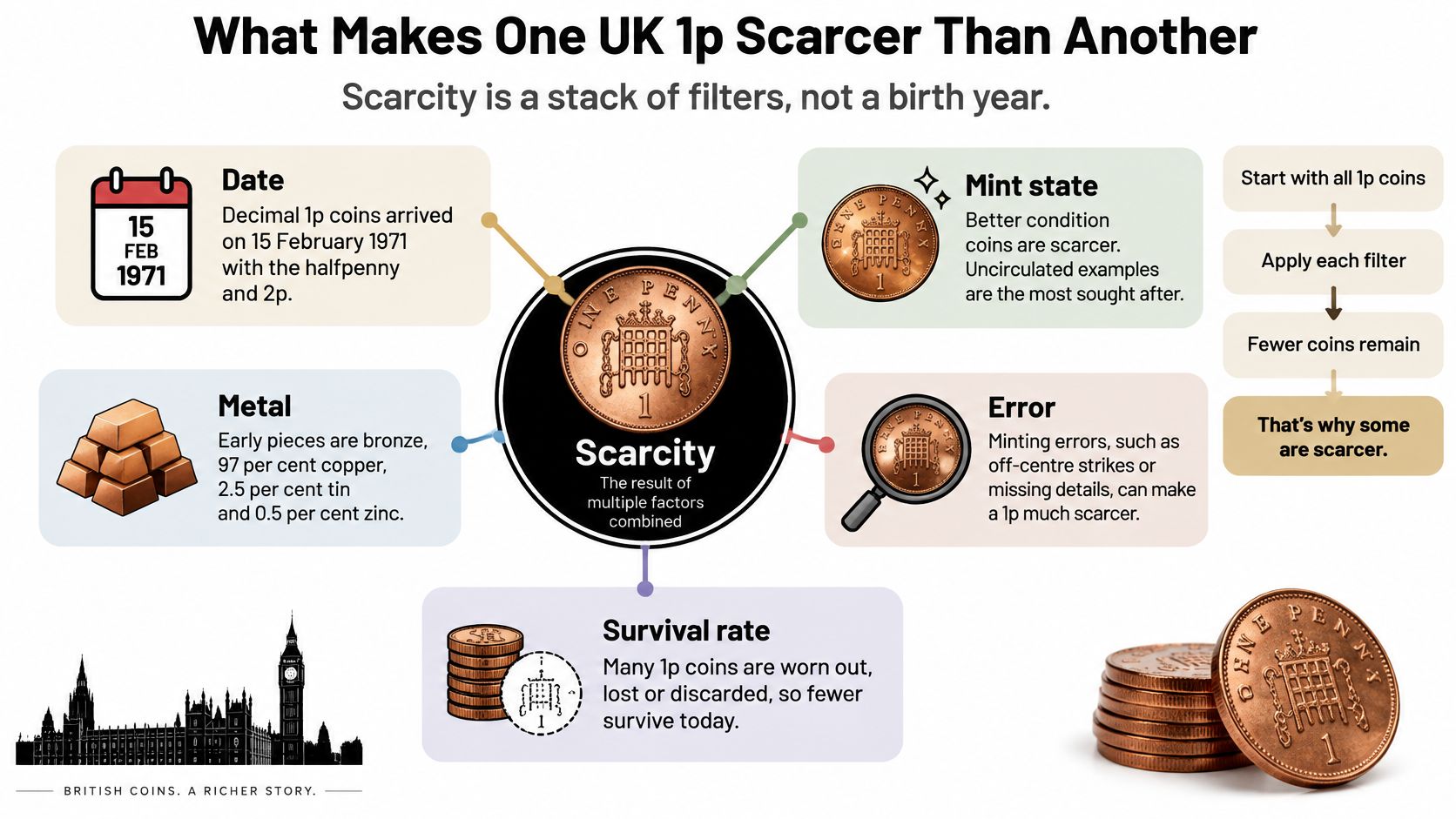
The specification gives you the first filters. The Royal Mint one pence designs and specifications page confirms the UK decimal 1p coin was introduced on 15 February 1971, when Britain moved to decimal currency alongside the ½p and 2p denominations. Early 1p coins were made from bronze containing 97% copper, 2.5% zinc and 0.5% tin.
From September 1992, rising global metal prices led to copper-plated steel, consisting of a mild-steel core coated with copper. Post-1992 1p coins are therefore magnetic, whereas earlier bronze pieces are not. The reverse originally carried the word NEW to distinguish decimal coins from pre-decimal currency, and that marking was removed in 1982.
The denomination remains legal tender, although payments in 1p coins are limited by law to amounts of up to 20 pence. That legal cap explains why a jar of pennies feels almost worthless as money and strangely tempting as a treasure hunt. You can't settle much with them, so you start hoping one is worth more as a collectable.
The Five Filters Collectors Actually Use
- Date: Does the year match a short issue, a type change, or a set-only release, or is it a heavy circulation year?
- Metal: Is it bronze or copper-plated steel, and does the magnet result fit the date?
- Minting purpose: Was it struck for pockets and tills, or for an annual set that most buyers kept sealed?
- Survival rate: How many remain available to collectors, rather than lost, damaged, or locked in institutions?
- Condition: Does the coin still show its original surface, or has circulation flattened the detail buyers pay for?
A modern date can be scarce if few examples were released. An older coin may be relatively common if it was produced in large numbers. That's why a beginner who sorts only by age will keep the wrong coins and spend the ones worth checking.
Think of a coin as a library book. The print run tells you how many copies once existed. What matters to the next reader is how many copies remain on the open shelf, complete and readable, rather than pulped, lost, or held in a closed archive.
Practical rule: Run a magnet over the jar and read the reverse wording. Those two checks sort most ordinary 1p coins into bronze or steel, and early or later decimal type, in about a minute.
Once a coin passes those filters, you still haven't proved value. You've only proved it deserves a slower look. Attribution comes first: naming the coin correctly, including its date, metal, design, and issue channel, before anyone talks about money.
How to Tell a Mint Error from Later Damage
The coins people photograph most are silver coloured, unusually bright, or misshapen. They're also the coins most often mislabelled, because a dramatic look feels like evidence when it usually isn't.
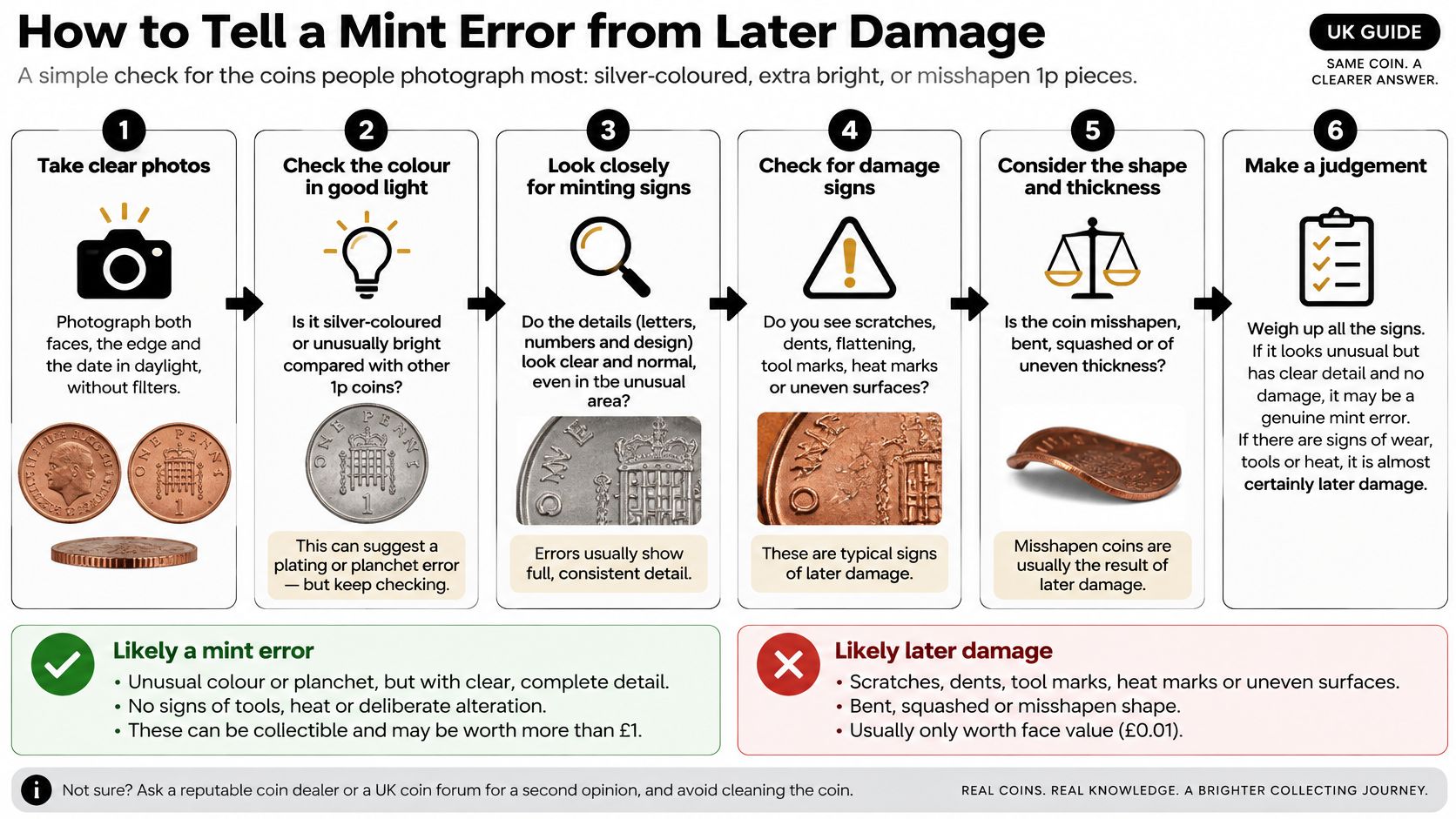
The Royal Mint Museum enquiries guidance explains that 1p and 2p coins changed from bronze to copper-plated steel in 1992 because of rising base-metal prices, so a magnet test can help identify composition but cannot by itself prove rarity. It also notes apparent silver-coloured pieces may have been maltreated after issue and plated, while ordinary 1971 coins bearing NEW PENCE are common and not especially valuable. The Museum can explain mis-strikes but does not provide valuations.
A Five Step Triage You Can Do at Home
- Photograph everything first. Take both faces, the edge, and a close shot of the date in plain daylight, with no filter and no flash glare. Good photographs let a dealer help you without handling the coin, and they record the surface before you touch it further.
- Test magnetism gently. Hold a small magnet close to the coin and note whether it attracts. A magnetic result fits copper-plated steel, and a non-magnetic result fits bronze. Record the result as a fact about metal, not as a claim about rarity.
- Weigh and measure the piece. Check the weight and diameter against the official specification for a standard 1p. A large miss points you towards damage, a wrong blank, or a different denomination entirely, so set that coin aside rather than guessing.
- Read the reverse wording carefully. NEW PENCE on an ordinary early decimal coin is correct and common, not a mule. Don't paste the well known 2p New Pence mule story onto a 1p just because the word NEW looks unfamiliar.
- Sort into three piles. Make one pile for a possible mint-origin mis-strike, one for post-mint plating or chemical colour change, and one for normal wear. If you can't defend the first pile with weight, metal, and design evidence, it doesn't belong there.
If you want broader examples of how genuine striking faults present across denominations, our guide to UK coin errors helps you compare shapes and surfaces before you describe your own piece. Use it as a visual check, not as permission to borrow another coin's story.
What Each Pile Usually Means
A genuine mis-strike tends to look consistent with how a coin is made, with metal flow and design displacement that follow the strike. Post-mint damage tends to interrupt the design, with plating over scratches, unnatural colour in recesses, bent edges, or chemical brightness that sits on top of wear. Normal wear flattens the high points while the colour and metal stay true to type.
A visually dramatic coin is often less collectable than a correctly attributed example with its original surface intact.
Finish with a blunt decision. If weight, metal, and date disagree with the specification, set the piece aside for a dealer opinion. If they agree and the date is common, you've got a spendable coin with an interesting history of abuse, and that distinction will save you listing fees and embarrassment.
How Grade Changes the Price of a Shortlisted 1p
Grade is where a shortlisted coin becomes a priced coin, or doesn't. Two examples of the same date can sit at opposite ends of the market because one kept its detail and original surface while the other spent decades in tills.
| Grade | What you see | What it means for value |
|---|---|---|
| Fine | Clear date, obvious wear on the high points of the design | Little premium on common dates |
| Very Fine | Lighter wear, most detail still sharp | Small step up where a premium exists |
| Extremely Fine | Only traces of wear, nearly full detail | Rarely justifies a grading fee on a common date |
| Uncirculated | No circulation wear, some original lustre may remain | Premium only where the original surface survives |
| Brilliant Uncirculated | Describes how a set coin was sold, not a grade for a loose piece | Follows the sealed set and its packaging |
Use the language a UK seller will use. Fine means you can read the date clearly, but the high points of the portrait and the portcullis or dormouse show obvious wear. Very Fine keeps most detail sharp under lighter wear, while Extremely Fine shows only traces of wear and nearly full detail. Uncirculated means no circulation wear at all, and some original lustre may still survive in the fields.
Hold the coin by its edge under a side light, not a bright overhead bulb. Side light reveals flattened ridges, hairlines, and wiped patches that flat light hides. If you're learning the vocabulary, our plain English guide to how coins are graded settles the terms before you try to describe a coin to a buyer.
Original Surface Matters More Than Shine
Don't clean, wipe, or polish a copper coloured coin to make it look better. Cleaning leaves hairlines that dealers treat as damage, and those fine scratches can wipe out the very premium you were chasing. A dull but original coin often outsells a bright but wiped one.
Watch the edge and the surface closely. Edge dings, verdigris, and spots matter more on a 1p than on many higher denominations, because the copper surface is a large part of the design's appeal. Once that surface is interrupted, the grade story changes even if the date stays sharp.
Remember this distinction: Brilliant Uncirculated on a set coin describes how it was sold. It isn't a grade you award to a loose piece you've taken from a till.
Apply a simple fee test before paying for third party grading. If the date is common, even Extremely Fine rarely justifies the cost. If it's a set-only year, keep the capsule shut and sell the packaging story intact. If someone claims a 1933 penny, stop handling it and get a specialist opinion before any slab or sale is discussed.
A grade describes wear. It isn't itself a price, and a confident grade on the wrong coin still leaves you with the wrong coin.
How to Estimate Value and Where to Sell
A defensible estimate doesn't need an invented price. It needs four facts recorded in the same order every time, then evidence from coins that sold.
Build the Estimate from Evidence
- Fix the four facts. Write down the date, metal, grade, and whether the coin came from a set or from circulation before you search anything. If one of those is a guess, your comparison will drift.
- Search sold results only. Look at recent sold listings and published auction results for the same date and grade. Asking prices show what sellers hope for, and hope isn't a market.
- Get two written offers. Ask two dealers and note whether each quote is for the coin loose or in its original capsule. Written offers stop a verbal figure being remembered differently later.
- Match the route to the coin. Use a dealer for common or set coins, an online marketplace with clear photographs for mid-value sets, and a specialist auction house for any claimed 1933 or verified rarity.
- Change nothing before an offer. Don't clean, wipe, or polish the coin, since a buyer needs to judge the surface exactly as it survives.
Our guide to valuing old coins in the UK walks through this comparison method in more depth if your coin turns out to be part of a wider collection rather than a single find. The discipline transfers directly, because buyers reward clear attribution far more than excited description.
Keep one page of notes for each shortlisted piece. Record the date, monarch, reverse, source, grade, and every offer received, with the date of each offer. That page becomes your provenance when a buyer asks where the coin came from, and it stops you re-researching the same piece every few months.
Photograph both faces, the edge, and any packaging in daylight before you list or post anything. A buyer who can judge the coin quickly is a buyer who bids with confidence.
Treat last year's figure as a starting point, not a quote. Estimates move with demand, with metal fashion, and with how many similar set coins reach the market at once. Two fresh offers beat one remembered price every time, especially on a denomination where most pieces are worth face value.
Decide Whether to Spend Keep or Sell
You've done the checks. Now force each coin into one clear action, because a maybe pile is how a jar stays unsorted for another five years.
- Common date, circulated grade: Spend it, or keep a single tidy example as a type coin for your own reference. Don't list it as rare, because a buyer will check the same shortlist you did.
- Set-only date with packaging: Buy or sell it as a set coin. Original packaging and a straight, original surface matter more than a loose example of the same date with no story.
- Metal, weight, or design that doesn't match: Don't call it a mint error in a listing. Record what you observed, photograph it, and let a dealer confirm or reject the claim in writing.
- Claimed 1933 penny: Stop handling it, keep it in a capsule or soft holder, and take the specialist auction route. A casual online lot is the wrong venue for a coin that needs authentication first.
- You want stock, not a one-off find: Build from properly described material instead of hoping the next jar behaves differently.
For readers who enjoy the older series, our Coins collection offers collectible, rare and spendable coins, and old one penny coins from 1825 to 1967 are listed from £7.99 GBP. We also list lots of rare, interesting and collectable items for auction each week on our Cavalier Coins eBay Store, which suits collectors who prefer to watch a named variety sell before bidding.
Your next action is one of three things. Spend the common coin, leave the set piece sealed, or ask for a price on a named, checked variety.
Start tonight with the coin that prompted your search. Photograph the date and edge, run the magnet and weight checks, and write the result down. You'll either free up small change, protect a set coin properly, or have a clean description ready for a dealer, and all three outcomes beat another year of guessing.
If your checks point to a set-only date or a named variety worth buying properly, browse the collectable and rare coins at Cavalier Coins Ltd and compare them against the date, metal, and grade notes you've just made. You'll find UK pennies and wider world material described for collectors, plus weekly auction lots if you'd rather watch a verified piece find its price. Bring your photographs and your one page of notes, and you'll buy or sell with a far clearer eye.