
You're sorting through your change when one coin catches your eye. Perhaps a penny looks silver, a £2 coin seems to have its centre turned the wrong way, or a 20p has no date. It's natural to wonder whether you've found a valuable error. But an unusual appearance is only a starting clue, not proof of a minting mistake or a guide to what someone might pay.
The useful question is not "Does this look strange?" It's** "What could have caused this feature, and how can I check?"** A genuine mint error, damage after the coin left the Mint, a counterfeit and a novelty piece can look surprisingly similar at first glance. Asking prices online add another complication, since a high listing price doesn't show what a buyer paid.
Why UK Coin Errors Capture Every Collector's Imagination
A coin error turns an everyday object into a small production mystery. One side might be off-centre, a detail might appear doubled, or a familiar feature might be missing. For new collectors, that sudden difference can feel like a discovery. Experienced numismatists are drawn to the same thing for a different reason: a well-preserved error can reveal how a coin's blank, dies and strike came together.
That curiosity is worth following. It's also worth slowing down before deciding that a coin is rare. Some genuine errors are dramatic, but unusual-looking surfaces can also result from wear, plating, tampering or damage after the coin was made. And even when a coin appears to be an error, the way it was produced and its condition both matter.
The UK's undated 20p is a useful example of why diagnosis comes before claims about value. Its missing date has a documented minting explanation, but that doesn't mean every 20p without a clear date is the same coin, or that the absence of a date by itself proves authenticity. You need to consider the design, the coin's construction and whether its features fit the known error.
A helpful first rule: Treat oddness as a reason to investigate, not as evidence of rarity.
This guide offers a practical way to make that investigation. Start by learning how coins are made, then match the feature to a possible production stage. From there, check for signs of post-mint damage or alteration, compare the coin with authoritative references, and consider authentication before you think about selling. That approach helps you avoid two common traps: calling damage a mint error, and treating a headline asking price as a reliable valuation.
How UK Coins Are Actually Made
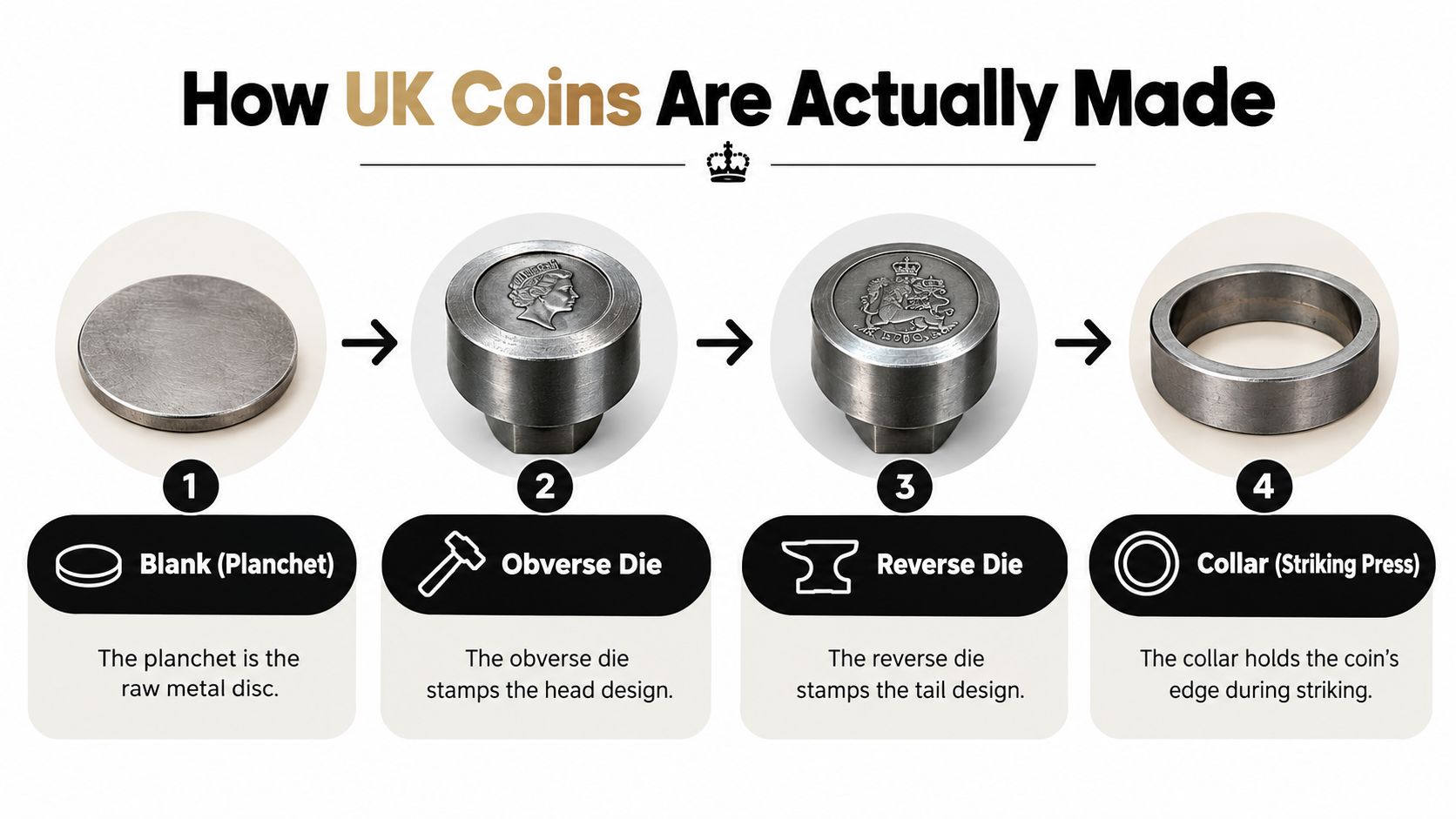
To understand an error, it helps to know what a normal strike involves. A blank, also called a planchet, is the metal disc that will become a coin. An obverse die carries the design for the heads side; a reverse die carries the design for the other side. During striking, the dies press their designs into the blank, while a collar helps contain the metal and form the coin's edge.
Learn more about how coins are made before looking for a fault. The important idea is that a coin's features come from different parts of a production process. A missing section might relate to the blank or its position; a broken design detail might relate to a die; an unusual layout might have formed when the coin was struck.
The Royal Mint Museum describes the blank as the disc fed between two dies. Modern Royal Mint presses can apply approximately 60 tonnes of pressure and strike up to 850 coins per minute, so a problem with alignment, feeding, die retention or ejection can create mechanical abnormalities on UK coins (Royal Mint Museum coin-collecting glossary). Those figures help explain why production errors can have a recognisable physical pattern rather than appearing as a random mark.
Match the feature to the production stage
A coin that looks unusual doesn't automatically tell you which part of production went wrong. Try to connect what you see to how the coin was made:
- Blank or planchet: Look for a feature that seems to involve the metal disc itself, such as an unusual shape or an unexpected metal appearance. First check whether the surface could have been altered after striking.
- Dies: Look for a feature that seems to repeat or distort part of the design. The question is whether the pattern looks like it was transferred during striking, rather than cut or scraped into the finished coin.
- Strike: Check the placement and completeness of the design. An off-centre strike, for instance, affects the layout, so the surrounding blank area and rim should make sense as part of the same event.
The edge can also help. It's part of the coin's construction, not an afterthought, and its details may be relevant when you're comparing a suspect piece with a normal example. Keep the coin's whole structure in view. A close-up of one strange mark can make ordinary damage look like a technical error.
The Main Types of UK Coin Errors You Can Actually Find
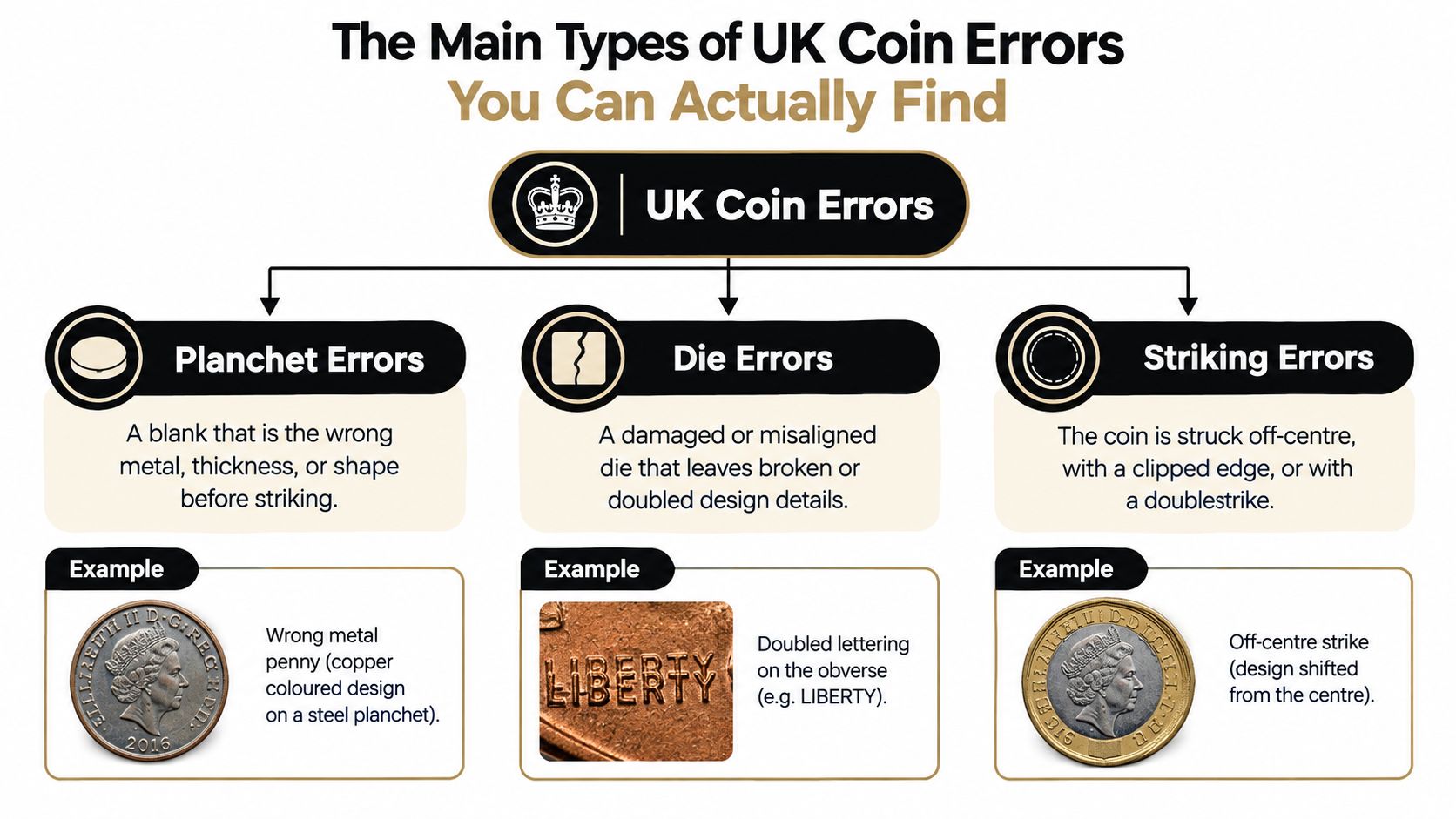
Once you know the production stages, the broad categories become easier to follow. Collectors commonly describe errors in terms of the blank, the dies or the strike. Those labels aren't just vocabulary. They help you ask a more precise question about what could have happened during manufacture.
Errors involving the blank
A planchet error begins with the blank, before it receives the designs. A coin might appear to have an unexpected metal colour or shape, but that appearance isn't enough to identify the cause. A different colour could be the result of plating after issue, so check for evidence that the feature belongs to the coin's original manufacture.
Errors involving the dies
A die error relates to the tool that stamps the coin's design. Cracks, chips or breaks in a die can leave corresponding marks on coins struck with it. What matters is whether the detail fits the surrounding design and metal. A raised or broken-looking feature isn't automatically a die fault; a scratch, impact mark or other later alteration can also change a coin's surface.
Errors involving the strike
A striking error happens as the dies press the design into the blank. An off-centre result can leave part of the design missing from the struck area. A brockage has a distinctive cause-and-effect pattern: a previously struck coin sticks to a die and transfers a mirror-image, incuse design to another coin. That coherent pattern is more telling than a vague claim that the coin has a “double image.”
A documented transitional mule
A mule pairs dies intended for different designs or stages of production. The Royal Mint explains that the undated 20p arose in November 2008, when dies from different stages of the redesign were paired. Fewer than 250,000 affected coins came from roughly 136 million 20p pieces minted during 2008–09, less than 0.184% of that production run (Royal Mint account of the undated 20p). The coins remain legal tender at their face value.
The story is a reminder that “no date” is a description, not an authentication. Compare the coin's design with the documented example, and check its condition and construction before drawing a conclusion. For more on that specific issue, see this guide to the 20p coin with no date.
How to Inspect a Suspect Coin at Home
A careful first inspection doesn't require specialist equipment. A camera, good light and a way to record measurements can help you document what you've found. The aim isn't to certify the coin at home. It's to create a clear record that helps you compare it with a normal example or explain it to someone who can examine it.
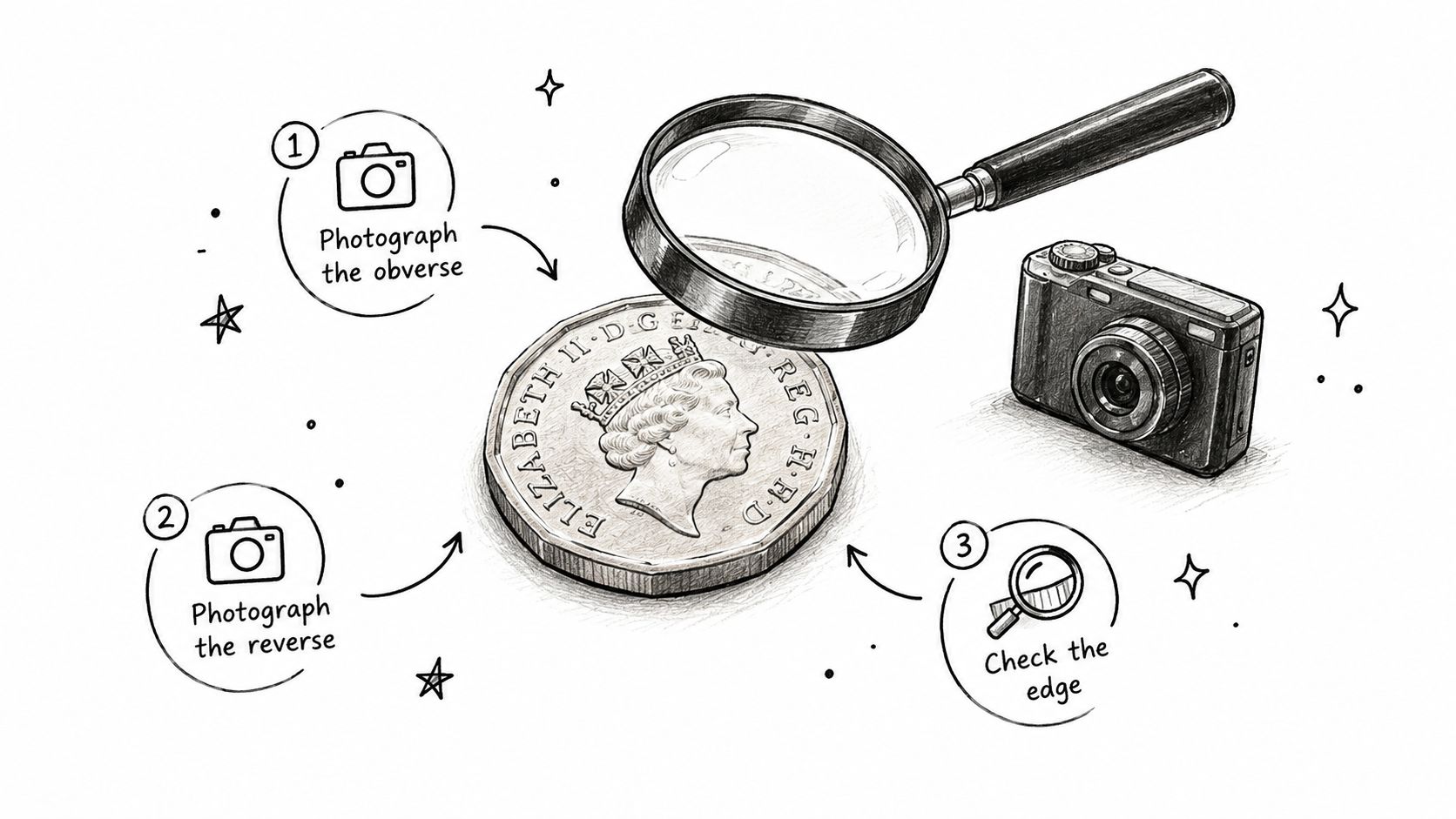
Begin with the whole coin, not just the suspicious area. Photograph both faces and the edge in clear, even lighting. Keep the camera at a consistent distance and include a close view of the feature, but don't let a magnified detail replace the wider view of the coin.
Next, record the coin's weight and diameter, then compare them with a reliable reference for the same denomination and issue. Measurements don't prove that a feature is a mint error, but they can help flag a mismatch that deserves further investigation. Also compare the date, lettering, edge and overall design with a known example.
Don't clean or alter the coin. Polishing, straightening or even vigorous handling can obscure the surface clues an examiner needs to assess how the metal moved.
Use a magnifying glass to look at the feature in context. Does it seem raised, incuse, flattened or cut into the surface? Does the same abnormality affect the rim or nearby design in a way that fits a striking event? A single mark can be misleading, so check whether the rest of the coin supports the same explanation.
A simple record helps keep your observations separate from your theory:
- Photographs: Both faces, the edge and the affected area.
- Measurements: Weight and diameter, compared with a suitable reference.
- Description: What you can see, without labelling it an error prematurely.
- Condition: Any wear, scratches, marks or signs of later handling.
When an Odd Coin Is Really Just Damage or Tampering
A dramatic appearance can be a poor guide to a coin's history. Before asking whether an unusual feature is rare, ask whether it could have been made after the coin left the Mint. That question can save collectors from confusing a genuine production fault with plating, reassembly or ordinary design variation.
The Royal Mint Museum reports that most silver-coloured pennies and two-pence pieces submitted for examination had been plated after issue. The same Museum notes that an apparently inverted inner section on a £1 coin was very likely dismantled and reassembled after circulation, rather than mis-struck (Royal Mint Museum review). A changed colour or rotated centre can look striking, but the coin's construction and surfaces need to support a mint-made explanation.
Other features that attract attention can be normal. The orientation of a £2 coin's edge inscription relative to the portrait is random in production, so an upside-down inscription generally isn't an error. By contrast, a 1983 2p bearing the earlier “NEW PENCE” wording is an anomalous issue, since that date's coins should read “TWO PENCE.” The useful distinction is between a feature that falls within normal variation and one that differs from the intended specification.
| Common UK coin abnormalities | Most likely explanation | How to verify |
|---|---|---|
| Silver-coloured penny or two-pence piece | Often plated after issue | Check the surface and compare with a normal example |
| Apparently inverted £1 centre | May have been removed and reassembled | Examine the join and whether the coin's construction supports a mint-made cause |
| Upside-down £2 edge inscription | Generally normal production variation | Compare the edge orientation with the coin's normal design and manufacture |
| 1983 2p with “NEW PENCE” | Recognised anomalous issue | Confirm the date and wording against the intended specification |
A genuine doubling or brockage should make sense as part of the strike. A scratch or dent can create a second-looking outline, but it won't necessarily form a coherent raised or incuse design. Look at the feature's relationship to the surrounding metal, not just its shape in isolation.
The Royal Mint Museum has also advised people with apparently abnormal coins to seek examination, since some pieces may be counterfeit or damaged. The lesson is simple: visual oddity is weak evidence of rarity. Establish what the coin should look like, then work out whether the difference fits a minting process or a later alteration.
Grading and What 'Mint Error' Actually Means to Services
A dealer pulls two £2 coins from the same tray. One is bright and untouched; the other is worn smooth by years in tills. Which is the better error coin? The question contains a trap: condition and error status are separate judgements, and a coin can score highly on one while failing the other completely.
A coin's grade describes its condition, meaning how much wear it has picked up since leaving the press. Terms such as UNC (uncirculated), EF (extremely fine) and AU (about uncirculated) sit within British grading conventions, while MS (Mint State) marks uncirculated coins on the numerical scale used by US-based services. None of these labels says anything about how the coin was struck.
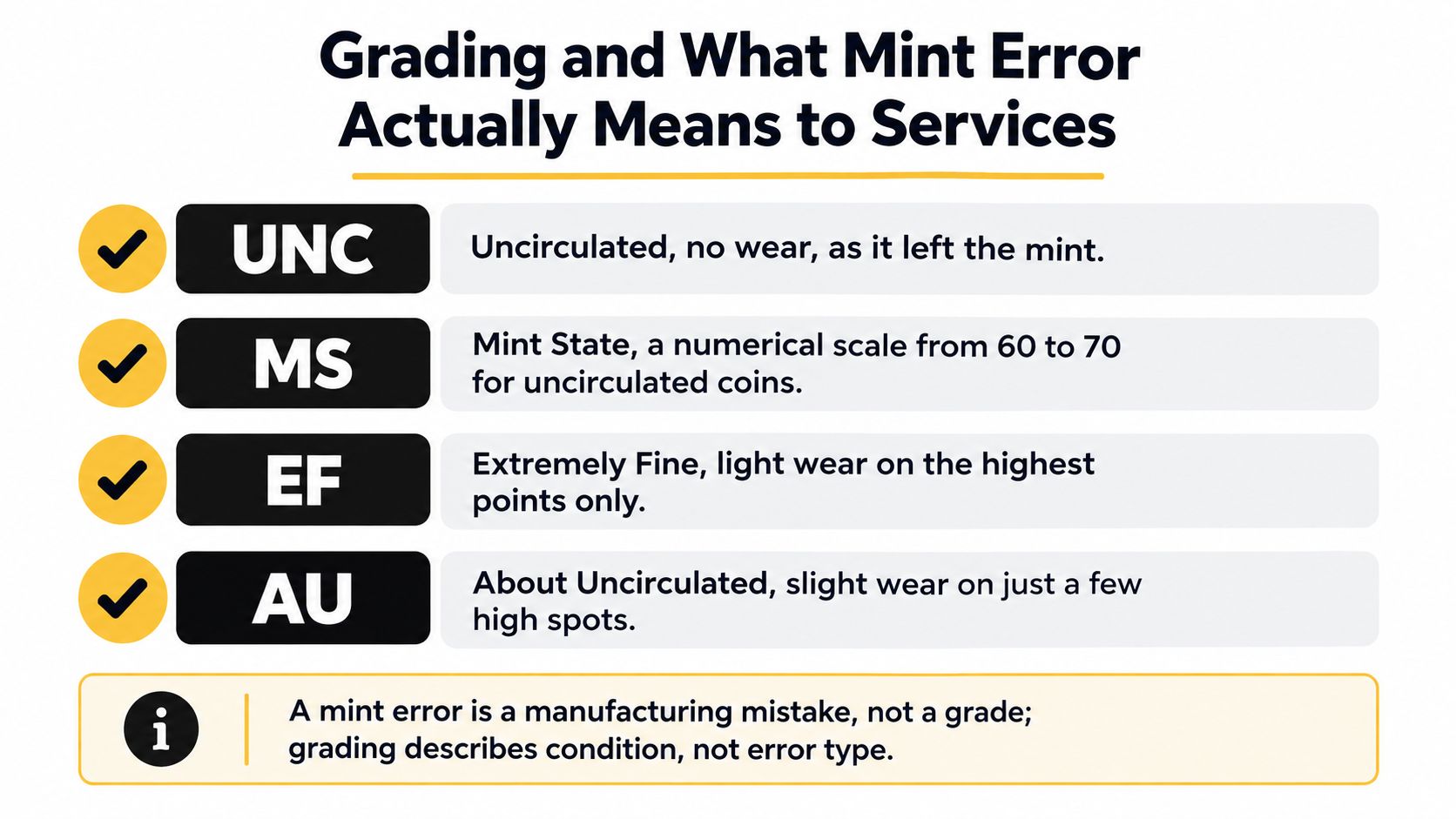
Grading services therefore work through two questions in sequence. Did the unusual feature happen during manufacture? If so, does it qualify as a recognised mint error rather than normal production variation? A coin in superb condition can still be a damaged piece, and a genuine irregularity can still be too minor to register as an error at all.
The second question is stricter than most collectors expect. NGC's error-attribution guidance states that post-1985 mint errors are assessed case by case, and minor die chips, breaks and rotations on modern UK coins may fall within normal mint tolerance rather than receiving an error designation (NGC's coin-grading standards). A small raised fleck near the rim of a recent £1 can look dramatic under a loupe and still count as routine die wear to a grader. Unusual appearance does not equal a certifiable error.
Condition only enters the picture after that hurdle is cleared. Wear softens the fine detail a service needs to examine, so a sharper specimen usually gives an attribution firmer footing. But a high grade cannot convert a scrape from a vending machine into a striking flaw. The two judgements stay separate from start to finish.
Before paying for an opinion, pin down which question you need answered: what happened to the coin, or how well it survived afterwards. This overview of coin grading services sets out what each type of assessment covers, which makes the choice easier once your own photographs, weight and measurements are in place.
Authentication, Pricing and Selling Your UK Error Coin
A surprising find draws a crowd at any coin fair, and the first question is always the same: what is it worth? Hold that question until you know what the coin is. Pricing an unpicked piece is like appraising a painting before anyone has checked whether it is a print. A sale built on an unsupported claim tends to unravel, because buyers who specialise in errors will test that claim before they pay.
Work through three judgements in order. Does the feature match a known striking failure, or could it be damage, a counterfeit or a novelty alteration? Then decide which opinion you need: identification, authentication or grading. Only after those does value come into it.
The Royal Mint Museum examines apparent Royal Mint mis-strikes for £20 per decimal coin, though it does not provide valuations (Royal Mint Museum examination service). Its report settles what the coin is, nothing more. If the piece might carry significant value, a third-party grading service can add a documented opinion on authenticity, condition and error classification, which is the paperwork serious buyers ask for.
Find market evidence, not a headline
An asking price is only a wish. The number that matters is the one a buyer paid, and recent listings for the 2025 King Charles III bee £1 show how far apart the two can sit: asking figures have stretched from low double digits to four-figure sums. That spread proves very little on its own. A handful of hopeful listings can make a common variety look scarce, and a viral post can inflate expectations overnight, so treat social-media claims the same way you treat the top price on a marketplace: as marketing until a completed sale confirms it.
When you compare sales, match denomination, design, error type and condition as closely as you can. Give far more weight to authenticated examples and completed transactions than to anything still waiting for a buyer.
Choose a sale route that fits the coin
A fixed-price listing gives you control, but control cuts both ways: aim too high on an unverified error and the coin sits. An auction lets interested bidders reveal what they will pay, though the outcome depends on who happens to be watching that week. Whichever route you take, describe only what you can show. A phrase like "consistent with an off-centre strike" stays honest when status is unconfirmed; reserve the word "error" for coins whose status is supported.
For ordinary coins or larger accumulations, a specialist retailer, bulk buyer or charity-collection route may beat listing each piece alone. Cavalier Coins Ltd offers fixed-price coin and banknote listings and weekly eBay auctions, and it purchases bulk coin collections from charities. Keep your description, authentication evidence and price research as three separate records. A clear account of what you know is worth more than a confident claim you cannot substantiate.
A Final Routine for Every UK Coin You Pick Up
The next time a coin looks unusual, photograph both faces and the edge, then record its weight and diameter. Compare it with a known example of the same issue, and check the intended wording, design and edge before assigning a rarity label. Ask whether the feature fits the coin's manufacture or could have appeared after circulation.
Don't clean, polish or straighten it. Don't treat an asking price as proof of value, and don't list a suspected error as confirmed before you've had it examined. Error-coin collecting is a diagnostic hobby, not a lottery. Keep a careful record, follow the evidence and choose your next step with confidence.
If you're building a collection or deciding what to do with coins and banknotes you already hold, explore the range at Cavalier Coins Ltd. You'll find fixed-price listings and weekly auctions, with bulk collection options also available for charities.