
So, what’s a shilling actually worth? The answer can be anything from a few pence for a common, battered coin to thousands of pounds for a rare, pristine example. There’s no single fixed price; a shilling's value is a direct reflection of its unique history, rarity, and condition.
What Is Your Shilling Collection Really Worth?
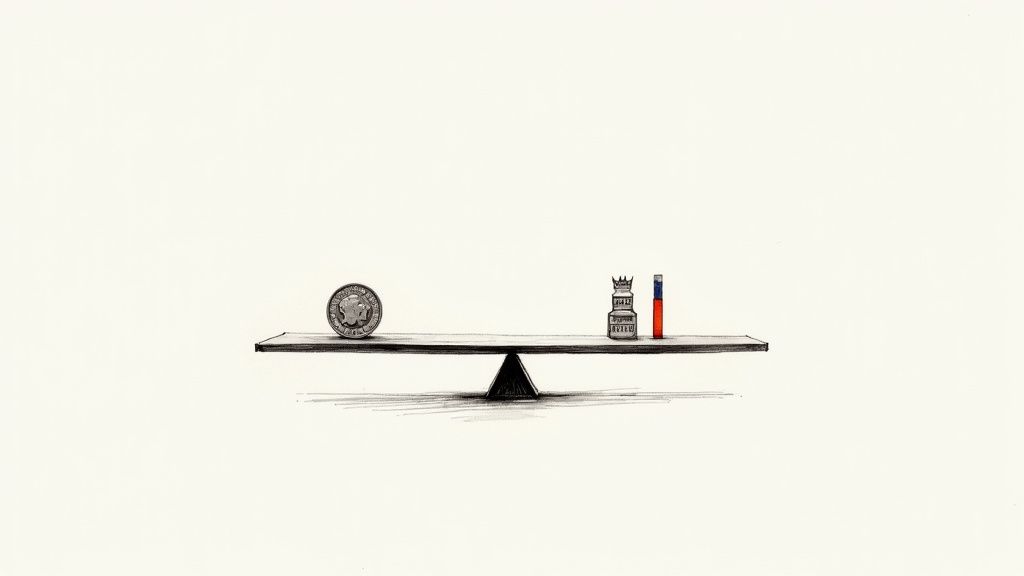
Figuring out the true value of an old shilling is a bit like valuing a classic car. A common, heavily used model might be an interesting piece of history, but a rare version in mint condition becomes a collector’s treasure. It's fascinating how the very same coin, just from a different year or mint, can have a completely different value.
This is where you put on your detective hat. You need to look far beyond the face value of "one shilling" and piece together the clues that tell its story. That story is what determines its market price. The journey starts with identifying the key characteristics that numismatists (that’s us coin collectors!) use to gauge a coin's desirability.
Key Factors Influencing Shilling Value
A handful of core elements come together to determine a shilling's final valuation. Getting to grips with these gives you a solid framework for assessing any coin you might have, whether it’s a single piece inherited from your grandparents or an entire collection.
Here are the main things you need to look at:
- Age and Monarch: As a general rule, older is better. Shillings from earlier reigns, like those of Queen Victoria or even further back to King George III, tend to be more sought-after than more modern 20th-century issues.
- Metal Content: The year 1947 was a massive turning point. Before this, shillings contained 50% silver; afterwards, they were made from cupro-nickel. This means any pre-1947 shilling has an inherent value just from its silver content alone.
- Rarity and Mintage: Simple supply and demand. Some shillings were produced in tiny numbers, making them rare from the get-go. A coin from a year with a low mintage figure is naturally harder to find and, therefore, more valuable.
- Condition or Grade: This is probably the biggest factor of all. A coin with sharp, crisp details and its original mint lustre can be worth hundreds of times more than the exact same coin that's been heavily worn down by decades in circulation.
Think of these factors like ingredients in a recipe. A coin that combines rarity, top-grade condition, and precious metal content will always cook up a much higher value than one missing these key components.
By understanding this simple framework, you can start to get a much more accurate picture of what your collection is really worth.
The Story of the Shilling Through Time
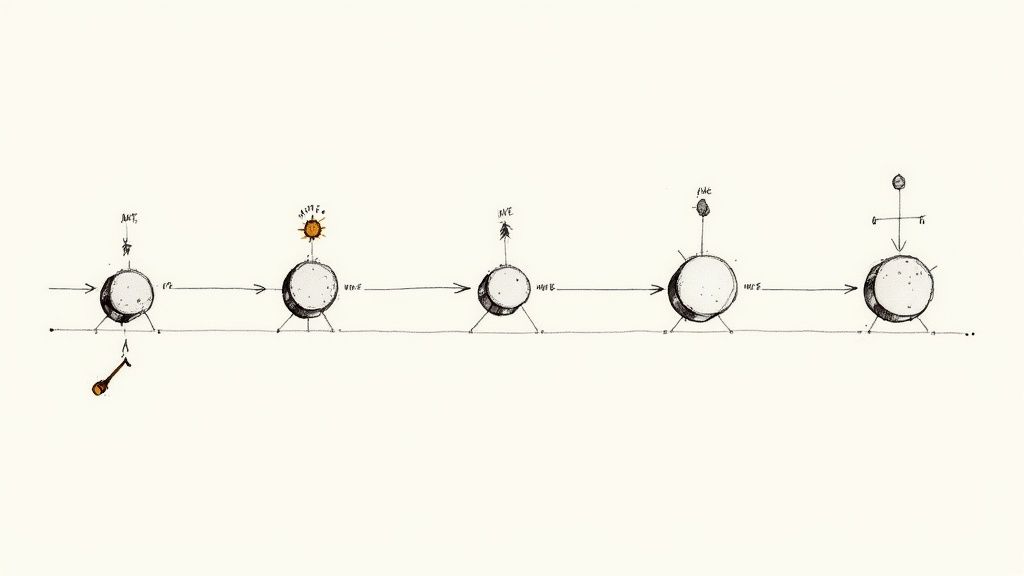
Before you can work out a shilling's value, you need to get a feel for its deep roots in British history. This wasn't just another coin; it was a witness to coronations, conflicts, and the daily lives of people for nearly five centuries. Its long journey, from a Tudor-era innovation to a familiar pre-decimal staple, is the real reason some pieces are so prized by collectors today.
For generations, the shilling was a cornerstone of UK currency. First minted around 1503 during the reign of Henry VII, it was worth 12 pence, or one-twentieth of a pound sterling. This new denomination quickly became essential for everyday trade and held that role right up until its final minting in 1966. You can dive deeper into its long history by exploring the timeline of the British shilling).
From Sterling Silver to Base Metal
The story of what the shilling was made from is a massive clue to its value. For hundreds of years, it was a trusted piece of silver. The purity was officially standardised in 1816 under George III at 92.5% silver—a quality you'll know as sterling silver. Shillings kept this high silver content until the economic fallout from the First World War forced a change.
That led to a major shift in 1920, when the silver content was slashed to just 50%. This 'debasement' marks a clear dividing line for collectors and is a key date to remember.
Then, after the Second World War, another big change happened. In 1947, silver was removed completely, replaced by cupro-nickel (an alloy of copper and nickel). This means any shilling dated before 1947 has real value just from its silver content, while any coins after that date are valued purely on their collectability.
Understanding these key dates—1920 and 1947—is fundamental. It's the first clue an amateur collector can use to separate potentially valuable silver coins from their base metal counterparts.
A Reflection of Britain's Monarchs
As each new monarch took the throne, the shilling's design changed, making it a tangible link to the past. The portrait on the obverse (the 'heads' side) doesn't just date the coin; it places it right in the middle of a specific historical period.
- Tudor and Stuart eras: Early shillings were often struck by hand, which resulted in irregular shapes and little variations. These quirks are exactly what make them so sought after by numismatists.
- Georgian and Victorian periods: The introduction of milled coinage (machine-made coins) created more uniform and detailed designs. Shillings from Queen Victoria’s long reign are especially popular, with different portraits marking the different stages of her life.
- 20th Century: Shillings of George V, George VI, and Elizabeth II are the ones you'll come across most often. But even among these, certain years with low mintage figures can be surprisingly scarce and valuable.
Each era brought with it new designs, different political climates, and unique economic pressures, all of which influenced the coins that ended up in people's pockets. This rich historical tapestry is what transforms a simple piece of old money into a genuine collectable artefact, directly impacting the modern shilling coins value.
The Four Key Drivers of a Shilling's Value
Figuring out what a shilling is worth is a bit like being a detective. You can't just look at one clue; you have to piece together several different bits of evidence to get the full picture. For a shilling, there are four critical factors that every collector needs to understand.
Think of these factors not as a simple checklist, but as interconnected parts of a puzzle. A rare date is a great start, but a rare date in pristine condition? That’s where you find the really exceptional value. It's this combination of factors that truly determines what a shilling is worth.
1. Year and Monarch
The first and most obvious clue on any coin is its date and the portrait of the monarch. This isn't just about how old the coin is; it’s about its historical context and, most importantly, its rarity. A shilling from the long reign of Queen Victoria, for example, tells a very different story to one minted under the much shorter reign of George VI.
As a general rule, earlier shillings are harder to find. Coins from the 18th and 19th centuries had a much tougher life, and very few survived in good nick. Certain years can also be surprisingly rare because of historical events like wars or economic downturns, which often resulted in much smaller production runs. A seemingly ordinary shilling might be a "key date"—a year with a tiny mintage—making it highly sought-after by collectors.
2. Mintage and Mint Marks
This brings us to the next crucial element: pure supply and demand. The mintage is simply the total number of coins struck for a specific year and design. A coin with a mintage in the millions is common, while one with a mintage of only a few hundred thousand is considered scarce.
Look closely, as some coins also feature a small letter or symbol known as a mint mark, which tells you where it was made. While most British shillings were struck at the Royal Mint in London, some were produced at branch mints. These little marks can drastically change a coin's rarity and are a detail that many new collectors miss.
3. Metal Composition
The metal your shilling is made of provides its fundamental base value. There's a clear dividing line in the history of the shilling that every collector absolutely must know.
- Pre-1920 shillings: These coins were struck in 92.5% sterling silver, giving them a high intrinsic metal value.
- 1920-1946 shillings: The silver content was slashed to 50%. They still have silver value, just less than their older counterparts.
- Post-1946 shillings: From 1947 onwards, shillings were made of cupro-nickel, a common metal alloy with no precious metal content. Their value is based entirely on their collectability.
The key takeaway here is that any shilling dated before 1947 will never be worthless because it contains silver. This gives it a solid floor price based on the current spot price of silver, even if the coin is heavily worn.
4. Condition and Grade
Finally, we get to what is often the most significant value multiplier of all: the coin's condition. In the world of coin collecting, the physical state of a coin, known as its grade, is everything. Two shillings from the exact same year and mint can have wildly different values based purely on how well-preserved they are.
A heavily worn coin with flat, faded details might only be worth its scrap silver value. But the very same coin in "Uncirculated" condition—looking as fresh as the day it left the mint, with sharp details and original lustre—could be worth hundreds or even thousands of times more.
Why the huge difference? It's all about rarity. Millions of shillings were used in daily life, getting passed from hand to hand. Only a tiny fraction were put aside and preserved perfectly. This massive premium placed on condition is often the single biggest driver of a shilling's value.
From Common Coins to Rare Treasures
Knowing the theory behind what makes a shilling valuable is one thing, but seeing it in practice is what really brings it to life. The gulf between a common coin and a true treasure often boils down to a subtle mix of its date, how many were made, and the condition it’s in today.
Let’s look at a few real-world examples to see how these factors create such a massive spectrum of value.
Think about a typical George VI shilling minted after 1946. Millions of these cupro-nickel coins were struck and passed through countless hands for decades. Because of this, a well-worn one from a high-mintage year is often just a curiosity you might find in an old change jar, worth very little. Its story is one of everyday use, not of rarity.
A Victorian shilling, however, tells a completely different story. A shilling from the early years of Queen Victoria’s reign, like an 1840 ‘Young Head’ design, is immediately more interesting to a collector. It's made from sterling silver, comes from a bygone era, and far fewer have survived the years in good shape.
Comparing Common and Scarce Issues
To really get a feel for this, let's put two very different coins side by side. A 1953 English shilling, the first of Queen Elizabeth II's reign, had a huge mintage of over 43 million. It's a great, accessible coin for new collectors, but those high production numbers mean its value stays modest unless it’s in perfect, uncirculated condition.
Now, pit that against an 1887 ‘Jubilee Head’ shilling with the small head variety. Not only is this a popular type, but specific varieties are much harder to find than others. Finding one in a high grade—with crisp, sharp details on the Queen’s portrait and the royal shield—can send its value soaring, turning a simple silver coin into a prized collectable.
The image below breaks down the key drivers—the monarch, the metal, and the coin's condition—that separate a common find from a rare gem.
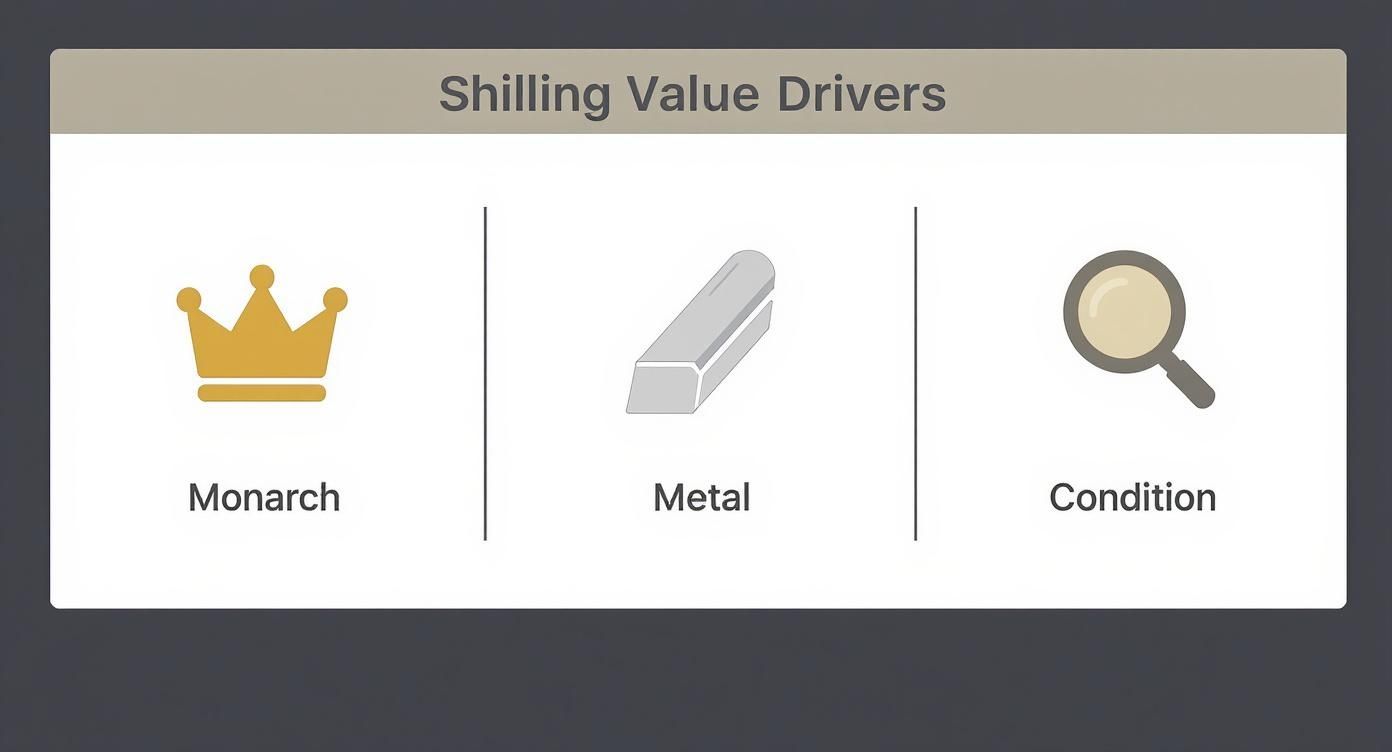
This really shows how a coin's historical context (who was on the throne), its physical makeup (what it’s made of), and its state of preservation all come together to decide what it's ultimately worth on the market.
How Condition Transforms Value
Condition is the ultimate value multiplier. A coin’s grade can make its price jump from a few pounds to hundreds, or even thousands. Take a 1947 shilling. In 'very good' condition, it might only fetch around £0.05, but a 'fine' example could be worth £1.50. Get up to 'extremely fine' and you could be looking at £150.
To illustrate this, here are some ballpark figures for different shillings based on their condition. Remember, the market is always changing, but this gives you a good idea of how much grade matters.
Example Shilling Coin Values by Grade
| Coin (Year/Type) | Approx. Mintage | Fine (F) Value | Extremely Fine (EF) Value | Uncirculated (UNC) Value |
|---|---|---|---|---|
| 1953 English Shilling | 43,150,000 | £0.10 | £0.50 | £5.00 |
| 1925 Shilling | 4,200,000 | £2.00 | £25.00 | £120.00 |
| 1887 'Jubilee Head' | 3,960,000 | £10.00 | £45.00 | £150.00 |
| 1840 'Young Head' | 2,300,000 | £20.00 | £150.00 | £600.00 |
| 1745 LIMA Shilling | 200,000 | £75.00 | £400.00 | £1,500+ |
As you can see, a common 1953 shilling needs to be in perfect uncirculated condition to be worth a few pounds. In contrast, a genuinely rare 1745 LIMA shilling is valuable even with significant wear, and its price climbs astronomically in higher grades.
A key takeaway for any collector is that grade is paramount. An otherwise common coin can become exceptionally valuable if it has survived in nearly perfect condition, a state that is far rarer than the coin itself.
Getting to grips with these real-world examples helps you appreciate the forces that create value. To learn more about how scarcity and condition influence prices, check out our comprehensive guide on understanding rare coin pricing. This knowledge is essential for spotting the hidden gems in any collection.
How to Assess Your Shilling's Condition
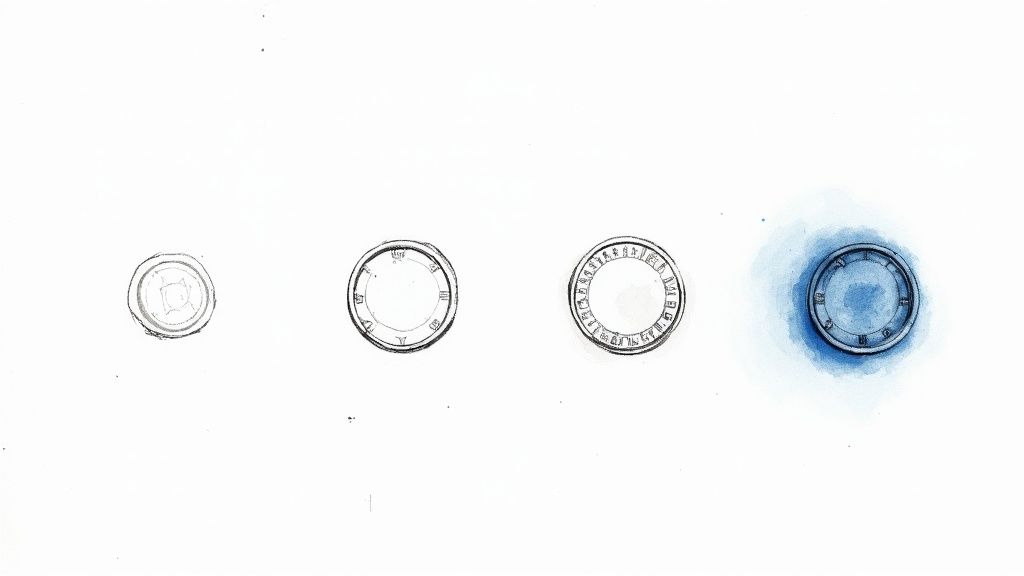
So, you’ve sorted your shillings by monarch and figured out the metal type. Now for the most hands-on part of working out their value: checking their physical condition. This process, which we call grading, isn't about finding flaws. It’s about seeing how much of the coin’s original detail has survived its journey through time.
Grading is probably the single biggest multiplier of a shilling's value. A common, everyday shilling in perfect, untouched condition can easily be worth more than a very rare date that’s seen heavy use. Think of it like a first-edition book; a copy with a crisp, unmarked cover is far more desirable than one with dog-eared pages and a broken spine.
Before you start, a quick word of advice: always handle your coins by their edges. The natural oils and dirt from your fingers can cause permanent damage to a coin’s surface, especially on older silver pieces with a delicate patina. It's a simple habit that can preserve a surprising amount of value.
Understanding the Grading Scale
Coin grading works on a spectrum, from heavily worn and barely identifiable to absolutely perfect. While the official grading services use a detailed numerical system, most collectors start by learning the basic adjectival grades. These visual clues tell the story of a coin’s life in circulation.
Here’s a simplified rundown of what to look for:
- Fair (F) or Poor (P): The coin is extremely worn, with the main design elements almost gone. You’ll struggle to make out dates and lettering, if you can see them at all.
- Good (G): Most of the design is worn quite flat, but you can still see the main outlines. The monarch’s portrait is weak, and while the date is readable, it isn't sharp.
- Very Fine (VF): The coin has clearly been in circulation, but the major details are still quite sharp. You should be able to see some of the finer points, like individual strands of hair on the portrait.
- Extremely Fine (EF): The details are very crisp, with only the slightest touch of wear on the very highest points of the design. You'll also see a lot of the original 'mint lustre'—that satiny sheen a new coin has.
- Uncirculated (UNC): The coin looks just as it did the day it left the mint. There is no trace of wear whatsoever, and it has its full, original mint lustre.
Professional grading is a nuanced art, but a simple magnifying glass and good lighting are all you need to get started. Try tilting the coin under a lamp to see how the light plays across the surface. That shimmer is often the first sign of a high-grade coin.
Spotting Fakes and Getting Help
As you go through your collection, remember that valuable coins can sometimes be counterfeited. Keep an eye out for mushy or indistinct details, an incorrect weight, or a thin seam around the edge where two halves might have been joined together. If a coin feels unusually light or has a strange "ring" to it, it’s worth a closer look.
For coins that appear to be in exceptional condition or are known rare dates, getting them professionally graded is a wise investment. It provides an official, impartial assessment that maximises a coin's market value and gives buyers complete confidence. Learning how to get coins graded is a crucial next step for any serious collector looking to properly validate their finds.
Ultimately, mastering basic grading skills is what empowers you to accurately evaluate the shilling coins value within your own collection.
Finding Reliable Prices and Reputable Buyers
Once you have a good handle on your shilling’s rarity and condition, the next step is figuring out its current market value. Knowing where to look for trustworthy pricing information is every bit as important as grading itself. It stops you from letting a rare coin go for a song or, just as bad, overpaying for a common one. This knowledge also gives you the confidence to connect with the right buyers if you decide to sell.
The coin collecting world has a few different avenues for pinning down a shilling's value, and each has its own strengths. I always recommend using a couple of these methods together; it gives you the most accurate and complete picture of what your coins are really worth today.
Where to Check Shilling Prices
The easiest place to start is with online price guides and catalogues. These sites pull together huge amounts of data, giving you a solid baseline for what coins are selling for in different grades. They’re a fantastic overview, but always remember they are just guides. The market can and does change.
For a more up-to-the-minute view, I always look at recent auction results. Major auction house websites often list the prices realised for specific coins. This tells you exactly what a real, willing buyer actually paid for a coin just like yours, which is often the truest measure of its current value.
A coin is ultimately worth what someone is willing to pay for it. Published price guides provide an estimate, but recent, verifiable auction results reflect the real-time pulse of the collector market.
Options for Selling Your Coins
If you're ready to sell, you've got a few main choices. Reputable coin dealers are a great option for a straightforward and secure sale. They offer expert valuations and can often pay you on the spot. Of course, their offer will be below the full retail value to cover their own costs and profit, but it's often the best path for speed and convenience.
Another route is selling through an auction. This can sometimes achieve a higher price, especially for rare or top-grade shillings, because it puts your coin in front of a whole room of competing bidders. Just be sure to factor in the seller’s fees and the fact that it’s a much slower process.
Finding a professional you can trust is the most important part of the process. For a detailed breakdown of all your options and some advice on picking the right valuation service, have a look at our article on where you can get coins valued.
Your Top Shilling Questions Answered
When you start digging into the world of shillings, a few key questions always seem to pop up. Let's tackle some of the most common ones that collectors ask.
Are All Silver Shillings Valuable?
Not necessarily. It's true that any shilling struck before 1947 has silver in it, but that alone doesn't make it a treasure. A very worn, common-date silver shilling might only be worth its basic silver or 'scrap' value.
What really drives the price up is a combination of rarity and exceptional condition. A coin in pristine, high-grade condition from a scarce year is where you'll find significant value far beyond just its metal content.
What Is the Most Valuable Shilling Coin?
This is the million-dollar question, isn't it? Well, maybe not a million, but some certainly fetch a pretty penny. Among the most sought-after are rare early milled shillings and unique patterns.
A couple of famous examples include the 1746 LIMA shilling, which was struck from Spanish treasure captured at sea, and the incredibly rare 1954 English shilling. This 1954 coin is a 'mule' – a mistake where the dies for two different coins were paired together. In top condition, either of these can sell for thousands of pounds at auction.
How Do I Spot a Scottish Reverse?
This is a great one to look out for on shillings minted between 1937 and 1951. You'll need to flip the coin over and check the design.
- The English version shows a lion standing proudly on top of a crown.
- The Scottish reverse, however, features a lion seated on the Scottish Crown, holding a sword and sceptre. It's a subtle but distinct difference that's easy to spot once you know what you're looking for.
Whether you're trying to value a single inherited coin or an entire collection you've built over the years, the experts at Cavalier Coins Ltd are here to help. Feel free to explore our collection or get in touch for a professional, no-obligation valuation at https://www.cavaliercoins.com.