
That old shilling you’ve got tucked away in a drawer could be more than just a relic of the past. The real shillings coins value can swing dramatically, from less than a pound for a common, well-worn piece to thousands of pounds for a rare date or a coin in pristine condition. It all comes down to the details—the date, the monarch on the obverse, and its physical state are what separate a simple curiosity from a collector's treasure.
Unpacking the Value of Your Shilling Coins
Think of your shilling as a tiny metal time capsule. Its true worth isn’t just its old face value but the story it carries and, crucially, how many others like it are still out there. A common shilling might just be an interesting historical footnote, but a rare one is a sought-after piece of history. This guide will be your roadmap, helping you go from simply having a coin to truly understanding its potential value.
To get started, you need to understand the fundamentals of what makes one shilling more valuable than another. It really boils down to three core pillars: rarity, condition, and demand. Even a coin from a common year can become surprisingly valuable if it’s in near-perfect, uncirculated condition. Learning to spot these key features is the first step for any collector.
Here’s an example of a historic British shilling, showing the kind of design details that collectors scrutinise.
This image gives you a good look at the detailed portrait and reverse design, which are critical for assessing a coin's wear and tear.
Key Factors Influencing Shilling Value
Getting a handle on these elements will give you the power to make a solid first assessment of your own collection. Before we get into the nitty-gritty, let’s look at the foundational concepts:
- Mintage Figures: This is simply the number of coins struck in a particular year. Lower mintage numbers almost always mean higher rarity and, in turn, a higher value. British shilling production, for instance, exploded after WWII. The Royal Mint struck a whopping 45,576,923 shillings in 1948 alone. You can dig into its history and production figures over on Wikipedia.
- Coin Condition (Grading): A coin’s physical state is everything. Collectors use a formal grading scale that runs from "Poor" (heavily worn) all the way up to "Uncirculated" (perfect). The closer a coin is to its original mint condition, the more a serious collector will be willing to pay for it.
- Historical Significance: Some coins just have a better story. Coins tied to major historical events or specific monarchs often carry a premium. For a more detailed look at this whole process, check out our guide on how to value coins.
Placing Your Coin in History
Every shilling tucked away in a collection is a tiny time capsule, a direct link to a specific monarch and a bygone era of British history. Getting a feel for this historical context is the first real step in discovering your shilling's value. This famous coin's journey stretches back centuries, with its design and the very metal it was struck from changing right alongside the nation itself.
Think of yourself as a historical detective. A shilling from Queen Victoria's reign tells a completely different story to one minted under George VI. The visual clues are your best evidence, from the King or Queen's portrait on the 'heads' side (the obverse) to the intricate shield or lion designs on the 'tails' side (the reverse). Figuring out where your coin sits on this historical timeline is absolutely fundamental to valuing it properly.
A perfect example of this is the major shift that happened in 1920. Any shilling minted before that year contains 92.5% sterling silver, giving it a solid intrinsic value based on its precious metal content alone. After 1920, that was slashed to just 50% silver, and by 1947, all the silver was gone, replaced with a much cheaper cupro-nickel alloy.
This timeline gives you a great visual guide to how the date, the monarch, and the coin's metal all come together to determine what a shilling is worth.
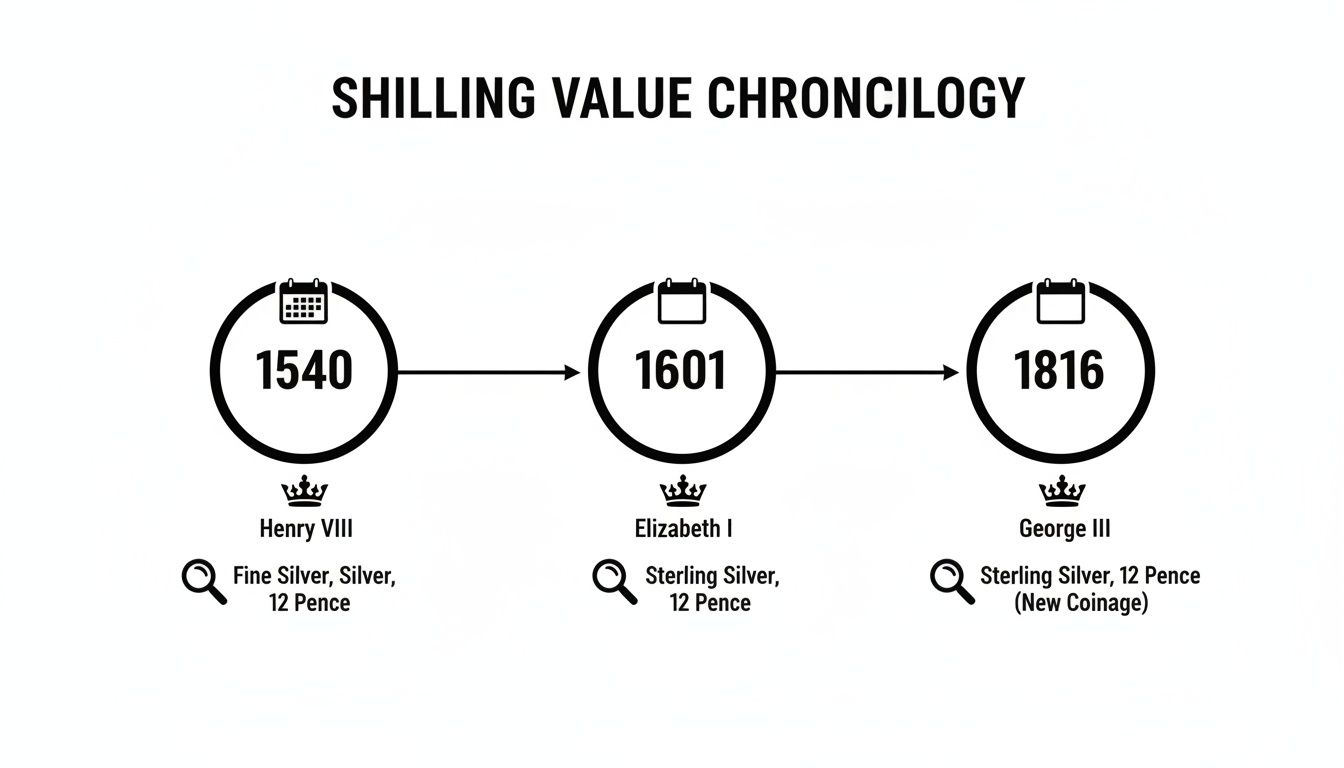
As you can see, the much earlier shillings from monarchs like Elizabeth I or Charles II are far rarer and, as a result, much more valuable. Meanwhile, the story of the 20th-century shilling is largely one of dwindling silver content.
The Major British Shilling Eras
To get a proper handle on your coin, you need to know which distinct period it came from. Each era has its own unique quirks and features that serious collectors are always on the lookout for.
- Early Milled Shillings (1663–1816): These coins were struck during the reigns of Charles II all the way through to George III. They are prized for their rich history and genuine rarity. Finding one in good condition is a real feather in any collector's cap.
- The Great Recoinage to Victorian Era (1816–1901): This period saw the standardisation of British money. Shillings from Queen Victoria's time are common, but their value hinges almost entirely on their condition and date, as some years had surprisingly low mintages.
- The 20th Century and Decimalisation (1901–1970): This is the modern era, and it saw the most dramatic changes. The reigns of Edward VII, George V, George VI, and finally Elizabeth II are all defined by the move away from silver coinage.
Shilling values, when seen in their historical UK context, reveal fascinating economic shifts, all rooted in its simple denomination of 12 pence. As a standout auction example, an 1850 shilling lot sold for £2,750, hailed as the second finest known with a rare overdate variety. This just goes to show how superb condition can sometimes trump even low mintage numbers. You can discover more insights into the shilling's rich history on the Collectors Club of Great Britain website.
Knowing these key periods helps you pop your coin into the right category, which is the starting point for figuring out its rarity and potential worth. Every monarch's reign brought small design tweaks, giving the sharp-eyed collector even more clues to follow.
Understanding How Condition Impacts Price
Ever wondered why two shillings from the exact same year can have completely different price tags? The secret is all in the condition, or what we in the collecting world call the 'grade'. This is probably the single most important factor that determines what a shilling is truly worth on the market, often even more so than its age or how rare it is.
I like to use a classic book analogy. Imagine two copies of the same first-edition novel. One is a well-read copy with a bent spine and worn pages. The other is a crisp, untouched copy that looks like it just came off the printing press. They're the same book, but their physical state makes one vastly more valuable to a collector. The very same logic applies to the shillings coins value in your possession.
A coin that has been jangling in pockets and passed through countless hands for decades is going to show it. The delicate details—the strands of the monarch's hair, the fine lines on the shield—will be worn smooth. On the other hand, a coin that was squirreled away soon after it was minted will still have that original sharp detail and a beautiful lustre.
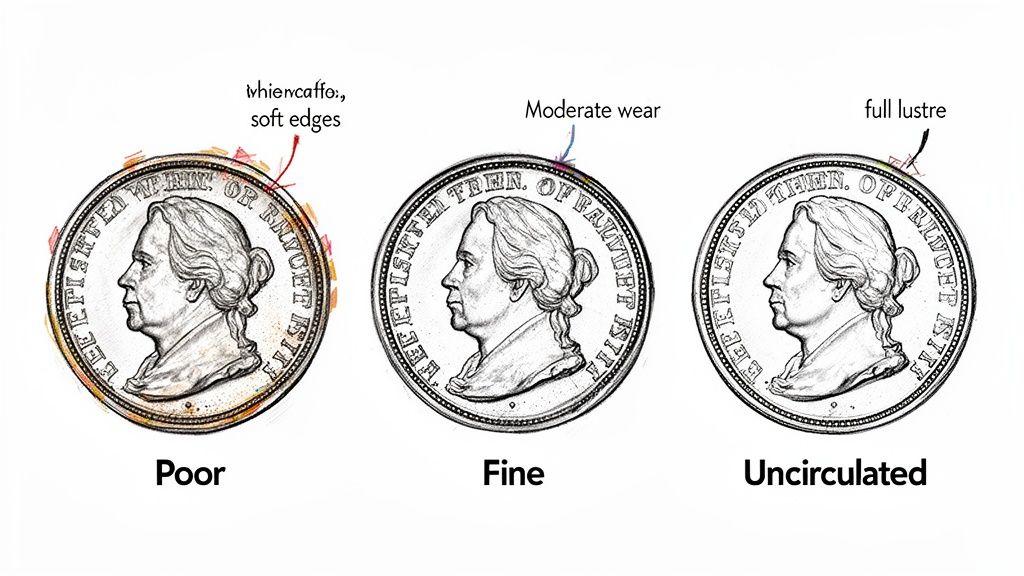
From Worn to Flawless: The Coin Grading Scale
Numismatists rely on a standardised scale to describe a coin's state of preservation. While the professional scale gets incredibly detailed, just getting a handle on the main tiers will give you the confidence to make a pretty good first assessment of your own shillings. It's important to remember that each step up this ladder can mean a significant jump in price. For a deeper dive, feel free to explore our guide on the professional grades of coins.
Here's a quick look at the grading system that collectors use to assess a coin's condition and, by extension, its value.
| Grade | Abbreviation | Description of Wear | Impact on Value |
|---|---|---|---|
| Poor/Fair | P/F | Heavily worn with major details smoothed out. Date may be illegible. | Lowest value, often just its metal content. |
| Good | G | Significant wear across the coin, but main design and lettering are visible. | Low collector value, but a good "filler" for a collection. |
| Fine | F | Moderate wear is noticeable, especially on the high points. Details are clear. | A respectable grade, value starts to climb for key dates. |
| Very Fine | VF | Light, even wear. Most of the finer details are still sharp and distinct. | A popular and collectible grade with solid value. |
| Extremely Fine | EF | Very light wear only on the highest points. Retains a lot of mint lustre. | Highly desirable grade; value increases significantly. |
| Uncirculated | UNC | No signs of wear at all. Looks brand new with full original lustre. | The highest value tier, often multiples of lower grades. |
As you can see, the journey from a heavily worn coin to a pristine, uncirculated specimen brings a dramatic increase in worth.
What to Look for on Your Shilling
When you're inspecting your shilling, pay close attention to the highest points of the design. These are the first places to show wear and tear.
For a typical British shilling, this means looking closely at the monarch's hair, their ear, and the very top of the crown. Flip the coin over and check the highest points of the lion or shield on the reverse. The other big clue is the presence of original mint lustre—that subtle, satiny sheen a brand-new coin has. If you can see that, you're likely looking at a high-grade, and therefore more valuable, coin.
Hunting for Rare Dates and Valuable Varieties
Once you get past a coin's general condition, you enter the real heart of collecting: the treasure hunt. This is where the magic happens, turning a simple shilling into a seriously prized find. It all boils down to the classic principle of supply and demand. If the Royal Mint had a slow year and produced fewer shillings, there are simply fewer of them around today. That scarcity makes them harder to find and, you guessed it, much more valuable.
This hunt is what elevates the hobby from just having old coins to actively seeking out specific, sought-after pieces. Think of yourself as a historical detective. You're searching for the clues—the dates, the tiny mint marks, the almost invisible errors—that separate a common coin from a true numismatic gem. The shillings coins value can absolutely skyrocket based on these tiny but crucial details.
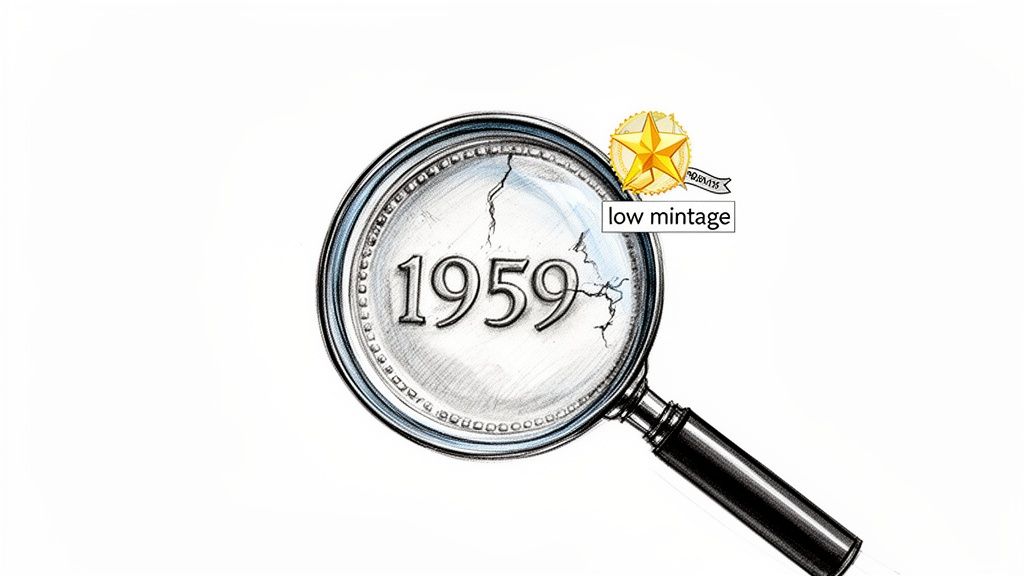
Key Dates with Low Mintage Figures
Certain years are legendary among collectors purely because of their scarcity. These "key date" shillings are always in high demand, pretty much regardless of their condition. Keeping an eye out for these specific years is one of the quickest ways to spot potential value in any pile of old coins you happen upon.
Among British shillings, some of the most wanted are from these low-mintage years. For instance, the 1959 issue is a tough one, with a tiny production run of just 1,012,988 pieces. The 1961 shilling isn't much more common, with only 2,762,558 minted. To put that in perspective, a common year like 1955 saw over 27 million shillings struck. Going back further, Victorian shillings have their rarities too; the 1869 shilling had a very low mintage of just 737,000. You can find some great insights into these coins and their history on YouTube.
A low mintage figure acts like a value multiplier. Even a circulated, worn shilling from a rare year will almost always be worth more than a pristine, uncirculated coin from a common year. It’s a perfect example of rarity trumping condition.
This is a fundamental concept in understanding the coin market. A full date run is impressive, but a collection that includes a few of these key dates is what gets seasoned numismatists really excited. While we're focused on shillings here, this idea applies across the board. You can learn more by checking out our guide on the value of two shillings, otherwise known as the florin.
Spotting Minting Varieties and Errors
Beyond just the date, the manufacturing process itself sometimes created accidental rarities. We call these varieties or errors, and finding one can make a coin exceptionally valuable. It's important to remember these aren't damaged coins; they are unique specimens that left the mint with a distinct, verifiable flaw.
Keep an eye out for these fascinating minting quirks:
- Overdates: This happens when a die from a previous year is re-punched with a new date. Look closely, and you might see the faint outline of a '3' hiding under the '4' in a date like '1844'.
- Die Cracks: As the coin dies wore down from use, they could develop tiny cracks. These transfer onto the coin's surface as raised, squiggly lines. While minor ones are common, significant or dramatic die cracks can add a nice premium.
- Misaligned Dies: If the obverse (heads) and reverse (tails) dies weren't perfectly aligned during striking, the coin will look rotated when you flip it over. A slight rotation is common, but a major one is a collectible error.
Finding these varieties requires a keen eye and usually a good magnifying glass, but the payoff can be huge. An otherwise common shilling can become a one-of-a-kind collectible because of a small minting error, turning your coin searching into a genuine treasure hunt.
Getting to Grips with Current Market Values for Shillings
So, we've covered the theory behind what makes a shilling rare and how its condition plays a huge role. Now, let's bring it back to the real world. Understanding the current market is absolutely key to figuring out a realistic shillings coins value—it’s what separates wishful thinking from genuine worth.
Prices can swing wildly. You might have a common 20th-century shilling that’s been through the wars, worth just a few pounds. On the other hand, a rare date in perfect, untouched condition could be worth thousands.
The biggest jump in value always happens when you move from a circulated coin (think Fine or Very Fine) to an uncirculated (UNC) one. Take a common George V shilling, for example. In Very Fine condition, it might fetch £5-£10. But find that same coin in uncirculated condition, still gleaming with its original mint lustre, and it could easily sell for £50 or more. Why the huge premium? Simple—very few coins survive in perfect shape, which makes them incredibly desirable for serious collectors.
A Snapshot of Market Prices
To give you a clearer picture, let’s look at some typical value ranges. Bear in mind these are just estimates. Prices can and do shift based on what dealers have in stock, recent auction results, and general collector demand. Still, this is a solid starting point for assessing shillings from different eras.
The following table really brings home just how much a coin's grade can impact its final market value.
Estimated Value Ranges for Key British Shillings
This table summarises the approximate market values for a few selected shilling coins based on their grade. The difference between a well-circulated coin and a pristine, uncirculated example is often staggering.
| Monarch & Year | Grade Fine (F) | Grade Very Fine (VF) | Grade Uncirculated (UNC) |
|---|---|---|---|
| Victoria (1887) | £15 - £25 | £30 - £50 | £150 - £250+ |
| George V (1927) | £3 - £5 | £8 - £15 | £70 - £120 |
| George VI (1948) | 50p - £1 | £1.50 - £3 | £8 - £15 |
| Elizabeth II (1956) | 20p - 50p | £1 - £2 | £6 - £12 |
As you can see, the older Victorian-era sterling silver shillings carry a strong premium. By contrast, the later cupro-nickel coins are much more accessible, with their value almost entirely dependent on them being in top uncirculated grade.
Real-World Sales and Auction Results
Nothing tells you what a coin is truly worth like a recent auction record. These are the ultimate proof of market value. A classic example is the rare 1763 Northumberland shilling—a highly coveted piece that can sell for well over £2,000, even in a lower grade.
More recently, a top-grade, uncirculated 1959 English shilling—a key date with a low mintage—sold for over £100. A circulated version of that same coin would likely be worth just a few pounds.
The market speaks loudest through verified sales. An exceptional coin, like a rare variety or a piece with an impeccable provenance, will always attract fierce bidding, often pushing its final price far beyond initial estimates.
These sales show how key dates and exceptional condition create a powerful combination that drives the highest values. While your common date shilling might not reach these heights, it demonstrates the potential that could be hidden in any collection and reminds us why it's so important to examine every single coin carefully.
So, What’s Next for Your Shilling Collection?
You’ve now got a solid handle on how to figure out a shilling's value, which is a fantastic start. But what’s your next move? This knowledge is the key that unlocks the true potential of your collection, turning it from a box of old coins into an active and exciting pursuit.
If selling is on your mind, how you present your coins makes all the difference. Reputable dealers are a great option for fair prices and a quick, secure sale. On the other hand, online marketplaces can get your coins in front of a much larger crowd, but you'll need to put in the work with clear, well-lit photos and honest descriptions to attract serious interest.
Growing Your Collection
For many, learning more about their coins sparks a desire to find more. If that’s you, adopting a focused approach is often the most enjoyable way forward. Instead of just buying coins at random, concentrating on a specific area gives your search real structure and purpose.
Here are a few popular ways collectors approach this:
- Focus on a Monarch: Try to put together a complete set of shillings from a single reign, like George V or the long-reigning Queen Victoria. It’s a classic challenge.
- Hunt for Varieties: Grab a good magnifying glass and start looking for small minting errors or design variations. This transforms your hobby into a genuine treasure hunt.
- Build a Type Set: Aim to find one nice example of each major shilling design, charting the coin’s evolution from the first milled issues right up to the final pre-decimal coins.
Selling Your Shilling Coins
If you've decided the time is right to sell, your main options each have their own pros and cons. A local coin dealer brings expertise and the convenience of a quick sale, whereas online auctions could potentially bring in a higher price if you manage to catch the eye of the right bidders.
Whichever path you choose, never forget that knowledge is your greatest asset. An informed collector or seller always makes the best decisions, ensuring you get the most enjoyment and value from your journey in numismatics.
Whether you're selling a single rare coin or building a collection to pass down through generations, these next steps should give you a clear path forward.
Your Shilling Questions Answered
Got a few lingering questions about the value of your shillings? You're not alone. Here are some quick answers to the most common queries we get from fellow collectors.
Are All Old Shillings Made of Silver?
This is probably the biggest misconception out there, and the answer is a definite no. The silver content of British shillings is a moving target, which makes understanding their history so crucial for valuation.
Put simply, shillings struck before 1920 are the real deal: 92.5% Sterling silver. From 1920 to 1946, the silver content was slashed to 50%. Any shilling you find from 1947 onwards has no silver at all; it's made from a cupro-nickel alloy. For these later coins, value comes purely from their collectability, not from any precious metal.
How Much Is a Shilling From 1947 Worth?
Given that a 1947 shilling is made of cupro-nickel, it has zero value based on its metal content. Its worth is tied entirely to its condition and whether a collector needs it for their set.
A heavily circulated 1947 shilling might only be worth a handful of pence, maybe 10p to 50p. Find one in pristine, uncirculated condition with its original mint lustre, though, and it could fetch several pounds from a collector aiming to complete a top-grade collection.
What Is the Rarest British Shilling Coin?
While countless early milled and hammered shillings are incredibly rare, one of the most famous is the 1763 Northumberland shilling. These were minted for a very specific purpose and are a holy grail for serious collectors, often fetching thousands of pounds when they appear at auction.
But rarity isn't always about age. In the modern era, it often comes down to low mintage numbers. Take the 1959 shilling, for instance. It's considered scarce and can command a surprising price, especially if you find one that looks like it just left the mint. It's a great reminder that treasure can be found in more recent history, too.
Ready to dive in and find the next centrepiece for your collection? At Cavalier Coins Ltd, we stock a huge range of fascinating and rare coins from across the UK and the world. Have a look at our curated sets and new arrivals to discover something special. Visit us at https://www.cavaliercoins.com.