
When you look at a gold sovereign, its true value isn't just about the gold it contains. The final price is a fascinating mix of its raw metal worth (bullion) and its appeal as a collector's piece (numismatic value). This combination can often push its worth far beyond the simple spot price of gold.
Decoding the Worth of a Gold Sovereign
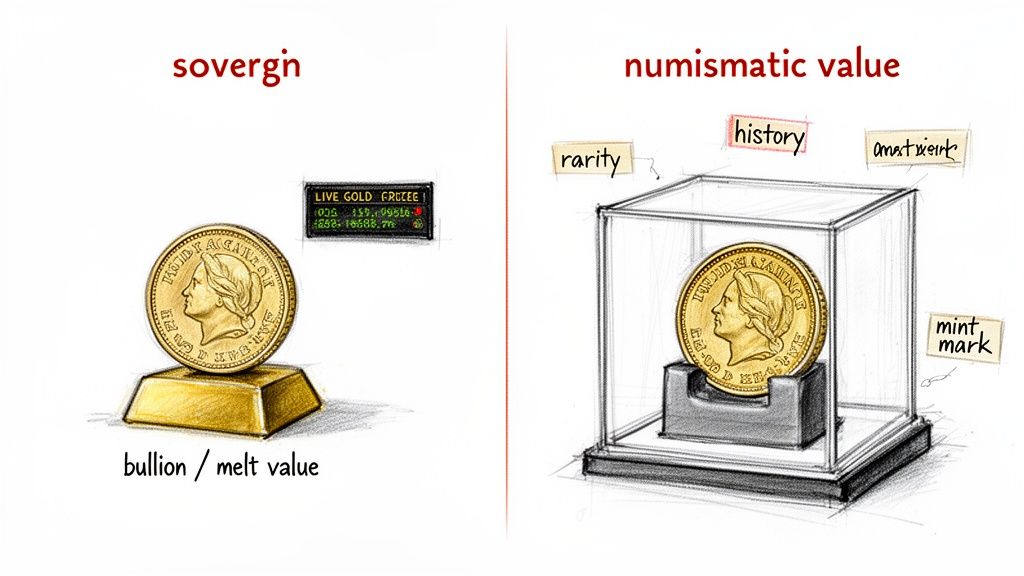
Think of a gold sovereign a bit like a classic car. It has a base value in its raw materials – the steel, leather, and rubber. That sets a price floor. But its real value often comes from its history, the brand, its rarity, and its condition. A sovereign works in exactly the same way.
This guide will break down every element that shapes its market price. We’ll look at how the daily gold price sets the stage, but also how the finer details—like mint marks, condition, and historical significance—are what truly drive the performance.
Understanding these two sides of the coin's value, bullion and numismatic, is the first step to appreciating what your collection is really worth.
The Two Pillars of Sovereign Coin Value
A sovereign's final price tag is built on two distinct pillars. Getting these two mixed up is a common way people undervalue their coins. This table breaks down the basics.
| Valuation Component | What It Represents | Primary Driver of Value |
|---|---|---|
| Bullion Value | The intrinsic worth of the pure gold in the coin. | The live global spot price of gold. |
| Numismatic Value | The extra premium collectors pay for a specific coin. | Rarity, condition, history, and market demand. |
Let's dig into what this means for you.
Bullion Value: The Foundation
This is the most straightforward part of the equation. It’s the raw value of the pure gold within the coin, which is a consistent 7.32 grams or 0.2354 troy ounces. This value is tied directly to the global spot price of gold, which changes by the minute. It represents the coin’s absolute minimum "melt" value.
Numismatic Value: The Story
This is where things get interesting. Numismatic value is the extra premium a coin commands because of factors beyond its gold content. This is all about collector demand, rarity, historical importance, and condition.
A common, heavily circulated sovereign might have little to no numismatic value. In contrast, a rare date in pristine condition could be worth thousands of pounds more than its weight in gold.
In essence, bullion value answers the question, "What is the gold in this coin worth right now?" On the other hand, numismatic value answers, "How much more is a collector willing to pay for this specific coin's story and scarcity?"
Getting a handle on this distinction is critical. Learning to spot the factors that build a numismatic premium is how you separate a standard gold coin from a genuine historical treasure.
Bullion Value Versus Numismatic Premiums
Every gold sovereign has a rock-solid price floor, an absolute baseline that underpins its market value. This is its bullion value, which is simply the current market price for the 7.32 grams of pure gold it contains. You can think of this as its 'melt value'—what it would be worth if you simply melted it down into a shapeless lump of gold.
But that’s just where the story starts. The real magic, the thing that turns a simple piece of precious metal into a sought-after treasure, is its numismatic premium.
Understanding the Numismatic Premium
The numismatic premium is the extra value collectors, historians, and investors are willing to pay above the gold content. This value isn't driven by weight, but by the coin's story, its scarcity, and how much people want it. It's what separates a common coin from a rare artefact.
Here’s an analogy: imagine two copies of the same classic novel. One is a modern paperback you can pick up for a few pounds, worth little more than the paper it's printed on. The other is a signed first edition from the original print run. They both tell the same story, but that signed first edition is a rare piece of history, commanding a huge premium from collectors.
Gold sovereigns work in exactly the same way. A modern, mass-produced sovereign and a rare Victorian-era sovereign have the same amount of gold inside. Yet, their numismatic premiums can create a massive difference in their final price, often turning a £400 coin into one worth several thousand pounds.
The Historical Context of the Sovereign
The sovereign's rich history is a huge driver of its numismatic appeal. Britain's iconic coin was first minted way back in 1489 under Henry VII and later reintroduced in its modern form in 1817. As the gold standard of the British Empire, it circulated far and wide, with branch mints in colonies like Australia and South Africa.
Everything changed in 1914. At the start of the First World War, the government urged people to surrender their sovereigns for the war effort. Vast quantities were melted down, and the coin's role shifted from everyday currency to a store of value.
This fascinating history means that certain years, mint marks, and monarchs are far rarer than others, which directly inflates their value today.
A coin's bullion value is set by global markets, changing every day. Its numismatic premium, on the other hand, is driven by the passion and demand of the collecting community—a value shaped by history, rarity, and condition.
Bullion Sovereigns Versus Numismatic Sovereigns
This difference essentially splits sovereigns into two main camps. Knowing which category your coin falls into is the first step to figuring out what it’s really worth.
- Bullion Sovereigns: These are your common-date coins, often modern issues or heavily circulated older ones. Their value is almost entirely tied to the spot price of gold, with only a very small premium over their melt value. Investors often buy these simply for exposure to gold.
- Numismatic Sovereigns: These are the rare ones. Their value is massively influenced by factors like the year it was made, the mint mark, its grade (condition), and overall scarcity. These are the pieces that serious collectors hunt for.
The journey to uncovering a sovereign's full value starts by understanding what bullion means in the world of coins. Once you have a solid grasp of that foundation, you can start to appreciate the more complex—and often more valuable—numismatic layer.
The Key Factors Driving Sovereign Prices
Figuring out what a sovereign is truly worth is a bit like appraising a piece of fine art or a vintage car. It’s never just one simple calculation. Instead, it's about looking at several connected pieces of a puzzle. While the gold content gives you a solid price floor, the coin’s real market value only comes into focus when you dig a little deeper into four critical factors.
Understanding these drivers is what separates a common bullion coin from a genuine numismatic treasure. Each one plays its own part, and they all influence each other. For example, a coin might be incredibly rare, but if it’s in terrible condition, its value is going to take a serious hit. Likewise, a perfect-looking coin from a very common year will never fetch the price of a slightly less perfect but truly scarce one.
Let’s break down what you really need to look for.
The Baseline Gold Spot Price
First and foremost, you have the bullion value. This is tied directly to the global gold spot price. Every full gold sovereign contains exactly 7.32 grams (that's 0.2354 troy ounces) of pure gold. This gives it a baseline worth that changes every day, sometimes every minute, along with the international markets.
Think of the spot price as the absolute starting point for any valuation. It’s the coin’s ‘melt value’—the minimum it could ever be worth. No matter the year, monarch, or condition, a sovereign will always be worth at least its weight in gold. This provides a brilliant safety net for investors and a solid foundation for collectors to build on.
But for any sovereign with a bit of history or rarity to it, this is just step one. The real art of valuation begins where the bullion value ends.
Year and Mint Mark Significance
This is where the story of the coin starts to have a huge impact on its price. The year a sovereign was struck is obviously important, but it’s often the tiny mint mark—a small letter showing where it was made—that creates serious rarity and pushes the value up.
The Royal Mint in London was the main hub, but at the height of the British Empire, branch mints were set up around the world to strike sovereigns for local use. Each one used a little letter to identify its work:
- S for Sydney, Australia
- M for Melbourne, Australia
- P for Perth, Australia
- I for Bombay (now Mumbai), India
- C for Ottawa, Canada
- SA for Pretoria, South Africa
In any given year, the London mint might have churned out millions of sovereigns, making them quite common. But in that exact same year, the Sydney mint might have only produced a few thousand. That massive difference in production numbers makes the 'S' mint mark sovereign from that year far rarer and, naturally, much more valuable.
A classic example is the 1887 Victoria Jubilee Head sovereign. One from the London mint is a common coin. But find an 1887 sovereign from the Sydney ('S') mint, and you’re looking at a considerably scarcer piece that commands a much higher premium, even though it has the same design and gold content.
Always look for a small letter on the reverse of the coin. It’s usually found on the ground just below the dragon in the St George design. Whether it’s there—or not there, meaning it’s a London coin—is a vital clue to its history and potential value.
The Crucial Role of Condition and Grade
The physical state, or grade, of a sovereign is one of the biggest value multipliers there is. A coin’s grade is simply a way of describing how much wear and tear it has picked up over its life. The price difference between a heavily worn coin and one that looks like it just left the mint can be absolutely staggering.
Experts use a detailed grading scale to describe a coin's condition. The key levels you’ll see are:
- Fine (F): Shows a lot of wear, with many of the design details smoothed down.
- Very Fine (VF): The main details are clear, but you can see wear across the whole surface.
- Extremely Fine (EF): You can only see light wear on the very highest points of the design. The coin is still sharp and has much of its original shine.
- Uncirculated (UNC): A coin with zero signs of wear. It looks just as it did the day it was made.
A common-date sovereign in 'Fine' condition might only sell for its basic bullion value. That very same coin in 'Uncirculated' condition could easily be worth two or three times its gold content. And for a genuinely rare date, that difference can jump into the tens of thousands of pounds. This is why you should never, ever clean your coins. Cleaning creates tiny scratches that destroy their surfaces and obliterate their numismatic value.
Overall Rarity and Mintage Figures
Finally, it all comes down to overall rarity, which is really a mix of all the other factors. Rarity isn’t just about the original mintage (how many were struck in the first place), but also the survival rate (how many are thought to still exist today).
Many sovereigns, particularly from the 19th and early 20th centuries, were used as everyday money and got worn down. Millions more were melted down by governments, especially during the world wars. Because of this, a coin that had a high mintage to begin with might be surprisingly hard to find today, especially in good condition.
This is why legendary rarities like the 1819 George III sovereign or the 1917 London mint sovereign fetch such astronomical prices—hardly any of them survived. Doing a bit of research into the mintage figures and survival estimates for your coin’s specific year and mint mark is the final step to understanding its true place in the market.
How Rarity and Condition Create Extreme Value
While the gold content in a sovereign provides a solid price floor, the real magic happens when you factor in two powerful multipliers: rarity and condition. This is where the thrill of the chase begins for collectors. When a scarce coin also happens to survive in pristine condition, its value can explode, leaving its simple bullion worth far behind.
A sovereign’s journey from a common gold piece to a prized numismatic asset is all about how few are left and how well they’ve been looked after. A tiny detail, a unique history, or a low survival rate can create a value that has little to do with the daily gold price and everything to do with collector demand.
The Power of Scarcity
Rarity in the sovereign world isn’t just about the original mintage numbers. The real story is in the survival rate. Millions of sovereigns were melted down over the years for war efforts or were simply lost to time. This means a coin with what seems like a high mintage could actually be incredibly scarce today.
Legendary examples tell this story perfectly. Take the 1819 George III sovereign. It's a true treasure. With an original mintage of only 3,574 pieces, it’s thought that maybe only 10 examples still exist. This extreme scarcity means that when one does appear at auction, it doesn’t just fetch a small premium; it commands prices in the tens of thousands, sometimes even breaking into six figures.
Think of it this way: Rarity creates the potential for high value, but condition is the key that unlocks it. An extremely rare coin in poor, damaged condition will always be valuable, but a rare coin in near-perfect condition is what creates auction records.
This interplay between price, rarity, and condition is the absolute core of understanding sovereign coin value. The graphic below shows how these three elements work together.
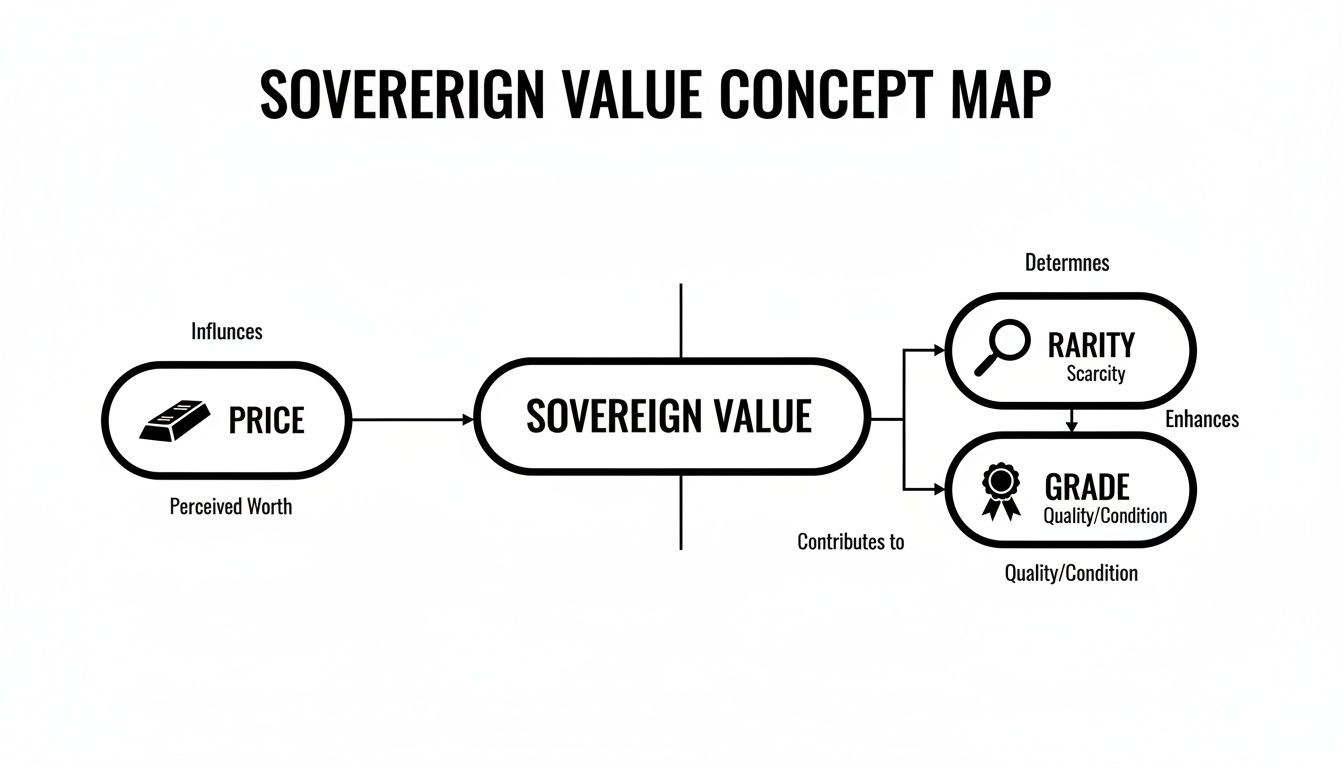
As you can see, a sovereign's base gold price is just the starting point. Rarity and grade act as powerful amplifiers, creating its final numismatic value.
When Condition Commands a Premium
The physical state of a coin—its grade—is the second piece of the puzzle. A flawless, ‘Uncirculated’ coin looks just as it did the day it left the mint, with sharp details and its original lustre. A heavily worn ‘Fine’ grade coin, on the other hand, will have its features smoothed down from years of being handled.
For serious collectors, condition is everything. The difference in price between an ‘Extremely Fine’ and an ‘Uncirculated’ example of a rare date can easily run into thousands of pounds. Rarity is what can send a sovereign's value sky-high for UK numismatists, pushing it far beyond its gold content. A great example is the 1859 'Ansell' Sovereign, an experimental coin with fewer than 25 known to exist. In top grade, it has sold for over £10,000, showing just how much condition amplifies scarcity. You can explore more about how rarities like the 1841 or 1917 London mints exceed their melt value in our other guides on gold sovereign prices.
Example Sovereign Value Ranges Bullion vs Numismatic
This table really brings home the dramatic difference in value between a standard, common sovereign bought for its gold content and a rare, high-grade piece sought after by collectors.
| Sovereign Type | Typical Condition | Primary Value Driver | Estimated Value Range (£) |
|---|---|---|---|
| Common Date (e.g., QEII) | Circulated to Uncirculated | Bullion (Gold Spot Price) | £420 - £480 |
| Scarce Victorian Mint Mark | Extremely Fine (EF) | Rarity and Condition | £600 - £1,200 |
| Key Date Rarity (e.g., 1819) | Very Fine (VF) or better | Extreme Rarity and History | £10,000 - £100,000+ |
Looking at these high-end examples makes it clear why a sovereign is so much more than just a simple piece of gold. It’s a historical artefact where scarcity and preservation come together to create something of extraordinary value.
A Practical Guide to Valuing Your Sovereigns
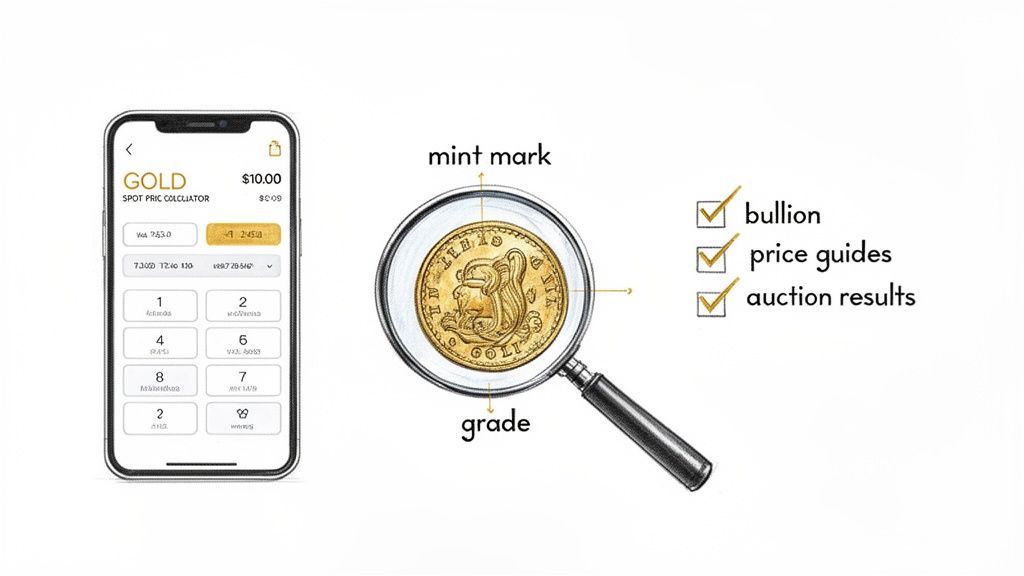
So, you're ready to find out what your gold sovereigns are really worth? It might seem like a complex world, but figuring out a solid estimate is more straightforward than you think. By following a few logical steps, you can get a very good idea of your coin's value before you even speak to an expert.
Think of it as building a case for your coin's value. You start with the undeniable foundation and then add the layers of detail that make it special. This knowledge is your best asset when you eventually talk to a dealer or an auction house.
Start with the Bullion Foundation
First things first, let's establish the coin's base value. This is simply the worth of the pure gold it contains. Every full sovereign has 7.32 grams of pure gold, and its value is tied directly to the live market price.
- Check the Live Gold Spot Price: A quick search online will give you the current gold price per gram in pounds sterling (£). This number changes constantly throughout the day.
- Use an Online Calculator: Even easier, most bullion dealers have free "scrap gold" or coin calculators on their websites. Just select "Sovereign," and it will do the maths for you instantly.
This figure is your coin's absolute floor price. No matter what, it will never be worth less than its weight in gold, giving you a solid starting point.
Investigate the Numismatic Premium
Now for the interesting part: the collector's premium. With the bullion value as our base, we can now dig into the details that might make your coin worth more to a collector. This means looking at the specific year, the mint mark, and its overall condition.
A coin's final worth is its bullion value plus its numismatic premium. While bullion value is universal, the premium is highly specific to the individual coin and current market demand.
To get a sense of this premium, you'll need to consult the same sources the experts use.
- Consult Reputable Price Guides: The bible for British coins is the "Spink Coins of England & the United Kingdom" catalogue. It gives estimated values for nearly every sovereign by year, mint, and grade.
- Check Recent Auction Results: This is where the rubber meets the road. Looking at the "sold" listings on major coin auction sites or even eBay shows you what people are actually paying for coins like yours right now. It’s often the most realistic gauge of value.
By comparing your coin's details against these sources, you'll see whether it carries a small premium or something far more significant. It’s a bit like getting a jewelry appraisal for insurance; the small details can make a huge difference to the final figure.
Seek an Expert Opinion
Once you’ve done your homework, the final step is to get a professional opinion from someone you trust. Now that you understand its base value and potential premium, you can have a much more confident and informed conversation with a dealer.
An experienced numismatist can accurately grade your coin's condition, something that takes a trained eye. If you'd like to learn more about this crucial skill, our detailed coin grading guide for beginners and experts is a great place to start. A true expert can also provide insights into market trends that price guides haven't caught up with yet.
Here at Cavalier Coins, we're always happy to help collectors understand what they have. We can provide an accurate, no-obligation valuation backed by decades of experience in the market.
Maximising Your Return When Selling Sovereigns
Once you’ve got a firm grasp of what your sovereigns are worth, the next logical step is making sure you get the best possible price when you decide to sell. It can feel like a daunting market to navigate, but with the right strategy, you can walk away confident you’ve secured a fair return on your investment.
It all comes down to choosing the right sales channel for your specific coins. There are two main paths collectors and investors take, and your choice will hinge on what kind of sovereigns you have and what you prioritise – whether that’s a quick, certain sale or holding out for the absolute highest price for a rare piece.
Choosing Your Sales Channel
Deciding where to sell is the single most important decision you'll make, as it directly impacts your final payout. What works for a common bullion sovereign is almost never the right choice for a rare numismatic treasure.
- Selling to a Dealer: This is the most straightforward and fastest way to sell. A reputable dealer, like us here at Cavalier Coins, can assess your collection and make an immediate, on-the-spot offer. This route gives you certainty and quick payment, which is perfect for bullion-grade sovereigns or when you simply want a hassle-free transaction.
- Selling at Auction: If you have rare dates, high-grade examples, or coins with a unique story, an auction is often your best bet. Auctions create a competitive buzz where passionate collectors bid against one another, which can drive the price far higher than a standard dealer offer. This path takes a bit more time, but it can truly maximise the return on exceptional coins.
The Golden Rule of Selling: Whatever you do, never, ever attempt to clean your coins. Cleaning might seem like a good idea, but it creates microscopic scratches that permanently damage the coin's original surface. This can completely destroy its numismatic value, instantly turning a valuable collectible into something worth only its weight in gold.
Preparing for a Successful Sale
A little preparation goes a long way towards getting the price you deserve. Start by simply organising your collection by year, monarch, and mint mark. Having a clear inventory helps both you and any potential buyer understand exactly what’s on the table.
It’s also wise to have a realistic expectation of your sovereign's value. Gold Sovereigns are a cornerstone of UK investment, highly sought after for their 22-carat purity and Capital Gains Tax (CGT) exemption. Each one contains 7.32g of pure gold, so their base value naturally moves with the market, which has seen UK gold hit recent highs of £3,917.48 per ounce. You can get a feel for these movements by checking out the gold price history on TheGoldBullion.co.uk. Understanding these market dynamics, alongside the specific rarity of your coins, puts you in a much stronger position.
Finally, whether you opt for a dealer or an auction, always work with established and trusted professionals. A reputable expert will offer transparent pricing and guide you toward the best sales strategy for your individual collection. For a much deeper dive into the selling process, have a look at our comprehensive guide on how to get the best price when selling gold sovereigns.
A Few Common Questions About Sovereign Value
Even after getting a handle on the factors that drive a sovereign's price, a few specific questions always seem to pop up. We hear them all the time from collectors and investors alike, so let's tackle them head-on.
Think of this as a quick-fire round to clear up any lingering confusion about rarity, condition, and the ever-shifting market. Each answer builds on that core idea of a coin's dual identity: its raw gold value versus its historical, collectible worth.
Is It Better to Buy Common or Rare Sovereigns?
This is a fantastic question, and the answer comes down to what you're trying to achieve. There’s no single “better” option here—it’s all about matching the coin to your personal strategy.
- For pure gold investment: If you're simply looking to own physical gold, then common-date sovereigns are an absolutely brilliant choice. You can often buy them for a small premium over the gold spot price, and their value tracks the market directly. They’re a simple, liquid asset.
- For collector growth: If you’re a collector, or an investor hoping for higher long-term growth, then rare-date sovereigns in top condition offer that potential. Here, the value is driven by scarcity and demand from other collectors, which can often outpace the raw gold price.
Many people actually do both. They'll build a solid base of common sovereigns for their bullion value and then add a few special, high-grade pieces for their numismatic potential. It's a great hybrid approach.
The key is to ask yourself: am I buying gold, or am I buying a piece of history? Your answer will point you straight to the right type of sovereign.
How Much Does a Mint Mark Affect a Sovereign's Value?
A mint mark is that tiny letter on the coin telling you where it was made—like an ‘S’ for Sydney or ‘M’ for Melbourne. Its impact on value is huge, and it all comes down to one thing: rarity.
In any given year, the main Royal Mint in London might have struck millions of sovereigns, making them fairly common. But at the same time, a branch mint in a place like Sydney or Melbourne might have only produced a tiny fraction of that number.
This massive difference in production means a sovereign with a Sydney ‘S’ mint mark from that year is far, far scarcer. Because of that scarcity, it will command a much higher numismatic premium, even though it has the exact same gold content and design as its London-made cousin.
Should I Clean My Gold Sovereigns Before Selling?
In a word: no. Absolutely not. This is easily one of the most common and painful mistakes a new owner can make.
When you try to clean a coin—no matter how gently you think you’re being—you create thousands of microscopic scratches across its surface. In the coin world, we call this damage 'hairlines', and it can completely torpedo a coin's collector value.
Cleaning can turn a valuable historical artefact into something worth little more than its melt value. That original surface, sometimes called a 'patina', is part of the coin's story and is what serious collectors prize most. Always, always leave your coins as they are.
At Cavalier Coins Ltd, we provide expert, no-obligation valuations based on the latest market data and decades of hands-on experience. Whether you want to understand your collection's true value or find the perfect piece to add to it, we can help. Explore our services at https://www.cavaliercoins.com.