
Ever wondered if that 50p in your pocket could be worth more than a cup of coffee? Many people don't realise that everyday change can hide numismatic treasures worth hundreds, sometimes thousands, of pounds. Identifying these valuable 50p coins boils down to understanding two key factors: rarity and error.
The most sought-after 50p pieces are those with tiny production numbers or unique manufacturing flaws. Coins like the famous 2009 Kew Gardens 50p and the record-holding 2023 Atlantic Salmon 50p are worth a fortune compared to their face value, all thanks to their incredible scarcity.
How to Spot Rare 50p Coins Worth a Fortune
So, how does a common coin become a collector's dream? It almost always starts with its production run. This is what we in the coin world call mintage—the total number of coins of a specific design that The Royal Mint produces. When this number is exceptionally low, the coin becomes inherently scarce, transforming it from simple currency into a collector's item.
Low Mintage and Minting Errors
The market for rare UK 50p coins has really taken off, especially after commemorative designs started entering circulation back in 1997. The most coveted piece in modern circulation is the 2023 Atlantic Salmon 50p, which snagged the top spot with a mintage of just 200,000 coins. It recently knocked the iconic 2009 Kew Gardens 50p off its pedestal, a coin that held the title for over a decade with its 210,000 mintage.
Beyond planned scarcity, some of the most fascinating valuable 50p coins are born from pure chance. These are known as error coins—pieces that left the mint with a flaw. These aren't just damaged coins; they are genuine manufacturing mistakes that create unique and often valuable variations.
Here’s a look at the two main paths a coin can take to become valuable.
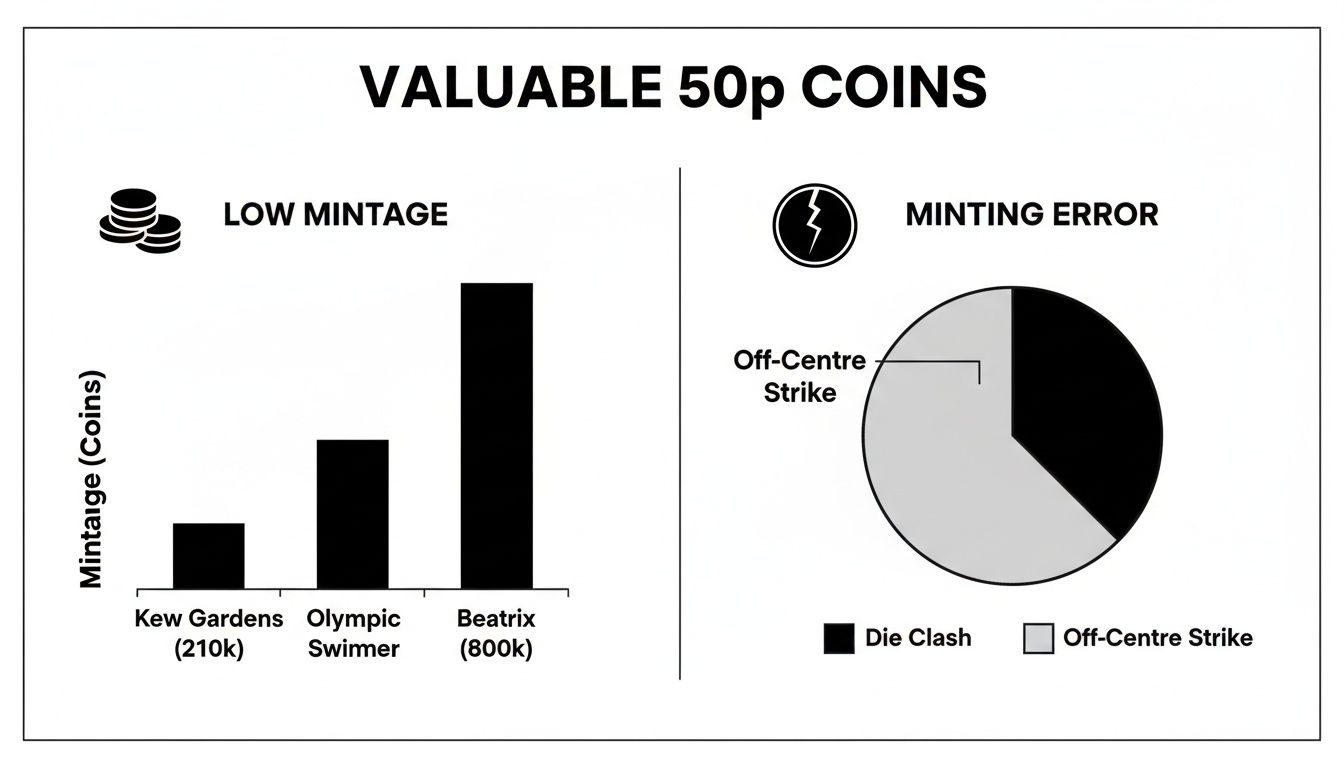
As you can see, a coin’s value can stem from either intentional scarcity (low mintage) or unintentional uniqueness (minting errors).
Turning a Hobby into a Treasure Hunt
Commemorative designs have turned coin collecting from a niche hobby into a national treasure hunt. Designs celebrating everything from Beatrix Potter characters to the Olympic Games have captured the public's imagination, and this increased demand only fuels the value of already scarce coins.
For example, the 2011 series celebrating the London Olympics included 29 different designs. While millions of each were minted, certain designs like the original Aquatics coin are particularly sought after. This is especially true for those with a specific error where water lines obscure the swimmer’s face. If you're curious, you can take a look at our deep dive into the complete Olympic 50p coins collection.
The core principle for any collector is simple: Rarity drives value. A coin is only worth what someone is willing to pay for it, and collectors will pay a premium for a piece they can't easily find elsewhere.
This guide will show you exactly what to look for, transforming the way you see your spare change. By learning to spot low mintage figures and recognise genuine minting errors, you can begin your own treasure hunt today.
Why Mintage Figures Determine a Coin's Rarity
What makes one 50p coin worth hundreds of pounds while another is worth just its face value? The answer, in most cases, is surprisingly simple: mintage.
This term simply means the total number of coins of a specific design that The Royal Mint has produced and released into circulation. It’s the single most important factor when it comes to a modern coin's value.
Think of it like a limited edition art print. If an artist releases only 250 signed prints, each one is far more valuable than a poster with millions of copies. The same principle applies to valuable 50p coins. The lower the mintage, the greater the scarcity, and scarcity is the engine that drives value in the world of coin collecting.
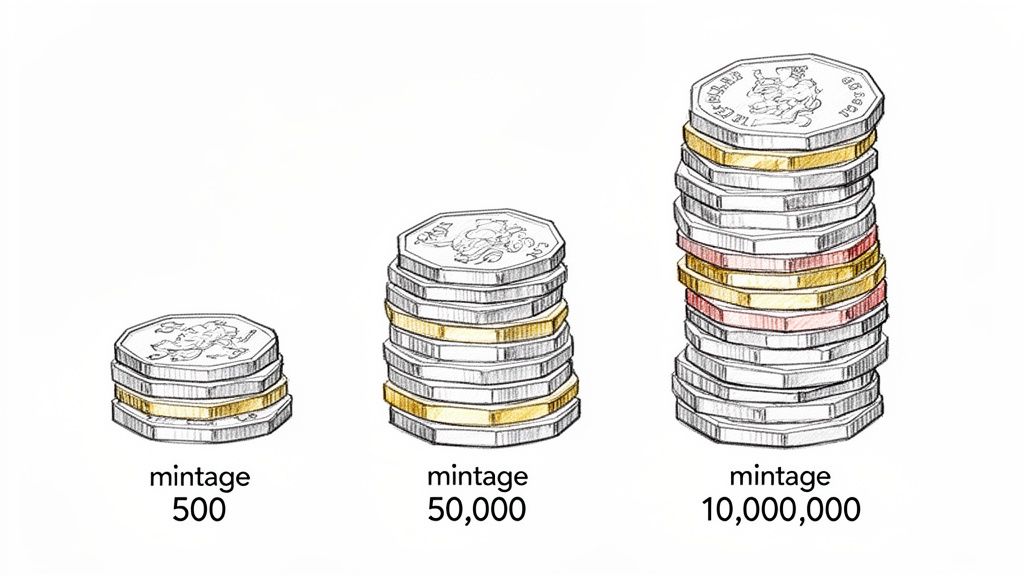
This fundamental rule of supply and demand explains why a coin like the 2009 Kew Gardens 50p became legendary. With only 210,000 minted, finding one in your change is like finding a needle in a haystack. For comparison, the standard 1997 Britannia 50p had a mintage of over 456 million. The difference is staggering.
Where Mintage Data Comes From
So, how do collectors know these exact numbers? Thankfully, The Royal Mint periodically releases official mintage figures for all coins. This data is the bedrock of modern coin collecting, providing a reliable and transparent source for determining which coins are genuinely rare.
These figures aren't secrets; they are publicly available, empowering anyone to become an informed collector. Knowing these numbers allows you to check your change with purpose, turning a casual glance into a calculated treasure hunt. It's the difference between hoping for a lucky find and knowing precisely what you're looking for.
Mintage is the single most important factor in determining the baseline rarity of a modern commemorative coin. While condition and errors add layers of value, a low mintage figure is what gets a coin noticed in the first place.
Understanding this concept is the first major step towards identifying potentially valuable 50p coins. It allows you to sift through dozens of common pieces and focus your attention on the designs that have a real chance of being worth more than 50 pence.
The Rarest 50p Coins in Circulation
To put this all into practice, let’s look at the official figures. The table below is your practical checklist, listing the top 10 rarest 50p coins you could genuinely find in your change, ranked by how few were made.
Top 10 Rarest Circulated 50p Coins by Mintage
Here's the definitive list of the scarcest 50p coins released into general circulation in the UK, based on official data from The Royal Mint. Keep an eye out for these.
| Rank | Coin Design | Year | Mintage Figure | Estimated Value Range |
|---|---|---|---|---|
| 1 | Kew Gardens | 2009 | 210,000 | £140 - £200 |
| 2 | Olympic Football | 2011 | 1,125,500 | £10 - £16 |
| 3 | Olympic Wrestling | 2011 | 1,129,500 | £7 - £12 |
| 4 | Olympic Judo | 2011 | 1,161,500 | £8 - £12 |
| 5 | Olympic Triathlon | 2011 | 1,163,500 | £8 - £12 |
| 6 | Peter Rabbit | 2018 | 1,400,000 | £8 - £15 |
| 7 | Flopsy Bunny | 2018 | 1,400,000 | £5 - £10 |
| 8 | Olympic Tennis | 2011 | 1,454,000 | £5 - £8 |
| 9 | Olympic Goalball | 2011 | 1,615,500 | £4 - £7 |
| 10 | Paddington at the Station | 2019 | 1,601,000 | £4 - £8 |
Note: Values are estimates for circulated coins and can fluctuate based on condition and market demand.
This table clearly illustrates the power of mintage. The Kew Gardens coin, with its tiny figure of just 210,000, sits in a league of its own. Even the Olympic coins, with mintages over one million, are considered scarce compared to the tens of millions produced for more common commemorative designs.
Now that you have this data, you're equipped to spot a truly rare find.
How Minting Errors Create Unique Collectibles
While low mintage figures give us a predictable kind of rarity, some of the most exciting and valuable 50p coins are born from pure, beautiful chance. These are the happy accidents of manufacturing, where a mistake at The Royal Mint turns a standard coin into a truly unique and sought-after collectible.
Think of it like a factory churning out thousands of identical toy cars. If one accidentally rolls off the production line with its doors attached upside down, which one do you think collectors will scramble for? It’s the same principle with coins.
These “error coins” aren’t just damaged; they're genuine pieces that left the mint with a distinct flaw. The imperfection tells a story about the coining process, giving us a fascinating glimpse behind the curtain. For a collector, owning an error coin is like owning a piece of that history—a one-of-a-kind deviation from the norm that can never be intentionally replicated.
Common Types of Minting Errors
Not all flaws are created equal, but a few specific types are well-known among collectors. Learning to spot these can be the key to finding a hidden gem in your change.
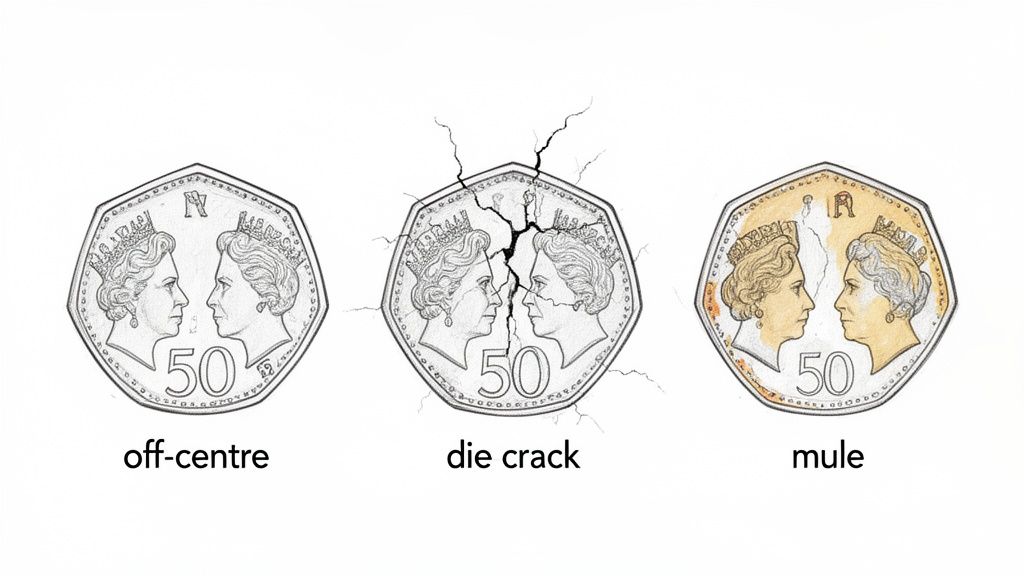
- Off-Centre Strikes: This happens when the blank disc (or planchet) isn’t perfectly aligned when it gets struck. The result is a design that’s off-kilter, leaving part of the coin’s surface completely blank.
- Die Cracks: A tiny crack develops in the die used to stamp the coin's design. During striking, metal fills this crack, creating a raised, squiggly line on the finished coin.
- Mule Coins: This is one of the rarest and most dramatic errors. It occurs when a coin is struck with two mismatched dies—for instance, the ‘heads’ side of one coin and the ‘tails’ side of a completely different one.
These are just a handful of the things that can go wrong during the high-speed, high-pressure minting process. While low mintage numbers create predictable scarcity, these kinds of manufacturing defects can make a coin’s value skyrocket.
Case Study: The Aquatics 50p Error
A perfect real-world example is the famous 2012 Aquatics 50p, part of the London Olympics series. The very first design showed a swimmer with water lines flowing clearly across their face. This version was quickly withdrawn and replaced with a modified design where the swimmer’s face is completely visible.
That original "lines over face" coin is now a prized collectible. It's a subtle but distinct difference that makes it significantly more valuable than the common version. This coin teaches a crucial lesson for collectors: the value is often hiding in the details.
Distinguishing Error from Damage
This brings us to the most important skill for any error coin hunter: telling the difference between a valuable minting flaw and simple, everyday damage. A coin that’s been scratched, dented in a tumble dryer, or intentionally altered has no added value whatsoever.
A genuine error has characteristics that are consistent with the minting process itself. A die crack appears as a raised line, whereas a scratch is an indented groove. An off-centre strike will have sharp, well-defined edges where the design cuts off, unlike the random dings a coin picks up in circulation.
Learning these distinctions is absolutely essential. For more detailed guidance, you can discover valuable error coins and their hidden treasures in our dedicated guide.
A Practical Checklist for Examining Your Coins
So, you think you might have a rare 50p. Now the real fun begins – the treasure hunt. When you stumble upon a promising commemorative coin, a systematic inspection is the only way to figure out what it’s really worth. This isn’t about giving it a quick glance; it’s about playing detective and hunting for the tiny details that separate pocket change from a proper collector's piece.
To do this right, you’ll want to check four critical areas on every coin. A methodical approach means you won't miss a subtle flaw or feature that could send its value soaring. Think of it as a four-point inspection for every coin that comes your way.
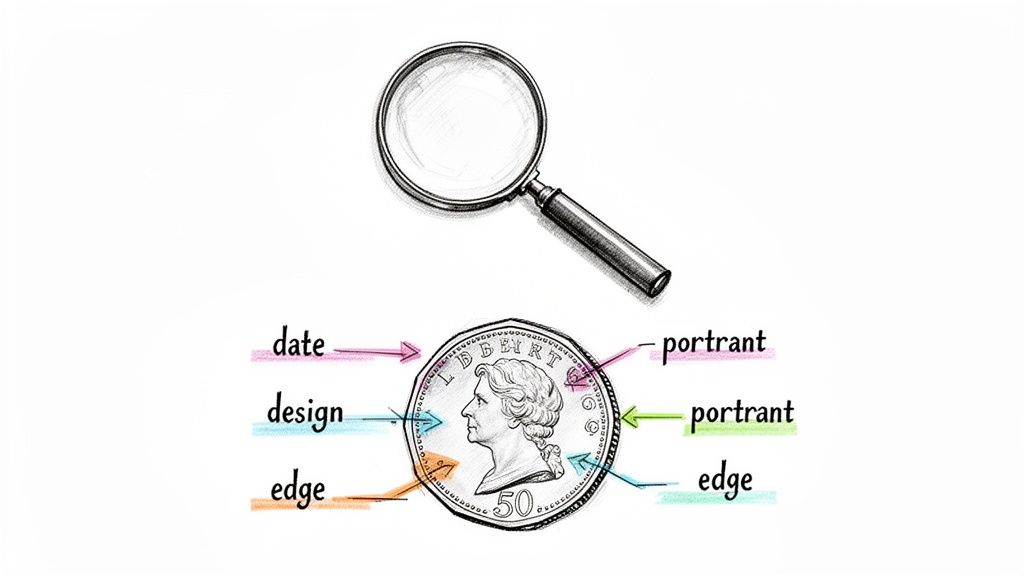
You don't need any fancy gear to get started. A simple magnifying glass and a good, bright light are your best friends for spotting the tiny variations that make all the difference.
The Four Pillars of Coin Inspection
To keep things organised, focus on these specific elements one by one. Each part of the coin can hold vital clues to its rarity and, ultimately, its value.
-
Check the Date: This is your first port of call. The year of issue is absolutely crucial because it ties the coin directly to its official mintage figure. A 2018 Peter Rabbit 50p, for instance, is a much scarcer find than the 2016 or 2017 versions.
-
Examine the Design (Reverse): Look closely at the commemorative design on the ‘tails’ side. Pull up official images from The Royal Mint and compare them. Are there any strange lines, missing bits, or extra marks that could point to a minting error? Think of the famous water lines on the original Aquatics 50p – that’s the kind of detail you’re looking for.
-
Inspect the Portrait (Obverse): Don’t just focus on the fancy side! The monarch’s portrait on the ‘heads’ side should be crisp and well-defined. If you see faint traces of the reverse design bleeding through, you might have a ‘die clash’ error on your hands.
-
Analyse the Edge: The seven-sided edge of a 50p is so often overlooked, but it shouldn't be. Run your finger along it and look for any inscriptions or irregularities. While less common on 50p coins, edge errors can add significant value to other denominations.
By running through this simple checklist, you’ll build a solid habit of proper examination, making it much harder to miss a potentially valuable 50p coin. To help you track your collection, our 50p coin checker is a fantastic resource for staying organised.
Understanding Coin Condition and Grading
Once you’ve confirmed you have a rare coin, its physical condition is the next big factor in determining its value. It's simple, really: a coin that looks like it just rolled out of the mint will always be worth more than one that’s been clanking around in someone’s purse for a decade.
Coin collectors use a grading scale to describe a coin’s level of wear. The official scale can get a bit complicated, but for our purposes, you can use a simplified version to get a good idea:
- Brilliant Uncirculated (BU): This is a perfect coin. It has absolutely no wear, retains its original mint shine, and looks brand new.
- Good: The main design is still visible, but the coin shows heavy wear. Many of the finer details have been smoothed down from years of being passed from hand to hand.
- Circulated: This is a catch-all for any coin that shows obvious signs of use. We’re talking minor scratches, little dings, and a duller finish. The vast majority of coins you find in your change will fall into this category.
The difference in value between a circulated coin and a Brilliant Uncirculated one can be absolutely staggering. For a highly sought-after coin, the BU version can be worth 10 to 20 times more than its well-worn counterpart.
This huge price gap really highlights why condition is king. A badly scratched Kew Gardens 50p is still an amazing find, of course, but one in pristine condition is in a completely different league.
How Condition Impacts Coin Value
To show you just how much wear and tear can hit a coin's price, let's look at a quick comparison for a rare commemorative 50p. This table makes it clear how the value drops as the condition gets worse.
| Coin Design (Year) | Circulated Condition Value | Good Condition Value | Brilliant Uncirculated (BU) Value |
|---|---|---|---|
| Rare Commemorative 50p | £15 - £25 | £50 - £80 | £150 - £250+ |
As you can see, keeping a coin in top-notch condition is paramount. This is why serious collectors will only ever handle their best pieces with cotton gloves and store them safely in protective capsules. If you find a rare coin, your first priority should be protecting it from any further damage.
Getting to Grips with Common Minting Flaws
Everyone dreams of finding a dramatic error like a mule coin or a wild off-centre strike. While those are the stuff of legend, they are incredibly rare. For most of us sifting through our change, the real hunt for valuable 50p coins is about spotting the more subtle, yet still significant, minting quirks.
Learning to spot these common imperfections is what separates a casual looker from a serious collector. These aren't just random dings and scratches picked up in circulation; they are distinct patterns that tell a fascinating story about the moment the coin was made.
The Tell-Tale Signs of a Die Clash
One of the most interesting errors you might genuinely find is the die clash. Picture this: the two metal stamps (dies) used to create the coin—one for the Queen's head and one for the reverse design—smash into each other without a blank coin in between. This powerful collision can actually transfer faint details from one die to the other.
What you're left with is a ghostly trace of the Queen’s portrait on the reverse side, or maybe elements of the special design showing through on the front. This isn't damage. It’s a permanent imprint left on the die itself, which is then stamped onto every single coin it strikes afterwards.
A die clash error is a ghost image—a faint impression of one side of the coin appearing on the other. It’s a direct result of the two dies striking each other and gives us a fascinating glimpse into the mechanics of the minting process.
This exact issue shot to fame when it happened to a huge number of the 2016 Jemima Puddle-Duck 50p coins and again on some 2017 Isaac Newton 50p pieces. For whatever reason, modern UK 50p coins seem particularly prone to these kinds of manufacturing hiccups across various designs. You can discover an introduction to UK error coin types to learn more about the different varieties out there.
Mechanical Doubling and Die Rotations
Another common sight is mechanical doubling. It’s easy to get excited by this one, as it can look like a much rarer and more valuable type of error. This flaw creates a flat, shelf-like doubling effect on letters or parts of the design, usually caused by the die bouncing ever so slightly during the strike. While it looks cool, mechanical doubling is generally seen as a minor blip and adds little, if any, value.
Finally, keep an eye out for die rotation. If you take a normal coin, hold it upright and flip it over vertically, the design on the back should also be perfectly upright. A rotation error happens when one of the dies is misaligned, causing the reverse design to be tilted when you flip it.
Here’s a quick way to check:
- Hold the coin so the Queen's portrait is perfectly upright.
- Use your fingers to grip it at the top and bottom.
- Now, flip the coin over horizontally, as if you’re turning a page in a book.
- If the design on the back isn't straight, you’ve got a rotated die.
Small rotations are quite common on the seven-sided 50p and don't carry much of a premium. However, a major rotation of 90 degrees or a full 180 degrees (often called "medal alignment") is a different story. That’s a very desirable find for error collectors and can certainly add a decent premium to the coin’s value.
A Collector's Guide to Buying and Selling Coins
So, you've either stumbled upon one of the UK’s most valuable 50p coins or you're on the hunt for a specific piece to complete your collection. Either way, you need to know how to navigate the market. The right platform can connect you with fellow collectors, but the wrong one is fraught with pitfalls.
Selling Your Coins
If you're selling, presentation is everything. Don't even think about listing a coin without high-quality, clear photos. You need to capture both the front (obverse) and back (reverse) in good, natural light. Your description must be brutally honest—mention every visible scratch or sign of wear. Be specific about the year, design, and any errors you think you've spotted.
Buying Coins Safely
For buyers, due diligence is your best friend. Always, always check a seller's feedback and history, especially on open marketplaces. If a deal looks too good to be true, it absolutely is. Scrutinise the photos, comparing the details to known genuine examples before you even think about hitting 'buy'.
Where to Buy and Sell Your Coins
The coin market has a home for everyone, from someone who’s found a single interesting coin in their change to a seasoned professional dealer. Each option has its own pros and cons, so the right choice really hinges on what you’re trying to achieve.
-
Online Marketplaces (like eBay): These sites offer a huge audience, but they’re also a minefield of wildly inflated prices and outright fakes. If you’re using them, here’s the single most important tip: always check the sold listings, not the active ones. That’s the only way to see what a coin is actually selling for and get a feel for its true market value.
-
Specialist Coin Dealers: A reputable dealer, like us here at Cavalier Coins, brings expertise and fair pricing to the table. It's a straightforward way to sell your finds for immediate payment or to buy authenticated coins with total confidence. You might get a slightly lower price when selling directly to a dealer, but you get to skip the fees and the hassle of finding a private buyer.
-
Auction Houses: If you're lucky enough to have an exceptionally rare or high-value coin, a dedicated coin auction is your best bet. They handle all the marketing and verification, making sure your coin gets in front of serious collectors who are ready to pay top-dollar. Just be prepared for them to take a significant commission.
A quick reality check: The price a coin is listed for means absolutely nothing. The only price that matters is what someone actually paid for it. It's common to see misleading online listings for everyday 50p coins priced at thousands of pounds—these are best ignored.
Choosing the right place to trade ensures you get a fair price for your valuable 50p coins and helps you build your own collection without getting burned. Whether you’re offloading a single treasure or buying your next prized piece, confidence is key.
Your 50p Coin Questions Answered
When you first start looking closely at the coins in your pocket, it’s natural to have a lot of questions. We get asked all sorts of things by new and seasoned collectors alike, so we've put together some quick, clear answers to the most common queries about hunting for valuable 50p coins.
Which 50p Coins Are the Rarest in Circulation?
Without a doubt, the rarest 50p coin you can realistically find in your change is the famous 2009 Kew Gardens 50p. The Royal Mint only struck 210,000 of them, making it the ultimate prize for many collectors hunting through their change.
Some of the other big hitters come from the 2011 Olympic series. Keep an eye out for designs like Football, Wrestling, and Judo – they all have mintages of just over one million, which sounds like a lot but is incredibly low for a circulation coin.
How Much Is a Kew Gardens 50p Really Worth?
This is the big question! The value of a Kew Gardens 50p changes with the market, but the single biggest factor is its condition. A circulated coin—one that’s been jangling around in pockets and tills—will typically sell for between £140 and £200.
However, if you have a Brilliant Uncirculated (BU) version that has never seen public hands, it’s a different story. These pristine examples can easily command prices north of £250.
A key takeaway for any collector is that a coin's condition dramatically impacts its final value. A pristine example of a rare coin will always be worth significantly more than a heavily worn one.
What Should I Do If I Find a Valuable Coin?
Finding one is a real thrill! The first rule is simple: protect it. Straight away. Handle it only by its edges to avoid getting fingerprints on the surface, as the oils from your skin can cause damage over time. Pop it into a protective holder or even a soft, non-abrasive pouch to stop it from getting scratched.
Once it's safe, here’s what to do next:
- Verify it's real by comparing it to official images from The Royal Mint.
- Assess its condition as honestly as you can. Look for any scratches, dings, or general wear.
- Research its market value by looking at sold listings on sites like eBay. Don't look at the asking prices, as they can be wildly optimistic!
This little process will give you a much more realistic idea of what your new treasure is actually worth.
Are Commemorative 50p Coin Sets a Good Investment?
Commemorative sets, especially those sold in Brilliant Uncirculated or Proof condition, can certainly be a good investment, but it’s never a guarantee. Their future value is really tied to how popular the theme is and, crucially, how many sets were made.
While some sets appreciate nicely over time, others might not. It’s best to see them as enjoyable collectibles first and a potential investment second. For most people, the real joy comes from owning a complete, beautifully presented collection of coins you genuinely love.
At Cavalier Coins Ltd, we provide a trusted platform for both new and seasoned numismatists to buy and sell with confidence. Explore our extensive collection of rare coins and banknotes or get a fair valuation for your treasures by visiting us at https://www.cavaliercoins.com.