

Ever noticed a tiny letter stamped onto a coin? That's a mint mark, and it’s one of the most important clues a coin can give you. Think of it as a ‘made in’ label, telling you precisely which facility struck the coin, whether it was the Royal Mint in London or one of its many branches across the globe.
This small detail is far more than just a letter; it’s the key to unlocking a coin's history, scarcity, and ultimately, its value to collectors.
Unlocking a Coin's Story Through Its Mint Mark
At its heart, a mint mark answers a simple but vital question for any collector: where did this coin come from? Much like a postmark on a letter, it pinpoints the geographical origin, connecting a simple piece of metal to a specific moment in history.
Suddenly, a coin isn't just currency; it's a tangible artefact. A British Sovereign bearing an ‘S’ mark, for example, wasn’t minted in the UK at all. It was struck thousands of miles away at the Sydney branch of the Royal Mint in Australia.
This seemingly minor detail gives a coin its context. It can tell you a story about:
- The Reach of Empire: Marks from mints in Canada, India, and South Africa are physical proof of the British Empire's immense economic influence across the world.
- Wartime Demands: Certain mint marks reveal coins produced under extraordinary circumstances, such as needing to supply currency to troops overseas during a conflict.
- Economic Booms: The opening of new branch mints often coincided with major events like gold rushes, where a sudden need for local coinage was critical.
Without understanding the mint mark, you could easily mistake two coins from the same year as being identical. One might be a common issue, struck in the millions in London, while the other is a rare variety from a branch mint that only operated for a few years. This is precisely why knowing what a mint mark on coins is is so fundamental for every serious collector.
To get you started, here is a quick reference table of some of the most common mint marks you’re likely to encounter on British and Commonwealth coins. It's a great starting point for identifying the treasures in your own collection.
Common Mint Marks on British and Commonwealth Coins
| Mint Mark | Mint Location | Example Coin |
|---|---|---|
| S | Sydney, Australia | Gold Sovereign |
| M | Melbourne, Australia | Gold Sovereign |
| P | Perth, Australia | Gold Sovereign |
| C | Ottawa, Canada | Gold Sovereign |
| I | Bombay, India | Gold Sovereign |
| SA | Pretoria, South Africa | Gold Sovereign |
Keep this guide handy as you look through your coins. You might be surprised to find you own a piece of history from the other side of the world
The Story Behind British Mints and Their Marks
To really get why a tiny letter on a coin can be such a big deal, we need to hop in a time machine. The story of mint marks in the UK is completely tangled up with the history of the Royal Mint, an institution that’s been around for over a thousand years. Its journey from a handful of workshops to a global powerhouse is the reason these little marks became so critical.
The Royal Mint’s story begins way back in AD 886 with Alfred the Great, who started to bring coin production under one roof. For centuries, though, various mints operated across England in places like Bristol and Oxford. It wasn't until 1279 that things got serious, and operations were consolidated within the mighty walls of the Tower of London. For almost a millennium, London was the beating heart of British coinage, right up until the mint packed its bags for Llantrisant, Wales, in the 1970s.
An Empire Built on Coinage
As the British Empire stretched across the globe, so did the demand for currency. Trying to ship tonnes of coins from London to far-flung colonies was not just impractical; it was downright dangerous. The only sensible solution was to set up local branch mints to keep the economies of these growing territories running smoothly.
This expansion brought a new headache: how could you tell a coin struck in London from one made in Sydney, Pretoria, or Bombay? This is where the mint mark stepped onto the stage.
A mint mark was the Royal Mint's global signature. It was a simple yet brilliant system for quality control and accountability, making sure every coin, no matter where it was made, could be traced straight back to its source.
These branch mints weren't rogue operations. They were official extensions of the Royal Mint, using the same designs and dies shipped over from London. The only thing that set them apart was a tiny initial—like an 'S' for Sydney or an 'I' for India—but that small difference meant everything.
The infographic below shows just how powerful that one little mark is in telling a coin's story.
This simple process shows how a single mark can turn an anonymous piece of metal into a historical artefact with a real story to tell.
Branch Mints and Their Unique Stories
Every branch mint has its own fascinating history, often linked to huge local events like gold rushes or periods of massive economic growth. These facilities were set up to meet the real-world demands of a global empire.
Here are a few of the most important outposts in the Royal Mint's global network:
- Sydney, Australia (S): The first Royal Mint branch outside England, it opened its doors in 1855. Its main job was to turn the gold pouring out of the Australian gold rush into sovereigns.
- Ottawa, Canada (C): Founded in 1908, this branch struck sovereigns and other local currency, a clear sign of Canada's growing economic clout.
- Bombay, India (I): This mint was an absolute workhorse, striking enormous numbers of sovereigns during World War I to keep British economic interests afloat in the region.
Getting to grips with this history is a must for any serious collector. The very existence of these branch mints, each with different production runs and lifespans, is what creates the rarity and value we see in British coins today. To explore this topic further, you can learn more about the worldwide reach of the Royal Mint in our detailed article. This historical background is what makes a simple mint mark so incredibly exciting.
How to Identify Royal Mint Marks on Your Coins
Moving from the rich history of the Royal Mint to the practical skill of identification is a crucial step for any collector. It’s where knowledge turns into discovery. One of the most fascinating quirks for newcomers is realising that the main London mint often used no mark at all—its absence is the signature.
This section is your field guide to spotting these small but significant symbols on your coins. It will help you confidently distinguish between a standard London issue and a rarer piece from a historic overseas branch. This skill is fundamental to understanding your collection's true story and value.
The iconic Gold Sovereign is a perfect coin to start with, as its mint marks are relatively consistent. For Sovereigns struck at branch mints, the mark is almost always found on the reverse side, nestled within the design itself.
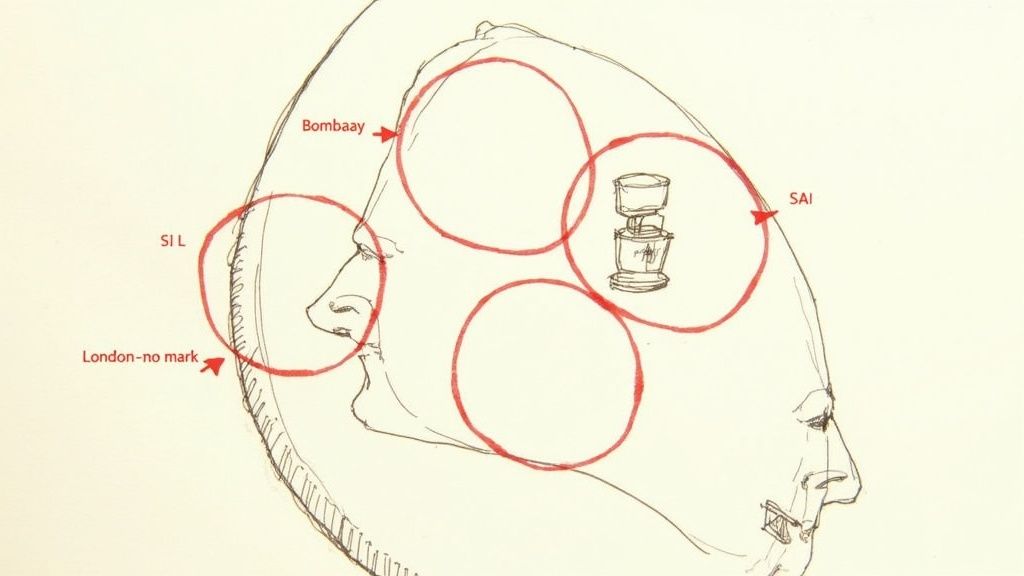
Where to Look on a Gold Sovereign
For Sovereigns featuring Benedetto Pistrucci’s classic St George and the Dragon design, the mint mark is typically located on the small patch of ground directly beneath the dragon. You will need good lighting and possibly a magnifying glass to see it clearly. The placement is subtle, designed to integrate with the artwork rather than distract from it. To understand more about the artistry involved, check out our guide on how coins are made.
This specific location was chosen to be discreet yet clear enough for verification. Look carefully at this area for one of the key letters indicating its origin.
Decoding the Branch Mint Marks
Once you know where to look, you need to know what you’re looking for. Each branch mint used a specific initial to identify its work. Here are some of the most important ones for collectors of British coins:
- S for Sydney, Australia
- M for Melbourne, Australia
- P for Perth, Australia
- C for Ottawa, Canada
- I for Bombay (Mumbai), India
- SA for Pretoria, South Africa
The defining characteristic of The Royal Mint is that it rarely uses a mint mark for British coins produced within the UK itself. Sovereigns minted in London and later in Llantrisant, South Wales, feature no mint mark whatsoever. However, when The Royal Mint established branches overseas, coins produced there were distinctively marked. For example, those from India used an 'I', while the South African mint produced an impressive 83.4 million sovereigns marked with 'SA' between 1923 and 1932.
Collector's Tip: The absence of a mark is just as important as its presence. On a Gold Sovereign, finding no letter beneath the dragon is your definitive clue that it was struck in London.
This "no mark" rule is a frequent point of confusion but is a core piece of knowledge for any numismatist. It’s a classic case where what isn't there tells you everything you need to know. Mastering this simple principle is a huge leap forward in your collecting journey.
How Mint Marks Drive Rarity and Collector Value
A mint mark might just be a tiny letter stamped onto a coin, but in the world of collecting, it packs an enormous punch, often being the single biggest factor in a coin’s rarity and value.
Think of it as the ultimate clue in a game of supply and demand. The basic idea is wonderfully simple: the fewer coins a particular mint produced in a specific year, the scarcer those coins are today. And as any collector knows, scarcity is what drives value through the roof.
Two coins can look absolutely identical to the naked eye—same year, same design, even the same metal—but a different mint mark can mean a staggering difference in their market price. A sovereign struck in London, for instance, might have a mintage in the millions, making it a common and affordable piece. But its counterpart from a smaller branch mint in that very same year could have a mintage of only a few thousand, instantly turning it into a holy grail for collectors.
Mintage Numbers Tell the Story
The number of coins a mint produces in a given year is known as its mintage. These figures are the foundation of rarity. Historically, branch mints often had much smaller production runs than the main facility in London for a few key reasons:
- They were set up to serve smaller, regional populations across the Empire.
- Many operated for only a few years before closing their doors for good.
- Production was often tied to specific local events, like a gold rush in Australia or South Africa.
This is why a coin with a 'C' for Canada or an 'SA' for South Africa is often far more difficult to find than its London-minted equivalent from the same year. For serious collectors, hunting down these low-mintage branch coins is the very heart of building a truly impressive collection.
Mint Mark Impact on a Coin's Scarcity and Value
To see this in action, let's compare a few coins. The table below shows how the mint mark for the same coin type and year can dramatically alter its rarity and value. Notice how a lower mintage figure almost always corresponds to a higher relative value.
| Coin (Year) | Mint Mark (Location) | Original Mintage | Estimated Rarity | Relative Value Index |
|---|---|---|---|---|
| 1926 Sovereign | 'L' (London) | 4,625,313 | Common | 1x |
| 1926 Sovereign | 'SA' (Pretoria) | 11,103,411 | Very Common | 0.9x |
| 1926 Sovereign | 'S' (Sydney) | 4,374,000 | Common | 1x |
| 1926 Sovereign | 'P' (Perth) | 3,745,860 | Common | 1.1x |
| 1926 Sovereign | 'M' (Melbourne) | 4,057,200 | Common | 1.1x |
As you can see, even among relatively common coins, the mint of origin creates subtle but important distinctions for collectors tracking down a complete set. The real magic happens when one of these mints has an exceptionally low production run, turning an ordinary coin into a celebrated rarity.
How History Creates Scarcity
Initial mintage numbers are only part of the story. History has a habit of intervening, and events like wars, economic collapses, or government recalls can wipe out huge numbers of coins that were once common. A coin with a high mintage can become incredibly rare almost overnight.
A perfect example is the 1917 London Sovereign. Over one million were struck, which sounds like a lot. However, the vast majority were held back by the Bank of England and later melted down to settle war debts with the United States. Today, it’s believed that only 41 examples have survived, transforming a once high-mintage coin into one of the greatest sovereign rarities.
This is the fundamental lesson for collectors: a coin’s value isn't just about how many were made, but how many have survived. The mint mark is often the first clue in uncovering that survival story.
Understanding these forces is essential for evaluating any collection. Seasoned collectors and professional graders always check the mint mark first, as it provides the critical context for a coin's true place in the market.
If you'd like to go deeper, our detailed guide explains the key factors that influence rare coin pricing. Ultimately, that small letter connects a coin to a specific time, place, and story, unlocking its true numismatic value.
A Practical Guide to Finding and Reading Mint Marks
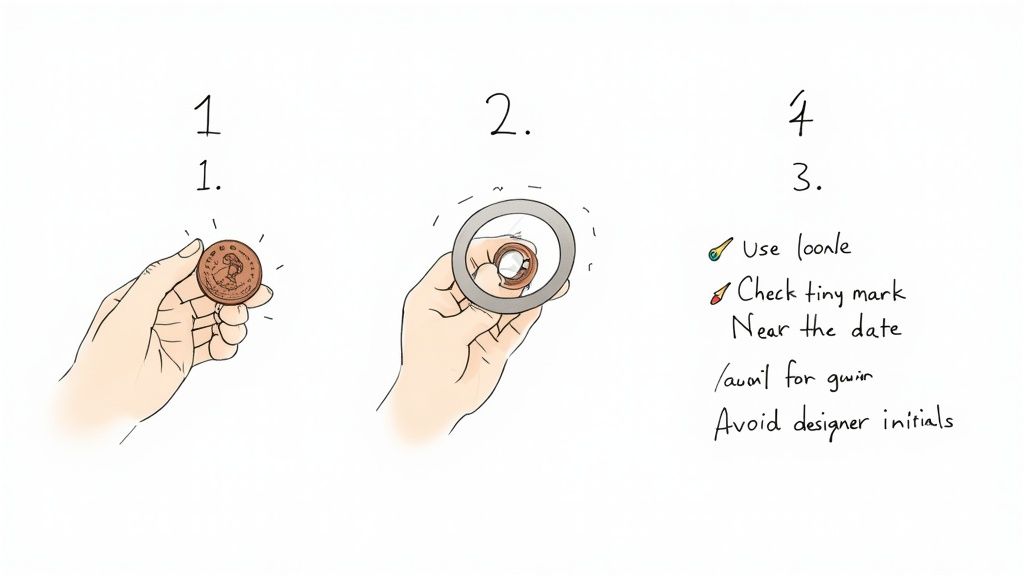
Finding a mint mark on a coin can feel like a genuine treasure hunt. These tiny symbols are often tucked away in the most unassuming places, and learning how to spot them is a fundamental skill for any collector. With a bit of practice and the right approach, you'll soon be identifying the origin of your coins with confidence.
First things first, you need the right tools for the job. While your naked eye might catch some of the more obvious marks, most are far too small to see clearly without help. A good quality magnifying glass is the absolute minimum, but for any serious examination, a jeweller's loupe is a priceless investment.
This small but powerful magnifier lets you get right in there, inspecting every tiny detail on the coin's surface. It makes spotting a well-hidden mint mark a breeze and helps you tell it apart from a random scratch or blemish.
Common Hiding Spots for Mint Marks
Once you’re properly kitted out, the next trick is knowing where to even begin looking. The location of mint marks can vary wildly depending on the coin’s series, its country of origin, and even the specific year it was struck. That said, there are some common patterns you’ll start to recognise over time.
For many British and Commonwealth coins, like the iconic Gold Sovereign, the mint mark is usually found on the reverse (tails) side. It’s typically placed in a discreet spot to avoid cluttering the main design.
A few classic locations include:
- Beneath the main design: Have a look in the space directly under the central figure, such as the ground beneath St George's dragon.
- Near the date: The mark is sometimes placed close to the year of issue, on either the obverse or reverse.
- Within a design element: Occasionally, the mark is cleverly worked into a part of the coin's artwork itself.
Important Takeaway: Always handle your coins by their edges. This prevents the oils from your skin from transferring to the surface, which can cause damage over time and obscure small details like a mint mark. Proper handling is key to preserving a coin's condition.
Avoiding a Common Beginner Mistake
As you start looking at your coins more closely, you'll definitely notice other small letters stamped into the design. It's really important not to confuse these with mint marks. One of the most common mistakes new collectors make is mistaking the designer's initials for a mint mark.
For instance, Benedetto Pistrucci’s famous St George and the Dragon design on the Sovereign often includes his initials, ‘B.P.’ These are part of his artistic signature, not an indicator of where the coin was made.
Mint marks are almost always single letters (like 'S' or 'M') or very short combinations ('SA'). Learning their specific locations is the key to telling them apart from other markings. It’s a skill that sharpens with experience and is a true sign of a developing numismatist.
Common Questions About Coin Mint Marks
As you get deeper into the world of coin collecting, you'll find a few questions about mint marks pop up again and again. Let's tackle those common points of confusion head-on. Think of this as your quick-reference guide for the practical side of numismatics.
Does Every Coin Have a Mint Mark?
No, and this is a crucial detail for anyone collecting British coins. For many centuries, coins struck by the Royal Mint in London didn't carry any specific identifying mark. In fact, the absence of a mint mark on a British Sovereign is the key indicator that it was produced in London.
Mint marks only became standard practice for the Royal Mint's overseas branches, as a way to tell their coins apart from those made back home. It's always worth researching the specific coin you're looking at, as the rules can change quite a bit from one series to another.
Key Takeaway: In British numismatics, the absence of a mint mark often tells its own story. On a Sovereign, no mark means a London origin—a rule that surprises many new collectors but is fundamental to accurate identification.
Can a Mint Mark Be Faked or Altered?
Unfortunately, yes. For particularly rare and valuable coins, unscrupulous individuals might try to add, remove, or change a mint mark to fool collectors. A common trick is to add an 'S' mint mark to a common coin, hoping to pass it off as a much rarer San Francisco issue.
These forgeries can be incredibly convincing to the untrained eye. A forger might use sophisticated tools to add a letter that looks authentic at first glance. This is precisely why it’s so important to buy high-value coins from reputable dealers or have them authenticated by a professional grading service. Experts are trained to spot the subtle tooling marks and other tell-tale signs of tampering.
What Is the Difference Between a Mint Mark and a Privy Mark?
This is another common source of confusion. While both are small symbols added to a coin, they serve completely different purposes.
- A mint mark strictly identifies the mint where the coin was produced. Its job is to show the geographical origin of the coin, like an 'S' for Sydney or 'C' for Canada.
- A privy mark is a special symbol added to a coin to commemorate an event, celebrate an anniversary, or show it belongs to a particular series. For instance, a modern commemorative coin might feature a small privy mark of a landmark to celebrate its centenary.
So, while both are small symbols, just remember their functions are distinct. One tells you where it was made (mint mark), while the other signals a special occasion or theme (privy mark).
How Should I Care for Coins to Preserve the Mint Mark?
Proper handling is everything when it comes to preserving the fine details on a coin, especially a delicate mint mark. The number one rule is to always hold a coin by its edges, never by its flat faces. The natural oils and acids on your fingertips can cause corrosion over time, which can permanently damage the coin's surface.
For storage, use materials specifically designed for archival purposes, like acid-free holders, capsules, or albums. Most importantly, never clean your coins, especially with abrasive pastes or chemicals. Cleaning strips away the coin's natural patina and leaves microscopic scratches, which drastically reduces its numismatic value and can obscure or even erase small details like the mint mark.
At Cavalier Coins Ltd, we understand the stories these tiny marks tell. Whether you are hunting for a specific branch mint Sovereign, selling a bulk collection, or just starting your numismatic journey, our curated auctions and extensive inventory can help you find that perfect piece of history. Explore our collection today!