
Russian coins offer a tangible link to one of the world's most dramatic histories, from the opulence of the Tsars to the stark ideology of the Soviet Union and the resilience of modern Russia. This guide is your starting point for getting to grips with these metallic artefacts, whether you're just starting out or already have a few pieces in your collection.
Your Journey into Russian Coinage Begins Here
Welcome to the captivating world of Russian numismatics. For many, the fascination begins with a single, unfamiliar coin—maybe a silver Kopek from the Tsarist era or a modern Rouble found in a jar of foreign currency. Each piece is so much more than money; it's a miniature historical document, telling a story of empires, revolutions, and shifting national identity through its design.
Think of this guide as your personal map through one of the most interesting areas of coin collecting. We'll give you a clear path to explore each major period and help you identify your finds with confidence. The goal is simple: to turn that initial curiosity into genuine knowledge, helping you build a collection you can be truly proud of.
What You Will Discover
This comprehensive guide is put together to build your understanding step-by-step, from the absolute basics to practical advice for collecting. Here’s a quick look at what’s ahead:
- Historical Eras Uncovered: We'll journey through the three great periods of Russian coinage—Imperial, Soviet, and Modern—pointing out the key features that define each one.
- Decoding Your Coins: You'll learn the essentials of reading Cyrillic inscriptions, identifying crucial mint marks, and accurately dating your coins.
- Understanding Value: We'll demystify what makes a coin valuable, looking at everything from rarity and historical importance to its physical condition.
- Practical Collecting Tips: From buying and selling safely to developing a smart collecting strategy, we will arm you with the essential skills you need.
Russian coinage is a vast field, but every expert was once a beginner. The key is to start with a solid foundation, learning to appreciate the stories that each Rouble and Kopek has to tell. This approach turns a simple hobby into a lifelong passion for history.
For those keen to get a head start, our overview of the coins of Russia is an excellent place to begin your exploration. Let’s start this exciting journey together, one coin at a time.
Exploring the Three Great Eras of Russian Coins
To really get your head around Russian coins, it helps to think of their history in three distinct acts. Each period has its own cast of characters, symbols, and stories, reflecting the enormous upheavals the country has gone through. By breaking down the timeline into Imperial, Soviet, and Modern eras, we can start to see the context behind every coin we handle.
This historical framework is a collector's best friend. It lets you quickly place a coin in its proper setting and understand what you're looking at. The journey from the Tsars to today's Federation is a fascinating one, and each era builds on the last.
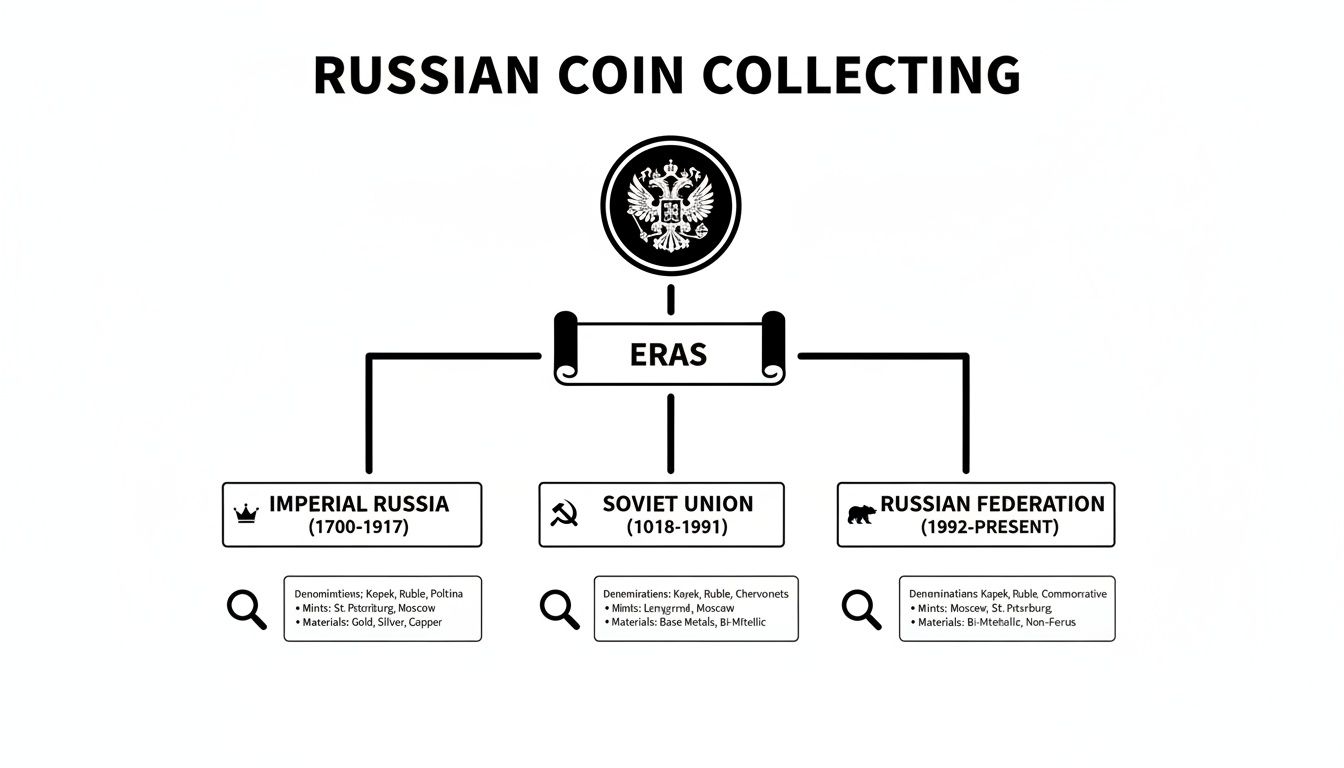
As you can see, grasping these main eras is the first step. From there, you can dive deeper into the specific mints, materials, and denominations that make each period unique.
The Imperial Era: Pre-1917
First up is Imperial Russia, the longest and perhaps most romanticised period, defined by the rule of the Tsars. Coins from this time are like miniature monuments to autocratic power and tradition. Minted from the early 18th century right up until the Romanov dynasty collapsed in 1917, these pieces were often struck from precious metals like gold and silver.
The designs are usually ornate and instantly recognisable. You'll find the portrait of the reigning monarch on one side and the formidable double-headed eagle—the coat of arms of the Russian Empire—on the other. Denominations like the silver Rouble and the smaller copper Kopek were the workhorses of the economy. For any collector, Imperial coins offer a tangible link to the world of Peter the Great, Catherine the Great, and the last Tsar, Nicholas II.
The Soviet Union: 1917-1991
After the 1917 Revolution, everything changed, and Russian coinage was no exception. The Soviet era ushered in a complete ideological reset, and the coins became a tool for communicating this new world order. Gone were the Tsarist eagles and portraits of monarchs, replaced by powerful symbols of the state and its workers.
Designs from this period are dominated by the hammer and sickle, sheaves of wheat representing agriculture, and bold industrial imagery. The focus was squarely on the collective, not the individual ruler. The metals changed, too. Base metals like aluminium-bronze and copper-nickel alloys became the norm for everyday coins. Soviet coins tell the story of communist ideology, five-year plans, and a society reaching for a completely different future.
For collectors, the switch from Imperial to Soviet coinage is one of the most abrupt and fascinating in all of numismatics. It’s not just a design refresh; it’s a visual record of a total societal upheaval, captured forever on a small metal disc.
The Modern Russian Federation: Post-1992
With the fall of the Soviet Union in 1991, Russian coinage entered its third major phase. The modern Russian Federation looked to the past, bringing back older, pre-Soviet symbols. Most notably, the double-headed eagle was reinstated as the national emblem, appearing on coins once again.
But modern coins are far from a simple copy of their Imperial ancestors. They manage to blend a reverence for history with clean, contemporary design. While everyday circulation coins are made of practical materials like steel, the Russian Federation has also become a major producer of commemorative coins. These pieces celebrate everything from historical anniversaries and cultural icons to major sporting events, often struck in silver and gold specifically for the collector market.
Defining Features of Russian Coinage Eras
To make identifying these coins a bit easier, this quick-reference table breaks down the key differences you'll see between the three main periods.
| Characteristic | Imperial Russia (Pre-1917) | Soviet Union (1917-1991) | Modern Russia (1992-Present) |
|---|---|---|---|
| Key Symbolism | Double-headed eagle, monarch's portrait | Hammer and sickle, wheat sheaves, stars | Reinstated double-headed eagle, St. George |
| Common Metals | Silver, Gold, Copper | Aluminium-Bronze, Copper-Nickel | Bimetallic, Nickel-plated Steel |
| Political Context | Autocratic Tsarist Empire | Communist state, single-party rule | Federal republic |
| Design Focus | Display of monarchical power | Promotion of state ideology | National heritage and commemoration |
The clear distinctions between these eras make collecting Russian coins an incredibly rewarding pursuit. In UK numismatic circles, for example, Imperial silver roubles and gold chervonets are always in high demand. Auction records show that a common Nicholas II silver rouble can fetch anywhere between £200–£1,500 depending on its condition, with rarer examples easily topping £3,000 at specialist sales. You can learn more about currency trends by exploring official mint data; for instance, The Royal Mint publishes detailed UK currency statistics. This lasting interest really underscores the historical weight and artistry of the Imperial era's numismatic legacy.
How to Read the Story on Your Russian Coins
Every Russian coin holds a story, but you need to know its language to read it. Think of each coin as a tiny passport, stamped with vital clues about where it's from and when it was made. This is where we get practical and decode those details, turning what might look like a confusing piece of metal into a clear historical record.
We’ll break down the key elements you need to spot, from the Cyrillic script to the all-important date and mint mark. By the end, you'll be able to pick up any of the coins in Russia and start piecing together its past. It’s less of a puzzle and more of an exciting discovery once you know the signs.
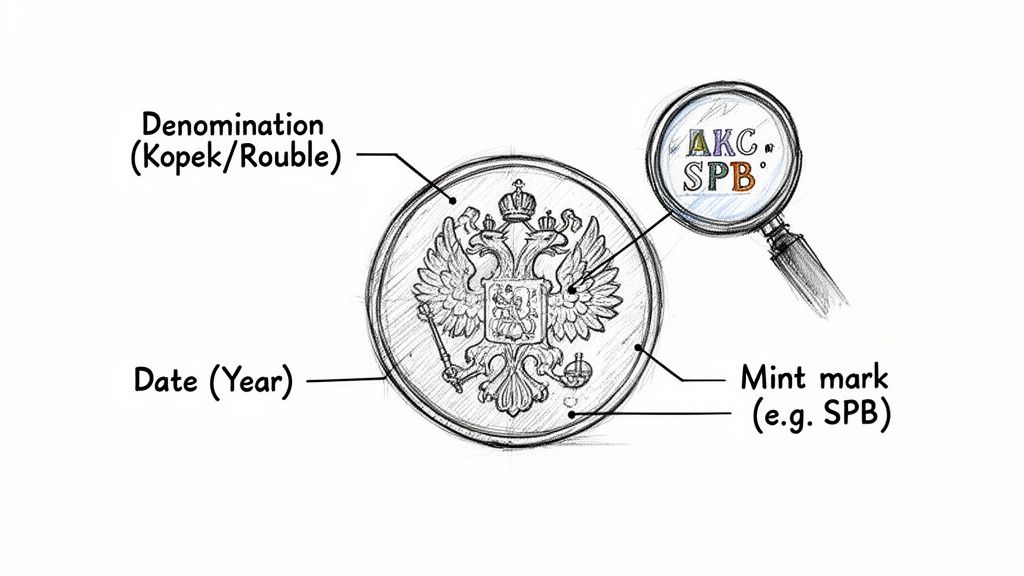
Decoding Cyrillic Denominations
The first hurdle for many new collectors is the Cyrillic alphabet. It might look intimidating, but you only need to recognise a couple of key words to identify most coins. The two terms you’ll see most often are for the main currency units.
- Рубль (Rouble): This is the main currency. On coins, you’ll likely see it as РУБЛЬ (for one Rouble) or РУБЛЕЙ (for plural values like 5 or 10 Roubles).
- Копейка (Kopek): This is the smaller unit, where 100 Kopeks make one Rouble. Look for КОПЕЙКА (singular), КОПЕЙКИ (for 2, 3, or 4), or КОПЕЕК (for 5 and above).
Once you can spot these words, you're on your way. You can instantly tell a coin's denomination, which is the crucial first step in any identification.
Finding the Birthplace: The Mint Mark
Just as a book has a publisher, every coin has a mint. The mint mark is a small set of letters telling you exactly where a coin was struck. Think of it as the coin’s birthplace—an essential detail for collectors, as some mints are far rarer than others for certain years.
These marks are often tiny, tucked away under the double-headed eagle, beneath the date, or near the denomination. For a deeper look into this, there's a helpful guide explaining what is a mint mark on coins and why it matters so much to collectors.
For Russian coins, the mint mark isn't just a technical detail; it's a link to a specific city and its history. A coin from Saint Petersburg carries a different story from one minted in Moscow, and this detail can significantly affect its rarity and value.
Some of the most common mint marks you'll come across on Russian coins include:
- СПБ or С.П.Б.: Stands for the Saint Petersburg Mint during the Imperial era.
- ММД or М: These marks represent the Moscow Mint.
- ЛМД or Л: These indicate the Leningrad Mint (the Soviet-era name for Saint Petersburg).
Locating the Date of Issue
The date is often the easiest detail to find, as it uses the familiar Arabic numerals we all recognise (e.g., 1898, 1985). You’ll usually find it on one of the main faces of the coin, often below a central design like the coat of arms.
On Imperial coins, you might also spot the word ГОДА after the date, which simply means "year." Finding the date lets you place the coin precisely within one of the three major historical periods we discussed earlier.
By combining these three elements—denomination, mint mark, and date—you have the essential toolkit for identifying almost any Russian coin. With a bit of practice, reading these details will become second nature, opening up a much richer appreciation for your collection.
Understanding What Makes a Russian Coin Valuable
Ever wondered why one Russian coin is worth a few quid while another, which looks almost the same, can fetch thousands? It usually boils down to two things: rarity and condition.
Rarity is simple enough—it’s about how many were made. But condition, or ‘grade’, is all about how well a coin has weathered the years. For collectors, this is often the most critical factor.
Think of it like a first-edition book. One that’s crisp and clean is worlds apart from a dog-eared copy found in a dusty attic. They’re the same book, but their value is dramatically different. In the world of coins, we have a formal system for this called grading.
A Practical Guide to Coin Grades
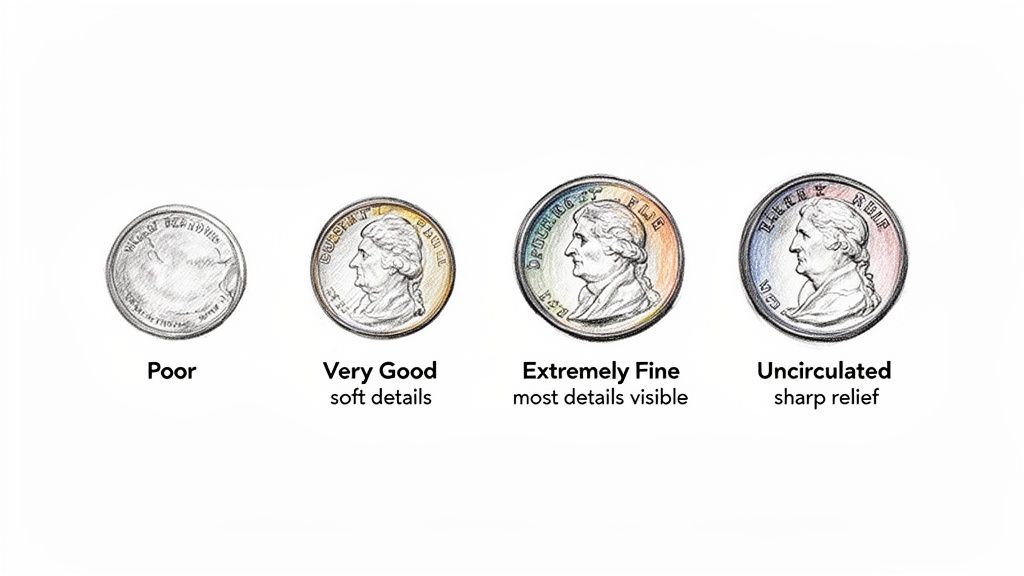
The grading scale is basically a universal language for describing a coin's state of preservation. While the system can get incredibly detailed, most coins in Russia fall into a few core categories. Getting your head around these is essential if you want to understand rare coin pricing.
Let's walk through it using a classic Imperial silver Rouble of Nicholas II as our example:
- Poor (P) or Fair (F): The coin is incredibly worn, with details almost completely smoothed away. You can make out what type of coin it is, but the date might be a struggle to read. On our Rouble, the Tsar's portrait would be just a faint shadow.
- Very Good (VG): There’s still a lot of wear, but the main design elements are visible. The Tsar’s beard on our Rouble would look flat and worn, with almost no detail in the individual strands of hair.
- Fine (F): The details are starting to come back into focus. You can see the general shape of the Tsar's hair and the outline of his uniform, but the finer points are gone.
- Extremely Fine (EF): This is a really nice coin that’s only seen a little bit of circulation. You'll see just light wear on the highest points of the design. The delicate lines in the Tsar’s beard and hair would be sharp and clear.
- Uncirculated (UNC): A perfect coin. It has absolutely no signs of wear and looks just as it did the day it was struck at the mint, often with its original shine, or lustre, fully intact.
You can think of a coin's grade as its biography. An Uncirculated coin tells a story of being carefully tucked away, while a Very Good coin speaks of a long journey, passing through countless hands in the markets and shops of the Russian Empire.
Pitfalls That Diminish a Coin's Worth
It’s not just about the wear from being used. Some types of damage can absolutely destroy a coin's value, even if the details look sharp at first glance. Collectors want originality above all else, so anything that’s altered a coin from its natural state is a major problem.
Be especially wary of coins that have been cleaned. Using harsh polish or abrasive materials creates a web of tiny scratches, called 'hairlines', which strips off the coin’s original surface and colour, or 'patina'. This can kill its numismatic value. Other serious issues to look out for are deep scratches, nicks on the rim, or signs it was once mounted in jewellery.
Ultimately, how you handle your coins makes all the difference. Always hold a coin by its edges, never touching the flat faces where fingerprints can leave oils that cause corrosion over time. Storing them in proper, acid-free holders will protect them from the environment and ensure your collection holds its condition and value for years to come.
How to Safely Buy and Sell Russian Coins
Diving into the market for Russian coins can seem a little daunting at first, but if you know where to look and what to watch out for, you can trade with real confidence. Whether you’re looking to add a key piece to your collection or sell a few duplicates, understanding the landscape is your best tool for a smooth transaction.
Think of the market as having different layers, each with its own pros and cons. You’ve got everything from prestigious auction houses to lively online forums, and each one caters to a different kind of collector. The trick is to find the right fit for you and to go in with your eyes open.
Reputable Dealers and Numismatic Shops
For most collectors, and especially if you're just starting out, a specialised coin dealer is your safest bet. These are professionals whose entire business is built on their reputation and the trust of their clients. A good dealer doesn't just sell you a coin; they offer their expertise, a guarantee of authenticity, and solid advice.
When you're checking out a dealer, see if they belong to any respected trade bodies, like the British Numismatic Trade Association (BNTA). Being a member is a good sign they stick to a code of ethics. A trustworthy dealer will always be upfront about a coin's condition and provenance, and they should be happy to answer your questions without making you feel pressured.
Specialised Auction Houses
This is where the big fish swim. If you’re hunting for the rarest and most valuable Russian coins, auction houses are the place to be. They’re the main stage for top-tier Imperial silver and gold, drawing in serious collectors from all over the globe. Taking part in an auction can be a real thrill, but you need to know the rules of the game.
Before you even think about bidding, remember to account for the buyer's premium. This is an extra percentage tacked onto the final hammer price, usually somewhere between 15% and 25%. Always read the lot descriptions with a fine-toothed comb, paying close attention to the grade and any notes on the coin's history. If you can, it’s always best to view the coins in person before the sale or, at the very least, ask for high-resolution photos.
Online Marketplaces and Collector Forums
The internet has thrown the doors wide open for buying and selling Russian coins, but this is also where you need to be most careful. Sites like eBay and dedicated collector forums can be fantastic for finding common-date coins and connecting with other enthusiasts who share your passion.
That said, you have to be cautious. Here are a few essential checks to run every single time:
- Check the Seller's Feedback: Don't just glance at the score. Look for sellers with a long, consistent history of positive reviews specifically for selling coins.
- Analyse the Photos: You need to see clear, high-quality images of the exact coin you are buying. If the photos are blurry, generic, or stock images, that’s a massive red flag.
- Verify Authenticity: For anything valuable, think about using a third-party authentication service. Better yet, stick to coins that have already been professionally graded and encapsulated ("slabbed").
- Use Secure Payments: Always, always use payment methods that give you buyer protection, like PayPal or a credit card. Avoid bank transfers with sellers you don't know and trust.
There's a well-worn saying among experienced collectors: "Buy the coin, not the story." It's a simple reminder that your decision should be based on the physical coin in front of you—its grade, authenticity, and fair market price—not on some romantic or unverifiable tale the seller is spinning.
A Note on Donated Coins
It's funny where Russian coins turn up. You'll even find them in charity collection tins. Charities and cash-appeal organisations here in the UK often report that foreign coins, including Russian Kopeks and Roubles, are a regular feature in their donations. It’s estimated that this foreign currency can make up anywhere from 2–7% of the total small change donated. Specialist dealers will often buy these coins in bulk, sorting through them to pick out the collectible pieces. It’s just one more fascinating way these little bits of history find their way back into the market. You can find more insights into UK currency statistics and trends from the Bank of England.
By picking the right venue and doing your homework, you can confidently take part in the exciting world of Russian coins. Whether you're tracking down a rare Imperial Rouble or simply selling on some spare Soviet Kopeks, a smart and careful approach will always be your greatest asset.
Building a Collection with Purpose and Strategy
A truly great collection is more than just a jumble of interesting coins; it’s a story you’ve curated, with a beginning, middle, and end. When you build with a clear purpose, a simple hobby transforms into a focused and deeply rewarding journey.
This strategic approach is what separates a thoughtful collector from an impulse buyer. It ensures every new piece you acquire adds real value and meaning to your collection. The secret? Define your focus before you start spending.
Choosing Your Collecting Path
The first step is deciding what story you want your collection to tell. There are countless paths to explore in Russian numismatics, and the right one is all about what sparks your interest. You'll often find that a narrow, specific focus creates a far more impressive and coherent collection than a broad, scattered one.
Here are a few popular ways to focus your efforts:
- Focus by Era: You could dedicate your collection to a single historical period. Maybe you want to collect only Soviet commemorative roubles from 1965-1991, or perhaps you're drawn to the final years of the Tsars and want to concentrate on the coinage of Nicholas II.
- Focus by Type: Another brilliant approach is to build a "type set." This involves hunting down one example of each denomination and design from a particular period. A great starting point could be collecting one of every coin type issued by the modern Russian Federation since 1992.
- Focus by Monarch: Diving deep into the coins of a single ruler, like the transformative Peter the Great or the formidable Catherine the Great, allows you to really get to grips with the history and artistry of a specific reign.
Think of your collecting goal as your compass. It guides your research, shapes your budget, and helps you instantly recognise a key piece for your collection when you see it. It turns a sea of overwhelming options into a clear, achievable target.
Budgeting and Prioritising Key Pieces
Once you know what you're looking for, you need a plan. Numismatics can be an expensive hobby, so setting a realistic budget is absolutely crucial. This isn't about limiting your ambition; it's about making smart, sustainable choices that let you build your collection steadily over time.
Think about which coins are the true cornerstones of your theme. These are the "key date" or high-grade coins that are harder to find and will almost certainly command a higher price. It’s often much wiser to save up for one exceptional, important coin than to spend the same amount on several common, low-grade pieces that don't really move your collection's story forward.
Patience and knowledge are your most valuable assets here. Use online resources, comb through auction archives, and get your hands on good numismatic catalogues. Learn the market, understand what drives the prices in your chosen area, and be prepared to wait for the right coin at the right price. This is a journey of discovery, one carefully chosen coin at a time.
Common Questions About Collecting Russian Coins
As you get deeper into the fascinating world of Russian numismatics, you'll find certain questions pop up time and again. Whether you’re sifting through your first bag of mixed world coins or eyeing a high-value Imperial piece, getting clear answers is key to collecting with confidence.
This section is designed to be your quick-reference guide. We’ll tackle some of the most common queries we hear, giving you straightforward advice to make your collecting journey smoother and a lot more enjoyable.
What Are the Easiest Russian Coins to Start Collecting?
For anyone just starting out, the best entry points are easily the late-Soviet era Kopeks (from 1961-1991) and the modern circulation Roubles issued from 1992 onwards. You'll often find these popping up in mixed foreign coin batches, making them a fantastic, low-cost way to get familiar with Cyrillic script and Russian designs.
Because they're so readily available, you can practise your identification skills on plenty of real examples. Early Soviet coins and pre-revolutionary copper Kopeks are also quite common, though their condition can be all over the place – a great practical lesson in why coin grading matters so much.
Are Imperial Silver Roubles Always Valuable?
Not always, and it’s crucial to understand why. While Imperial silver Roubles certainly have an air of prestige, their value isn't a given. It all comes down to three key things: the monarch on the throne, the specific year it was minted, and its overall condition.
A common-date Rouble from the reign of Nicholas II, for instance, might be worth little more than its silver weight if it's heavily worn. But take a Rouble from an earlier reign, a rare date, or one in pristine Uncirculated condition, and you could be looking at a coin that fetches hundreds, or even thousands, of pounds at auction.
A coin's value is a unique combination of its history, scarcity, and preservation. Two coins from the same year can have wildly different values based entirely on their life story—one spent in circulation, the other carefully preserved.
How Can I Spot a Counterfeit Russian Coin?
Spotting fakes takes a sharp eye, a bit of scepticism, and a methodical approach. While the best forgeries are incredibly deceptive, many fakes have tell-tale signs that give them away. The first rule is simple: if a deal seems too good to be true, it probably is.
Here are a few red flags to keep an eye out for:
- Incorrect Weight: A precise digital scale is your best friend. Fake coins are often slightly off their official weight, even by a fraction of a gram, so always compare it to the standard specifications.
- Soft Details: Genuine coins are struck with immense pressure, resulting in sharp, crisp details. Counterfeits, on the other hand, often have a soft, 'soapy' or slightly fuzzy look, especially on intricate parts like hair or lettering.
- Wrong Metal Properties: A real silver coin has a distinct high-pitched ring when tapped. More importantly, it is not magnetic. Always carry a small magnet with you to do a quick check on any suspicious silver pieces.
- Casting Seams: Look very closely at the coin's edge. A faint line or seam running around the circumference is a classic giveaway of a cast copy, not a properly struck coin.
When it comes to high-value coins, the safest bet is always to compare the coin against a known genuine example and to buy only from reputable dealers or authenticated sources.
What Is the Relationship Between Kopeks and Roubles?
This one is refreshingly simple and has stayed the same for centuries: 100 Kopeks equal 1 Rouble. This straightforward decimal system has been the standard right through the Imperial, Soviet, and modern periods of Russian coinage.
Think of it just like the relationship between pence and the pound here in the UK. Historically, the humble copper Kopeks were the workhorses for everyday shopping, while the grander silver Rouble served as the primary currency unit.
At Cavalier Coins Ltd, we provide a trusted source for authentic world coins, from common Soviet-era Kopeks to rare Imperial Roubles. Explore our extensive collection and find the next great piece for your collection at https://www.cavaliercoins.com.