
The value of a one shilling coin from 1948 is a classic case of "it depends"—specifically, on its condition. A heavily worn coin that’s seen decades of circulation is worth very little, often just a few pence. But find a pristine, uncirculated example? You could be looking at a coin that commands prices well over £20.
Unpacking The 1948 One Shilling Value

If you've stumbled upon a 1948 shilling, you're holding a genuine piece of post-war British history. Issued during the reign of King George VI, this isn't just a coin; it's a memento from a time of immense national recovery and economic change. Understanding its backstory is the first step in appreciating its true worth.
This coin’s journey began just after the Second World War, a period when Britain was under severe financial strain. This pressure forced a significant shift in the nation's currency. Unlike older shillings, the 1948 version contains no silver, a decision driven by the need to conserve precious metals. Instead, it was struck from a hard-wearing cupro-nickel alloy, heralding a new era for British coinage.
A Common Coin With Uncommon Potential
The Royal Mint produced a staggering number of these shillings—over 45.5 million for the English reverse design alone. This massive mintage is precisely why circulated examples are so common and hold minimal value today. Their sheer abundance means most have passed through countless hands, showing the wear and tear of daily life.
But this is where things get interesting for collectors. While millions were minted, only a tiny fraction were tucked away and saved from circulation. This scarcity of pristine examples creates a fascinating split in value:
- Circulated Coins: Worn from use, these are plentiful and often worth less than £1.
- Uncirculated Coins: Kept safe from pockets and tills, they retain their original mint lustre and sharp details, making them highly sought-after by numismatists.
For common date coins like the 1948 shilling, preservation is everything. The huge jump in value from a worn-out piece to a perfect specimen is a powerful lesson in why coin grading is so critical.
To give you a clearer picture, let's look at how condition directly impacts the price you can expect.
1948 One Shilling Value At A Glance By Grade
This table breaks down the typical value ranges based on the UK coin grading standard. It's a quick reference to see how a coin's journey—or lack thereof—affects its worth.
| Grade (UK Standard) | Condition Description | Estimated Value Range |
|---|---|---|
| Very Good (VG) | Heavily worn, major details are gone, but the date is readable. | £0.05 |
| Fine (F) | Significant wear, but the main design is still visible. | £0.15 |
| Very Fine (VF) | Moderate wear on high points, with clear lettering and details. | £0.50 |
| Extremely Fine (EF) | Light wear, with sharp details and some original lustre remaining. | £1.50 |
| Uncirculated (Unc) | No signs of wear, as it looked the day it left the mint. | £5+ |
As you can see, the value escalates dramatically with each step up in grade. A coin in Very Good (VG) condition is little more than a curiosity, while an Uncirculated (Unc) example is a genuine collector's item. Later in this guide, we’ll dive deeper into how you can assess these subtle but all-important differences for yourself.
The Post-War Story Behind The Cupro-Nickel Shilling
If you've ever held a 1948 shilling, you might have noticed it feels a bit different from older British coins. It doesn't have that classic gleam or the satisfying heft of silver, and there's a very good reason for that. This isn't just a piece of currency; it's a small artefact of a nation struggling with the massive economic fallout of the Second World War.
To really get a feel for the one shilling coin 1948 value, you have to step back in time to the moment the war ended. Britain was victorious, but financially on its knees. The country was saddled with colossal war debts, especially to the United States. Repaying those loans demanded enormous sums of money and every precious resource available, forcing the government to make a drastic but necessary decision.
In 1947, for the first time in centuries, the United Kingdom officially stopped using silver in its coins for circulation. This wasn't a choice driven by a desire for modernisation, but one of pure economic survival. The nation’s silver reserves were desperately needed to pay off international debts and fund the monumental task of rebuilding a shattered country.
A New Era Of Coinage
This decision heralded the birth of a new generation of British money. The Royal Mint switched to producing coins from a far cheaper, yet still durable, alloy called cupro-nickel—a straightforward mix of 75% copper and 25% nickel. Your 1948 shilling is a direct product of this post-war austerity, an innovation born out of a country that had to put survival before tradition.
The move away from silver completely changed how the coin was valued. Before 1947, shillings had an intrinsic value tied to their precious metal content. But the 1948 shilling’s value is purely numismatic. Its worth depends entirely on how much collectors want it, which is driven by its condition and historical importance.
The change to cupro-nickel created a clear dividing line in British coinage. It separated coins with a 'melt value' from those whose worth is determined solely by collectors' demand and the coin's state of preservation.
This context is absolutely crucial. It explains why a heavily used 1948 shilling is worth very little, while its silver predecessors can still hold a base value from their metal content, even in poor shape. You can explore more about the fascinating materials that make up coins in our guide on what coins are made of.
The Economic Impact In Numbers
The scale of this economic shift was immense. UK shillings struck after 1946, including the 1948 issue, lost the 0.0909 ounces of silver found in their 1920-1946 counterparts. That small amount of silver carried a bullion value that could swing with the markets, whereas the new alloy was stable and, most importantly, cheap. This was a critical change when the costs of rebuilding were soaring into the billions.
With a huge mintage of over 45.5 million, the 1948 English reverse shilling perfectly captured this new, frugal approach while keeping the familiar size and weight people were used to.
This historical backdrop is the key to understanding your coin. It isn’t valuable for what it’s made of, but for the story it tells. It’s a symbol of austerity, of recovery, and of the beginning of modern Britain. The metal in your hand tells a tale of a nation picking itself back up, one shilling at a time. And that's why a perfectly preserved example can be such a prized find—not for its metallic worth, but for its place in history.
How To Grade Your 1948 Shilling Like A Pro
What’s the real difference between a 1948 shilling worth pennies and one that fetches a serious price? It all comes down to condition. Coin grading can sound a bit technical, but it’s really just a way of measuring the wear and tear a coin has picked up since the day it was made.
Think of it like comparing a battered, well-read library book to a pristine copy straight off the shelf. The story is the same, but the crisp, untouched pages of the new book make it far more desirable. For collectors, the holy grail is an Uncirculated (UNC) coin—one that looks as fresh as it did leaving the Royal Mint, complete with its original frosty lustre.
At the other end of the scale, you have coins graded as Good or Very Good, where the design has been worn almost smooth from passing through thousands of hands. Most 1948 shillings you find will be somewhere in the middle, and learning to spot the subtle differences is the key to understanding the one shilling coin 1948 value.
The infographic below shows how Britain's post-war economy forced a change in the coin's metal—a decision that has a huge impact on how we value it today.
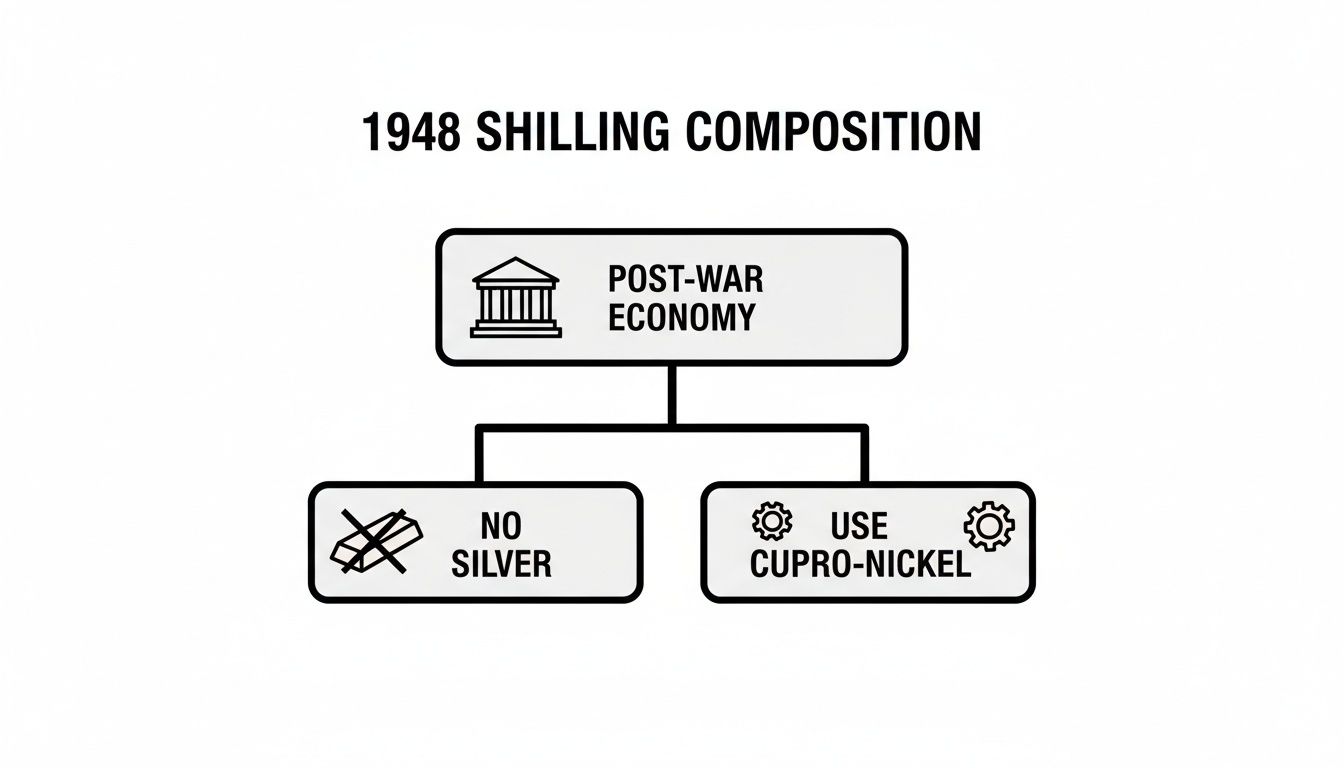
This move away from silver meant the coin's worth became entirely linked to its condition and rarity, not the value of the metal it was made from.
Identifying The Key Wear Points
To get an accurate grade, you need to know exactly where to look. Wear isn’t random; it always hits the highest points of the design first. For the 1948 shilling, there are two spots you absolutely must inspect.
First, look at the obverse (the 'heads' side) and get up close with King George VI's portrait. The very first place to show wear is on the high points of his hair, especially just above his ear and on his eyebrow.
- On a heavily used coin, these areas will be flattened and smooth, with almost no detail left.
- On a higher-grade example, you’ll be able to see individual strands of hair and the distinct lines of his eyebrow.
Next, flip the coin over to the reverse to see the English lion. Here, your focus should be on the lion’s mane and its facial features. A well-preserved coin will have sharp, clear lines making up the texture of the mane. On a worn coin, these details will look soft, blurry, and indistinct.
The ability to spot these subtle differences is what separates a casual finder from a knowledgeable collector. It’s these small details that create the biggest differences in value.
Visual Guide To Grading The 1948 Shilling
Knowing what to look for is half the battle, but seeing it makes all the difference. The table below breaks down what you should see on your coin for each of the main grades. Use it like a checklist to pinpoint where your 1948 shilling fits.
| Grade | Obverse (King's Portrait) | Reverse (Lion and Crown) | Overall Appearance |
|---|---|---|---|
| Good (G) | Hair and eyebrow are almost completely flat. The King's outline is clear, but finer details are gone. | The lion's face is a faint outline, and the mane is a soft, undefined mass with no texture. | Looks heavily used, with lots of scratches and a dull, worn-down surface. |
| Fine (F) | The main outline of the hair is visible, but details are merged. The ear is clear, but flat. | You can make out the main sections of the mane, but it lacks any fine detail. The crown is worn. | Still heavily circulated, but the main designs are distinguishable. Lettering is legible. |
| Very Fine (VF) | You can see some of the major hairlines, but the smaller strands are worn away. The ear shape is clear. | The main locks of the mane are visible, but the finer textures are soft and blended. | Shows moderate wear on high points, but is still a nice-looking coin with clear lettering. |
| Extremely Fine (EF) | Most of the hair detail is sharp. Only the very highest points show light flatness or rubbing. | Nearly all details on the mane, face, and crown are sharp. Any wear is minor and often needs a magnifying glass to see. | Sharp and clear. May still have some of its original mint lustre shining through in protected areas. |
| Uncirculated (UNC) | Every single strand of hair is perfectly defined. There's no flatness or friction on any part of the portrait. | The lion's mane, claws, and facial features are exceptionally sharp and crisp. | Has its full, original mint lustre. It looks just as it did the day it was made, with no signs of wear at all. |
Grading definitely gets easier with practice. By carefully checking these key wear points against the guide, you can make a confident assessment of your coin's condition and get a much better idea of its true value. If you want to dive deeper, you can learn much more about the official grades of coins and the numerical scales used by professional services.
Why A Common Coin Can Still Be A Rare Find
When collectors first start looking into the one shilling coin 1948 value, many hit the same wall. How can a coin made in the millions possibly be worth anything? It’s a perfectly reasonable question. The Royal Mint, after all, pumped out an enormous number of these shillings.
The answer comes down to the difference between two types of rarity: absolute and conditional. Absolute rarity is simple – it’s just the total number of coins ever minted. But conditional rarity is where the story of the 1948 shilling gets interesting. It asks: how many of those millions of coins have survived in a specific, high-grade condition?
Picture it: tens of millions of brand-new shillings leaving the mint. These weren't made for collectors; they were the workhorses of the British economy. They clinked around in pockets, were fed into vending machines, and rattled in shop tills, passing through countless hands for decades. Every single transaction left its mark—a tiny scratch here, a bit of wear there, slowly softening the sharp details of the original design.
The Great Survivor Paradox
This constant, daily grind is what numismatists call attrition. Think of it like a huge army marching off to a long and gruelling war. You might start with massive numbers, but only a handful of soldiers will come back without a single scratch. The same goes for coins.
The overwhelming majority of 1948 shillings were worn down, damaged, lost, or eventually melted for their metal. Only a tiny fraction were saved by pure chance, maybe stashed away in a forgotten tin or kept as a memento, escaping the rough and tumble of daily circulation.
This is the central paradox for many so-called "common" coins. Their massive mintage numbers guarantee you can find them easily in a worn state. But that same fact means almost all of them were used as intended, making pristine, untouched examples incredibly scarce.
The mintage figure only tells you how many coins started the race; it says nothing about how many crossed the finish line in perfect shape. That's precisely why a flawless, Uncirculated 1948 shilling can command a price hundreds of times higher than a heavily worn one. You aren't just buying the coin; you're paying for its incredible story of survival.
Mintage Numbers In Context
In 1948, the UK Royal Mint struck a staggering 45,576,923 English reverse one shilling coins for King George VI. This was part of a huge post-war push to get the economy back on its feet, with the total shilling output from 1937-1951 easily topping 600 million across all versions.
Experts studying hoarding and circulation patterns from that era estimate the attrition rate could be as high as 98%. That leaves just a fraction of the original mintage in existence today, with the vast majority being in grades below Very Fine. You can dig deeper into these figures in most good numismatic catalogues.
Here's a look at the data from Numista, a popular online coin catalogue, which lays out the key details for the 1948 English shilling.
This confirms the coin is made of cupro-nickel, not silver, and nails down the exact mintage. It reinforces the idea that its value today is all about preservation, not what it's made of.
So, while it's absolutely true that the 1948 shilling is a common coin, finding one in top-tier condition is anything but. The next time you see a massive mintage number, remember that it's only telling you half the story. The real treasure hunt is for the rare few that made it through the journey untouched.
Getting To Grips With The 1948 Shilling's Design
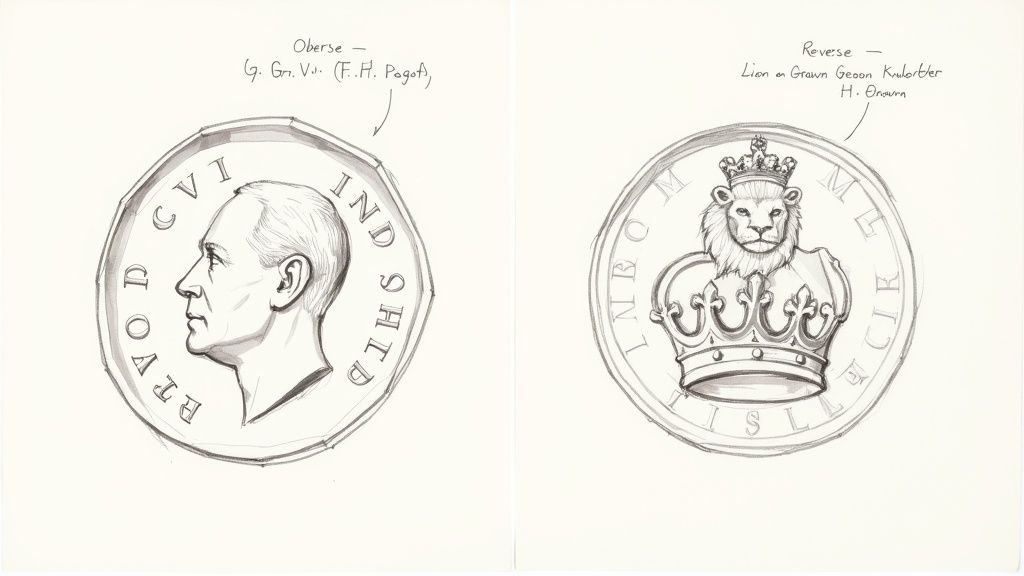
Before you can even begin to think about the one shilling coin 1948 value, you need to know exactly what you're looking for. A coin is much more than just a lump of metal; it’s a tiny canvas filled with historical clues and artistic details. Knowing these details is the first step to confidently identifying a genuine 1948 shilling and appreciating the story it tells.
Let's start with the obverse, or the 'heads' side. Every 1948 shilling features the same striking, uncrowned portrait of King George VI. The design, by the celebrated artist Thomas Humphrey Paget, was a deliberate choice. It was meant to portray a more serious, relatable monarch who had stood with his people through the austerity of the Second World War.
Surrounding the King's head is a Latin inscription: ‘GEORGIVS VI D:G:BR:OMN:REX’. This is an abbreviation for ‘Dei Gratia Britanniarum Omnium Rex’, which translates to the rather grand ‘By the Grace of God, King of all the Britains’.
A Tale Of Two Lions
Now, flip the coin over to the reverse, or 'tails' side. This is where things can get interesting for shillings from King George VI's reign, as two different designs were used: one for England and another for Scotland. This often catches new collectors out.
Luckily for us, 1948 keeps it simple. Only the English reverse was ever minted for this year. This is a crucial point. If you come across a 1948 shilling with the Scottish design, it’s a fake. No question.
The English reverse, crafted by George Krueger-Gray, shows a powerful lion standing atop St Edward's Crown. In the formal language of heraldry, this is a Lion Passant Guardant – it looks like it’s walking forward while staring right at you. It’s a classic symbol of English strength and sovereignty.
A common question is whether the Scottish version is worth more in other years. The answer is usually no. Both designs were minted in huge numbers, so for most years, their values are almost identical when in the same condition.
The Last Whisper Of Empire
One of the most fascinating details on the 1948 shilling is easy to miss but packed with history. Look closely at the inscription on the 'heads' side again, and you'll spot the letters ‘IND:IMP’. This is shorthand for ‘Indiae Imperator’, or ‘Emperor of India’.
This little detail turns the coin into a true historical artefact. India had gained its independence from Britain the year before, in 1947, making the title obsolete. The 1948 mintage was therefore one of the very last to carry this inscription before it was officially dropped from all British coins in 1949.
When you hold a 1948 shilling, you’re holding a direct link to a moment of profound global change. It represents the final echo of the British Empire in India, captured forever on a coin that was already symbolising a new, post-war Britain. That combination of powerful imagery and historical quirks is what makes it such a compelling piece for any collector.
Navigating the Market to Buy or Sell Your Coin
Once you’ve got a handle on your coin’s grade and a rough idea of its value, you might be thinking about buying or selling. Whether you're hunting for a top-grade 1948 shilling to complete a set or looking to cash in on a piece you've found, knowing your way around the market is the key to a fair deal.
There are a few different avenues you can go down, each with its own pros and cons. Big online marketplaces like eBay give you a massive audience, but you’ll have to do all the work yourself, from photos to postage. On the flip side, specialist coin dealers can give you an instant offer, but remember they’re buying at a wholesale price to sell on. Then there are local coin fairs, which are great for face-to-face deals, combining expert eyes with instant results.
Tips for a Successful Sale
If you do decide to sell, particularly online, how you present the coin is everything. The one shilling coin 1948 value is all about its condition, and your job is to show off that condition as accurately as you possibly can.
-
Photography is Paramount: Clear, well-lit photos are non-negotiable. Get sharp pictures of both the front (obverse) and back (reverse) against a simple, plain background. You'll want to capture the crucial grading areas in detail—think King George VI’s hair and the fine details on the lion’s mane. When you're on a platform like eBay, great pictures are what stop buyers from scrolling, and using services for professional eBay product photos can make a world of difference.
-
Write an Honest Description: Be clear about the coin's grade, at least to the best of your knowledge. Don't hide any issues. If there are scratches, rim nicks, or other blemishes, point them out. A bit of honesty goes a long way in building trust and stops any headaches or disputes down the line.
-
Set a Realistic Price: A quick search for "sold" listings on eBay or a look at a current dealer price guide will give you a good starting point. If you overprice a common coin, it’s just going to sit there.
For a more in-depth look at the process, our guide on how to sell a coin breaks it all down step-by-step.
Advice for Savvy Buyers
When you're the one buying, the name of the game is getting exactly what you pay for. Stick to sellers who have a solid history of positive feedback and, crucially, a clear returns policy just in case.
There's an old rule in coin collecting: "Buy the coin, not the grade." Always scrutinise the seller's photos with your own eyes. A dealer might list a coin as "Extremely Fine," but your assessment might put it closer to "Very Fine." That small difference can have a big impact on the price you should be paying.
Finally, a quick word on postage. Whether you’re buying or selling, make sure the coin is packed securely. A simple padded envelope or a small box, sent via a tracked service, gives everyone peace of mind and protects your investment while it’s in transit.
Got Questions? We’ve Got Answers
When you start digging into the details of a specific coin like the 1948 shilling, a few questions always seem to pop up. Here are some straightforward answers to the most common queries we hear, giving you a quick reference guide to get you up to speed.
Is The 1948 One Shilling Coin Rare?
In a word, no. The Royal Mint produced a staggering 45 million of these coins, so finding a circulated one is incredibly easy. But this is where it gets interesting for collectors; its rarity is what we call "conditional."
What that means is that while a worn, well-used 1948 shilling is common, finding one in pristine, uncirculated condition is a real challenge. Think about it – very few coins survived decades of being passed from hand to hand without picking up scratches, dings, and general wear. That’s precisely why top-grade examples are so prized by collectors.
How Much Silver Is In A 1948 Shilling?
This is a common point of confusion, but the answer is simple: there is zero silver in a 1948 shilling. The UK officially stopped using silver in its circulating coins back in 1947. This wasn't a choice made lightly; it was a direct result of the immense economic strain of the Second World War.
From 1947 onwards, these coins were made from a hardy cupro-nickel alloy (75% copper and 25% nickel). Because of this, its value comes purely from its collectability and condition, not from the metal it's made of.
The switch to cupro-nickel is a defining moment for this coin. It draws a clear line between it and its silver predecessors, placing its value squarely in the hands of numismatists who appreciate its history and state of preservation over any melt value.
What Is The Difference Between An English And Scottish Shilling?
During King George VI’s reign, you'll find two distinct designs on the back of shillings. The "English" version features a lion standing proudly atop St Edward's Crown. The "Scottish" version, on the other hand, shows a lion rampant, brandishing a sword and sceptre.
For the year 1948, however, there’s no mystery. Only the English reverse design was minted. Every single genuine 1948 one shilling will have the lion on the crown. If you come across one with a Scottish design dated 1948, it's a tell-tale sign that you're looking at a fake.
Where Can I Get My 1948 Shilling Valued?
For a quick, casual valuation, your best bet is to look at the "sold" listings on online marketplaces like eBay. This gives you a real-world snapshot of what people are actually willing to pay for coins in different states of wear. A friendly chat with a reputable local coin dealer can also give you a good ballpark figure.
If you believe you have a coin in exceptional, almost-new condition, it's worth considering a formal, certified grade. This involves sending it to a professional third-party grading service. While it's a paid service, it provides an official, authenticated grade that cements its quality and can significantly boost its value on the market.
Whether you're just starting your journey or hunting for that one specific piece to complete a set, having a trusted expert in your corner makes all the difference. At Cavalier Coins Ltd, we don't just sell coins; we offer the expertise to help you build a collection you can be truly proud of. Explore our curated selections and discover your next treasure today.