
Most pound coins you find are, unsurprisingly, worth exactly one pound. But every now and then, a rare design, a tiny production run, or a mistake at the mint can make a simple quid worth much more. The real skill is knowing what to look for when you're sifting through your spare change.
A Quick Guide to What Makes a Pound Coin Valuable
Ever found yourself tipping out a coin jar, wondering if a little piece of treasure is hiding in plain sight? While the huge majority of £1 coins are just everyday currency, a handful are genuinely sought after by collectors. Figuring out what drives their value is the first step in spotting a numismatic find.
It really boils down to three main things: rarity, design, and errors.
This simple chart breaks down the thought process for spotting a potentially valuable coin.
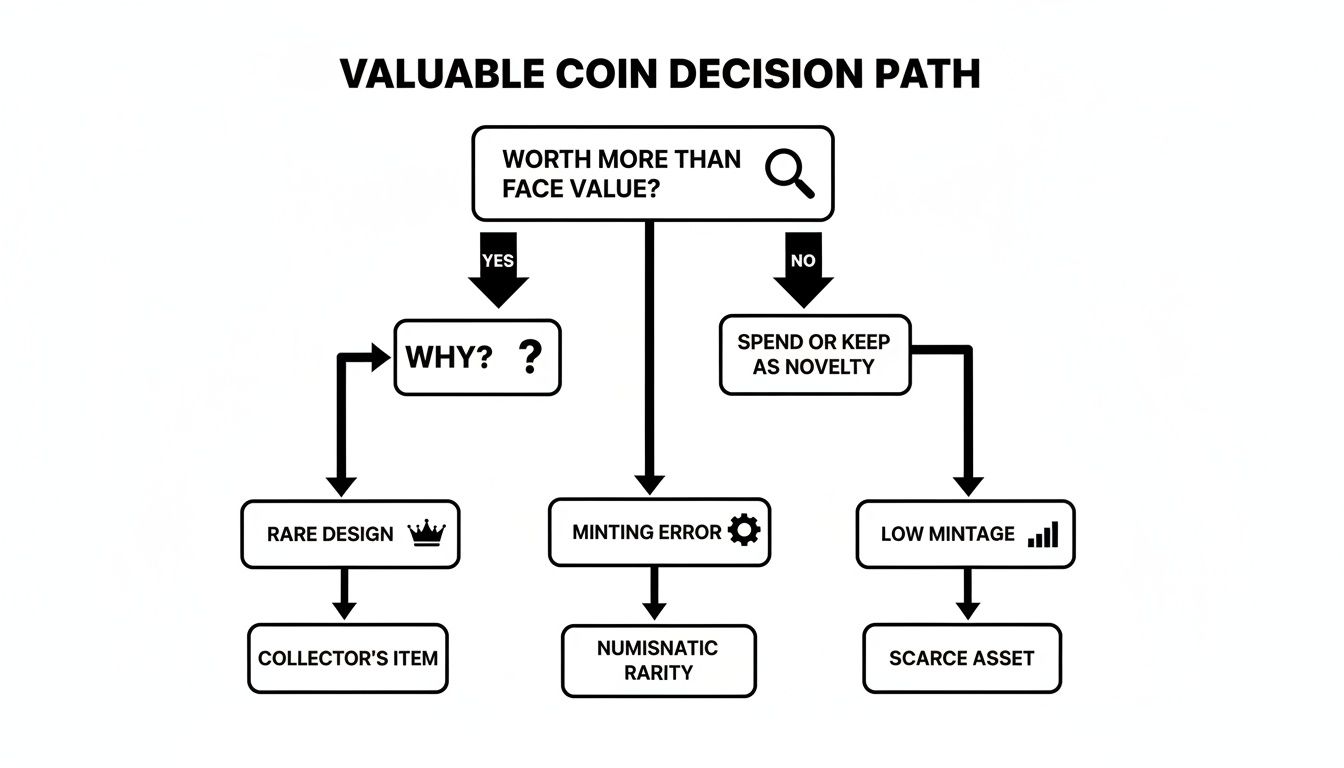
As you can see, the value is almost always tied to scarcity. That scarcity could come from a deliberately low production run, a special one-off design, or a unique mistake made during the minting process.
Key Value Factors for UK Coins
The modern round pound coin first appeared in 1983, taking over from the flimsy £1 banknote. To get things started, the Royal Mint churned out a massive 594,054,500 of them in that first year, making it the most common date you'll find by a country mile.
This perfectly illustrates the number one rule of coin collecting: scarcity is king. The fewer coins of a particular type that were made, the more likely it is to be valuable today.
Here's a quick rundown of the main things you should be checking for.
- Low Mintage Figures: This is simply the total number of coins made for a specific year and design. A low mintage almost always means higher demand from collectors down the line.
- Commemorative or Rare Designs: Some coins are struck to mark big national events or to celebrate the UK's home nations. Certain designs, like the 2011 Edinburgh City £1, have become famous among collectors for their rarity.
- Minting Errors: Mistakes can and do happen, even at the Royal Mint. Coins that have been struck with errors—things like a misaligned design or the wrong lettering—are often highly prized simply because they're one-of-a-kind.
This table gives you a quick-glance guide to the main features to look for.
Key Features of a Valuable Pound Coin
| Feature | What to Look For | Potential Value Indicator |
|---|---|---|
| Mintage Figures | Check the coin's year and find out how many were produced. Lower is better. | Low |
| Design | Look for special commemorative designs, not the standard Royal Arms. | Rare or Commemorative |
| Minting Errors | Inspect for oddities like misaligned strikes, incorrect edge inscriptions, or 'mules'. | High |
| Condition | Assess for wear and tear. Uncirculated or near-mint coins are more desirable. | Excellent (Uncirculated) |
By focusing on these areas, you can quickly decide if a coin is worth a closer look or if it’s just heading for the piggy bank.
For a more detailed breakdown, you can check out our in-depth guide on the value of pound coins to see which specific ones you should be hunting for.
Spotting Rare Designs and Low Mintage Pound Coins
In the world of coin collecting, the simplest rule is often the truest: scarcity creates value. While a dramatic minting error is always a thrilling find, the most reliable way a pound coin becomes worth more than its face value is through low production numbers.
The Royal Mint publishes official mintage figures, giving you a precise count of how many coins of a specific design were ever made. The lower that number, the tougher it is to find one in your change, and that's what gets a collector's pulse racing.
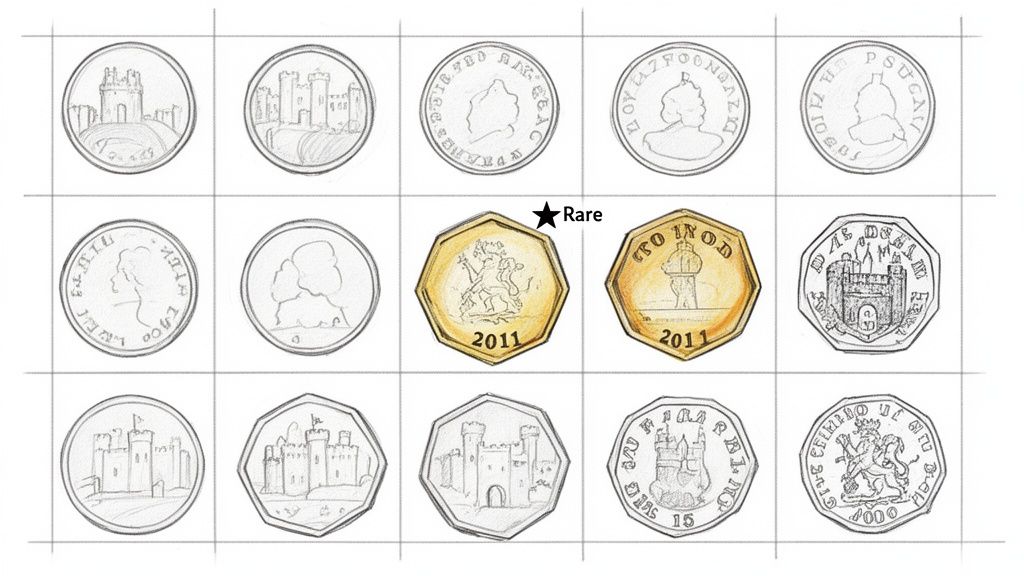
This is exactly why some of the commemorative designs are so sought-after. Coins created to celebrate the capital cities of the UK, for instance, had much smaller production runs than the standard Royal Arms design. They were never meant to be the workhorses of our currency.
The Round Pound Scarcity List
When the old round pound was demonetised back in 2017, it kicked off a nationwide treasure hunt. Everyone was suddenly checking their change jars and wallets for the rarest designs before they vanished for good.
The undisputed champion of scarcity for the round £1 coin is the 2011 Edinburgh City design. With a mintage of just 935,000, it’s the only circulating round pound to ever dip below the one-million mark.
A few other key coins to keep an eye out for from this era include:
- 2011 Cardiff City: The Welsh capital's coin is the second rarest, with a mintage of 1,615,000.
- 2010 London City: Part of the same series, this coin had a run of 2,635,000.
- 2008 Royal Arms: It might look like a standard design, but this specific year had a surprisingly low mintage of just 3,910,000.
A common mistake is to assume any coin showing a home nation's capital is automatically valuable. While the Edinburgh and Cardiff coins are rare finds, the 2010 Belfast City coin, for example, has a mintage of over six million, making it far more common. You always have to check the year and the specific city.
Scarcity in Modern 12-Sided Coins
The new 12-sided pound coin, introduced in 2017, was designed for high security and was minted in absolutely massive quantities to replace the old round pound. As a result, finding a low-mintage bimetallic £1 from your everyday change is a much tougher challenge. Most years see production figures in the hundreds of millions.
That said, rarity can still be found. Be on the lookout for the 2016 trial coins. These were never intended for public circulation; they were given to businesses to test out their vending machines. Inevitably, some slipped into public hands and are now highly collectible.
Likewise, any "Nations of the Crown" design dated anything other than 2016 or 2017 could signal a scarce issue. If you're keen to learn more, you can dive deeper into this comprehensive list of rare one pound coins and see what they're fetching. This is how an ordinary pound coin can become something special to a collector.
How to Spot Valuable Minting Errors and Imperfections
While the Royal Mint has a world-class reputation for quality, the sheer volume of coins they produce means a few mistakes are bound to slip through. For a collector, these little slip-ups aren't flaws; they're opportunities. A tiny error can turn a bog-standard quid into something genuinely rare, making that pound coin worth money well beyond its face value.
Learning to spot these errors is all about training your eye to see what's different. Most imperfections are incredibly subtle, so you have to know what you’re looking for. It’s not about finding a coin that’s been scuffed up or dented in a pocket – it's about spotting a genuine mistake that happened the moment it was made.
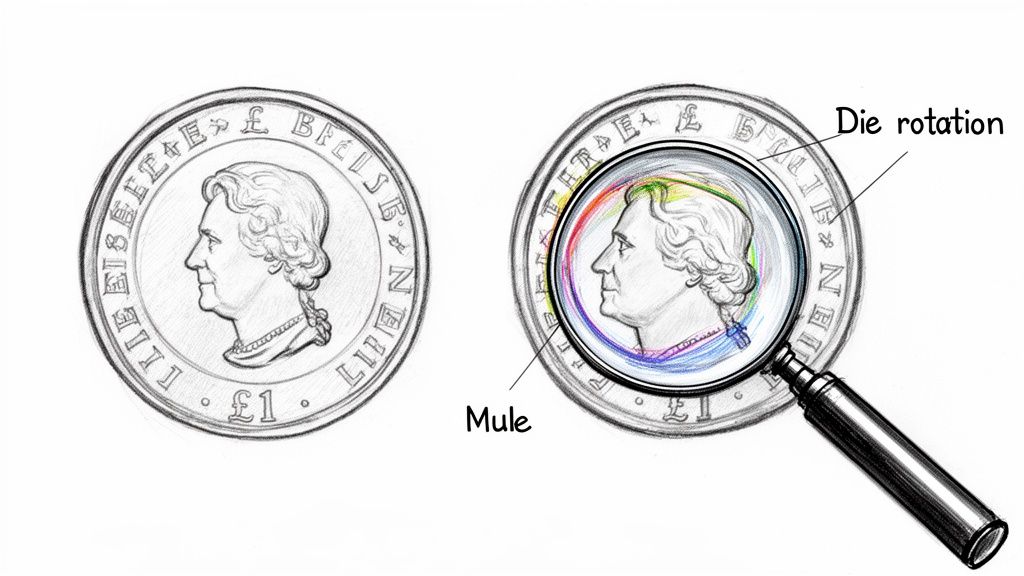
Honestly, a simple magnifying glass will become your best friend in this hunt. It’s the easiest way to tell the difference between a real minting error and the everyday wear and tear a coin gets rattling around in circulation.
Recognising Famous Coin Errors
Some types of errors are much more famous and sought-after than others. Knowing the main categories helps you zero in on a potential treasure almost immediately. One of the most famous is the 'mule' coin. This happens when a coin is struck with two dies that were never meant to be a pair – for instance, the 'heads' (obverse) from one design and the 'tails' (reverse) from a completely different one.
Other key errors to keep an eye out for include:
- Die Rotation Errors: This is a brilliant one to check for because it's so simple. Hold the coin with the Queen's head facing up, gripping it by the edges. Now, flip it over from top to bottom. The design on the back should also be perfectly upright. If it’s skewed at an angle, you've found a die rotation error.
- Off-Centre Strikes: Sometimes the metal blank, or 'planchet', isn’t sitting dead centre when it gets struck. This shoves the whole design to one side, often leaving a crescent of blank, unstruck metal.
- Wrong Planchet Errors: These are the real unicorns of the coin world. In exceptionally rare instances, a coin gets struck on a metal blank meant for a completely different coin. Imagine finding a pound coin design struck on the copper-coloured planchet of a 2p piece – that would be an incredibly valuable discovery.
It's absolutely crucial to learn the difference between a true mint error and post-mint damage. A coin that’s been mangled in a washing machine or run over by a bus is just damaged, not valuable. A true error is a flaw that was baked in during its creation at the Mint.
How to Examine Your Coins Systematically
To give yourself the best chance of finding these imperfections, you need a consistent method. First things first, get yourself some good lighting. Subtle errors are impossible to spot in a dim room. Lay your coins out on something soft and non-scratchy, like a microfibre cloth, so you don't add any new marks yourself.
Start with a quick visual scan of both sides. Look for anything that just seems a bit off with the design – any doubled lettering, missing bits, or odd-looking textures.
Next, do the flip test for die rotation errors we mentioned earlier. Finally, don't forget the edge of the coin. The inscription should be crisp and evenly spaced. On the new 12-sided coins, the pattern of reeded and smooth edges should be consistent all the way around. Any deviation could signal a less common, but still very interesting, error. By sticking to a simple process, you really boost your chances of finding a genuine rarity.
Why the Condition of Your Coin is Everything
So, you've found a coin with a rare date or a sought-after design. That’s the first hurdle cleared, but now for the big question: what sort of shape is it in? For a serious collector, the physical condition of a coin is often the single most important factor determining its final price.
A flawless, uncirculated coin that looks like it just rolled out of the Royal Mint can fetch a price many times higher than the very same coin that’s been rattling around in someone's pocket for years. Every single scratch, knock, and patch of wear and tear chip away at its numismatic appeal.
It's a bit like finding two classic cars of the same rare model. One has been kept under a dust sheet in a dry garage, preserving its original paintwork. The other has been left outside, gathering rust and dents. It’s obvious which one will be worth a fortune, and the very same logic applies to coins.
Getting to Grips with Coin Grades
As you start looking into the coin market, you'll see a few key terms pop up again and again. These are "grades," and they form a universal language for collectors and dealers to describe a coin's condition accurately.
- Proof: These aren't your average circulation coins. Proofs are specially struck using highly polished dies to create a stunning, mirror-like finish. They're produced in small numbers and sold directly to collectors, representing the absolute pinnacle of minting quality.
- Brilliant Uncirculated (BUNC): Just a small step down from Proof. BUNC coins are also struck with new, polished dies but at a much faster rate. They have a fantastic shine but might have tiny, minor imperfections from the minting or bagging process.
- Uncirculated (UNC): These are standard coins that, for whatever reason, never made it into general circulation. They might have a few small "bag marks" from being stored with other new coins, but they’ll still have all their original detail and that fresh-from-the-mint lustre.
When you're fishing through your loose change, you're far more likely to find coins in grades like 'Extremely Fine' (EF) or 'Very Fine' (VF). These terms describe coins that have seen a bit of life but still have most of their details sharp and clear, with only slight wear on the highest points. Even at these grades, a rare coin can still be very valuable.
How to Give Your Own Coins a Quick Assessment
You don't need to be a professional grader to get a decent idea of your coin's condition. All you need is a good, bright light source and a keen eye.
First, always hold the coin by its edges to avoid getting fingerprints on the faces. Tilt it back and forth under the light to let any surface marks, scratches, or scuffs reveal themselves.
Next, look for a loss of detail on the highest points of the design – these are the areas that wear down first. On a modern pound coin, this could be the Queen's hair, the delicate cables on the Forth Bridge design, or the fine lines of the Royal Arms. If these spots look smooth and flattened, the coin has seen plenty of circulation. Any noticeable dings on the rim or deep scratches will also pull the grade down, and its potential value along with it.
How to Research Prices and Sell Your Valuable Coins
That moment of discovery, finding a coin you think might be valuable, is a brilliant feeling. But it's really just the first step. To actually turn that potential into cash, you have to get a handle on the current market and figure out the smartest way to sell.
A classic mistake I see newcomers make is getting their hopes up by looking at inflated asking prices online. They see a coin listed for hundreds of pounds and think they've hit the jackpot, only to be disappointed later.
The secret is to ignore what people want for their coins and focus only on what coins have actually sold for. That’s your realistic benchmark.
Finding a Realistic Market Value
Your first port of call should be the big online auction sites, but you need to use a specific trick. Don't just browse the current listings – anyone can ask for a silly price. Instead, run a search for your coin and then filter the results to show only "Sold" or "Completed" items.
This one simple action cuts through all the hopefuls and shows you the real-world prices collectors are actually paying right now.
As you look through the sold listings, really scrutinise the photos and compare them to the coin in your hand. A gleaming Brilliant Uncirculated (BUNC) coin will always fetch more than the same one with scratches and dinks from being in circulation. This direct comparison is the quickest way to get a solid idea of what your specific pound coin is worth in money today.
It's also worth remembering why buyers can be a bit cautious, especially with the old round pounds. Before they were pulled in 2017, the number of fakes in circulation was staggering, with some estimates putting the number as high as 45 million. This history makes proving your coin is genuine absolutely vital.
Choosing Your Selling Path
Once you have a good idea of your coin's value, it's time to decide how to part with it. There’s no single "best" way – the right choice really depends on the coin's value, how quickly you need the money, and how much legwork you're prepared to do.
Let's break down the main options.
Selling Options for Your Valuable Coins
Choosing where to sell can feel overwhelming, but it boils down to balancing speed, convenience, and the final price you’ll get. Here's a quick comparison to help you decide which route is best for you and your coins.
| Selling Method | Best For | Pros | Cons |
|---|---|---|---|
| Coin Dealer | Quick, hassle-free sales for common to mid-value coins. | Instant payment, no need to photograph or list items, expert appraisal. | You'll receive a wholesale price, which is lower than the retail value. |
| Online Marketplace (e.g., eBay) | Reaching a huge audience of collectors for a wide range of coins. | Potential for higher prices, you control the listing and sale price. | You handle all photos, descriptions, postage, and customer queries; fees can be high. |
| Specialist Auction House | Extremely rare, high-value, or certified coins. | Access to serious, high-spending collectors; they handle authentication and marketing. | Process can be slow, and commission fees are significant (often 15-25%). |
Each path has its place, so weigh what matters most to you.
For a much deeper dive into the selling process, our guide on how to sell a coin walks you through every step with practical advice.
If you're dealing with a large inherited collection or managing a charity donation, things can get complicated fast. In these cases, specialist help is a godsend. Services like ours can assess entire collections, pick out the valuable items, and either make an offer for the whole lot or consign the best pieces for sale. It saves an enormous amount of time and ensures a hidden gem doesn't get accidentally tossed out with the loose change.
Your Top Pound Coin Questions Answered
Once you start sifting through your change, a whole host of questions naturally come up. Is this shiny one worth keeping? What actually makes a coin rare? Let's dive into some of the most common queries we get from people who suspect they've stumbled upon a hidden gem.
Getting the right answers is the best way to sidestep any disappointment and channel your energy into finding the coins that are genuinely worth a closer look. There are a lot of myths and half-truths floating around online, so a reliable source is absolutely essential.
What Is the Rarest Pound Coin?
This is, without a doubt, the question we hear most often. For the classic round pound, the undisputed champion is the 2011 Edinburgh City £1. With a mintage of just 935,000, it's the only circulating round pound design that ever dipped below the one-million mark.
When it comes to the newer 12-sided coins, most of the standard designs were minted in enormous quantities. Real rarity here usually comes from specific, verified minting errors or trial pieces that were never intended for public hands. It's always a good idea to check the latest official mintage figures directly from The Royal Mint, as they do update their data.
Does a Shiny Coin Mean It Is Valuable?
Not necessarily, and this is a really important distinction to make. A coin might be shiny because someone has aggressively cleaned or polished it, which actually strips away the original surface and dramatically reduces its value to a serious collector.
A genuinely valuable shiny coin is one in 'Uncirculated' or 'Brilliant Uncirculated' condition. This means it has kept its original mint lustre simply by avoiding the damage that comes from being handled or cleaned.
If you're new to collecting, here's the one thing to remember: originality is everything. A worn but original coin is almost always better than one that's been improperly cleaned to look new. Whatever you do, don't clean your coins!
How Can I Spot a Fake Round Pound?
The old round pound was famously targeted by counterfeiters. There are a few tell-tale signs of a fake:
- Poor quality details: The design might look a bit soft, blurry, or just incomplete.
- Incorrect edge inscription: The lettering around the coin's edge could be misspelled, badly spaced, or completely wrong for the year on the coin.
- Weight and colour issues: A fake often feels noticeably lighter or heavier than the official 9.5g and might have a strange, off-colour look.
The 12-sided coin was designed to be much more secure, but it’s still worth checking for crisp, clear lettering and a well-defined hologram.
What Should I Do with Old Round Pounds?
Even though they were demonetised back in 2017, you can still deposit old round pound coins at most high street banks. But before you rush off, it’s vital to check them for any of the rarer dates, like the 2011 Edinburgh or 2010 Cardiff designs.
Many charities also welcome bulk coin donations. It’s a great way for them to raise crucial funds, as they can have the collection checked for any valuable pieces before banking the rest.
At Cavalier Coins Ltd, we specialise in helping collectors and organisations identify and monetise rare coins. Whether you're building a collection or managing a charity donation, explore our services to turn your currency into something more. https://www.cavaliercoins.com