
Figuring out the true price of coin silver isn't as simple as checking one number. It’s a bit like valuing a vintage car—sure, it has a base value as scrap metal, but its history, rarity, and condition can make it priceless to the right enthusiast. The value is a blend of its raw metal content and how desirable it is as a collectible.
Unpacking The True Value Of Your Silver Coins
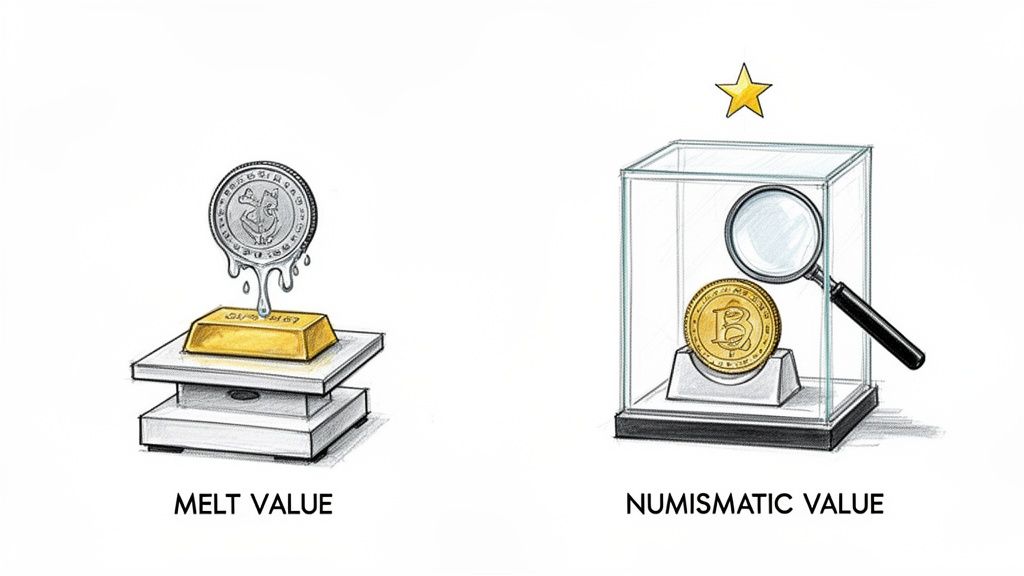
To really understand what your silver coins are worth, you need to look beyond a quick online search. The first step is realising that every silver coin has two potential sources of value, and these can be worlds apart. Getting your head around this distinction is fundamental to accurately assessing your collection.
Every silver coin's price is built from two core components:
- Melt Value (Intrinsic Value): This is the coin's baseline price, calculated purely from the weight and purity of the silver inside it. It changes daily along with the global silver market, a figure often called the "spot price."
- Numismatic Value (Collectible Value): This is the premium a collector is willing to pay over and above the melt value. This extra value comes from things like the coin's rarity, historical importance, condition (its grade), and general demand from other collectors.
A common, heavily circulated silver coin from a year when millions were minted might only be worth its melt value. On the other hand, a rare coin from a limited production run, especially one in pristine condition, could be worth thousands of pounds—far more than its actual silver content.
To help clarify these two concepts, here’s a quick breakdown of how they stack up against each other.
Melt Value vs. Numismatic Value at a Glance
| Attribute | Melt Value (Intrinsic) | Numismatic Value (Collectible) |
|---|---|---|
| Primary Source | Weight and purity of the precious metal | Rarity, condition, history, and demand |
| Stability | Fluctuates daily with the market "spot price" | More stable, but can shift with collector trends |
| Applies To | All precious metal coins | Only specific coins collectors desire |
| Typical Coin | Common, circulated, damaged coins | Rare dates, mint marks, high-grade examples |
Essentially, all collectible coins have a melt value, but only a select few have a numismatic value that pushes their price tag higher.
The Role Of Silver Purity
The purity of the metal is a massive factor in its base price. For instance, the "coin silver" used in historic UK and US currency was often a .900 alloy, meaning it was 90% silver. By contrast, Sterling silver is .925, or 92.5% silver. Knowing the difference is crucial. As a useful benchmark, it helps to know what is the value of 925 silver today to get a feel for the market.
A coin's value is not just in its shine, but in its story and scarcity. A simple silver shilling can be a piece of history worth far more than the metal it's made from.
This guide will walk you through how to calculate both the melt and numismatic values for your coins. Soon, you'll be able to see them not just as pieces of silver, but as potential treasures. If you’d like to dig deeper, our experts offer more insights into determining the price for silver coins that you can apply right away.
Understanding What Makes a Coin Silver
Before you can work out the value of your silver coins, you need to get to grips with what the term 'coin silver' actually means. It’s not just a catch-all phrase for any old shiny coin; it refers to a specific silver alloy created for a very practical reason. The simple truth is that pure silver is far too soft to stand up to the rigours of daily commerce.
Just imagine a pure silver coin being passed from hand to hand, day in, day out. It would quickly become scratched, dented, and worn down, losing its beautiful design and even its weight. To get around this, mints blended silver with a stronger base metal—most often copper—to create a much more durable alloy. That, in a nutshell, is "coin silver."
This specific blend is what sets it apart from other common silver standards you'll come across. Each standard has a specific purity level, and understanding this is absolutely crucial for valuation.
Purity: The Key Factor in Value
The purity of silver is usually measured in "fineness," a number that tells you the parts per thousand of pure silver. It’s quite simple: the higher the number, the more pure silver the item contains.
Here’s a quick comparison of how coin silver stacks up against other standards:
- Fine Silver (.999): This is as pure as it gets, containing 99.9% silver. You’ll find it mostly in modern bullion coins and investment bars, which are never meant for circulation.
- Sterling Silver (.925): The classic standard for British silverware and jewellery, Sterling silver is made of 92.5% silver and 7.5% other metals.
- Coin Silver (.900): While the exact mix varied over time and between countries, the most common standard, especially for historic U.S. coins, was 90% silver and 10% copper. Interestingly, pre-1920 British silver coins were actually Sterling, but this changed later.
This difference in purity is fundamental. A coin made from .900 silver has less raw precious metal than a Sterling coin of the exact same weight, and that directly impacts its baseline melt value.
A Quick Trip Back in Time
Using silver alloys in coinage was a global standard for centuries. In the United Kingdom, for instance, silver coins were struck from Sterling silver for hundreds of years. But things changed. In 1920, the silver content was slashed to just 50% because the price of silver shot up after World War I. Then, in 1947, silver was removed from circulating British coinage altogether.
Understanding a coin's historical context is vital. Its composition tells a story about the economic pressures and technological capabilities of its time, which in turn influences its modern-day value.
Knowing these historical shifts is essential for proper identification. A 1918 British shilling might look a lot like a 1938 shilling, but they have vastly different silver contents. This knowledge is your first and most important tool for assessing value correctly. For a deeper dive, our guide on identifying the silver content in coins can help you out. With this foundation, we can now move on to the practical steps of calculating what that silver is actually worth.
Calculating the Melt Value of Your Silver Coins
Right, let's get down to the brass tacks—working out what your coins are worth based purely on the silver they contain. This is what we call the melt value, and it's the absolute baseline for any price of coin silver.
You don't need to be a maths whizz for this. The process is surprisingly straightforward, and once you get the hang of it, you'll feel much more confident when looking at any silver coin.
Think of the melt value as a safety net. No matter how common or worn a coin might be, it can’t be worth less than its weight in silver. Any value above that is a bonus, coming from its rarity or appeal to collectors. This method works for everything, from old British shillings to American dimes.
Your Step-by-Step Calculation Guide
To figure out the melt value, you just need a couple of details and some simple multiplication. It all boils down to finding out how much pure silver is in your coin and then multiplying that by the current market price for silver. Easy as that.
Here’s the five-step process:
- Identify the Purity: First, pin down the coin's silver fineness. Is it .925 (Sterling), .900 (very common for older coins), or perhaps .500 (like many later British coins)? This is the most important piece of the puzzle.
- Find the Total Weight: Pop your coin on an accurate digital scale. For the best precision, it’s always best to work in grams.
- Calculate the Actual Silver Weight (ASW): This is the key step. Multiply the coin's total weight by its purity percentage. For example, if you have a 10-gram coin that's .900 silver, it contains exactly 9 grams of the good stuff (10g x 0.90 = 9g).
- Check the Current Silver Spot Price: The spot price is the live market rate for an ounce (or gram) of pure silver. It changes constantly, so you’ll need to look up today's price from a reliable source.
- Multiply to Find the Value: Finally, just multiply the Actual Silver Weight (ASW) you calculated by the current spot price per gram. The number you get is your coin's melt value.
This diagram shows the most common silver purity standards you're likely to come across.
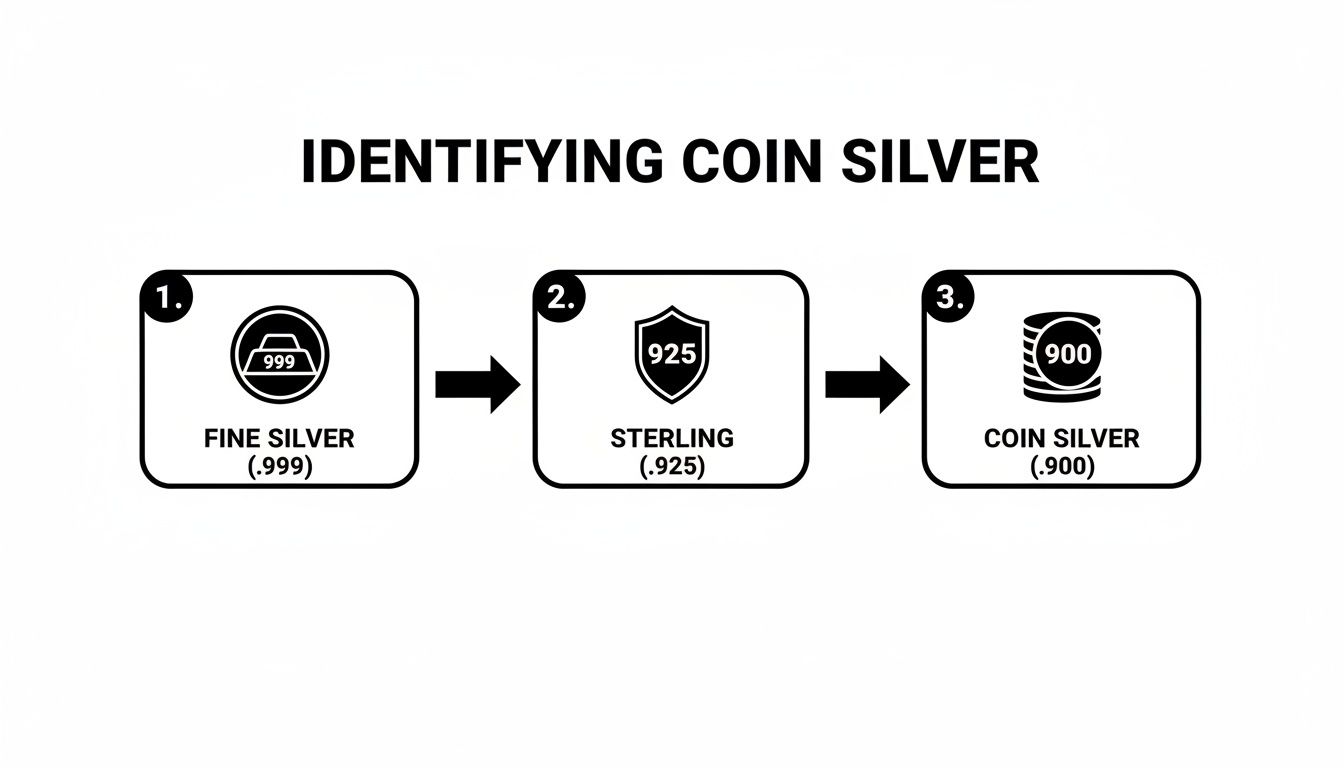
As you can see, figuring out if your item is fine, sterling, or standard coin silver is the first move in discovering what it’s really worth.
Putting It into Practice
Let's run through a real-world example. The British Silver Britannia is a hugely popular coin for investors. It contains exactly one troy ounce of .999 pure silver.
With the silver price in the UK currently sitting at around £26.36 per ounce, a single Britannia has a melt value of, you guessed it, £26.36. Of course, its actual market price is often a bit higher because it's a sought-after bullion coin. If you're curious, you can dig into more details about Britannia silver coin prices and charts on Monex.com.
Remember: Melt value is your starting point, not the final word. It's the foundational price upon which numismatic value can build, sometimes dramatically.
With this simple bit of maths, you’re now set to work out the base value of any silver coin that comes your way. It’s a solid foundation for any further appraisal.
What Makes a Coin Valuable Beyond Its Silver?
Ever wondered why one old silver coin might be worth its weight in silver—say, £20—while another of the exact same size and weight could fetch a staggering £2,000? The secret isn't in the metal; it's in the story.
This extra value is what collectors call numismatic value. It's the premium people are willing to pay for a coin's unique history, rarity, and appeal. Understanding this is how you spot a true treasure hiding in a pile of old change.
While the melt value gives you a solid price floor for your price of coin silver, the numismatic value is where the real excitement lies. It’s what turns a simple piece of metal into a coveted piece of history.
Let's break down the four pillars that build a coin's value and separate common bullion from a collector's prize.
The Core Four Numismatic Factors
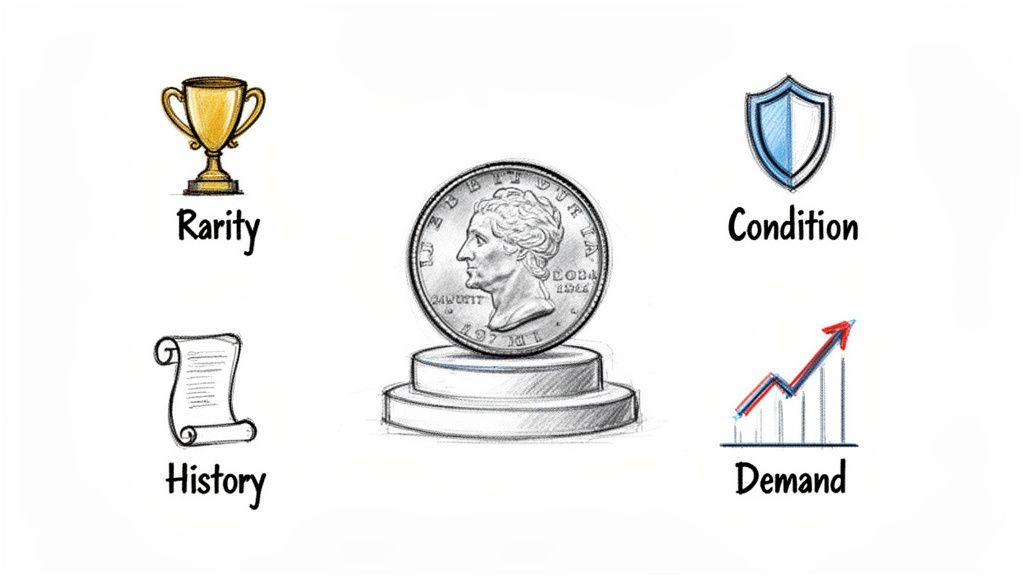
The jump from melt value to collector's price is almost always down to four key things: rarity, condition, history, and demand. A coin that scores high in one of these can be valuable, but a coin that ticks multiple boxes? That’s when things get really interesting.
- Rarity: This one’s pretty straightforward. How many of them are out there? A coin from a year with a tiny production run will nearly always be worth more than one from a year when millions were struck. Error coins—those with fascinating mistakes from the minting process—are another kind of rarity that can send values soaring.
- Condition (Grade): Take a look at the coin. Is it worn smooth from decades in people’s pockets, or does it look like it just fell off the press? A coin's state of preservation, or its grade, is absolutely critical. A pristine, uncirculated coin can be worth hundreds of times more than an identical one that’s been heavily worn.
- Historical Significance: Does the coin have a story to tell? Coins struck during pivotal moments in history—a major war, the coronation of a new monarch, or a nation’s founding—carry an extra layer of appeal. They are tangible links to our past.
- Collector Demand: At the end of the day, a coin is only worth what someone is willing to pay. Certain series, designs, or historical periods are simply more popular with collectors. High demand can push prices up even for coins that aren't especially rare.
Think of it like this: two identical silver candlesticks have the same melt value. But if one belonged to Winston Churchill, its historical significance gives it a numismatic premium that far exceeds the value of its silver.
For numismatists, coins like the British Britannia have held their appeal for over 25 years, blending beautiful design with solid investment potential. The premium these coins command over the spot silver price reflects their status as legal tender, their iconic look, and their consistent .999 purity. You can read more about the enduring appeal of Britannia silver coins on Monex.com.
How Global Markets Influence Silver Prices
The melt value of your silver coin isn't set in stone; it dances to the rhythm of the global silver market. This "spot price" is a living number, shaped by powerful worldwide forces that are surprisingly easy to get your head around once you break them down. Keeping an eye on these factors is key to timing your buying or selling decisions just right.
At its heart, the price of silver, like any other commodity, comes down to the timeless tug-of-war between supply and demand. When industrial and investor demand outstrips the available supply from mining and recycling, prices naturally climb. On the flip side, if supply floods the market while demand dries up, prices will almost certainly fall. It’s a constant balancing act on a global scale.
Key Drivers of Silver's Price
Several major forces are constantly tilting this balance, creating the peaks and troughs you see on price charts. Understanding them gives you a much clearer picture of why the price of coin silver can swing so wildly.
- Industrial Consumption: Unlike gold, silver has massive industrial demand. It's a critical component in everything from solar panels and electric cars to the phone in your pocket and advanced medical equipment. As these industries boom, so does their appetite for silver, putting upward pressure on its price.
- Investor Sentiment: During shaky economic times or periods of rising inflation, many investors flock to precious metals as a "safe-haven" asset. This flight to safety boosts demand for silver bullion and coins, pushing prices higher as people look for a reliable way to protect their wealth.
You can think of the silver market as a sensitive economic barometer. When investors get nervous about the stability of traditional currencies or the stock market, they often seek refuge in tangible assets like silver, causing its value to climb.
A Look at Historical Volatility
Silver's price history is famously a rollercoaster, marked by dramatic spikes and sharp drops. Just look at the legendary price surge in 1980, when silver shot up to nearly $50 per ounce. When you adjust for inflation, that peak becomes even more staggering, hitting an equivalent of around £170 per ounce in today's money—a moment fuelled by intense speculation. You can dig deeper into UK silver price history on tavexbullion.co.uk. Understanding this bigger picture is vital for making smarter moves with your silver assets.
Expert Tips for Buying and Selling Silver Coins
Once you've got your head around melt value, numismatic premiums, and the market forces at play, it's time to put that knowledge into action. Whether you're a new collector dipping your toe in or a seasoned seller looking to cash in, navigating the coin market requires a healthy mix of caution and confidence. Making smart decisions is the secret to building a collection you're proud of or getting the best possible return on your investment.
If you're just starting out, the golden rule is start small and learn as you go. Don't try to collect everything at once. Instead, pick a specific series of coins you find interesting, like pre-1947 British shillings. This lets you become a real specialist in one small area, making it far easier to spot a bargain and avoid overpaying for common pieces.
For the more experienced seller, the goal is always to find the right buyer. A specialist dealer or an auction house will understand the numismatic worth of a rare coin. On the other hand, a pawn shop or a "cash for gold" business will almost certainly only offer you its scrap metal value. To get the best price, you need to find someone who appreciates the coin's story and rarity, not just its silver content. For a deeper dive, our guide on how to approach selling your silver coins has plenty more valuable strategies.
Common Pitfalls to Avoid
Even the most experienced collectors and sellers can make costly mistakes. One of the biggest traps is being fooled by heavily polished coins. A super-shiny coin might catch your eye, but aggressive cleaning strips away its original surface, known as the "patina," and can completely destroy its numismatic value. Serious collectors want original, untouched coins, not something that's been polished to within an inch of its life.
Another frequent error is misjudging a coin's grade. The difference between a "Very Fine" and an "Extremely Fine" grade can be hundreds of pounds. If you're not 100% sure about a potentially high-value piece, getting a professional appraisal is always a smart move.
Understanding the historical context of silver's value provides a powerful perspective. The long-term record of UK silver prices shows remarkable stability in previous centuries, contrasting sharply with the volatility we see today.
It's fascinating to look at the UK's historical data on silver prices. Records were kept with incredible consistency, dating back to at least 1821 when the price was fixed at 15.6 shillings per ounce for fifty years straight. You can discover more insights about silver's price history on sdbullion.com. Taking this long-term view helps you see silver not just as another commodity, but as a truly enduring store of value across generations.
Frequently Asked Questions About Coin Silver Prices
Even after you get your head around melt value and numismatic premiums, a few questions tend to crop up again and again. Let's tackle them here to build your confidence when you're looking at coin silver.
Is It Better to Invest in Gold or Silver Coins?
This is a classic question, and honestly, it all comes down to your personal goals. Gold has long been seen as the ultimate store of wealth – a safe harbour when economic seas get choppy. Silver, on the other hand, is much more volatile and affordable, which opens the door for a wider range of people to get started.
What makes silver interesting is its huge industrial demand. It's a critical component in everything from electronics to solar panels, so its price is tied to economic growth as well as what investors are doing. Gold has far fewer industrial uses, meaning its value is more closely linked to investment demand and the policies of central banks.
Many seasoned investors don't pick a side; they hold both. This strategy allows them to balance the bedrock stability of gold with the growth potential of silver, creating a much more diversified precious metals portfolio.
How Does the Gold-to-Silver Ratio Affect Prices?
The gold-to-silver ratio is a fascinating tool. It simply tells you how many ounces of silver it takes to buy one ounce of gold. Think of it as a barometer for which metal might be undervalued compared to the other at any given moment.
For instance, back in the early 1980s market peak, the ratio plummeted to around 16-to-1, which showed that silver was incredibly valuable relative to gold. In more recent times, we've seen that ratio climb much higher, sometimes even past 80-to-1. These big swings show just how dramatically silver's relative value can change over the decades. You can see this for yourself by exploring silver prices over the last 100 years on tavexbullion.co.uk. As a rule of thumb, a high ratio often signals to investors that silver might be the smarter buy.
At Cavalier Coins Ltd, we are passionate about helping collectors find the perfect pieces to complete their collections. Whether you're a seasoned numismatist or just starting your journey, explore our curated selection of rare and beautiful coins from around the world at https://www.cavaliercoins.com.