
Absolutely. Some rare £2 coins can be worth a surprising amount of money, often many times their face value. Take the 2002 Commonwealth Games Northern Ireland coin, for instance. In good condition, it can sell for up to £50. It's the unique designs, low mintages, and occasional errors that turn a simple piece of change into something a collector will pay top-dollar for.
Your Pocket Change Could Be a Hidden Treasure
Ever wondered if that handful of coins rattling around in your pocket is hiding a small fortune? While most of the £2 coins you get are worth exactly that, a select few have become modern-day treasures, eagerly sought after by collectors all over the UK.
Think of it less as a hobby and more as a treasure hunt. Your map is the knowledge you're about to gain, and the prize could be sitting in your change from the corner shop.
This guide is designed to be your go-to resource, turning you from someone who just spends coins into a sharp-eyed collector. We'll dive into the fascinating world of numismatics—the study of coins—and show you exactly why some bits of metal are worth hundreds of times more than others.
Why Some Coins Become Valuable
The journey from everyday currency to a collector's item isn't a random one. It all comes down to a few key factors that make a coin rare and desirable, transforming it from loose change into a genuine asset. Getting your head around these elements is the first step to spotting a hidden gem.
So, what drives a £2 coin's value?
- Low Mintage Figures: The Royal Mint doesn't produce the same number of every commemorative coin. When a particular design has a very small production run, its scarcity alone pushes up its value. Simple supply and demand.
- Commemorative Designs: Coins that celebrate big moments in history, famous anniversaries, or cultural icons tend to grab the public’s imagination. This creates a much higher demand from people wanting to own a piece of that story.
- Minting Errors: Mistakes happen, even at a place as precise as the Royal Mint. Coins that escape with flaws—like an incorrect inscription, a wonky design, or a mis-strike—are exceptionally rare and, for that reason, highly prized by collectors.
Here’s a good way to think about it: a standard £2 coin is like a mass-produced family car – functional and everywhere. A rare commemorative coin is a limited-edition sports car. But an error coin? That's a one-of-a-kind prototype that was never meant to leave the factory.
This principle of scarcity and uniqueness is the engine that drives the market for rare £2 coins. It’s not just about the metal; it’s about the story, the rarity, and the sheer thrill of the find.
While we're focusing on the two-pounders here, it's worth remembering they aren't the only coins with potential. You can learn more about other valuable pound coins in the UK in our detailed guide. With the right knowledge, you'll be able to spot these special pieces and understand exactly what makes them so coveted.
Understanding What Makes a £2 Coin Valuable
Not every £2 coin rattling around in your pocket is a hidden gem. While most are just face value, a select few are genuine rarities worth hunting for. But what exactly turns a regular two-quid piece into a collector's prize?
It’s about much more than just being old or shiny. There are really three core elements that work together: how many were made, what condition the coin is in, and the story behind its design. Get your head around these, and you'll have the foundational knowledge every serious collector needs to spot a treasure.
Mintage Figures: The Golden Rule of Rarity
The single biggest factor in a coin’s value is its mintage figure. In simple terms, this is just the total number of coins of a particular design that The Royal Mint released into circulation. It all comes down to supply and demand – the fewer coins that were made, the harder they are to find today.
Think of it like a limited-edition art print. An artist who releases only 500 prints will find they are far more sought-after than a mass-produced poster printed in the millions. It’s exactly the same with coins. Any design with a mintage below one million is considered scarce, and anything under 500,000 is exceptionally rare.
This is precisely why the 2002 Commonwealth Games Northern Ireland £2 coin is the undisputed king of modern collectibles. Its mintage was a tiny 485,500. Compare that to the standard ‘Technology’ £2 coin, which has a mintage in the tens of millions, and you can see why one is common and the other is a prize.
Condition Is King: How Wear and Tear Affects Value
Once you've confirmed a coin has a low mintage, the next thing to check is its physical condition. A coin that’s been clinking around in tills, pockets, and wallets for years is going to pick up scratches, dings, and general wear. All this damage from circulation drastically reduces its value to a collector.
Coin experts use a grading scale to describe a coin's state, from heavily worn to absolutely perfect. Here’s a quick rundown:
- Circulated: This is the state of most coins you’ll find in your change. They show obvious signs of use, like smoothed-down details and marks on the surface.
- Uncirculated (UNC): This is a coin that has never been spent. It looks brand new, but it might have small "bag marks" from bumping against other coins during production.
- Brilliant Uncirculated (BU): This is the top tier. A BU coin is in flawless condition, with all its original mint lustre and no visible imperfections. These usually come straight from sealed bank bags or special collector sets.
Imagine two identical classic cars from 1965. One has been a daily driver for decades, covered in rust spots, dents, and faded paint. The other has been kept under a cover in a garage, perfectly preserved. The second car would be worth exponentially more, and the exact same principle applies to coins.
The metals used to make the coin also affect how it ages. If you're curious about the specific alloys in modern currency, our article on what coins are made of offers a great deep dive. This knowledge helps explain why some coins seem to tarnish or scratch more easily than others.
The Power of Story and Design
Finally, the design itself plays a massive part in a coin's appeal. Commemorative coins that celebrate major historical events, beloved cultural figures, or important anniversaries often capture the public’s imagination. This creates a powerful emotional link that drives demand far beyond the usual collecting community.
A coin that tells a great story, like the 2011 Mary Rose £2 or the 2015 First World War Navy £2, becomes more than just money. It’s a tiny piece of history that people feel a connection to and want to own. When you find a coin that combines a compelling story, a beautiful design, and a low mintage, you’ve found the perfect recipe for a real collectible.
The Most Sought-After Commemorative £2 Coins
Right, this is where the real treasure hunt begins. Let's get into the specific commemorative £2 coins that get collectors' pulses racing. Think of this as your 'most wanted' list for your pocket change—a field guide to the pieces that have their own unique story and, crucially, their own potential value.
We'll run through the absolute champions of the £2 coin world, kicking things off with the legendary 2002 Commonwealth Games series. Getting to grips with what makes these particular bits of metal so special is the key to spotting them out in the wild.
The Undisputed Champion: The 2002 Commonwealth Games Series
If there's one set of £2 coins that every collector dreams of finding, it's the four-coin series released in 2002 for the XVII Commonwealth Games in Manchester. Each coin represents a home nation: England, Scotland, Wales, and Northern Ireland. And while all four have pretty low mintage figures, one stands head and shoulders above the rest.
The undisputed 'holy grail' is the Northern Ireland Commonwealth Games £2 coin.
This is the rarest circulating £2 piece out there, a simple fact that makes it incredibly desirable. With a tiny mintage of just 485,500, its scarcity sends its value soaring. The whole series is tough to find, but the Northern Ireland version is the one everyone's after. Of course, the price collectors are willing to pay can vary based on condition, but even a circulated one fetches a huge premium. For a bit more background, you can explore the rarest UK £2 coins on The Royal Mint's website.
- Northern Ireland Coin: With its rock-bottom mintage, this coin can sell for £30 to £50 in circulated condition.
- Wales Coin: The second rarest, with a mintage of 588,500. Expect values around £15 to £25.
- England Coin: A bit more common with 650,500 minted, and typically valued at £10 to £18.
- Scotland Coin: The most common of the four, with 771,750 released. It still commands a respectable £8 to £15.
The infographic below breaks down the key things that drive the value of these coins.
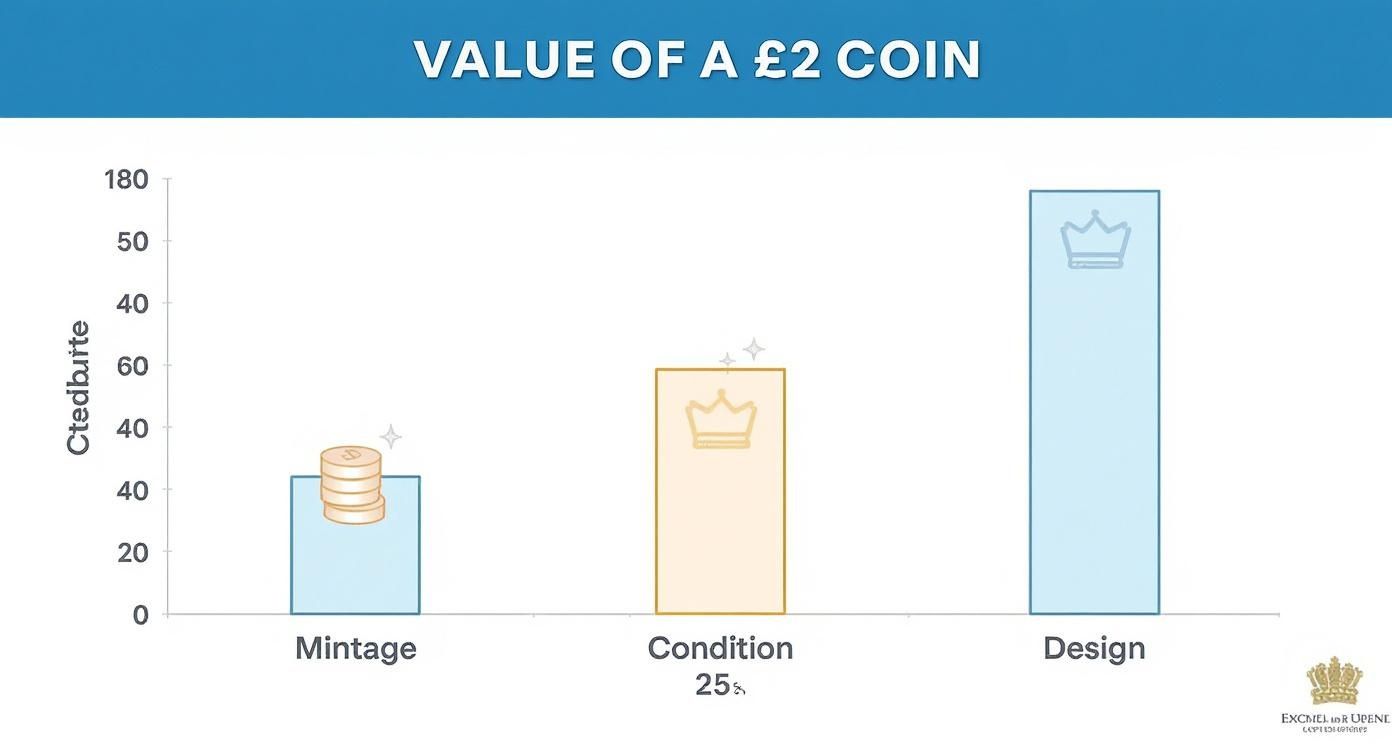
As you can see, a low mintage is the biggest factor, but the coin's physical condition and the design's popularity also play a massive part in what it's ultimately worth.
To help you keep track, here's a quick rundown of the top 5 rarest £2 commemoratives you might find in circulation.
Top 5 Rarest Commemorative £2 Coins
| Coin Name and Year | Mintage Figure | Estimated Circulated Value |
|---|---|---|
| 2002 Commonwealth Games: Northern Ireland | 485,500 | £30 - £50 |
| 2002 Commonwealth Games: Wales | 588,500 | £15 - £25 |
| 2015 First World War Centenary (Navy) | 650,000 | £10 - £15 |
| 2002 Commonwealth Games: England | 650,500 | £10 - £18 |
| 2008 Olympic Handover Centenary | 918,000 | £8 - £12 |
These are the big hitters to look out for. Finding any of these in your change is a genuinely exciting moment for any collector.
The Olympic Handover Centenary 2008
Another coin to keep a sharp eye out for is the 2008 Olympic Handover Centenary £2. This one was released to mark the moment the Olympic flag passed from Beijing to London.
What makes this coin interesting is that there are two versions floating around, and knowing the difference is key. The more common one shows the flag being passed to the London 2012 logo. However, the rarer, more valuable version is the one without the logo, featuring the original portrait of Queen Elizabeth II by Ian Rank-Broadley. A later version was released with an updated design, making that initial issue much scarcer.
With a mintage of 918,000, it’s a brilliant find. A circulated version can be worth between £8 and £12—not bad for a two-quid coin!
The Mary Rose 2011
History buffs and collectors both love the 2011 Mary Rose £2 coin. Its beautiful design celebrates the 500th anniversary of the maiden voyage of Henry VIII's famous warship, and the intricate depiction of the ship makes it a really striking piece.
Its mintage is just 1,040,000, which puts it firmly in the 'uncommon' bracket. Pulling one of these from your change is a great feeling.
The appeal of the Mary Rose coin is a perfect example of how a great story can boost value. It’s not just a coin; it's a tangible link to a dramatic piece of Tudor history, which makes it highly sought after by people who might not even be traditional coin collectors.
In circulated condition, the Mary Rose £2 typically sells for around £4 to £6. It might not be in the same league as the Commonwealth Games coins, but it's still a fantastic piece for any collection.
First World War Navy 2015
The Royal Mint's five-year series commemorating the First World War centenary produced some truly memorable designs, but one really stands out for its rarity: the 2015 Royal Navy £2 coin.
The design features a mighty battleship cutting through the waves, a powerful symbol of the Royal Navy's strength during the conflict. That strong imagery, combined with a very low mintage, has turned it into a modern classic.
With only 650,000 ever entering circulation, it's just as rare as the England Commonwealth Games coin. This scarcity has really pushed its value up. You can expect a 2015 Navy £2 in good circulated condition to be worth between £10 and £15, making it an essential piece for anyone trying to complete the WWI centenary set.
Spotting Valuable Minting Errors and Flaws
Beyond the official designs and mintage numbers, there’s a far more exciting side to coin collecting: the hunt for 'error coins'. These are genuine coins that, through some accident during production, managed to leave The Royal Mint with a unique mistake. Far from being duds, these flaws make them incredibly rare and can turn a regular £2 piece into a collector's prize.
Think of it as being a bit of a detective. You’re not just looking for a particular picture; you’re searching for tiny imperfections and oddities that make a single coin stand out from the millions of others. These flawed coins often fetch prices much higher than even low-mintage commemorative editions, purely because they were never supposed to exist.
Uncovering Edge Inscription Errors
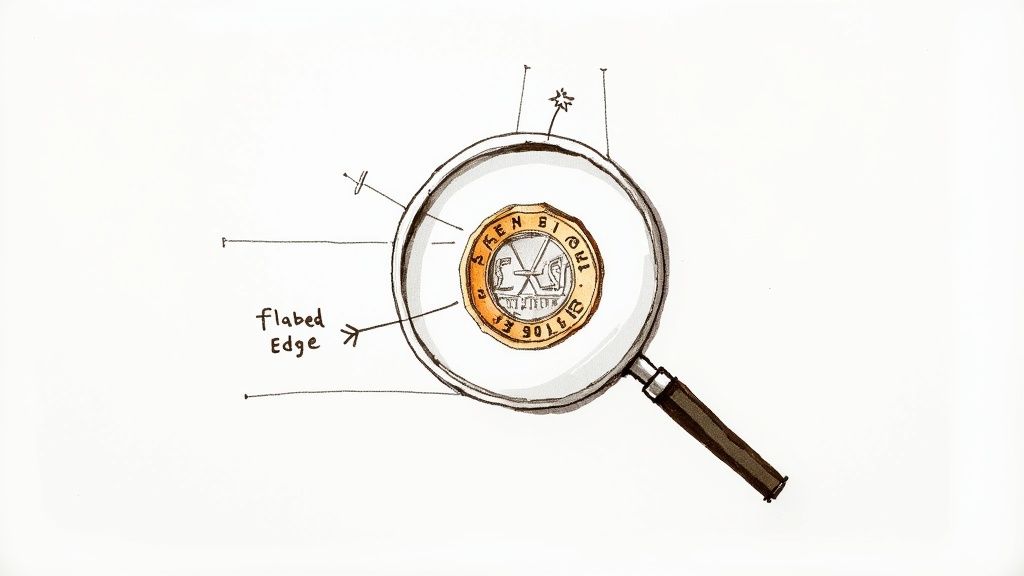
One of the most common places to find an error on a £2 coin is the edge inscription – that little line of text pressed into the rim. When you're making millions of coins, it's almost inevitable that a few mistakes will slip through on this tiny canvas.
An edge error might mean the inscription is wrong, upside down, or even missing completely. An 'upside down' inscription is actually a common occurrence and doesn't add any value, as the orientation is totally random. A completely incorrect inscription, however, is a different story.
A brilliant example is the 2016 Shakespeare Tragedies £2 coin. A handful of these were accidentally struck with the edge inscription "THE WHOLE WORLD IS A STAGE" from the Comedies coin, instead of the correct "WHAT A PIECE OF WORK IS A MAN". That simple factory mix-up created a very desirable error.
Error coins, such as edge errors, can significantly enhance the value of a £2 coin. For example, a 2016 Shakespeare's Tragedies £2 coin with an incorrect edge inscription sold for £123, including buyer's fees. This occurred due to a mix-up in the minting process, where the edge inscription from a different coin was used. Discover more about the fascinating world of error edge coins and their values.
It just goes to show how a production hiccup can skyrocket a coin's collectability and market price.
Hunting for Die and Strike Errors
Another fascinating type of flaw to hunt for is a die error. A 'die' is the metal stamp that strikes the design onto a blank coin (called a planchet). When something goes wrong with the dies, it can create some really interesting and visually striking mistakes.
Keep an eye out for these specific types of die errors:
- Rotated Die Errors: This happens when the die for the Queen's head (obverse) or the design (reverse) is misaligned. To check, hold the coin by its edges and flip it vertically. The Queen's head should be perfectly upright. If it’s tilted at an angle, you’ve found a rotated die error, which can be valuable depending on how severe the rotation is.
- Off-Centre Strikes: Sometimes the blank planchet isn't sitting perfectly centred when the dies strike it. This pushes the whole design off to one side, often leaving a crescent of blank metal. The further off-centre it is, the more dramatic and valuable the error.
- Mule Coins: This is the holy grail of error coins and is incredibly rare. A 'mule' is a coin struck with two dies that were never meant to be paired—for instance, the head of one coin and the tail of another. Finding a £2 mule would be the numismatic discovery of a lifetime.
So, when you're checking your change, don't just glance at the picture on the back. Take a second to inspect the whole coin. Look at the edge, check the alignment of the front and back, and see how cleanly it was struck. The smallest imperfection could be the clue that you're holding something truly special.
How to Sell Your Rare Coins for the Best Price
Finding a valuable coin in your change is a thrill, but that's just the start. The real skill comes in getting the best possible price for it. Selling your rare find isn’t as simple as just putting it online; it needs a bit of strategy, from where you sell it to how you present it. Your approach here will make all the difference to the final figure you get.
One of the first big decisions is where to sell. You could go for an online marketplace like eBay, which has a massive audience, but you’ll be one of many, many listings. On the other hand, a specialised coin dealer brings genuine expertise to the table, but they’ll likely offer a lower price since they need to build their own profit margin.
Preparing Your Coin for Sale
In the collecting world, presentation is absolutely everything. Think about it: a blurry photo or a lazy description will get a potential buyer to scroll right past, even if you’re holding one of the most sought-after rare 2 pound coins worth money.
To give yourself the best shot at a great sale, there are a few simple but crucial steps to follow:
- Take High-Quality Photographs: Use natural daylight and a plain, neutral background. Get crisp, clear shots of the front (obverse), back (reverse), and don't forget the edge inscription. Being honest about the coin's condition, even showing minor flaws, is how you build trust with serious buyers.
- Write a Detailed Description: Don't just list it as a "rare coin." Be specific. Mention the year, the design, and any interesting quirks like minting errors. If you know a little about the coin's story, share it! A compelling narrative can make all the difference to a bidder.
- Set a Realistic Price: This is key. Before you even think about listing, search for sold prices on sites like eBay—ignore the asking prices. This shows you what people are actually paying for the same coin in a similar condition. It helps you find that sweet spot between being competitive and getting what your coin is truly worth.
Choosing the Right Platform to Sell
The platform you pick can have a huge impact on your final profit, especially when you factor in the fees. It’s vital to know the costs involved. For example, it’s well worth understanding the fee structure on platforms like eBay to see exactly how much of that final sale price you’ll actually pocket.
Expert Tip: When you're posting your coin, never let it rattle around in the packaging. Secure it firmly between two pieces of thick cardboard before placing it in a padded envelope. This simple step prevents damage during transit and makes sure your buyer gets the coin in the exact condition they paid for.
Ultimately, whether you opt for an auction site or a specialist dealer, doing your homework first is non-negotiable. For a deeper dive into the pros and cons of each method, our guide on how to sell rare coins effectively offers more expert strategies to help you get the best price.
Common Questions About Rare £2 Coins
As you start your coin-hunting journey, a few common questions are bound to pop up. Getting clear answers can help you dodge simple mistakes and build your confidence as you sort through your change. Here, we tackle some of the most frequently asked questions from new collectors.
Getting your head around these key points will put you in a much better position to assess the rare 2 pound coins worth money that you might stumble upon.
Are Coins from a Sealed Bank Bag Worth More?
Yes, almost always. Coins straight from a sealed, uncirculated bank bag are typically in what collectors call 'Brilliant Uncirculated' (BU) condition. This is a massive advantage.
Because they've never been touched by human hands or rattled around in tills, they are absolutely pristine. They don't have the scratches and dings that instantly devalue a circulated coin, making them far more desirable to a serious collector.
How Can I Tell if a Buyer's Offer Is Fair?
Your best friend here is solid research. Don’t just look at what sellers are asking for, as these prices can be wildly inflated and give you a completely wrong idea of a coin's value.
The most reliable method is to check the 'sold listings' on platforms like eBay for the exact same coin in a similar condition. This data shows what people are actually paying right now, which is a much truer indicator of its current market value.
Does Cleaning My Old Coins Increase Their Value?
Absolutely not—and this is easily the single biggest mistake a new collector can make. Whatever you do, never clean your coins.
Cleaning, especially with abrasive materials or chemicals, permanently damages the coin’s surface. It strips away the natural protective layer, known as the patina, and creates countless microscopic scratches. To an experienced collector, a cleaned coin is a damaged coin, and its value plummets instantly. An original, untouched coin is always more valuable.
At Cavalier Coins Ltd, we provide a trusted platform for both new and experienced numismatists. Explore our extensive collection of rare coins and banknotes to find the next centrepiece for your collection by visiting us at https://www.cavaliercoins.com.